
Product Strategy Consulting Services for Pricing and Scope

Product strategy consulting services turn customer needs, market evidence, and business goals into clear product choices and a prioritized roadmap. The work can cover market and competitive analysis, product direction, feature priorities, and decisions across the product lifecycle. A useful roadmap explains what to prioritize and why, rather than simply listing ideas.
Customer feedback matters, but the challenge is separating useful signals from loud opinions and deciding what deserves time and investment. This guide explains what product strategy consulting includes, how customer needs inform roadmaps, what shapes the scope and cost of an engagement, and how strategic support can help organizations make product decisions. You’ll get a clearer picture of the work and the questions to resolve before moving forward.
Table of Contents
What Is Product Strategy Consulting?
Product strategy consulting helps a business decide which product problems to solve, for which audience, and why. It connects customer evidence, market conditions, and business goals to choices teams can act on.
Product Vision and Business Goals
A product vision describes the change a product aims to create for customers. Strategy turns that direction into choices about audience, value, and investment. Start by naming the business goal, such as entering a market or improving retention. Then test each proposed initiative against that goal. An idea should not take priority just because it sounds innovative; it should support a clear customer need or business objective.
Roadmap and Market Alignment
A roadmap links customer problems to product priorities and the conditions that affect delivery. A consultant can compare customer feedback, market signals, and competitive analysis to identify what to address first. Repeated requests for a feature may indicate demand, but teams should also assess whether the intended audience will use it and whether it supports the product’s direction. Revisit priorities as evidence changes.
The process often begins with workshops focused on vision, alignment, and ideas. A facilitator can help leadership and product teams define the audience, identify unresolved needs, and explore possible solutions. The team then tests ideas against business goals and evidence instead of treating every suggestion as a commitment. The output should clarify the chosen direction, key assumptions, and next decisions, creating a roadmap tied to execution rather than a brainstorm on its own.
How do product strategy consulting firms compare with independent consultants? Firms may bring a team with different specialties, while an independent consultant often offers focused expertise directly. Compare the people who will do the work, their relevant experience, and the proposed deliverables, not just the provider’s label.
How do you choose a product strategy consulting firm? Look for a clear approach to customer research, prioritization, and roadmap decisions. Check that the proposed outputs connect to your business goals and that the project scope, responsibilities, and decision points are explicit.
What are the risks or limitations of hiring a product strategy consultant? Recommendations can miss the mark when customer evidence is weak, internal leaders disagree, or teams lack capacity to execute. Define assumptions and decision rights early; the National Institute of Standards and Technology (NIST) notes that work beyond agreed scope can trigger additional or cancellation charges.
Which product strategy consulting firms serve startups and small businesses in the United States? RevenueBase recorded 9,207 US product strategy consulting firms with 1-10 employees. Startups can narrow the field by matching a provider’s relevant expertise and proposed scope to their product stage and immediate strategic decision.
Customer needs and customer-centric product strategy
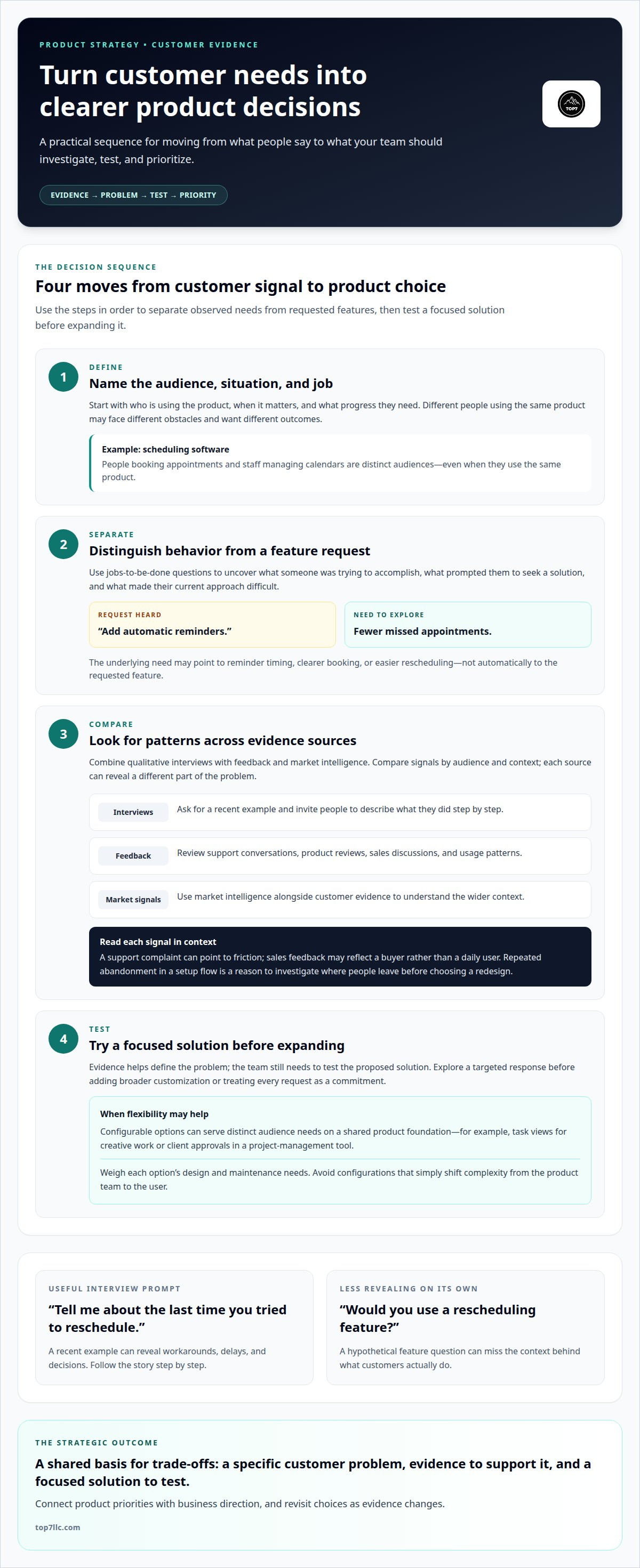
Customer-centered product decisions begin with behavior, not assumptions. First, define the audience and the situation in which the product matters. A team designing scheduling software, for example, should distinguish people booking appointments from staff managing calendars. They may use the same product but face different obstacles and seek different outcomes.
Jobs-to-be-done questions uncover the progress customers want beyond a feature request. Ask what someone was trying to accomplish, what prompted the search for a solution, and what made the current approach difficult. A customer asking for automatic reminders may really want fewer missed appointments. That distinction can lead the team to explore reminder timing, clearer booking, or easier rescheduling instead of building the requested feature by default.
Qualitative customer interviews can reveal these underlying needs. Use a consistent discussion guide, ask for a recent example, and invite people to describe what they did step by step. “Tell me about the last time you tried to reschedule” gives more useful detail than “Would you use a rescheduling feature?” Follow up on workarounds, delays, and decisions. Separate recurring themes from individual preferences so one vivid story does not shape the whole strategy.
Combine interviews with market intelligence and customer feedback from support conversations, product reviews, sales discussions, and usage patterns. Each source has limits: a support complaint can identify friction, while sales feedback may reflect a buyer rather than a daily user. Compare signals by audience and context. If customers repeatedly abandon a setup flow, investigate where they leave before choosing a redesign. Evidence should define the problem; the team still needs to test the proposed solution.
Customizable and reconfigurable products can serve different needs without turning every request into a separate product. A project-management tool, for example, might let teams configure task views for creative work or client approvals. Each option also adds design and maintenance decisions. Prioritize flexibility when distinct audience needs share a common product foundation, and avoid configurations that simply shift complexity from the product team to the user.
Turn evidence into a decision sequence:
Define the audience, situation, and job customers need done.
Separate observed behavior from requested features.
Compare interview themes with feedback and market signals.
Test a focused solution before expanding customization.
This approach gives product teams and business leaders a shared basis for trade-offs. If customer evidence points to a broader shift in priorities, strategic planning can connect product choices with business direction. Make the customer problem specific first. Then decide what the product should change.
Product consultants work with businesses to understand their goals and challenges and provide tailored advice intended to improve product performance and market success.
Product strategy formulation and roadmapping
Strategy formulation turns evidence and business priorities into choices about what to build, improve, or stop. A roadmap makes those choices visible, connecting opportunities to a value proposition and practical next steps.
Strategy Formulation Process
What is the typical process for product strategy consulting? It starts by clarifying business goals and reviewing customer, market, and product evidence. The team then identifies opportunities, compares their value and feasibility, and selects strategic priorities. According to the National Institute of Standards and Technology (NIST), consulting work included identifying new product lines as priority growth areas. The process ends by translating selected priorities into decisions and an actionable roadmap.
A focused process makes trade-offs explicit. A company considering a new product line, for example, can assess its target audience, customer problem, strategic fit, and required capabilities. Record assumptions that still need testing rather than treating an appealing idea as proven demand. This helps decision-makers distinguish evidence-backed opportunities from distractions competing for the same resources.
Roadmaps and Value Propositions
A value proposition explains who benefits, which problem the product solves, and why the approach matters. A roadmap connects that promise to planned product changes. If a product promises faster invoice processing, for example, roadmap initiatives should address the steps causing delays, not add unrelated features. Check that each initiative strengthens the promise for a defined audience and supports the intended business direction.
Roadmaps should communicate priorities, dependencies, and decision points, not imply that every future detail is fixed. Group work around customer outcomes, such as reducing errors or making setup easier. Show what needs to happen first and which assumptions require validation. This helps teams stay focused while adapting plans as customer insights or market conditions change.
Consulting Deliverables
What deliverables should you expect from a product strategy consultant? Expect outputs suited to the decisions at hand, such as a strategy brief, prioritized opportunities, a value proposition, and a roadmap. A useful package also explains the evidence behind priorities, records key assumptions, and identifies next steps. Check whether each deliverable helps leaders make a real decision, rather than simply presenting findings.
Before work begins, define the audience, scope, decision owners, and intended outputs. A roadmap without owners may stall, while a strategy brief without clear priorities can leave teams guessing. Make the handoff practical by connecting each initiative to its rationale and next action. Strong deliverables support execution because teams can see what matters, why it matters, and how to proceed.
Product strategy consulting combines market intelligence, competitive analysis, customer feedback, and expert guidance to align product roadmaps with customer needs and market conditions. Together, these inputs help teams connect priorities to the needs they address and the timing they reflect.
Average hourly rates
Hourly billing charges for time spent on agreed product strategy work. The total depends on the project, not just the consultant’s hourly rate. Define the work before comparing proposals: an organization seeking a roadmap review needs a different scope from one assessing a new market opportunity. A rate without clear tasks, expertise, and outputs tells you little about an engagement’s value.
The cost depends on the scope, expertise, research needs, and access to stakeholders. These factors shape the work required and the kind of specialist involved. A project involving customer interviews, competitive analysis, and leadership workshops, for example, differs from a review of an existing product brief. Make the expected work clear before assessing a proposed rate.
Consultants may spend billable time in workshops, interviews, analysis, and decision sessions. Preparation and synthesis also matter. A half-day leadership workshop, for instance, can require preparation beforehand and a summary afterward. Ask how the engagement accounts for these tasks, who performs them, and what outputs follow. Otherwise, two hourly proposals may appear comparable while covering very different work.
Experience and role can affect the rate. A senior strategist may lead executive discussions, while another team member handles research or documentation. That division can suit a larger project, provided responsibilities are clear. Review the proposed team by role, then connect each role to a defined task and deliverable. Assess the capability assigned to your work, not a title alone.
Hours can also shift when scope expands. If a project begins with roadmap prioritization and adds market research, the consultant’s tasks change. Set boundaries around included activities, decision owners, and the process for approving extra work. The National Institute of Standards and Technology (NIST) says a partner who moves beyond a project's agreed scope can trigger additional charges or cancellation charges. Clear scope helps keep decisions and billing aligned.
Use this checklist to assess an hourly proposal:
Scope: Are tasks, exclusions, and deliverables described?
Staffing: Who leads interviews, analysis, and recommendations?
Time: How are preparation, meetings, and follow-up handled?
Changes: How are new requests approved and documented?
Finally, check whether the work is actionable. A product team paying for analysis should know which decision it will support, such as prioritizing a feature or pausing an initiative. Connect each activity to a business question and expected output. This puts the rate in context: what work is needed, who should do it, and how the organization will use the result?
Consulting across the product lifecycle
Product strategy support can help at different stages, from an early concept to an established product facing competitive pressure. The work depends on the decision: an idea may need validation, while a mature product may need renewed priorities. Match the engagement to the stage and challenge, not to a generic package.
How long does a product strategy consulting engagement take? That depends on the scope, research needs, stakeholder access, and how quickly leaders make decisions. A focused review of an existing roadmap differs from an assessment of a new product opportunity across customer, market, and operational questions.
At the concept stage, a consultant can help define the customer problem, examine market signals, and test whether the proposed value makes sense. A team considering a scheduling tool, for example, can map how customers currently book appointments, identify friction, and compare possible approaches. The output should clarify the next decision: validate demand, refine the concept, or stop investing in it.
During development, strategy support can keep product choices tied to the intended audience and business direction. If a team is building a payment feature, a review can assess whether it solves a confirmed customer problem, fits the product’s position, and supports launch priorities. Regular decision points expose trade-offs early, before extra features complicate delivery or dilute the central value.
At launch, teams need to learn whether the product’s message and experience match customer expectations. Consultants can review feedback and identify findings that may affect product strategy. If new users repeatedly struggle with account setup, for instance, the team can assess whether onboarding, product messaging, or the target audience needs attention. The goal is to turn launch observations into clear decisions, not merely collect comments.
Established products face a different test. Customer needs shift, competitors adjust their offers, and older features can absorb effort without strengthening the product’s position. A lifecycle review can help leaders decide whether to improve a key workflow, explore a new audience, simplify the product, or redirect investment. Each option should connect to evidence and a defined business objective.
Use lifecycle checkpoints to keep the engagement actionable:
Concept: define the problem and test the opportunity.
Development: resolve priority trade-offs and review assumptions.
Launch: examine customer feedback and product performance signals.
Established product: reassess competitive position and future priorities.
At each checkpoint, set the decision owner, evidence to review, and next action. If a finding changes the strategy, update priorities rather than letting the roadmap lag behind. Plan product strategy across lifecycle stages to connect decisions with business priorities.
Top7: Fractional CTO
Top7’s Fractional CTO can help when product priorities depend on technology decisions, but your team needs senior technology leadership to evaluate them. Use this support to connect the product roadmap with technical direction, clarify trade-offs, and align technology choices with business goals. It’s a fit when leaders need stronger oversight of technology decisions, not custom software development.
Bring a clear decision to the discussion: which product initiative should move forward, what technical questions are blocking it, and who needs to act? That gives the engagement a practical focus and helps teams turn strategic priorities into coordinated decisions. If the main challenge is operational, financial, or company-wide leadership, a different fractional executive role may be a better fit.
Contact Top7 to discuss whether Fractional CTO support fits your product strategy needs.
Make the Next Product Decision Count
The next move is not another round of planning. It is deciding who owns the product choices and how they connect to business priorities. Product strategy consulting services can help create direction, but progress depends on leaders turning decisions into action.
When product direction is tied up with technology leadership, Top7’s Fractional CTO can help connect product priorities with technology decisions. Top7 also offers Fractional COO and Fractional CEO support for organizations whose execution or company-wide leadership needs stronger alignment. Choose the leadership focus that matches the decision in front of you.
Start with a clear question: what product decision is slowing progress? Bring the issue, its business context, and the outcome you need. A focused conversation can clarify the next step and who should own it.
Contact Top7 about product strategy and take the next step with a clear direction.
Frequently Asked Questions
What services are included in product strategy consulting?
Product strategy consulting can include customer and market research, product positioning, value proposition development, opportunity assessment, and roadmap planning. Some engagements also examine product performance or guide launch and portfolio decisions. A business weighing two new product ideas, for example, can compare customer demand, strategic fit, and delivery needs before choosing where to focus. The scope should match the decisions the organization needs to make.
How does a product strategy consultant help a business?
A consultant helps leaders make clearer product decisions by organizing evidence, surfacing trade-offs, and connecting priorities to business goals. If sales teams request a feature that current users rarely need, for instance, a consultant can help assess whose problem it solves and what evidence supports the investment. The result is a stronger basis for deciding what to pursue, pause, or investigate further.
How much do product strategy consulting services cost in the United States?
The price depends on the case and is provided after a quote request. Cost factors include project scope, the expertise required, research needs, stakeholder access, and the expected deliverables. A focused review of an existing strategy involves different work from a broader engagement involving customer research and leadership workshops. Compare proposals by the work and outputs they cover, not by the hourly figure alone.
What pricing models do product strategy consultants use?
Consultants may bill hourly, charge a fixed project fee, or use a retainer for ongoing support. Interim leadership engagements may use daily or weekly rates. The right structure depends on how clearly the work can be scoped and whether support is ongoing or time-bound. For a defined strategy project, clarify deliverables and how changes will be handled; for recurring guidance, establish responsibilities and cadence.
Which product strategy consulting firms serve startups and small businesses in the United States?
The US market included 9,207 product strategy consulting firms with 1-10 employees as of September 21, 2026. Startups can narrow the options by matching each provider’s expertise and proposed scope to their product stage and immediate strategic decision.



Comments