
Benefits of a Fractional CPO for a Mature Product

A mature product rarely needs more features for their own sake. It needs clearer decisions about what will drive growth. The benefits of a fractional CPO for a mature product come from senior product leadership that connects customer needs, the roadmap, engineering priorities, and commercial goals. The role helps identify whether the challenge is execution capacity or a product direction that no longer supports repeatable sales.
You may already have a capable product team and a roadmap. But if priorities keep shifting, customer feedback isn’t shaping decisions, or launches aren’t translating into commercial progress, more activity won’t solve the underlying problem. You need alignment on what to build, why it matters, and how the business will bring it to market.
This article explains what a fractional CPO does, how the role differs from a product manager, and which signs suggest it’s time to bring in product leadership. You’ll also see how the role aligns product, engineering, sales, and go-to-market around outcomes, creating the conditions for repeatable growth instead of improvised wins.
Table of Contents
Fractional CPO responsibilities and business-wide commercialization
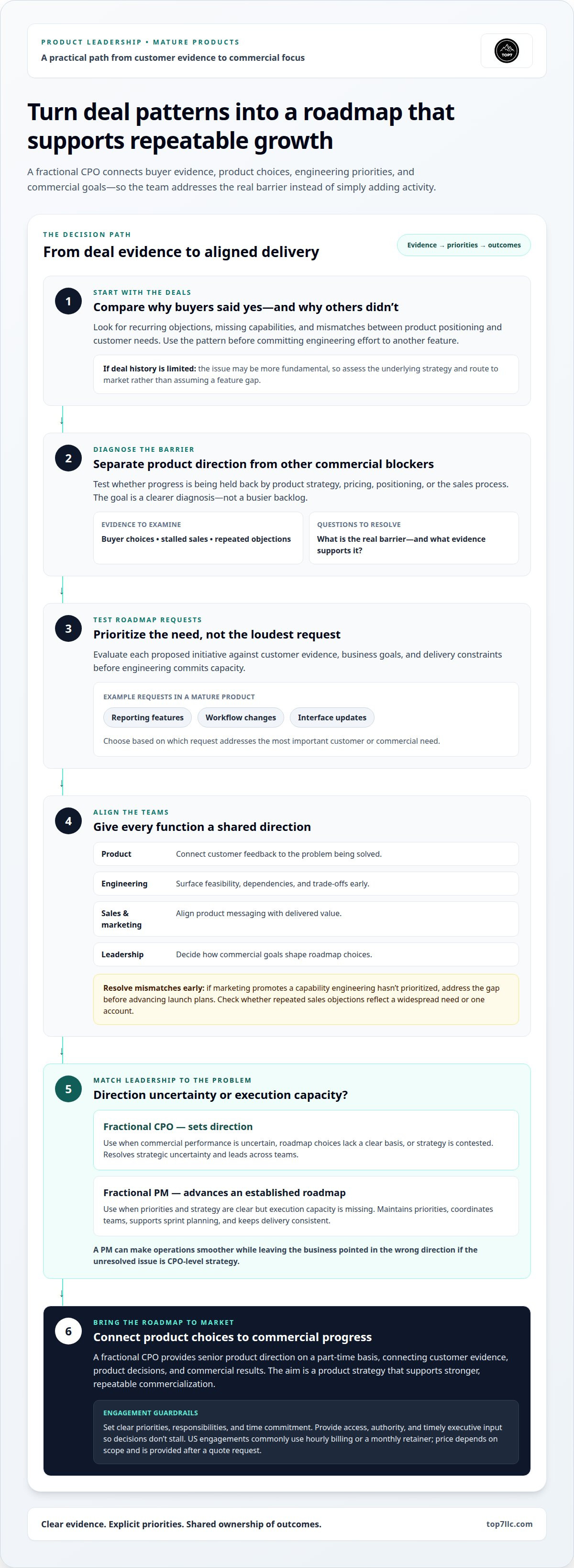
A fractional CPO provides senior product direction without taking a full-time executive role. For a mature product, the job is to connect customer evidence, product choices, and commercial results. That means examining why buyers choose the product, where sales stall, and whether the roadmap addresses the real barrier. The goal isn’t a busier backlog. It’s a product strategy that supports stronger, repeatable commercialization.
For a US engagement, pricing commonly uses hourly billing or a monthly retainer. The price depends on scope and is provided after a quote request; responsibilities, time commitment, and engagement structure shape the model.
Deal patterns can sharpen that diagnosis. Compare why recent deals closed with why others didn’t. Look for recurring objections, missing capabilities, and mismatches between positioning and customer needs. If there isn’t enough deal history to reveal a pattern, the underlying issue may be more fundamental. A fractional CPO can help assess whether the challenge lies in product strategy, pricing, positioning, or the sales process.
A fractional product manager solves a different problem. When strategy and the roadmap are clear, a product manager can maintain priorities, coordinate teams, run sprint planning, and support consistent delivery. The CPO sets direction and resolves strategic uncertainty; the product manager executes within that direction. Hiring a product manager to solve a CPO-level problem can make operations smoother while leaving the business pointed the wrong way.
A fractional PM solves a different problem. When strategy and roadmap are clear, a PM can maintain priorities, coordinate teams, run sprint planning, and keep delivery consistent. The CPO sets direction and resolves strategic uncertainty; the PM executes within that direction. Hiring a PM to solve a CPO-level problem can make product operations smoother while leaving the business pointed the wrong way within six months.
Use a CPO when commercial performance is uncertain or roadmap choices lack a clear basis.
Use a PM when priorities are set but execution capacity is missing.
Review deal evidence before committing engineering effort to another feature.
There are limits. A fractional leader works part-time, so decisions can stall if executives don’t provide access, authority, or timely input. A startup trying to close its first 20 deals may accept a roadmap shaped by vocal stakeholders; a mature business needs stronger evidence and decision discipline. Match the engagement to the problem, then give the CPO a clear mandate to lead across teams.
Product, engineering, and go-to-market alignment
Product strategy fails when product, engineering, and sales work from different assumptions. A fractional CPO creates a shared direction, then connects roadmap decisions to customer needs and commercial priorities.
Product Vision and Cross-Functional Alignment
A fractional CPO improves product strategy by testing roadmap requests against customer evidence, business goals, and delivery constraints. They make priorities explicit, so teams can explain why one initiative takes precedence over another. A mature product might have requests for reporting features, workflow changes, and interface updates. The CPO assesses which addresses the most important customer or commercial need before engineering commits capacity.
Strategy and Roadmap Prioritization
A fractional CPO improves product strategy by testing roadmap requests against customer evidence, business goals, and delivery constraints. They make priorities explicit, so teams can explain why one initiative outranks another. A mature product might have requests for a reporting feature, workflow changes, and interface updates; the CPO evaluates which addresses the most important customer or commercial need before engineering commits capacity.
Compared with a product management consultant, a fractional CPO typically takes broader executive responsibility for product direction and cross-company decisions. An interim CPO generally fills a temporary executive position, while a fractional CPO provides senior leadership on a part-time basis.
That process also exposes gaps between the roadmap and go-to-market execution. If marketing promotes a capability engineering hasn’t prioritized, teams need to resolve the mismatch before advancing launch plans. If sales keeps raising the same objection, product leaders can assess whether it reflects a widespread need or a request from one account. Clear criteria prevent the loudest voice from setting strategy.
A fractional product manager works within an established context, maintaining the roadmap, coordinating cross-functional teams, running sprint planning, and aligning the backlog with priorities set by others. A fractional Chief Product Officer can help when a company’s roadmap is contested, unclear, or driven by whoever speaks loudest, or when customer feedback isn’t systematically informing product development. The role can also help when engineering builds features that don’t improve commercial outcomes.
Product: connect customer feedback to the problem being solved.
Engineering: surface feasibility, dependencies, and trade-offs early.
Sales and marketing: align product messaging with delivered value.
Leadership: decide how commercial goals shape roadmap choices.
Use these shared criteria in roadmap reviews and launch discussions. When the organization needs stronger coordination between product direction and company-wide priorities, cross-functional strategic planning can help teams turn competing inputs into aligned decisions.
A fractional product manager works within an established context, maintaining the roadmap, coordinating cross-functional teams, running sprint planning, and aligning the backlog with priorities set by others. A fractional Chief Product Officer can help when a company's product roadmap is contested, unclear, or driven by whoever speaks loudest, or when customer feedback is not systematically informing product development. The role can also help when engineering builds features that do not move commercial metrics.
A fractional CPO is appropriate when a company is unsure why deals are not closing, lacks a roadmap, or needs to reassess product, price, and positioning. A product manager hired to address a CPO-level problem may improve product operations while leaving the company pointed in the wrong direction within Six months.
Benefits and timing for hiring
A mature product can keep shipping while commercial performance weakens. A fractional CPO helps leaders decide whether the roadmap, customer experience, or product positioning needs a reset. The role is most valuable when product decisions require senior judgment but the business doesn’t need full-time executive coverage. Fractional CPOs typically work 10 to 20 hours a week, giving leadership focused capacity without adding a full-time position.
A fractional CPO can help track conversion from qualified opportunity to closed deal, feature adoption, retention, and time-to-value. The right KPIs depend on the product’s commercial bottleneck: weak conversion calls for examining buyer objections, while low adoption points toward onboarding or usability.
A fractional CPO can help track conversion from qualified opportunity to closed deal, feature adoption, retention, and time-to-value. The right KPIs depend on the product’s commercial bottleneck: weak conversion calls for examining buyer objections, while low adoption points toward onboarding or product usability.
The benefit is focused executive judgment across a defined product challenge. For example, a CPO can help a leadership team decide whether to invest in onboarding improvements or a requested feature, then connect that choice to customer and business outcomes. This creates a sharper decision process, not a guarantee that any single metric will rise.
Hiring full-time may be difficult to justify when the need is strategic and time-bound. A fractional arrangement offers part-time access to leadership; it suits a company that needs direction but doesn’t require a permanent executive role.
Set the engagement around a specific business question. Is the product losing qualified buyers because the value proposition is unclear? Are customers adopting the core workflow but ignoring a newer capability? Define the question first, then identify the evidence and decisions the CPO must lead. That keeps the work tied to business priorities instead of a general mandate to “improve product.”
Hire for strategic uncertainty: the roadmap lacks a defensible basis or commercial performance is unclear.
Hire for leadership capacity: executive decisions need focused product ownership, not another delivery resource.
Measure the constraint: choose KPIs that reflect the specific issue, such as conversion, adoption, retention, or time-to-value.
Delay hiring if the strategy is settled and the only gap is consistent backlog execution. That points to delivery capacity, not product leadership. Make the distinction before opening a role, or the business may add activity without changing the decisions behind its results.
Best practices for fractional CPO engagements
Choose a leader whose experience matches the product’s challenge, then onboard them with customer evidence, product data, team responsibilities, and revenue goals. Ask how they would diagnose the issue and make trade-offs. The product team should also understand whether the engagement calls for strategic leadership or hands-on execution support.
Use a short operating agreement to turn the mandate into daily practice. Define the executive sponsor, decision rights, meeting cadence, and expected outputs. Fractional executive engagements can provide strategic leadership on a part-time basis, so reserve that time for decisions that need senior judgment. Don’t fill the calendar with status meetings a product manager can run.
Make the first 90 days purposeful. The work usually includes auditing the product and roadmap, setting a prioritization framework, and publishing an outcome-focused roadmap. Give the CPO access to customer feedback, sales objections, product analytics, and engineering constraints. Without those inputs, they can’t distinguish a recurring customer problem from an isolated request.
Keep the fractional CPO and product manager roles distinct. The CPO leads product direction and prioritization; the product manager coordinates delivery against agreed priorities. For example, the CPO decides whether a recurring onboarding barrier warrants investment, while the product manager organizes the work with design and engineering. Clear ownership protects the team from duplicate instructions.
Set the outcome: Tie the engagement to a specific issue, such as improving adoption of a core workflow or clarifying why qualified buyers hesitate.
Share the evidence: Provide customer interviews, support themes, usage patterns, and sales feedback before roadmap decisions.
Assign decision owners: Name who approves priorities, resolves engineering trade-offs, and communicates changes to teams.
Review progress: Compare roadmap decisions with customer and business evidence, then adjust when new information changes the case.
Close the loop with documented decisions. Record the customer problem, evidence considered, chosen priority, and expected outcome. When a senior leader challenges the roadmap, the team can revisit the reasoning instead of restarting the debate. That discipline makes a fractional engagement useful beyond the meetings themselves.
Scaling reveals whether a product has a repeatable growth engine or depends on one-off wins. As a company grows, roadmap decisions can’t remain driven by a chorus of competing requests. A product leader builds discipline around what the company learns, builds, and sells. The aim is a pattern teams can reproduce, not a launch that succeeds once.
Product leadership for repeatable growth
The benefits of a fractional CPO for a mature product become clearer when leadership connects customer behavior to business choices. A fractional CPO can help examine retention, monetization, and product-market fit by tracing how customers experience value. They investigate where customers disengage, which capabilities support continued use, and whether pricing reflects the value delivered.
Retention depends on customers repeatedly reaching the outcome they chose the product for. A product leader can compare customer feedback with usage patterns and support themes, then focus teams on barriers to that outcome. For example, if new users struggle to complete onboarding, improving that journey may matter more than adding another advanced feature. Follow the evidence, not internal volume.
Monetization requires understanding which problems the product solves and how customers recognize its value. A fractional CPO can work with sales and marketing to compare product promises with actual usage. If buyers regularly ask about a capability before purchasing, leadership can determine whether the gap belongs on the roadmap or whether clearer positioning would address it. That distinction protects engineering capacity.
Product-market fit can weaken as customer needs and buying behavior change. The benefits of a fractional CPO for a mature product include a structured way to reassess who gains the most value, which problem remains urgent, and what evidence supports the current strategy. This helps the product adapt without chasing every request or treating past success as proof of future demand.
The benefits of a fractional CPO for a mature product matter most when leadership turns insight into consistent decisions. Identify the constraint threatening repeatable growth, then assign clear ownership for resolving it. Is the issue product direction, technical execution, or coordination across the business? Name it before adding another initiative to the roadmap.
Find a repeatable customer pattern: identify which customers gain value, what they use, and why they stay.
Connect roadmap choices to retention: prioritize barriers that keep customers from reaching core outcomes.
Test monetization logic: compare buyer expectations with delivered value and product usage.
Reassess fit: use customer behavior and sales feedback to spot when the value proposition needs adjustment.
These decisions make growth more systematic when evidence stays connected to execution. If your team needs sharper strategic direction for scaling, build a repeatable growth strategy around customer value and disciplined product choices.
Top7: Fractional CTO
Top7 can help when product growth depends on stronger technology leadership and execution. A fractional CPO sets product direction, while a Fractional CTO helps connect technical decisions with that direction. This is relevant when engineering priorities, delivery constraints, or technology choices are blocking the roadmap.
Top7 provides strategic guidance and execution support to help organizations address growth obstacles. Its Velocity-7 Adaptive Framework focuses on moving organizations from operational friction to efficient flow through agile-based transformation. If product priorities are clear but technical leadership is missing, a Fractional CTO can help align technology decisions with business goals. If the central issue is product strategy itself, identify that distinction before choosing the leadership focus.
Contact Top7 to discuss the leadership challenge your product team needs to solve.
Turn Product Leadership Into Your Next Growth Move
A fractional CPO is a senior product executive who works with a company part-time rather than holding a full-time role. They help leadership make product decisions that need executive ownership, such as choosing which customer segment to prioritize or deciding whether to retire a low-value feature. This arrangement suits a business that needs experienced product judgment for a defined challenge without adding a permanent executive position.
Use that diagnosis to align executive attention around the work that can change customer and commercial outcomes. Top7 offers Fractional CTO, Fractional COO, and Fractional CEO support for organizations facing different leadership and execution challenges. The right role depends on where decisions stall and which priorities need stronger ownership. Keep the focus on the business problem, not the title.
Take the next step with a clear view of the decision your team needs to make. Contact Top7 to discuss product leadership and explore a more deliberate path forward. Your product’s next stage can start with one sharper decision.
Frequently Asked Questions
What Is a Fractional CPO?
A fractional Chief Product Officer provides executive-level product leadership on a limited basis. Their work can include advising the CEO, setting decision rights for product teams, and resolving trade-offs across departments. For example, if sales wants a custom commitment but engineering flags product complexity, the CPO helps leadership weigh customer value against the cost of expanding the product’s obligations.
What Is a Fractional Chief Product Officer (CPO)?
An established product can benefit from clearer executive ownership of decisions that otherwise drift between teams. A fractional CPO can help identify duplicated initiatives, clarify which customer groups the product serves best, and establish criteria for stopping work that no longer supports those customers. For example, if two teams are building overlapping capabilities, leadership can assess whether to combine them and redirect effort to a more urgent customer need.
What are the main benefits of hiring a fractional CPO for an established product?
Choose a fractional CPO when the company needs senior product direction for a defined challenge but doesn’t require continuous executive attention. A full-time CPO is a better fit when product leadership must make ongoing decisions across teams every day, such as during broad organizational change or sustained expansion into new markets. The deciding factor is the continuing scope of executive work, not simply the age of the product.
When should a mature company hire a fractional CPO instead of a full-time CPO?
Choose a fractional CPO when the company needs senior product direction for a defined challenge, but doesn’t require continuous executive attention. A full-time CPO is a better fit when product leadership must make ongoing decisions across teams every day, such as during broad organizational change or sustained expansion into new markets. The deciding factor is the continuing scope of executive work, not simply the age of the product.



Comments