
Business Turnaround Specialists for Companies in Need of Recovery

Cash pressure is a warning, not a recovery plan. Business turnaround specialists identify why a company is underperforming, protect cash flow, and drive operational or financial changes. Turnaround assignments can last from 3 to 24 months, depending on the company’s size and the work involved.
When cash is tightening or growth exposes weaknesses, business turnaround specialists can help you move beyond another strategy deck. You need a clear diagnosis, decisive priorities, and people accountable for execution.
This article explains what turnaround specialists do, how they tackle cash flow and restructuring, and what shapes service fees and duration. You’ll also learn how to assess whether a specialist’s role fits your company’s needs, so you can act before avoidable problems narrow your options.
Table of Contents
What Does A Business Turnaround Consultant Do?
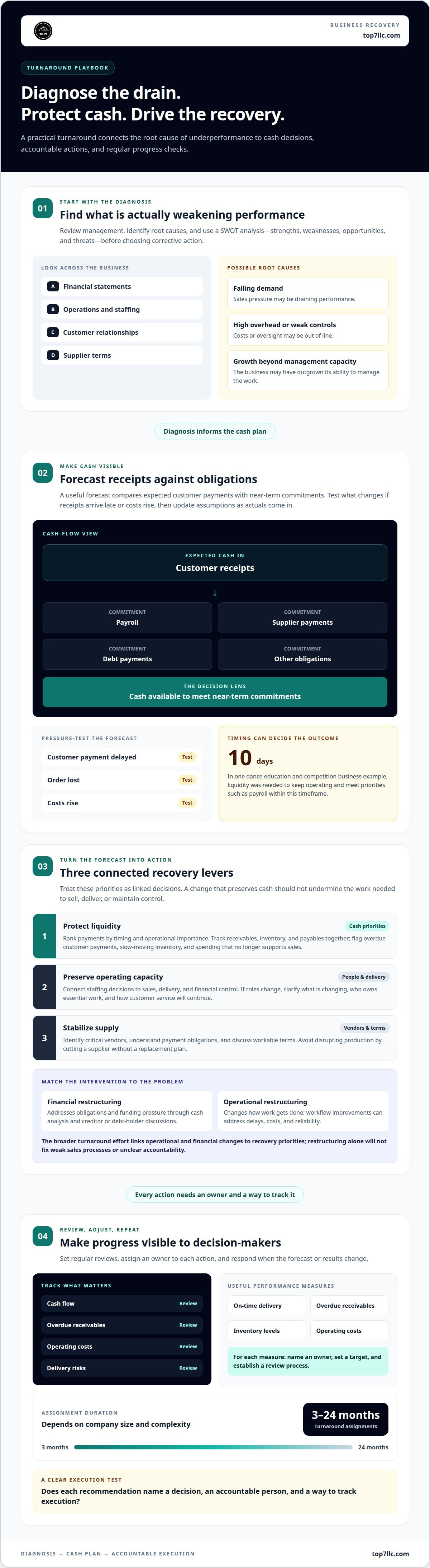
A turnaround consultant finds what is draining performance and turns the diagnosis into an action plan. The work starts with management review, root-cause analysis, and a SWOT analysis of strengths, weaknesses, opportunities, and threats. The specialist examines financial statements alongside operations, staffing, customer relationships, and supplier terms. This reveals whether the problem is falling demand, high overhead, weak controls, or growth that has outpaced management capacity. A preliminary plan then identifies the central problems, corrective actions, key strategies, and a cash-flow forecast. The aim is not to produce another presentation. It is to set priorities, owners, and measurable checkpoints.
Cash-flow forecasting makes the plan operational. The consultant compares expected receipts with payroll, supplier invoices, debt payments, and other obligations, then tests what happens when sales arrive late or costs rise. That forecast gives leaders a clearer view of liquidity, the cash available to meet near-term commitments. A turnaround firm may deploy consultants across business areas to identify root causes and preserve cash. The team can flag slow-moving inventory, overdue customer payments, or spending that no longer supports sales. Working capital improves when the organization manages receivables, inventory, and payables as connected decisions, not isolated accounting lines.
Managing redundancies requires more than deleting roles from a spreadsheet. The specialist assesses which activities support revenue, delivery, and control, then compares staffing needs with the recovery plan. If roles must change, clear communication and accountability matter: employees need to understand what is changing, who owns essential work, and how customer service will continue. Supplier relationships need the same discipline. The consultant can map critical vendors, review payment obligations, and lead discussions about workable terms. Cutting a supplier without a replacement plan can disrupt production and damage cash flow further.
Protect liquidity: Rank payments by timing and operational importance, then update the forecast as actual receipts and costs change.
Preserve capacity: Connect staffing decisions to the work needed for sales, delivery, and financial control.
Stabilize supply: Identify essential vendors and address payment pressure through direct, coordinated discussions.
Turnaround management and restructuring overlap, but they aren’t identical. Turnaround management is the broader effort to diagnose underperformance and restore business performance through management, operational, and financial changes. Restructuring changes how the business or its obligations are organized, which may include cost reductions, supplier negotiations, or discussions with debt holders and investors. A company may need both, but restructuring alone won’t fix a weak sales process or unclear accountability. The consultant connects each change to the cash forecast and the recovery priorities.
Stakeholders need a shared view of progress. A consultant can set regular reviews of cash flow, overdue receivables, operating costs, and delivery risks, then assign an owner to each action. If the forecast worsens, leaders can respond before missed payments trigger wider disruption. Turnaround assignments can last from 3 to 24 months, depending on organizational size and complexity. The first test is practical: does each recommendation name a decision, an accountable person, and a way to track execution?
Cash-flow forecasting and financial restructuring
Measure a turnaround plan against its starting position and agreed targets. Review cash flow, operating performance, and delivery, including whether the organization can meet obligations, stabilize operations, and carry out its recovery priorities.
Turnaround specialists handle cash, debt, and creditor negotiations by building a cash forecast, ranking obligations, and assessing payment capacity. They use that analysis to guide discussions with creditors and debt holders, while linking proposed terms to the company’s operating needs.
A useful forecast connects expected customer receipts with payroll, supplier payments, debt service, and other commitments. Then test the situation against realistic changes, such as a delayed customer payment or a lost order. A dance education and competition business faced a liquidity need to continue operating and meet priorities such as payroll within 10 days. That example shows why timing matters: a profitable-looking plan can still fail if cash arrives after obligations fall due. Update assumptions when actual receipts or costs diverge from the forecast.
Financial restructuring addresses obligations and funding pressure; operational restructuring changes how work gets done. The two should reinforce each other. If production delays drive overtime and late deliveries, redesigning the workflow may reduce costs while improving reliability. Set key performance indicators around the specific problem, such as on-time delivery, overdue receivables, inventory levels, or operating costs. Give each measure an owner, a target, and a review process. Turnaround management becomes actionable when leaders can see which intervention is working and change course when results fall short.
Investors need a clear account of the challenges, proposed changes, and evidence behind the plan. Present the cash forecast alongside its assumptions, risks, milestones, and decisions required. For example, explain how an arrangement with suppliers supports continued production and what operating improvements will fund future payments. Keep updates consistent across investors, employees, creditors, and other stakeholders. Conflicting messages can weaken confidence and delay essential decisions.
International restructuring adds coordination across jurisdictions, currencies, entities, and local operations. Map where cash is generated, where obligations sit, and which teams control each decision. Then align reporting definitions and decision rights so leaders can compare like with like. A cross-border organization needs a consolidated view that still accounts for local cash needs. This work depends on clear ownership and reliable information, not broad assumptions about every market.
Forecast: Match receipts and obligations, then revise assumptions when actual results change.
Restructure: Connect financial changes to operational causes and measurable performance indicators.
Communicate: Give investors and other stakeholders consistent evidence, risks, and next steps.
When a recovery plan stalls between decisions and execution, structured turnaround execution can help translate priorities into accountable work.
Turnaround consultants and specialist responsibilities
A turnaround specialist turns a company’s diagnosis into decisions, assigned actions, and operating changes. The right role depends on the organization’s challenges, assets, and management structure.
Specialist Roles and Responsibilities
A specialist may analyze performance, identify root causes, and recommend changes to operations, leadership, or finances. Some turnaround leaders also take an interim executive role, with direct responsibility for decisions during a recovery. Before work begins, define authority, reporting lines, deliverables, and how the specialist will work with existing managers. Put the goals in writing so the work supports a clear recovery structure.
When to Hire a Turnaround Consultant
Bring in a specialist when management cannot identify why performance is slipping or internal teams lack capacity to carry out a recovery plan. Rapid growth can outpace employees and managers, while a plan held only in leadership’s heads can leave teams working at cross-purposes. A specialist can also support a change in direction, strategy, or working methods, even without financial distress. Act when delayed decisions are increasing pressure on customers, suppliers, or investors.
Vetting a Turnaround Specialist
To assess a specialist, define the assignment first. Then compare relevant experience, proposed responsibilities, and the approach to reporting progress. Ask for a written scope that sets out decision rights, milestones, and how the specialist will work with current management. Resistance from leaders or employees can block essential actions. Reduce this risk by agreeing on authority, communication, and accountability before the engagement begins.
Yes, businesses can look for turnaround specialists in their state or work with professionals based elsewhere. Choose based on the company’s operating needs, access to decision-makers, and the work required, not proximity alone. The Turnaround Management Association connects professionals working in turnaround, restructuring, and corporate health. Existing management’s willingness to collaborate remains a practical factor wherever the specialist is based.
Qualifications and Certifications
No single qualification fits every turnaround assignment. Match experience to the work: financial analysis for liquidity challenges, operational knowledge for delivery problems, or executive experience when leadership decisions are central. Ask how the specialist has handled comparable situations and what evidence they use to track progress. Assess credentials alongside relevant experience, clear communication, and the ability to work with the existing team.
Turnaround strategy and business recovery
A recovery strategy must address cash pressure without undermining the capacity to grow. Build it around revenue, costs, customer risk, and actions leaders can implement.
Revenue Growth Strategies
Start by identifying where revenue can grow without adding avoidable complexity. A repositioning strategy may develop new products, enter new markets, or create alternative revenue sources. It can also change a company’s image or mission to better match customer demand. For example, a business losing sales in one market could test a related offer for a different customer group before committing major resources.
Include pricing in the analysis. Review product-level costs, customer demand, alternatives, and the value customers receive. If a product attracts sales but consumes too much capacity, adjust its price, terms, or offer structure. Track revenue alongside margins and cash collection, because top-line growth alone can deepen pressure when each sale contributes too little to recovery.
Retrenchment Strategies
Retrenchment reduces a business’s scope or size to protect its core. Options include selling assets, exiting difficult markets, downsizing, or outsourcing selected work. Assess whether each move releases cash or management capacity without damaging essential revenue. Closing a weak division, for example, may free resources, but leaders must account for customer commitments and capabilities needed elsewhere.
Customer concentration can expose the stakes: a business with two customers accounting for 60 percent of sales depends heavily on those relationships. A retrenchment plan should protect the work that serves key customers while reducing avoidable costs. Compare each proposed cut with its effect on delivery, revenue, and future competitiveness. A short-term saving that breaks a profitable operation can undermine recovery.
Strategic Recovery Solutions
Some organizations need renewal, not simply contraction. That may involve closing divisions, developing new markets or projects, or expanding stronger business areas. Align each action with a recovery objective, assign an accountable owner, and track meaningful measures. Give business units room to execute while central leadership monitors results and redirects resources when conditions change.
Keep the strategy adaptable. A plan designed for stable conditions can fail when demand or costs shift, so review assumptions and revise actions as results come in. Balance immediate cash protection with long-term goals, and do not replace effective routines just to signal change. A new strategy depends on disciplined implementation, clear accountability, and evidence that customers still value the offer.
To connect strategic choices with execution, assess each initiative against three questions:
Cash: Does the action stop losses or improve cash generation?
Customers: Does it preserve valuable relationships and meet demand?
Capacity: Can the organization deliver it with its available people and assets?
Review those answers as conditions change. A turnaround stays on course when leaders act on evidence, protect viable revenue, and adjust before old assumptions become new constraints.
Specialist fees and duration of services
Fees depend on the assignment’s scope, urgency, leadership needs, and execution demands. The price depends on the case and is given after a quote request; scope, complexity, leadership involvement, travel needs, and assignment duration shape the cost. Compare proposals by the work and accountability they include, not just the headline rate.
Many turnaround managers are freelancers who work on day rates and frequently travel for assignments. A day-rate arrangement ties payment to time worked, so define expected availability, responsibilities, reporting, and approval processes in writing. For example, a specialist leading daily execution has a different workload from an adviser delivering periodic analysis. Specify how travel and related work fit the engagement terms.
Some turnaround firms may take a minority equity stake to align their goals with business owners. Treat that as a distinct commercial arrangement, not a substitute for clarifying the assignment’s scope. Before accepting, establish how the stake affects ownership and decision-making, and ensure the specialist’s role and objectives are documented. Keep compensation terms separate from performance measures, so both parties can assess the work clearly.
Turnaround management assignments can last from 3 to 24 months, depending on the organization’s size and the job’s complexity. A defined diagnostic phase may lead to implementation and then a handover, while a complex recovery can require sustained involvement. Set review points around deliverables, decision rights, and business conditions. If the company stabilizes sooner, reassess the remaining scope rather than letting the original timetable dictate unnecessary work.
Set the engagement duration according to the work, not a calendar promise. A company addressing one operational bottleneck may need a narrower assignment than an organization changing leadership, operations, and financial structure. Agree on exit criteria at the outset, such as transferring responsibilities to internal leaders or completing agreed recovery actions. Reviews should also assess whether managers can maintain new processes without external direction.
Measure value through evidence connected to profitability and execution. Track whether agreed actions are completed, operating performance moves in the intended direction, and internal owners can sustain the changes. A specialist’s analysis should lead to decisions, not reports that sit unused. For each milestone, name the expected output, the person responsible, and the evidence that will show progress.
Before signing, use this checklist to put the engagement on a firm footing:
Scope: Define the assignment, deliverables, authority, and reporting structure.
Terms: Record the fee basis, travel arrangements, and approval process.
Duration: Set review points and clear exit criteria.
Value: Connect each milestone to measurable action and business outcomes.
Use a focused scope discussion to clarify responsibilities, milestones, and the right engagement structure before work begins.
Top7: Fractional CTO
Top7 offers Fractional CTO support when technology decisions are slowing operational change or complicating growth. A technology leader can help clarify priorities, connect technology choices to business goals, and give executives a clearer structure for decision-making. Turn to this support when your recovery plan depends on resolving technology-related bottlenecks, but your leadership team needs focused strategic guidance to move forward.
Top7 also offers Fractional COO, Fractional CEO, and Fractional CFO support for organizations whose needs extend beyond technology leadership. The right focus depends on where execution is breaking down: operations, company-wide direction, financial leadership, or technology. Define the challenge and the decisions that need ownership before choosing the role.
Contact Top7 to discuss the leadership support your recovery plan requires.
Turn Recovery Decisions Into Forward Motion
Make ownership unmistakable. Decide which business constraint needs attention first, who has authority to act, and how leaders will resolve competing priorities. A recovery effort loses momentum when responsibility is spread among people who cannot make the required decisions. Clear ownership turns urgency into coordinated action.
Before engaging business turnaround specialists, align leadership around the outcome the organization needs and the changes it is prepared to make. Be direct about internal resistance, decision bottlenecks, and capabilities the team lacks. That candid starting point keeps the work focused on real constraints, not a preferred story about them.
Top7 can help when leadership needs focused support to move from strategic intent to execution. Bring the challenge, the decisions that are stuck, and the outcomes leadership wants to pursue. Contact Top7 about turnaround support and start a practical conversation about the next move. A sharper decision today gives your team a stronger platform for progress.
Frequently Asked Questions
What is a turnaround strategy?
A turnaround strategy is a coordinated plan to restore a business’s viability and competitive position. It may combine cost controls, leadership changes, new revenue sources, or a shift in target markets. For example, a manufacturer facing falling demand might exit an unprofitable product line while investing in a more promising one. Connect each major decision to a business problem and define how leaders will assess progress.
What are the phases of a turnaround?
A turnaround often moves through diagnosis, stabilization, implementation, and transition. Diagnosis identifies the causes of underperformance. Stabilization prioritizes urgent risks and protects essential operations. Implementation puts agreed financial or operational changes into action. Transition shifts responsibility to internal leaders as new processes take hold. The phases can overlap, and changing conditions may require leaders to revisit earlier decisions rather than follow a fixed sequence.
What does a turnaround specialist do?
A turnaround specialist helps leaders identify the causes of business distress and organize a practical response. Depending on the assignment, the specialist may review performance, recommend operational changes, advise executives, or take an interim leadership role. If orders are delayed despite strong demand, for example, the specialist might examine workflow bottlenecks and management decisions. Define the role clearly, including authority, objectives, and how progress will be reported.
What is a turnaround firm?
A turnaround firm helps organizations address underperformance, financial pressure, or operational disruption. Its consultants may examine leadership, finance, and operations, with an approach ranging from advice and planning to hands-on execution support. Before work starts, clarify whether the engagement is led by one consultant, a team, or an interim executive.
What is turnaround and restructuring?
Turnaround is the wider effort to restore business performance; restructuring changes operations, obligations, or business structure to support that effort. A company might restructure a division while also changing its product focus and management practices. Restructuring can be one tool within a turnaround, but it does not automatically solve every underlying problem. Connect structural changes to the reasons performance declined.
What do business turnaround specialists do?
Business turnaround specialists diagnose problems, advise decision-makers, and help implement recovery actions. Their work can include reviewing business performance, identifying operational weaknesses, and coordinating leadership decisions. For example, they may help a company assess whether to close a struggling division or redirect resources toward stronger opportunities. Their value depends on a defined role, access to relevant information, and the organization’s willingness to act on agreed priorities.
When should a business hire a turnaround specialist?
Hire a turnaround specialist when serious problems persist and existing leaders cannot diagnose or execute a response effectively. Warning signs include repeated missed targets, deteriorating customer relationships, stalled decisions, or rapid growth that overwhelms internal systems. A specialist may also help when a business needs a change in direction without financial distress. Addressing root causes early gives the leadership team more options to weigh.
How much do business turnaround consultants cost in the United States?
There is no single fee for turnaround consulting in the United States. The price depends on the case and is given after a quote request; key factors include assignment scope, complexity, duration, leadership involvement, and travel requirements. Some professionals use day-rate arrangements, while other engagements may be structured around defined work. Compare proposals by responsibilities, deliverables, and decision authority, not by fee alone.



Comments