
Managing Cash Flow in a High-Growth Company Without Losing Control

Profit can look strong while the bank balance is under pressure. Profit measures whether revenue exceeds expenses; cash flow tracks when money actually enters and leaves the business. Managing cash flow in a high-growth company means planning for that timing gap as growth increases hiring, production, and other costs.
Revenue growth can feel like proof that the business is succeeding. But invoices do not pay payroll, and even a profitable company can struggle to cover bills when customers pay later than expenses come due. Without cash controls, growth can turn momentum into pressure.
This article explains how to distinguish profit from cash in the bank, forecast inflows and outflows, control expenses, and use automation to improve visibility and collections. It also covers how to support expansion without losing control of working capital.
Table of Contents
1. Operating expense control
Tracking cash coming in and going out can help a business monitor its ability to meet operating expenses. During expansion, production, hiring, and marketing can increase spending before new revenue arrives. Compare these costs with actual cash receipts, not just reported earnings. This distinction helps leaders see whether growth is funding itself or consuming working capital.
Start with an expense audit: group costs by function, identify recurring commitments, and flag spending that no longer supports current priorities. Review supplier contracts, rent, utilities, and insurance for terms or costs that could be renegotiated. Ask department heads to justify ongoing spending each quarter. Regular reviews make expense control an operating discipline, rather than a one-time reaction when cash gets tight.
Apply the same discipline to travel and expenses as to larger contracts. Set an approval process before employees book travel, define eligible expenses, and require itemized receipts with a business purpose. Review submissions by department and category. Repeated last-minute bookings may point to a planning problem, while duplicate subscriptions can reveal spending to remove without disrupting delivery.
Forecast expenses alongside earnings, then compare the forecast with actual payment timing. Include payroll, supplier invoices, rent, planned hiring, production needs, and marketing commitments. A forecast that assumes customer revenue arrives before bills are due can conceal a cash shortfall. Update it when sales volume, hiring plans, or supplier terms change, and use the revised view to assess whether planned spending fits available cash.
Seasonality also affects when expenses and receipts occur. A business with a busy peak season can build reserves then and review discretionary costs during slower periods. Keep inventory records current, and weigh stock on hand against supplier lead times before ordering more. Excess stock ties up cash that could support payroll, priority purchases, or other growth needs.
For U.S. tax and regulatory deadlines, add each applicable payment date to the cash calendar and reserve funds in advance. Map those dates against expected receipts, payroll, and supplier payments so a due obligation does not collide with another major cash need. This is a practical control for managing cash flow in a high-growth company: forecast the outflow, assign an owner, and protect the required capital before approving optional spending. Expense control should preserve cash without cutting costs that directly support delivery, customer retention, or profitable growth.
2. Why Is Cash Flow Management Important?
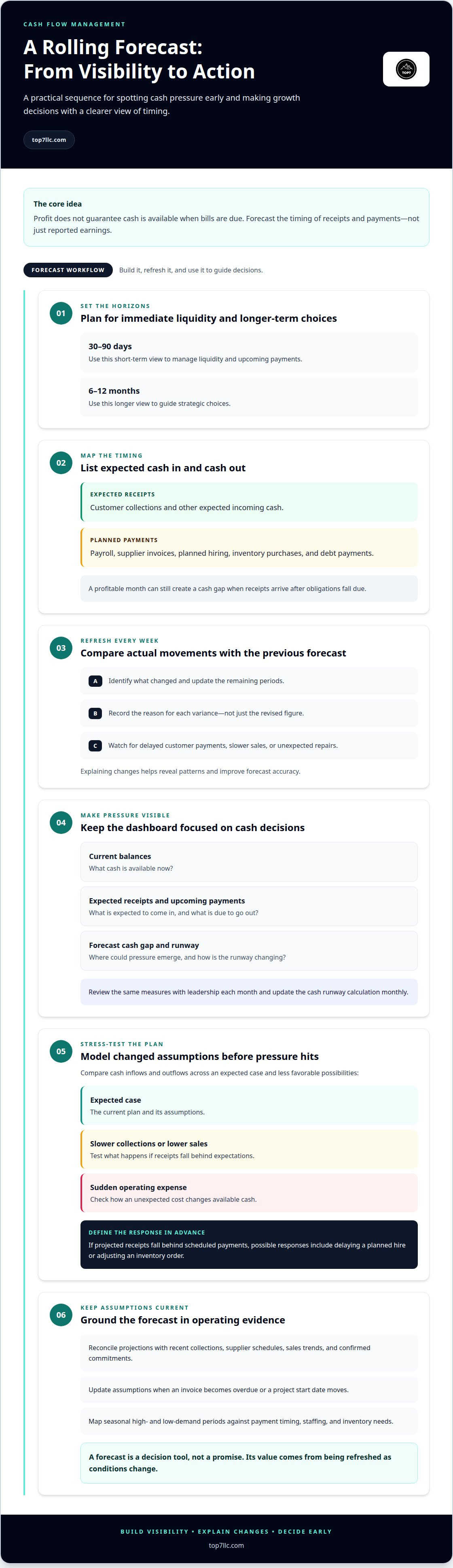
A forecast turns uncertainty into decisions. Build a 30-90-day view of expected receipts and payments to manage short-term liquidity, then use a 6-12-month forecast to guide strategic choices. Include customer collections, payroll, supplier invoices, planned hiring, inventory purchases, and debt payments. A profitable month can still create a cash gap if receipts arrive after obligations fall due.
Keep the forecast rolling. Each week, compare actual cash movements with the previous forecast, identify what changed, and update the remaining periods. A delayed customer payment, slower sales, or an unexpected repair can quickly shift the cash position. Record the reason for each variance, not just the revised figure. This gives leaders better evidence for improving forecast accuracy and spotting patterns before they become costly.
A dashboard should make upcoming cash pressure visible without burying leaders in accounting detail. Track current balances, expected receipts, upcoming payments, and the forecast cash gap. Review the same measures with leadership each month, and update the cash runway calculation monthly. According to the Board of Governors of the Federal Reserve System, liquidity guidelines may track both discrete and cumulative cash flow gaps across future time horizons under expected and adverse conditions.
Scenario planning tests whether a plan holds when assumptions change. Build an expected case, then model slower collections, lower sales, or a sudden operating expense. Compare cash inflows and outflows in each scenario, then identify decisions that would protect liquidity. For example, leaders might delay a planned hire or adjust an inventory order if projected receipts fall behind scheduled payments. Define the response before pressure hits.
To plan for seasonality and unexpected expenses, map recurring high- and low-demand periods against payment timing, staffing, and inventory needs. Model a slower-season case and a separate unexpected-cost case, then decide which spending can shift without disrupting delivery. Keep the assumptions visible so the team can update them when orders or customer payment patterns change.
Accuracy improves when forecasts use operating evidence rather than optimism. Reconcile projections with recent collections, supplier schedules, sales trends, and confirmed commitments. Update assumptions when an invoice becomes overdue or a project start date moves. A forecast is a decision tool, not a promise; its value comes from being refreshed as conditions change. For teams connecting cash scenarios to hiring, inventory, and market-entry choices, strategic planning can help align growth decisions with financial capacity.
3. Operating, investing, and financing cash flows
A cash flow statement divides movements into three sources: operating, investing, and financing activities. Operating cash flow reflects cash from core operations, including customer payments and supplier bills. Investing cash flow records asset purchases and sales. Financing cash flow captures borrowing, equity issuance, and dividend payments. Read all three together, because a single total can hide what is driving the company’s cash position.
Operating activity shows whether the business converts its work into cash. Compare customer receipts with payroll, supplier payments, and other operating costs. Positive operating cash flow supports day-to-day stability, while negative operating cash flow may signal inefficiencies or timing pressure. Profit alone cannot show whether receivables are arriving quickly enough to fund inventory and current obligations.
Investing activity needs context. Buying equipment or funding research and development can produce negative cash flow while supporting future capacity. That is not automatically a warning sign. Before approving an investment, compare its projected cash inflows and outflows with the expected return and strategic financial goals. For example, a capacity upgrade should clearly support demand, delivery needs, or lower operating friction.
Financing activity shows how the company funds itself and returns capital. Debt creates repayment obligations; issuing equity changes ownership; dividends send cash to shareholders. These choices shape the capital structure and cash available for growth. Match the financing plan to the purpose and timing of the need. Long-lived investments call for a different funding decision than a short-term gap between customer receipts and supplier payments.
A revolving credit facility or line of credit can bridge a temporary liquidity gap, but it cannot replace sound operations. Track the amount drawn, repayment timing, borrowing costs, and why cash is short. Short-term loans may also help during rapid expansion, but weigh their costs and risks against expected cash receipts. If the gap keeps returning, investigate collections, inventory, and payment terms before borrowing again.
Use accounting records or a cash flow dashboard to connect bank activity, receivables, payables, and investment commitments. Reconcile the records regularly, then review unusual movements by cash flow category. A finance leader can test assumptions, distinguish a planned investment from an operating shortfall, and explain trade-offs to decision-makers. If project spending is driving a cash squeeze, assign owners, milestones, and approval controls. Strong financial management keeps growth investments deliberate and protects the company’s operating position.
4. How can automation improve cash flow?
Automation helps cash arrive sooner by making receivables visible and keeping routine follow-up consistent. Set a process to issue each invoice as soon as goods or services are delivered, then record its due date and payment status. Revenue recognized at invoicing is not cash in the bank; the cash arrives when the customer pays. That gap matters when payroll or suppliers need payment first.
Reduce days sales outstanding by setting clear payment terms, sending reminders, and assigning overdue accounts for follow-up. Terms can require payment on receipt or within 30 days. For example, an automated reminder can go out when an invoice becomes overdue, while a staff member handles disputed charges or repeated delays. Track which customers pay late, then use that pattern when planning new work and expected receipts.
The best cash flow forecasting software is a system that connects accounting records, bank activity, receivables, and payables, while supporting automated invoicing, expense tracking, and current cash visibility. Choose based on the data it can bring together and the decisions your team needs to make. A dashboard is useful only when its figures stay current and leaders can act on them.
Automation should improve accounts payable, not trigger payments blindly. Route supplier invoices for approval, schedule payment for the agreed date, and flag discounts or changed terms. A supplier offering “2/10 net 30” gives a 2% discount for paying within 10 days on an invoice otherwise due in 30 days. Compare the discount with the cash needed for payroll and other commitments before taking it.
Fast-growing companies should track cash balances, inflows and outflows, runway, and days sales outstanding. Review these measures regularly and compare actual results with the forecast. Rising DSO can signal slower collections; a falling balance alongside stable invoices may point to higher spending or supplier payments. Review these indicators weekly or monthly so emerging gaps prompt a decision rather than a surprise.
Cloud accounting tools can centralize accounts and automate data collection, payment reminders, and expense records. Set clear ownership: who approves credit, follows up on late invoices, and reviews exceptions. For a new customer, establish payment terms in the contract and assess credit before extending them. If collections slow, pause additional work where appropriate and revisit the account’s payment plan. Direct some incoming cash to reserves when operating needs allow. Automation improves control only when people act on the signals it surfaces.
5. Balancing cash flow with rapid growth
Growth creates a timing problem: costs often arrive before the revenue they support. A company may hire staff, buy inventory, or expand infrastructure before customer payments arrive. Customers may take 30, 60, or 90 days to pay, while payroll and supplier obligations come sooner. Expansion plans must therefore account for cash timing, not just projected sales or profit.
Common cash flow problems in high-growth startups include rising payroll, excess inventory, delayed customer payments, and spending ahead of revenue. These pressures can overlap: a growing team increases payroll just as a large customer invoice remains unpaid. Limited cash reserves can also strain operations and restrict infrastructure expansion, according to the U.S. Government Publishing Office.
Protect capacity by matching commitments to demand. Before adding staff or inventory, compare the expected timing of customer receipts with the costs of delivery. For a long-running contract, deposits or staged invoices can bring in cash before completion. For inventory, order according to demand and supplier lead times, rather than optimistic sales assumptions. Growth should increase delivery capacity without draining the cash needed to operate.
Set a reserve target based on operating expenses, then treat it as a strategic boundary for expansion decisions. A common planning target is cash reserves equal to 3-6 months of operating expenses. Compare each proposed hire, market entry, or infrastructure investment against that buffer. If the plan would push cash below the target, phase the investment or adjust its timing instead of committing every expense at once.
Protect supplier relationships while negotiating payment timing that better matches receivables. Longer payment periods can preserve cash, but missed or late payments can damage trust and disrupt supply. For seasonal businesses, build reserves during peak periods and plan staffing, inventory, and marketing around slower demand. This creates room to pursue opportunities without mistaking a temporary cash balance for sustainable capacity.
Make expansion decisions through a simple gate: identify the expected benefit, map the cash outflows, estimate when receipts arrive, and test the plan against slower collections. If the adverse case creates a cash gap, change the project sequence or secure an appropriate funding source before launch. Use advanced project management for growth initiatives to align owners, milestones, and spending with cash capacity. Keep the balance between pace and liquidity deliberate; revenue growth is not success if the company cannot fund delivery.
A 2019 QuickBooks study found that 60% of small businesses experience cash flow issues during rapid growth. Rapidly growing service businesses may need to pay employees before receiving payment for their work, making regular monitoring important. Track runway, balances, and cash flow ratios weekly or monthly so emerging pressure can inform spending and timing decisions.
For example, a hypothetical project-billing arrangement can replace a 25% down payment and 75% payment upon completion with staged billing. Businesses can also negotiate longer payment periods, bulk-purchase discounts, and payment timing that better aligns with their receivables cycle. Amazon's rapid growth in the early 2000s was managed through favorable supplier payment terms and inventory optimization, illustrating how supplier arrangements and purchasing decisions can support expansion while managing cash needs.
Top7: Fractional CTO
Top7 can help connect technology decisions with the operational demands of rapid growth through Fractional CTO support. When new systems, infrastructure, or digital workflows must scale alongside the business, a Fractional CTO can provide technology leadership tied to business priorities.
Cash planning also requires financial ownership. A Fractional CFO can help leadership assess forecasts, spending commitments, and growth plans together, so decisions account for both opportunity and liquidity. Consider this support when cash visibility is weak, expansion decisions are outpacing financial processes, or executives need clearer accountability across teams.
For a conversation about the leadership your growth plans require, contact Top7.
Make your next growth move with cash in view
Growth keeps creating new demands: a market to enter, a team to expand, or systems to strengthen. The advantage comes from choosing the sequence deliberately. Before approving a major commitment, decide how much cash it requires, which business priority it supports, and how you will monitor its effect on liquidity. That discipline makes managing cash flow in a high-growth company a leadership practice, not a last-minute finance exercise.
When those decisions need stronger leadership alignment, Top7 offers Fractional CTO, Fractional COO, and Fractional CEO support. These roles can help connect technology, operations, and executive priorities as the business scales. Choose the perspective that matches the challenge in front of you, then make the next move with clear ownership.
Contact Top7 to discuss cash flow and the leadership support your growth plans may need. Build with intent, keep control, and give your next opportunity a stronger foundation.
Frequently Asked Questions
What’s the difference between cash flow and profit?
Profit measures whether revenue exceeds expenses under accounting rules; cash flow tracks money actually received and paid. A company can report a profit after completing a sale while still waiting for the customer’s payment. For example, a signed contract may add revenue to the books, but it cannot fund payroll until the customer pays. Use both measures: profit tests business performance, while cash flow shows near-term payment capacity.
Why Is Cash Flow Management Important?
Cash flow management helps a business meet obligations and choose which growth initiatives it can fund. A profitable company can still face trouble if customers pay after payroll, rent, or supplier bills come due. Tracking expected receipts against scheduled payments helps leaders spot timing gaps and adjust commitments early. It also supports clearer choices about reinvestment, reserves, and whether a new opportunity fits current liquidity.
Do Companies Need to Issue a Cash Flow Statement?
Public companies have been required by the Financial Accounting Standards Board to issue cash flow statements since 1987. The statement groups cash movements into operating, investing, and financing activities, giving readers a view of where cash came from and where it went. A company can use the same structure internally, even when it is not preparing a public filing, to investigate changes in cash and explain them to decision-makers.
How Are Cash Flows Different From Revenues?
Revenue records value earned from selling goods or services, while cash flow records when money is collected or paid. A business may recognize revenue when it invoices a customer, before receiving payment. That difference affects available funds, not necessarily reported sales. For a clearer view, compare sales records with bank deposits and outstanding invoices. This shows whether revenue is converting into usable cash at the pace the business needs.
How can automation improve cash flow?
Automation can reduce manual delays by issuing invoices promptly, recording payments, and flagging overdue accounts for follow-up. It can also collect expense data and make current balances easier to review. For example, an automated alert can prompt a team member to investigate an unpaid invoice instead of letting it go unnoticed. Automation works best when someone owns exceptions, such as disputed charges, missing purchase approvals, or unusual payment patterns.



Comments