

Interim vs. Fractional Leadership: Stop Guessing and Start Scaling
- Robert Fitzgerald
- 2 days ago
- 12 min read

Your C-suite vacancy is a bleeding wound, not a hiring opportunity you can afford to ponder for six months. While you wait for the perfect candidate, your remaining team is burning out and your growth is stalled. The reality is that 77% of organizations face a leadership gap, and a bad hire costs upwards of $320,000 in total compensation. You don't need a permanent title. You need to understand the choice between interim vs fractional leadership to stop the bleeding and start winning.
You're likely feeling the friction of operational chaos right now. We'll show you how to deploy the right executive talent to kill that friction instantly. This guide provides a clear roadmap to your next stage of growth by helping you choose between immediate operational stabilization and long-term strategic evolution. Stop gambling with your overhead and start scaling with precision.
Table of Contents
The Executive Leadership Gap: Why Waiting is Business Suicide
Every day that your C-suite seat stays empty is a day you are actively losing ground to competitors who move faster than you. The "leadership gap" is the dangerous period between an executive's departure and the successful onboarding of a permanent replacement. In the 2026 market, a traditional six-month executive search is a luxury you can't afford. While you sift through resumes and conduct endless interview rounds, your strategy drifts, your top talent burns out, and your revenue leaks into the pockets of more agile firms.
The hidden cost of the "empty chair" is staggering. It's not just the missing salary; it's the missed opportunities and the decision paralysis that infects every department. To maintain momentum, many firms are turning to Interim management to bridge the transition or strategic advisory to maintain growth. The choice between interim vs fractional leadership depends entirely on whether you need a temporary full-time operator or a long-term strategic architect.
To better understand how these roles function in high-stakes environments, watch this breakdown of executive success:
Leadership as a Weapon, Not a Title
Stop viewing C-suite roles as permanent fixtures. In high-growth hubs like Austin or Boston, mid-market companies are treating leadership as a strategic deployment. They don't hire for the next decade; they deploy for the next objective. This shift from "managing" to "executing" allows smaller firms to outpace slow-moving incumbents. You need a leader who hits the ground running on day one, not someone who needs a 90-day "onboarding" period to find the coffee machine. Whether you choose interim vs fractional leadership, the goal is the same: tactical superiority through immediate execution.
Signs Your Organization is Bleeding Value
How do you know if you're already in trouble? Look for decision paralysis and missed KPIs. If your team is waiting for "the new hire" to sign off on basic initiatives, you are already losing. Many CEOs try to "promote from within" during a crisis, but this often leads to double the failure as the promoted manager struggles with a role they aren't equipped for while their old department falls apart. Operational friction is the primary barrier to scalability. It manifests as missed deadlines, internal bickering, and a total lack of strategic clarity. You can't wait six months to fix this. You need to deploy talent now.
Interim Leadership: The Paratrooper for Your Operational Crisis
If your business is on fire, you don't hire an architect to draw up blueprints for a new wing. You call a firefighter. Interim leadership is that firefighter. It's a full-time, temporary executive engagement designed to bridge a gap or solve a specific, high-stakes crisis. Unlike a consultant who offers advice and leaves a slide deck, an interim leader takes the steering wheel. They own the P&L. They manage the team. They make the hard calls that your remaining staff is too exhausted or too scared to make. When evaluating interim vs fractional leadership, think of the interim model as a tactical paratrooper deployment.
These are seasoned veterans who have seen your specific disaster multiple times before. They drop into the organization, identify the bottlenecks, and execute a turnaround within months. They aren't looking for a permanent home; they're looking for a mission. Their focus is 100% on execution and 0% on internal office politics. They fix the mess, stabilize the function, and leave the system significantly better than they found it. It's about high-impact results in a compressed timeframe.
Stabilization and Continuity
Sudden executive exits create a vacuum that breeds panic. When a COO or CFO vanishes unexpectedly, the board gets nervous and the team freezes. An interim leader restores confidence by providing immediate, visible authority. They prevent the "culture shock" that often leads to secondary departures of key talent. If your operations are currently shaky, deploying Interim Leadership ensures the engine keeps running at full speed while you conduct a methodical search for a permanent successor.
Interim for M&A and Rapid Scaling
Mergers and acquisitions are where good companies go to die because of poor integration. The first 100 days are combat. You need someone who can manage the chaos of scaling from $20M to $100M without breaking the core culture. This isn't a "temp" role. It's a position of absolute authority. An interim leader isn't there to make friends; they're there to build the infrastructure that allows the next full-time hire to succeed. They provide the "heavy lifting" required during transitions that would otherwise crush your existing team.
Authority over Advice: They have the power to hire, fire, and restructure.
Defined Exit: They prepare a comprehensive handover for the permanent hire.
Speed of Entry: Most interim leaders are embedded and operational within days, not months.
The goal is total obsolescence. A successful interim leader documents every process, cleans up the balance sheet, and hand-delivers a stabilized department to the permanent replacement. They don't just fill a seat. They prepare the ground for the next stage of growth by killing operational friction at the source.
Fractional Leadership: The Architect for Sustainable Growth
If an interim leader is the paratrooper who stops the bleeding, a fractional leader is the architect who builds your immune system. You don't always need a full-time body occupying a leather chair to get full-time strategic results. In fact, many mid-market firms are waking up to the reality that a $300,000 base salary for a permanent executive is often just an expensive security blanket. Fractional leadership provides a different path: you buy the wisdom and the systems without the payroll bloat. It's a long-term, part-time engagement where an elite executive drives your strategy one or two days per week.
The core difference in the interim vs fractional leadership debate lies in the objective. While the interim model is about transition and stabilization, the fractional model is about building for the future. These leaders aren't just filling a gap; they are installing the frameworks, mentoring your junior talent, and ensuring your growth is repeatable. They bring a level of Tier-1 experience that your company likely couldn't afford on a full-time basis, giving you a massive competitive advantage over incumbents who are weighed down by traditional, sluggish C-suites.
Strategic Oversight Without the Overhead
Stop paying for hours and start paying for outcomes. A fractional CFO or CMO doesn't need 40 hours a week to identify why your margins are shrinking or why your customer acquisition cost is skyrocketing. They see the patterns because they've solved these exact problems for dozens of other companies. You get 100% of their expertise for roughly 25% of the cost of a full-time hire. For specialized support in construction or real estate, you can check out Okie Accounting Group LLC to see how fractional controller services implement these efficiencies. This "outside-in" perspective is often more valuable than a permanent hire who quickly becomes blinded by your internal culture and "the way we've always done it."
Building Internal Capability
A fractional leader shouldn't just do the work; they should level up everyone around them. They act as a high-level mentor for your existing VPs and Directors, providing the "Velocity" culture needed to move fast without breaking things. A Fractional CTO serves as the critical bridge between ambitious business goals and the technical execution required to reach them. By embedding these experts into your workflow, you aren't just buying a service; you're building a more capable, autonomous organization that can eventually sustain its own growth. It's about creating a roadmap to the next stage of your evolution, powered by elite strategy and disciplined execution.
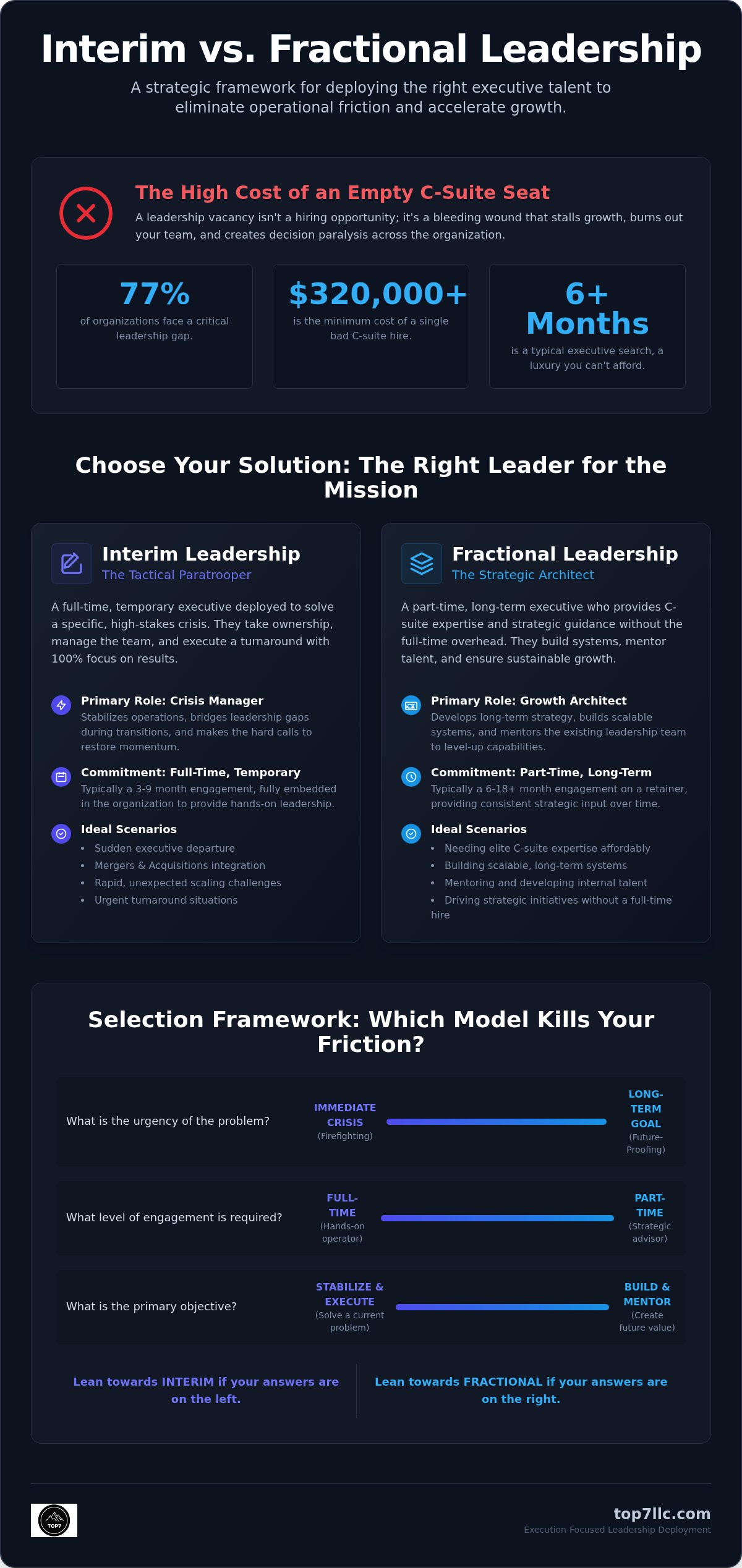
Selection Framework: Which Model Kills Your Friction?
Choosing between interim vs fractional leadership isn't a matter of preference; it's a matter of diagnostics. If you misdiagnose the problem, you'll waste capital on the wrong solution. You don't need a part-time architect if your warehouse is currently burning to the ground. Conversely, you don't need a full-time firefighter to help you design a three-year growth roadmap. To stop guessing, you must evaluate where the friction actually lives in your organization.
Start by diagnosing the urgency. Is the house on fire? If a key executive walked out yesterday and your operations are paralyzed, you need an interim leader. They provide the 40+ hours a week required to stabilize the ship. If your engine is simply underperforming or you lack the high-level strategy to reach the next $50M, a fractional leader is your architect. They provide the strategic fuel without the bloat of a full-time executive salary.
Next, evaluate the internal team's needs. Does your staff need a boss to give direct orders during a transition, or a mentor to level up their own capabilities? Interim leaders manage; fractional leaders build. Finally, apply the Velocity-7 lens to your growth dimensions. If the friction is in your systems and strategy, a fractional expert can install the necessary frameworks over 12+ months. If the friction is a temporary leadership vacuum, an interim paratrooper can bridge that 3-9 month gap until a permanent hire is ready.
Interim vs. Fractional: The Direct Comparison
The wrong choice leads to "Consultant Fatigue," where your team gets tired of advice that never turns into action. Understanding the commitment levels is critical for your budget. Interim roles are intense, full-time sprints usually lasting less than a year. Fractional roles are long-term strategic partnerships, typically requiring 4 to 16 hours per week. If you hire an interim leader for a long-term strategic project, you'll overpay for presence. If you hire a fractional leader to manage a crisis, they won't have the bandwidth to put out the fires. You need to know when to hire an Interim vs. Fractional COO to avoid burning through your runway.
Local Market Dynamics: From Boston to Dallas
In competitive tech and manufacturing hubs like Boston or Dallas, the talent shortage is a constant threat. Mid-market firms in these regions are ditching the "full-time-only" dogma because they realize that elite talent is often unavailable for permanent roles. They'd rather have 20% of a Tier-1 genius than 100% of a mediocre manager. This regional shift toward flexible leadership allows agile companies to outmaneuver larger, slower competitors who are still stuck in traditional hiring cycles. If you want to scale, you need to deploy leadership as a tactical weapon. If you're ready to stop the bleeding and start executing, explore our Fractional Leadership solutions to see how we embed experts directly into your workflow.
The Top7 Edge: Velocity-7 and Direct Execution
Most executive search firms treat your business like a dating app. They match a resume to a job description, collect their 30% fee, and disappear before the first board meeting. We don't do that. Top7 isn't a recruitment agency; we are an execution powerhouse. We don't just "place" people into your organization. We embed seasoned operators who use the Velocity-7 Adaptive Framework to systematically dismantle the barriers holding you back. Whether you are navigating the nuances of interim vs fractional leadership, the goal remains the same: moving your organization from operational friction to a state of efficient, profitable flow.
Our approach to Fractional CTO and Fractional COO roles is kíméletlenül őszinte, or ruthlessly honest. If your tech stack is a liability or your operations are a house of cards, we'll tell you. Then, we'll fix it. We don't deliver 50-page slide decks filled with "strategic recommendations" that sit in a shared drive. We deliver results. By embedding directly into your workflow, our leaders take ownership of the outcomes, ensuring that every tactical move aligns with your long-term roadmap to scale.
Agile Leadership for the Modern Mid-Market
Traditional C-suites are too slow for the 2026 economy. Decision-making shouldn't take months; it should take minutes. We apply agile principles to the highest levels of your organization to drive faster execution in financial strategy, sales guidance, and technical leadership. Our experts are operators first. They've built companies, managed massive P&Ls, and led turnarounds. They know that in a high-stakes environment, an "advisor" is a luxury, but an operator is a necessity. We solve the complex problems that keep you awake at night by installing systems that work when we aren't in the room.
Ready to Eliminate Friction?
You can't afford another quarter of "guessing" your way through growth obstacles. Operational friction is a silent killer of margins and morale. We move companies from chaos to strategic flow in as little as 90 days. It starts with a clear diagnosis of your leadership needs and ends with a scalable engine that doesn't depend on the CEO's constant intervention. We offer a no-fluff guarantee: we focus on measurable outcomes, or we're not doing our job. If you're tired of the empty chair and the stalled initiatives, it's time to deploy elite talent. Schedule a strategy audit with a Top7 executive today and let's identify the exact model you need to kill your friction and start scaling.
Deploy Your Strategic Advantage Today
Waiting for a perfect full-time hire while your operations stall is a form of business suicide. You've seen the data; the "empty chair" costs more than just a salary. It costs you momentum, talent, and market share. Whether you need a paratrooper to stabilize a crisis or an architect to build sustainable growth, the choice between interim vs fractional leadership determines your trajectory for the next three years. Stop treating your C-suite as a passive cost center and start treating it as a tactical weapon.
At Top7, we don't just hand you a stack of resumes. We embed seasoned CTOs, COOs, CEOs, and CFOs directly into your organization using our Velocity-7 Adaptive Framework. We focus on measurable execution, not just advice. It's time to kill the operational friction that's keeping you from the next stage of growth. You have the roadmap; now you need the driver.
Stop the leadership bleed. Get a Top7 Fractional Executive.
Frequently Asked Questions
What is the primary difference between interim and fractional leadership?
The primary difference between interim vs fractional leadership is the level of commitment and the core objective. Interim leaders are full-time paratroopers who drop in to stabilize a crisis or bridge a sudden vacancy. Fractional leaders are part-time architects who build long-term strategic frameworks. If your house is on fire, you hire an interim; if you need to build a better house, you hire a fractional executive.
How much does a fractional CTO cost compared to a full-time hire?
A fractional CTO typically costs about 25% of the total compensation package of a full-time hire while delivering 100% of the strategic wisdom. You avoid the $300,000+ salary overhead, benefits, and equity grants associated with a permanent C-suite role. This model allows you to buy results and outcomes instead of paying for a body to occupy a desk forty hours a week. It's about ROI, not payroll bloat.
Can an interim leader transition into a permanent role?
An interim leader can transition into a permanent role, but it's rarely the optimal outcome for either party. Most interim executives are specialized turnaround experts who thrive on fixing broken systems and moving to the next mission. Their value lies in their objectivity and lack of interest in office politics. They prepare the ground for a permanent successor rather than seeking to become one themselves.
Is fractional leadership suitable for small businesses or just mid-market companies?
Fractional leadership is effective for both small businesses and mid-market companies, though the application differs. Small businesses use fractional experts to access "big league" strategy they couldn't otherwise afford. Mid-market firms use them to install the Velocity-7 Adaptive Framework and scale operations from $20M to $100M. The goal is always the same: eliminating friction and driving profit without bloating the payroll.
How do I know if my company in Chicago or Boston needs a fractional COO?
You need a fractional COO in hubs like Chicago or Boston when operational friction starts killing your margins. These competitive markets don't forgive slow execution or decision paralysis. If your team is burning out and your strategic initiatives are stalled, you need an operator to install systems. Don't wait for a six-month executive search to fix a problem that's bleeding value right now.
What are the common pitfalls when hiring an interim executive?
The most common pitfall is hiring an interim executive as a "consultant" rather than an "operator." If you don't grant them the authority to hire, fire, and restructure, you're wasting your capital. Another mistake is failing to define a clear exit strategy. An interim leader must have a specific mission to stabilize the function and prepare a comprehensive handover for the permanent hire. They are there to execute, not just advise.
How does fractional leadership improve company culture?
Fractional leadership improves company culture by removing the "bottleneck" effect that causes employee burnout. When a seasoned leader installs clear systems and mentors junior VPs, the entire organization moves from chaos to flow. This "Velocity" culture replaces decision paralysis with confident execution. It empowers your existing team to win by giving them the high-level strategic air cover they've been missing.
What is the typical duration of a Top7 fractional engagement?
Most Top7 fractional engagements last 12 months or longer to ensure deep systems integration and cultural transformation. Our interim missions are shorter, typically spanning 3 to 9 months depending on the complexity of the transition. We don't believe in "forever" consulting; our goal is to build a self-sustaining engine that eventually makes our direct daily involvement unnecessary for your continued growth.


Comments