
When to Hire Your First Technology Leader: Stop Guessing and Start Scaling
- Robert Fitzgerald
- Jun 8
- 13 min read

Updated: Jun 20
Hiring a full-time CTO is often a premature ego-hire that turns into a permanent payroll anchor. You don't need a massive salary sitting in meetings; you need a strategy that actually moves the needle. If your developers are speaking in riddles while tech debt chokes your sales pipeline, you're likely asking when to hire your first technology leader. You're right to be worried. With total compensation for tech executives often exceeding $600,000 in 2026, a bad hire isn't just a setback. It's a terminal mistake for your scaling efforts.
You know that "winging it" has hit a ceiling and the operational friction is costing you real money. we're going to stop the guessing games. This guide identifies the exact moment your business requires high-level direction and how to avoid overpaying for talent you aren't ready to utilize full-time. We will provide a clear roadmap for tech leadership that reduces friction and implements a scalable strategy designed for profit, not just code.
Stop guessing when to hire your first technology leader. Most founders wait until the wheels fall off, but we'll show you how to identify the "Founder's Ceiling" before your technical intuition starts killing your growth. Learn to bridge the gap between business goals and technical execution without the usual friction.
We expose the "Full-Time Fallacy" and why hiring a permanent executive too early is a million-dollar mistake. See the true cost of salary, equity, and search fees that often turn a C-suite hire into a payroll anchor for mid-market companies.
Discover the four critical indicators that prove your operational complexity has outpaced your current team's capacity. We explain why your first tech leader should be your most expensive insurance policy against strategic risk and technical debt.
We break down the Mid-Market ROI Framework, comparing the Fractional CTO model directly against traditional full-time hires. Access elite leadership and the Velocity-7 Adaptive Framework to solve complex problems without the long-term commitment.
This isn't about just hiring better developers. It's about implementing a scalable technology strategy that reduces operational friction and drives profit. Walk away with a clear roadmap for tech transformation that actually delivers measurable results and market dominance.
Table of Contents
Identifying the Friction: Why Your Technology is Currently a Bottleneck
Technology isn't a cost center; it's your primary growth lever. If your tech stack is slowing you down, you've officially hit the Founder's Ceiling. This is the point where your technical intuition no longer scales with your business complexity. You need a bridge between your aggressive business goals and your team's technical execution. Without it, you're just throwing money into a black hole of Jira tickets and "infrastructure updates" that never seem to impact the bottom line.
Most mid-market owners try to solve a slow pipeline by hiring more developers. It's a trap. Without a captain, adding more developers just creates more noise and more complex ways to fail. You don't need more hands on deck; you need someone to navigate the ship. Understanding the actual responsibilities of a Chief Technology Officer (CTO) is the first step in realizing that leadership isn't about writing code. It's about making code profitable.
To better understand the weight of this first major leadership hire, watch this helpful video:
This is exactly when to hire your first technology leader. When the operational friction of your current systems starts eating your margins, you can't afford to wait. Efficient flow only happens when strategy dictates the tools. If your tools are currently dictating your strategy, you're losing the market battle before it even begins.
The Difference Between a Lead Dev and a Tech Leader
A lead developer is an expert at technical execution. They write clean code and fix bugs. A technology leader is an expert at technical strategy. They drive revenue and manage risk. Promoted developers often fail because they try to "code their way" out of business problems. This accidental leadership creates a strategic vacuum that costs mid-market firms millions in missed opportunities and technical debt. You need a strategist, not a senior coder with a fancy title.
Symptoms of a Leadership Vacuum
If you're unsure if you've reached this point, look for these red flags. Missed deadlines often have no clear technical root cause, yet they keep happening. Your tech stack probably looks like a Frankenstein monster of disconnected tools that don't talk to each other. Most importantly, you likely have zero ability to forecast tech costs or ROI for the next 12 months. If you're flying blind, your technology is a bottleneck, not a catalyst for scaling.
The 'Full-Time' Fallacy: Why a Premature CTO Hire Will Sink Your ROI
You've been told that a "real" company needs a full-time CTO on day one. It's an expensive lie. Most mid-market firms rush into a permanent hire because they crave the prestige of a C-suite title. They ignore the math. In 2026, the base salary for a full-time CTO ranges from $183,000 to $390,000. When you factor in equity, bonuses, and benefits, that number easily clears $600,000. Deciding when to hire your first technology leader shouldn't be based on ego; it should be based on a cold calculation of ROI.
Prematurely locking in a high-level executive creates "Bored Executive" syndrome. These leaders are used to managing massive departments, not fixing your broken API or babysitting three junior devs. To justify their presence, they often over-engineer simple solutions. They build for their resume, not your profit. They'll push for expensive, complex architectures that look great on LinkedIn but create a maintenance nightmare for your business. You end up paying a premium for complexity you never asked for and don't need.
The Million-Dollar Mis-hire
A bad executive hire is a terminal wound. If you bring in the wrong person, the 18-month cost is staggering. You lose the recruitment fee, which is often 25% of the base salary, plus the actual compensation and equity vest. Executive search firms don't always align with mid-market needs; they often prioritize filling the seat over long-term strategic fit. Tying up that much capital in a premature payroll anchor is an opportunity cost that could have funded your entire customer acquisition strategy for a year.
Strategy First, Payroll Second
You need a roadmap before you hire a driver. Why pay for a full-time pilot when your plane is still being built? "Renting" expertise allows you to build the foundation without the permanent overhead. This approach lets you identify the critical indicators for hiring a CTO before you sign a long-term contract. Engaging a Fractional CTO ensures you get the strategic heavy lifting done without the $600,000 price tag. Stop hiring "Heads of Tech" who are just glorified managers. Get the strategy right first, then decide if you actually need the permanent headcount.
The 4 Critical Indicators for Hiring Your First Tech Leader
Forget your ARR. Most gurus tell you to hire based on revenue milestones, but revenue is a lagging indicator. If you want to know when to hire your first technology leader, look at your operational complexity and strategic risk. Your tech leader shouldn't be seen as a luxury hire; they are your most expensive insurance policy. Right now, you're likely paying a massive "interest rate" on technical debt that you can't even see. Every time a developer hacks a fix to hit a deadline, that interest compounds. If you don't have a strategist to manage that debt, it will eventually bankrupt your agility.
Indicator 1: Strategic Decisions Are Being Made by Default
When "how we've always done it" becomes your default setting, you've lost control. Without a leader, your developers are forced to make business-altering decisions just to keep the lights on. They choose tools based on what's trendy on GitHub, not what's profitable for your balance sheet. Accidental strategy is a silent profit killer. You need someone who ensures every line of code serves a business objective, not a developer's curiosity. Stop letting your codebase dictate your business model.
Indicator 2: Scaling Friction is Impacting Sales
Is your sales team afraid to promise new features? That's a red flag. When your infrastructure stability becomes a PR risk, you've outgrown your current team's capacity. Scaling isn't just about adding more servers; it's about the "Velocity" dimension of growth. A tech leader removes the friction that keeps your sales team playing defense. They turn your technology into an offensive weapon that allows you to out-pace the competition without the fear of a system crash during a demo.
Indicator 3: The Complexity Gap
Integrating AI, managing security compliance, and navigating data privacy isn't a part-time job for a CEO. You can't effectively manage modern tech vendors if you don't speak the language. You need a translator between the boardroom and the server room. Someone who can explain why a $50,000 security audit is cheaper than a $5,000,000 data breach. This gap only widens as you scale; don't wait for a crisis to bridge it. You need a strategist who can navigate these waters before you hit an iceberg.
Indicator 4: You Can't Measure Technical ROI
If you're writing checks for tech but can't see the return, you're gambling. Understanding how to hire a CTO or engaging a Fractional CTO is about moving from "hope" to "metrics." Use this quick diagnostic: Can you explain your tech roadmap for 2027? Do you know which 20% of your stack creates 80% of your support tickets? If the answer is no, the leadership gap is already costing you market share. It's time to stop guessing and start measuring.
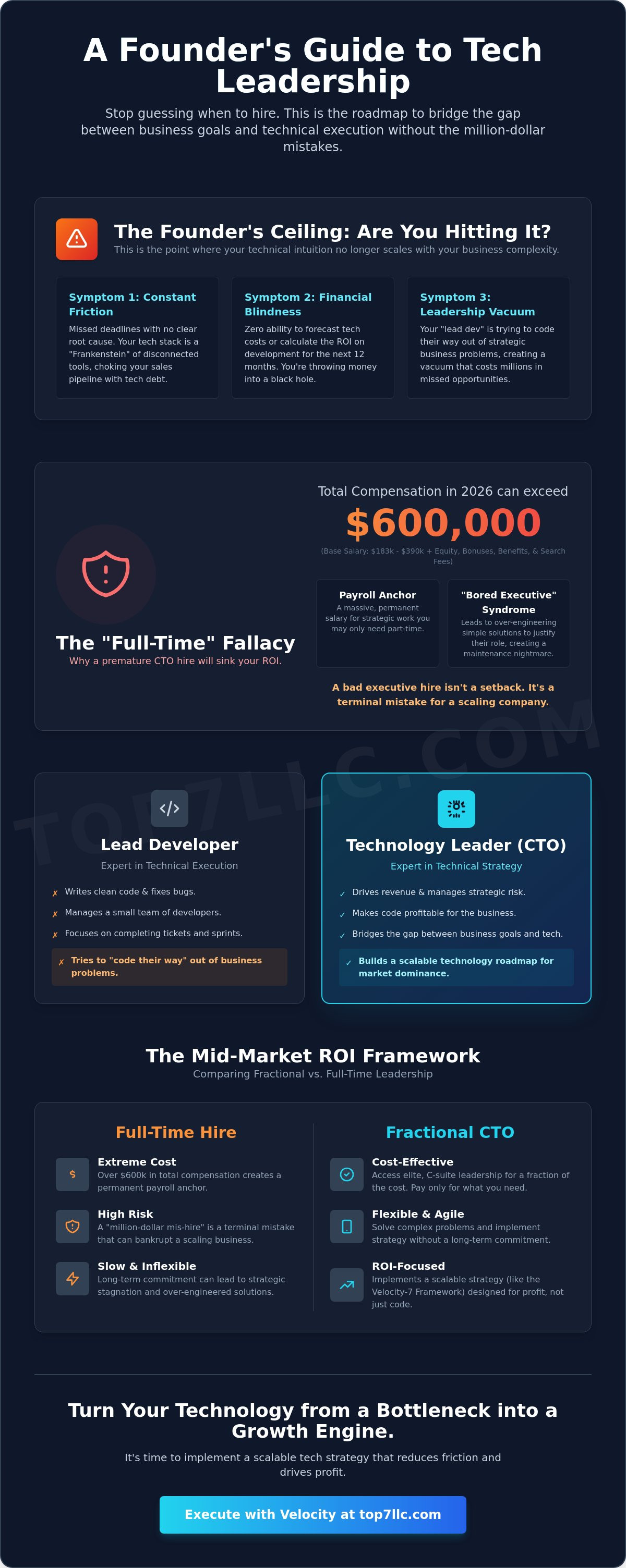
Fractional CTO vs. Full-Time Hire: The Mid-Market ROI Framework
Hiring a full-time executive is a marriage. Hiring a Fractional CTO is a surgical strike. For most mid-market companies, the decision of when to hire your first technology leader shouldn't result in a permanent payroll anchor that drains your capital before you've even scaled. You need the results of a veteran leader, not the overhead of a full-time salary, equity, and benefits package. A fractional model provides an outside-in perspective that internal hires lack. They aren't bogged down by office politics or "the way we've always done it." They're here to solve problems, build systems, and drive profit. It's about buying the outcome, not the headcount.
The fractional approach isn't a temporary band-aid. It's a strategic bridge. It allows you to stabilize your infrastructure and set a roadmap without committing to a $600,000 annual expense. You get the heavy-hitting strategy of a seasoned veteran who has seen fifty different tech stacks, rather than a full-timer who has only seen one or two. This is "Experience Arbitrage" in its purest form. You're getting elite-level intelligence for a fraction of the market price, allowing you to reinvest that saved capital into actual product development or market expansion.
When Fractional is the Superior Choice
If your revenue sits between $5M and $50M, you're in the sweet spot for fractional leadership. You have enough complexity to need a strategist, but not enough daily C-suite work to keep a high-level executive busy forty hours a week. Firms in competitive hubs like Boston, Dallas, or Austin are increasingly ditching the traditional hire in favor of fractional models to preserve cash while maintaining strategic dominance. This is especially critical during post-merger integrations or rapid digital transformations. You need a leader to stabilize the ship, not a long-term passenger who will be looking for their next move in eighteen months.
The Evaluation Framework: Risk vs. Reward
Speed is your greatest asset in a competitive market. A full-time executive search takes six months to find and another three to onboard. A fractional leader embeds and starts executing in days. By utilizing our Fractional CTO services, you gain access to the Velocity-7 Adaptive Framework. This allows you to scale your leadership up or down based on the actual needs of your roadmap. You get the elite strategy required to win without the terminal risk of a mis-hire. Stop paying for potential and start paying for performance. If you aren't ready for a full-time driver, don't buy the bus. Rent the pilot and get to your destination faster.
Executing with Velocity: How Top7 Bridges the Tech Leadership Gap
Identifying when to hire your first technology leader is only the first step in reclaiming your growth. The real challenge is finding a leader who doesn't just talk about strategy but actually knows how to execute it. Most mid-market firms are stuck in a cycle of "patch and pray" because they lack a repeatable framework for transformation. At Top7, we replace that uncertainty with the Velocity-7 Adaptive Framework. This isn't just another management theory; it's a high-octane engine for tech transformation that focuses on one thing: measurable profit.
We focus exclusively on the American mid-market, serving companies from the Northeast to the West Coast. Whether you're operating out of Boston, Chicago, or Dallas, your scaling problems are the same. Operational friction is killing your speed, and your current team is too bogged down in the "how" to see the "why." We don't just identify the friction; we eliminate it. Our leaders embed directly into your operations to solve complex problems in real-time. We bridge the leadership gap by aligning your technical infrastructure with your aggressive sales goals, turning a bottleneck into a competitive weapon. To ensure your market identity is equally powerful, check out Branding TITANS™.
Beyond Consulting: Embedded Execution
Consultants are famous for delivering a roadmap and then disappearing when it's time to do the actual work. We aren't consultants. We're interim and fractional leaders who stay to drive the car. We integrate financial strategy and sales guidance with pure tech leadership because code doesn't exist in a vacuum. Our Fractional CTO and Strategic Planning services are about results, not reports. We understand the regional talent wars in cities like Austin and Dallas, and we use that expertise to build teams that last. We don't just tell you what to do; we execute until the results show up on your balance sheet.
Your 90-Day Tech Leadership Roadmap
You don't have time for a multi-year discovery phase. You need a transition from chaos to efficient flow, and you need it now. Our 90-day roadmap is designed for speed and precision. We stop the bleeding and start the scaling process immediately through a disciplined, three-step process:
Step 1: Audit and Friction Analysis. We perform a Velocity-7 Audit to find where your money is leaking and where tech debt is hiding.
Step 2: Strategic Alignment. We map every technical initiative directly to your revenue goals. If it doesn't drive profit, we don't build it.
Step 3: Execution and Transition. We implement the systems and leadership required for sustainable, scalable growth.
Stop letting technical debt and leadership gaps dictate your company's future. You've reached the ceiling; now it's time to break through it. Stop letting tech debt slow you down. Schedule a call with Top7.
Take Command of Your Technical Strategy
You've seen the red flags. Your technical debt is compounding, your sales team is playing defense, and your current "Frankenstein" stack is a strategic liability. Deciding when to hire your first technology leader isn't a matter of "if" but how fast you can stop the bleeding. A full-time executive hire is a million-dollar mistake for mid-market firms that need strategy rather than more headcount. You don't need a $600,000 payroll anchor. You need a navigator who understands the nyers üzleti valóság of scaling.
Top7 provides the tactical edge you've been missing. Our seasoned professionals use the Velocity-7 Adaptive Framework to transform technical friction into efficient flow. From the tech hubs of Boston to the high-growth markets on the West Coast, we embed directly into your team to drive results. We don't just deliver reports; we execute. It's time to stop letting your infrastructure dictate your growth potential and start letting your strategy drive your profit.
Stop Guessing and Start Scaling: Get Your Fractional CTO Strategy Now. Take control of your roadmap today.
Frequently Asked Questions
What is the difference between a Fractional CTO and a technical consultant?
Consultants sell advice; Fractional CTOs sell execution. A consultant gives you a 50-page slide deck and leaves you to figure out the implementation. A Fractional CTO integrates into your C-suite, owns the technical roadmap, and takes full responsibility for the outcome. They don't just tell you the house is on fire; they grab the hose and then build a fireproof foundation for your growth.
How much does it cost to hire a first technology leader in 2026?
Market data for 2026 shows full-time CTO base salaries ranging from $183,000 to $390,000. Total compensation packages, including equity and bonuses, frequently exceed $600,000 at funded or mid-market firms. Fractional rates typically fall between $200 and $500 per hour. Choosing when to hire your first technology leader is a balance between needing elite expertise and avoiding a permanent payroll anchor that drains your capital.
Can a Fractional CTO help us prepare for a full-time hire later?
Stabilizing the chaos is exactly what a Fractional CTO does before you commit to a permanent headcount. They define the specific technical requirements for your next phase, write the job description, and interview candidates to ensure you don't make a million-dollar mis-hire. They ensure your permanent leader walks into a system built for scale rather than a technical minefield of unmanaged debt.
Do I need a technology leader if we outsource all our development to an agency?
You need an internal strategist even more when using an agency. Without a leader, you're at the mercy of an external vendor's billable hours and their convenience. A technology leader acts as your advocate, ensuring the agency builds for your profit and doesn't hold your IP hostage. They translate business goals into technical requirements so you don't get overcharged for over-engineered solutions.
What are the common mistakes when hiring a first-time CTO?
The most fatal error is hiring a "builder" when you actually need a "strategist." Founders often hire the smartest coder they know, only to find that person can't manage a budget or talk to the board. Don't hire a glorified developer to do a C-suite job. Another mistake is giving away too much equity too early to a leader who hasn't proven they can scale with the company.
How do I know if my current Lead Developer is ready to be a CTO?
Technical brilliance is not a proxy for strategic leadership. If your lead developer can't translate technical debt into financial risk or explain tech ROI to your investors, they aren't ready. A CTO must focus on the "why" of the business, while a lead dev is focused on the "how" of the code. Most developers are builders; very few are commercial strategists.
What specific metrics should a first tech leader be responsible for?
They should be judged on technical ROI, development velocity, and the reduction of operational friction. If your technology isn't directly accelerating your sales pipeline or protecting your margins through security compliance, the leader isn't delivering. They must own the "Velocity" of the team and ensure the tech stack is a growth lever, not a cost center.
How does the Velocity-7 Framework apply to technology leadership?
The Velocity-7 Adaptive Framework is the engine we use to bridge the gap between raw code and revenue. It's a disciplined 90-day cycle that audits your current friction, aligns your tech with aggressive business goals, and executes a transition to sustainable growth. It replaces "hope" with a repeatable system for technical dominance. It's about precision execution that moves the needle on your balance sheet.


Comments