
Unit Economics Analysis for Startups: Why Growth Without Profit is a Death Sentence in 2026

Updated: Jun 26
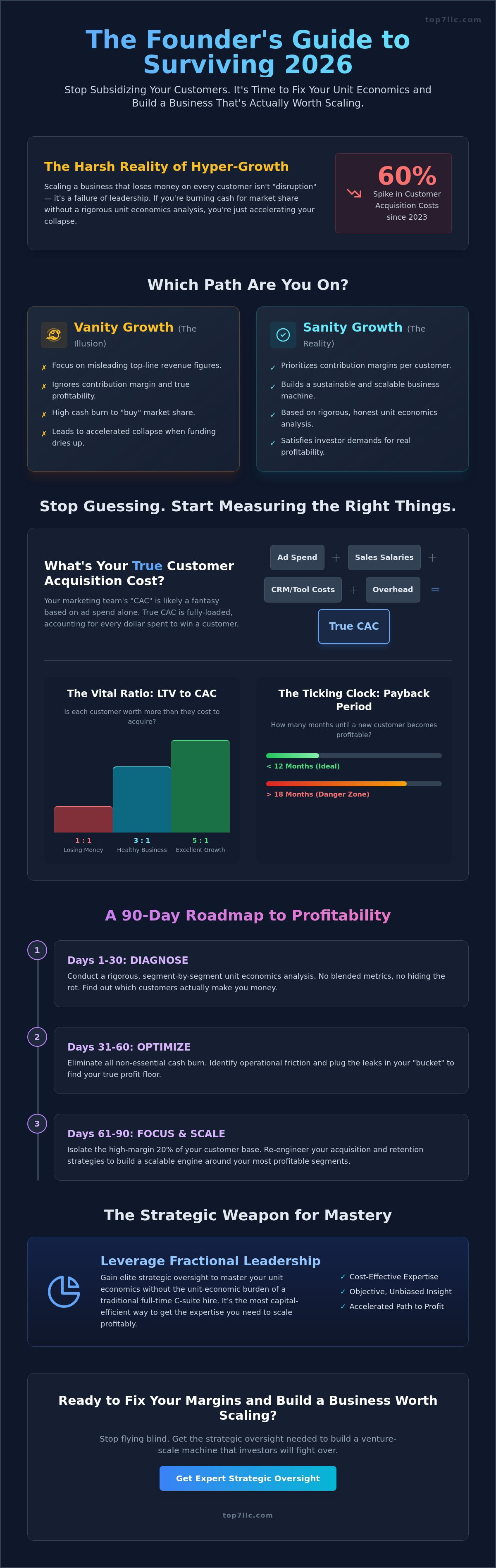
Your hyper-growth strategy isn't a success story; it's a slow-motion suicide note. In 2026, scaling a business that loses money on every customer isn't "disruption," it's a failure of leadership. Customer acquisition costs have spiked by up to 60% since 2023, yet most founders still fly blind. If you're burning cash to buy market share without a rigorous unit economics analysis for startups, you're just subsidizing your customers until your runway hits zero. Stop pretending the math will fix itself later.
You know the pressure is mounting. Your VCs are demanding better margins, and operational friction is eating the profits you thought you'd have by now. We're going to strip away the vanity metrics and focus on the raw business reality. This article delivers a clear diagnostic of your business health and a roadmap to profitability. You'll learn how to master the metrics that drive venture-scale growth and build a machine that's actually worth scaling. Let's get to work.
Table of Contents
Stop Chasing Revenue: The Harsh Reality of Startup Unit Economics
The Precision Metrics: Decoding LTV, CAC, and the Payback Period
Beyond the Spreadsheet: Identifying Operational Friction in Your Unit Costs
A Founders Roadmap to Fixing Broken Unit Economics in 90 Days
Fractional Leadership: The Strategic Weapon for Unit Economic Mastery
Stop Chasing Revenue: The Harsh Reality of Startup Unit Economics
Revenue is a drug. It feels good to see the line go up, but for most founders, it's a lethal distraction. If you're losing money on every customer you acquire, you aren't building a business; you're running a charity subsidized by your investors. In 2026, the "growth at all costs" era is officially buried. Investors have stopped funding dreams and started auditing reality. A rigorous unit economics analysis for startups is no longer a "nice-to-have" spreadsheet exercise. It's the only way to prove your company deserves to exist.
Unit economics is the atomic level of your business. It measures the fundamental profitability of a single "unit" before you add the weight of your entire organization. If the math doesn't work at the unit level, it will never work at scale. Scaling a broken model doesn't fix the problem; it just accelerates your collapse. To build something that lasts, you must shift your focus from "Vanity Growth" (top-line revenue) to "Sanity Growth" (contribution margin). This starts with understanding unit costs and how they dictate your survival.
To better understand this concept, watch this helpful video:
What is a "Unit" in Your Business Model?
You can't fix what you can't define. For a SaaS company, the unit is typically a single subscriber. For e-commerce, it's a single transaction or order. Service-based firms in high-stakes markets like Austin or Boston must treat "the project" as their unit to account for localized labor costs and overhead. Don't fall for the trap of "blended" metrics. Averaging your high-margin enterprise clients with your money-losing SMB accounts hides the rot. You need to see the raw data for each segment to know which parts of your engine are actually firing.
The Growth vs. Profit Conundrum
Founders love the "Land and Expand" myth. They argue that negative unit economics are fine because they'll "make it up on volume." This is a mathematical fallacy. If you lose five dollars on every widget, selling a million widgets just leaves you five million dollars in the hole. Negative unit economics are only acceptable during a brief, intentional period of aggressive market capture where the LTV is proven, not projected. For venture-backed startups, the Unit Economic Threshold is the non-negotiable moment where the contribution margin from a single unit exceeds its own variable costs and begins clawing back the fixed overhead required to scale. If you haven't hit that threshold, stop hiring and start fixing your margins.
The Precision Metrics: Decoding LTV, CAC, and the Payback Period
Metrics are the vital signs of your business. If you're still using "gold standards" from five years ago, you're already dead. A unit economics analysis for startups in 2026 requires more than a casual glance at a marketing dashboard. It demands brutal honesty about how much you actually spend to buy a customer and how long they stick around. Most founders are flying blind, relying on vanity ratios that collapse under the slightest market pressure. Stop guessing and start measuring the numbers that dictate your survival.
Calculating the "True" Cost of Acquisition
Your marketing team is likely lying to you. They show you a Customer Acquisition Cost (CAC) based on ad spend alone because it makes their performance look better. That's a fantasy. True CAC is fully-loaded. It must include the salaries of your sales development reps, the cost of your CRM, and even a portion of your executive overhead. If you aren't accounting for every dollar spent to move a lead through the funnel, your margins are a lie. This lack of transparency is why many scaling businesses partner with Cornerstone Marketing Solutions to build an online presence that is measured by actual contribution margins rather than just clicks.
Don't fall for the "Organic Trap" either. Organic growth isn't free. It costs time, content production, and brand equity. Regional variations also play a massive role. Acquiring a customer in high-competition hubs like Boston or San Francisco can cost significantly more than in the Midwest due to localized labor rates and saturated digital auctions. If you can't calculate these numbers with 100% certainty, you might need a Fractional CFO to stop the bleeding before you attempt to scale.
LTV: Is Your Retention Data a Fantasy?
Lifetime Value (LTV) is where founders hide their delusions. Most LTV models assume a customer will stay forever, but in a market where B2B SaaS monthly churn averages 3.5%, that's a dangerous bet. You must distinguish between gross retention and net retention. Gross retention tells you if your product is actually useful; net retention tells you if you're successfully upselling. To ensure LTV accuracy, you should use a 12-month trailing average of your contribution margin per customer to account for seasonal dips and market shifts. If your retention data is based on a "best-case scenario," your entire business model is built on sand.
Beyond the Spreadsheet: Identifying Operational Friction in Your Unit Costs
Most founders treat unit economics like a math homework assignment. They stare at the LTV:CAC ratio and pray for the numbers to change. They won't. Your unit economics analysis for startups is a diagnostic tool, not just a report card. If your margins are thin, the problem isn't just your ad spend; it's the grit in your gears. We call this operational friction. It's the invisible tax you pay for every manual handoff, every outdated tool, and every redundant meeting that slows down your delivery.
Spreadsheets lie by omission. They show you the "what" but never the "why." Think of your business as a bucket. Marketing pours in leads, but if the bucket is full of holes, you're just wasting water. This is the "Leaky Bucket" syndrome. While your sales team celebrates new logos, your C-suite is likely ignoring the quiet churn happening in the background. In 2026, technology bottlenecks are the primary culprit. If your tech stack is a patchwork of legacy systems, the cost of serving each customer remains high even as you scale. You aren't gaining efficiency; you're just getting bigger and more expensive.
Middle-market firms in cities like Chicago or Dallas often suffer from a specific type of rot: middle management bloat. These "hidden" unit costs don't show up in a marketing dashboard, but they destroy your contribution margin. Every layer of unnecessary bureaucracy adds friction to the delivery of your service. If it takes three meetings to onboard a single client, your unit economics are already broken. You're paying for coordination instead of execution.
Operational Friction vs. Efficient Flow
Manual processes in your sales funnel are margin killers. If a human has to manually move data from a lead form to your CRM, your CAC just went up. Efficient flow requires an Agile-based transformation of your internal operations. We've seen companies cut their CAC by 30% simply by fixing internal handoffs and automating the transition from sales to customer success. It's not about working harder. It's about removing the obstacles you built yourself. High-velocity growth requires a frictionless path from lead to loyalist.
The Leadership Gap in Unit Economics
A standard CFO looks at the bottom line and sees that costs are high. They rarely see the technical debt or process failures causing the spike. This is the leadership gap. You need executives who can bridge the divide between finance and operations. This is why "fractional" thinking is the strategic weapon of choice for 2026. Cross-functional leadership allows you to spot where The Hidden Costs of Executive Burnout are actually manifesting as operational inefficiencies. Don't hire a full-time executive to solve a part-time strategic problem; use precision leadership to fix your margins instead.
A Founders Roadmap to Fixing Broken Unit Economics in 90 Days
Most founders treat their burn rate like a weather report. They watch it, they complain about it, but they don't actually change it. If your previous unit economics analysis for startups revealed a bleeding heart, you don't have years to fix it. You have 90 days. This isn't about incremental "optimization." It's about a surgical strike on every process and customer profile that drains your bank account. If you aren't willing to make the hard cuts, stop reading now. You're already dead.
Step 1: The Brutal Audit. Stop all non-essential spend immediately. You need to measure the "floor," the absolute minimum cost required to keep the lights on and serve one unit. Everything else is negotiable.
Step 2: Customer Segmentation. Apply the Pareto principle with zero mercy. Identify the 20% of customers providing 80% of your margin. These are your only real customers; the rest are liabilities.
Step 3: Pricing Power. Raising prices is usually the first step, not the last. If your product is "too expensive" for a customer to provide you a profit, you're selling to the wrong person.
Step 4: Process Automation. Replace expensive human labor with automated workflows. Every manual touchpoint in your delivery is a margin killer.
Step 5: The Velocity-7 Adjustment. Align your leadership team to the new economic reality. If your C-suite isn't obsessed with contribution margins, they shouldn't be in the room.
Pruning the Customer Base
You must fire your "Unit-Negative" customers. It sounds counterintuitive to walk away from revenue, but losing money on a client is a liability, not an asset. Pivot your sales strategy to focus exclusively on high-LTV segments, particularly in the competitive East Coast markets where efficiency is the only way to survive. The psychological hurdle of "losing" top-line revenue is the biggest barrier to growth. Get over it. Profitability is the only metric that buys you more time.
Automation as a Margin Lever
Technology isn't just for building features; it's for protecting your bottom line. A Fractional CTO can often find 15 to 20 percent margin improvements by identifying where your tech stack is bloated or inefficient. By implementing Advanced Project Management systems, you reduce the hours required for delivery, directly lowering your variable cost per unit. The 90-day margin turnaround isn't a suggestion; it's the deadline for your company's survival. If you're ready to stop the bleeding and start building a scalable machine, it's time for professional Strategic Planning that prioritizes profit over vanity.
Fractional Leadership: The Strategic Weapon for Unit Economic Mastery
Hiring a full-time C-suite executive to fix a broken business model is like buying a Ferrari to drive through a minefield. It's expensive, unnecessary, and it won't save you. Mid-market firms often make the mistake of adding a $300,000 salary to their fixed costs before they've even performed a proper unit economics analysis for startups. You're trying to solve a margin problem by increasing your overhead. It's tactical insanity. You don't need a permanent fixture; you need an elite strike team that knows how to find the rot and cut it out.
The Top7 Advantage lies in precision. We don't just sit in meetings; we embed. Using the Velocity-7 Adaptive Framework, our executives move your organization from friction to flow by identifying the specific bottlenecks inflating your variable costs. This isn't advisory fluff. It's an Interim Leadership model designed for combat in the 2026 market. You get high-level strategic guidance without the crushing weight of executive benefits and long-term contracts. You pay for results, not presence.
Fractional CTO vs. Fractional CFO: Who Fixes What?
You can't win a war with just one general. A Fractional CFO fixes your pricing architecture and cost structure. They find the leaks in your spreadsheet and ensure your contribution margin is actually positive. A Fractional CTO, however, fixes the technical debt and delivery inefficiencies that a finance person will never see. If your software takes twice as long to process a unit as it should, that's a CTO problem. You need both perspectives to win, but you don't need two full-time salaries draining your runway during a unit-economic crisis.
Next Steps for US Mid-Market Leaders
The cost of waiting is higher than the cost of intervention. Every month you operate with a leadership gap is another month your valuation takes a hit. While startups in Austin and Boston are already pivoting to fractional models to preserve cash and maximize efficiency, laggards in other regions are still burning through their series B runway. Don't be the founder who realizes the math is broken when the bank account is empty.
A unit economics analysis for startups is the first step, but execution is the only thing that matters. If your current leadership team is too close to the problem to see the solution, it's time to bring in the professionals. Stop guessing and start scaling a machine that actually works. Schedule a strategy audit with a Top7 executive and get the clarity you need to survive 2026.
Stop Burning Cash and Start Building a Scalable Machine
Scaling a business with broken math isn't growth; it's a slow-motion suicide note. You've seen how "Vanity Growth" masks the rot and how operational friction destroys your margins. In 2026, the only way to win is to master the raw data. A rigorous unit economics analysis for startups is the diagnostic tool you need to identify your "Unit-Negative" liabilities and double down on high-margin segments. Stop pretending the spreadsheet will fix itself.
Don't let your runway hit zero while you're still guessing. Our seasoned executives bring decades of mid-market experience and local expertise from US hubs like Boston to Austin. We use our proprietary Velocity-7 Adaptive Framework to help you move from friction to flow. It's time to stop the bleeding and build a business that actually generates profit at scale. You have the roadmap. Now, you just need the strategic discipline to execute.
Stop the Bleeding: Get a Unit Economics Audit from Top7
Frequently Asked Questions
How do I calculate unit economics for a service-based startup?
You must treat the individual project or client engagement as your "unit." Calculate the total revenue from that project and subtract the direct labor costs, software licenses used for delivery, and any project-specific overhead. If you aren't accounting for the billable hours of your most expensive employees, your unit economics analysis for startups is a work of fiction. Precision in tracking time and resource allocation is the only way to see your true margin.
What is a "good" LTV to CAC ratio for a mid-market company in 2026?
A 3:1 ratio is no longer the gold standard; it's the survival floor. With customer acquisition costs having spiked by up to 60% since 2023, you should target a 4:1 or 5:1 ratio to ensure venture-scale profitability. If your ratio is sitting at 3:1 in a high-rent market like Boston, operational friction is likely already eating your net profit. Aim higher or prepare for a difficult conversation with your board.
Can unit economics change as a startup scales?
Unit economics almost always shift as you grow, and usually for the worse. As you exhaust your easiest marketing channels, your CAC will naturally rise due to diminishing returns. You must offset this by using automation to lower your variable delivery costs. If you don't proactively manage this transition, your successful scaling will ironically lead to a faster bankruptcy as your margins compress under the weight of volume.
What is the difference between unit economics and profitability?
Unit economics measures the profitability of a single transaction or customer, while company profitability is your total bottom line after all fixed costs. You can have "healthy" unit economics and still be unprofitable if your fixed overhead is too bloated. However, if your unit economics are negative, company-wide profitability is mathematically impossible regardless of how much you scale. Fix the unit first, then the overhead.
How does the Velocity-7 framework impact my unit margins?
The Velocity-7 framework identifies the specific operational friction points that inflate your variable costs. By auditing your internal handoffs and automating redundant processes, it lowers the "cost to serve" for every unit you sell. This directly expands your contribution margin without requiring you to raise prices or spend more on marketing. It's about building a leaner, faster machine that keeps more of every dollar earned.
Is a Fractional CFO better than a full-time hire for fixing unit economics?
For most mid-market firms, a Fractional CFO is the superior strategic choice. You get elite financial oversight to perform a rigorous unit economics analysis for startups without adding a $300,000 salary to your fixed overhead. Why would you hire a full-time executive to solve a strategic margin problem when that very salary might be what's killing your profitability? Use precision leadership for a surgical fix.
What are the most common mistakes in unit economics analysis?
The most fatal error is using "blended" CAC that includes organic leads to hide the high cost of paid acquisition. Founders also frequently overestimate LTV by ignoring the reality of a 3.5% monthly churn rate in the B2B SaaS sector. If your retention data is based on hope instead of a 12-month trailing average, your model is broken. Stop using vanity metrics to justify poor operational discipline.
How often should a startup founder review their unit metrics?
You should review your unit metrics monthly at an absolute minimum. High-growth companies or those operating in volatile sectors like Fintech should audit these numbers weekly. Waiting for a quarterly board meeting to discover a "leaky bucket" in your retention is a leadership failure. Real-time data allows you to kill underperforming segments before they drain your remaining runway.



Comments