

Investor-Ready Financial Reporting: Stop Killing Your Deals with Muddy Data
- Robert Fitzgerald
- 2 days ago
- 12 min read

If your financial data requires a twenty minute explanation before the first slide is finished, you aren't just losing time. You're losing the deal. Investors in 2026 have zero patience for muddy numbers. They've pivoted their focus toward operational value creation and downside resilience, which means they'll sniff out a weak back office in seconds. Achieving investor-ready financial reporting isn't about having a prettier spreadsheet. It's about signaling that you have absolute, surgical control over your business engine.
You know the feeling of a deal stalling in real time. It's the anxiety that hits when sales data doesn't match finance reports, or when you can't defend your unit economics under pressure. Despite 42% of investor relations teams adopting AI this year, 40% of professionals report an even higher administrative burden because their systems are fragmented. You're likely stuck in the mud of data silos while your competitors are moving at high velocity.
It's time to stop playing defense and start winning. You're about to learn how to transform your back-office accounting into a strategic asset that commands a higher valuation. We'll show you how to eliminate silos, fix your cash runway accuracy, and build a defensible financial story that turns skeptics into backers. Let's turn your data into a weapon for growth.
Key Takeaways
Stop relying on tax-compliant bookkeeping to win capital; investors demand predictive operational flow, not just historical accuracy.
Build a defensible financial story by mastering an integrated three-statement model and aggressive unit economics like LTV/CAC and Payback Period.
Identify hidden operational friction and prove your execution speed to skeptics using the Velocity-7 Adaptive Framework.
Execute a 90-day roadmap to achieve investor-ready financial reporting by unifying your tech stack into a single source of truth.
Secure high-stakes growth and elite strategic oversight by leveraging fractional leadership instead of bloated full-time executive salaries.
Table of Contents
Why Your Current Financial Reports Are Actually Deal-Killers
Most founders treat their P&L like a report card for the taxman. It's a fatal mistake that costs millions in valuation. Investors don't just want to see that you've paid your taxes; they want to see if you actually know how to drive the car. Real investor-ready financial reporting is the synthesis of historical accuracy and predictive operational flow. It's the difference between saying "we spent this money" and "we invested this capital to generate a specific, repeatable outcome."
Before an investor reads your executive summary, they perform a 2-minute scan of your core components of financial statements. They aren't looking for growth alone. They're looking for the smell of operational friction. If your gross margins are shrinking while revenue climbs, or if your "Other Expenses" category is a black hole of miscellaneous costs, you've already lost the room. They see a leader who's lost control of the engine, regardless of how fast the car is moving.
To better understand how to structure your finance function for high-stakes scrutiny, watch this breakdown:
The Difference Between Bookkeeping and Strategic Reporting
Your bookkeeper's job is to ensure the past is documented accurately. They live in the rear-view mirror, focused on compliance and tax mitigation. That's the "Accounting Gap." A Fractional CFO uses that same data to model the future. GAAP-compliance is simply the floor; it's the bare minimum required to stay in the game. Strategic reporting tells a story of scalability and capital efficiency. If your data is "muddy," meaning your sales CRM doesn't talk to your accounting ledger, you'll get shredded during due diligence. Investors hate surprises. Muddy data suggests you don't have a handle on your own business engine.
Common Reporting Mistakes That Tank Valuations
Growth solves many problems, but it can't hide structural rot. One of the biggest deal-killers is inconsistent CAC and LTV calculations. If your finance team and sales team use different definitions for customer acquisition, your data clarity is zero. You can't defend a valuation based on guesswork. Another red flag is hidden bloat in COGS. If your cost of goods sold doesn't scale properly with your revenue, it suggests your business model is inefficient or lacks true leverage. Finally, beware the "hockey stick" revenue ramp. If your projected growth isn't backed by hard, historical conversion data, it isn't a forecast. It's a fairy tale that kills your credibility before the first meeting ends. Achieving investor-ready financial reporting requires closing these gaps before you step into the boardroom.
The 3 Pillars of Investor-Ready Reporting in 2026
Investors in 2026 don't care about your "vision" until they see your math. They've shifted focus toward operational value creation and downside resilience. If your data is siloed, your valuation is already bleeding. To secure a deal, you must move beyond basic bookkeeping and build a reporting engine based on three non-negotiable pillars. These pillars prove that your business has moved from friction to flow, transforming investor-ready financial reporting from a chore into a high-velocity strategic asset.
Pillar 1 is the Integrated Three-Statement Model. Your Income Statement, Balance Sheet, and Cash Flow statement must be tethered. If a change in your accounts receivable doesn't immediately reflect in your cash position, your reporting is broken. Even the SEC guidelines on financial statements highlight how these documents must work in tandem to provide a truthful picture of health. Pillar 2 focuses on Unit Economics and Efficiency Metrics. This is where you prove the "Magic Number" and your Payback Period. Finally, Pillar 3 is the Burn-to-Milestone Map. You must show exactly how every dollar of investment converts into a specific operational win. Investors hate the "black hole" of general operating expenses; they want a roadmap to the next value inflection point.
Advanced Unit Economics for Mid-Market Companies
Surface-level churn metrics are for amateurs. In 2026, sophisticated investors demand cohort-based retention analysis to see the true health of your customer base. They've stopped obsessing over Gross Margin and started looking at Contribution Margin. They want to know if you can actually turn a profit after variable costs, or if you're just buying growth at a loss. Unit economics is the DNA of your business scalability. If these numbers are muddy, your scalability is a myth. Implementing high-level Fractional CFO oversight can ensure these metrics are defensible before you hit the due diligence phase.
Cash Flow Forecasting: The Lifeline of Your Runway
EBITDA is a vanity metric that hides the truth about your survival. In a high-interest environment, cash is the only king that matters. You need a 13-week rolling forecast that provides a real-time pulse of your liquidity. This isn't just about tracking spend; it's about sensitivity analysis. You must model "What If" scenarios for market downturns or supply chain shocks. Showing that you've planned for a 20% revenue dip proves to investors that you aren't just lucky, you're prepared. This level of precision builds the megawatt confidence required to close high-stakes deals in a volatile market.
Beyond the Spreadsheet: Proving Operational Velocity
Spreadsheets are often just a graveyard for past decisions. They tell an investor what happened, but they rarely explain why it happened or how fast you can do it again. If you want to win in 2026, your data needs to move beyond static rows and columns. Investors are looking for "Flow," the predictable, rhythmic execution of a strategic roadmap. They use what investors look for in high-level reports to determine if your business is a high-performance machine or a collection of broken parts. Real investor-ready financial reporting proves that you've eliminated operational friction at every level.
This is where our Velocity-7 Adaptive Framework changes the game. We don't just look at your bank balance; we look at your operational velocity. When your financials show a variance, it isn't just a math error. It's a signal of friction in your execution. Perhaps your sales cycle is lagging, or your product development is burning cash without hitting milestones. By aligning your finance function with your operations, you turn your back office into a high-velocity strategic asset. You stop reporting on the weather and start controlling the climate.
Linking Financials to the Velocity-7 Framework
We break down your operational health through specific dimensions. First, we look at how your strategy translates into budget allocations. If your board deck says you're a "product-led" company but your R&D spend is flat, you have a credibility gap. Second, we measure the efficiency of your execution team through labor-to-revenue ratios. This proves you aren't just throwing bodies at problems. Third, we use technology to eliminate the human error friction that plagues most mid-market reporting. In 2026, 42% of investor relations teams use AI to streamline these processes, yet 40% still report an increased administrative burden because their tools don't talk to each other. We fix that.
The Role of Fractional Leadership in Data Integrity
Silos are the silent killers of valuation. When your CRO's sales forecast doesn't match your CFO's cash projection, an investor sees a leadership team in conflict. A Fractional CFO acts as the bridge, ensuring that the vision you sell in the boardroom is the same reality reflected in your ledger. They work alongside a Fractional CTO to ensure data integrity from the CRM all the way to the final report. At Top7, we embed these experts directly into your executive team. We don't just give advice; we take ownership of the data flow. This ensures that when you sit down for due diligence, your story is clean, defensible, and built for speed.
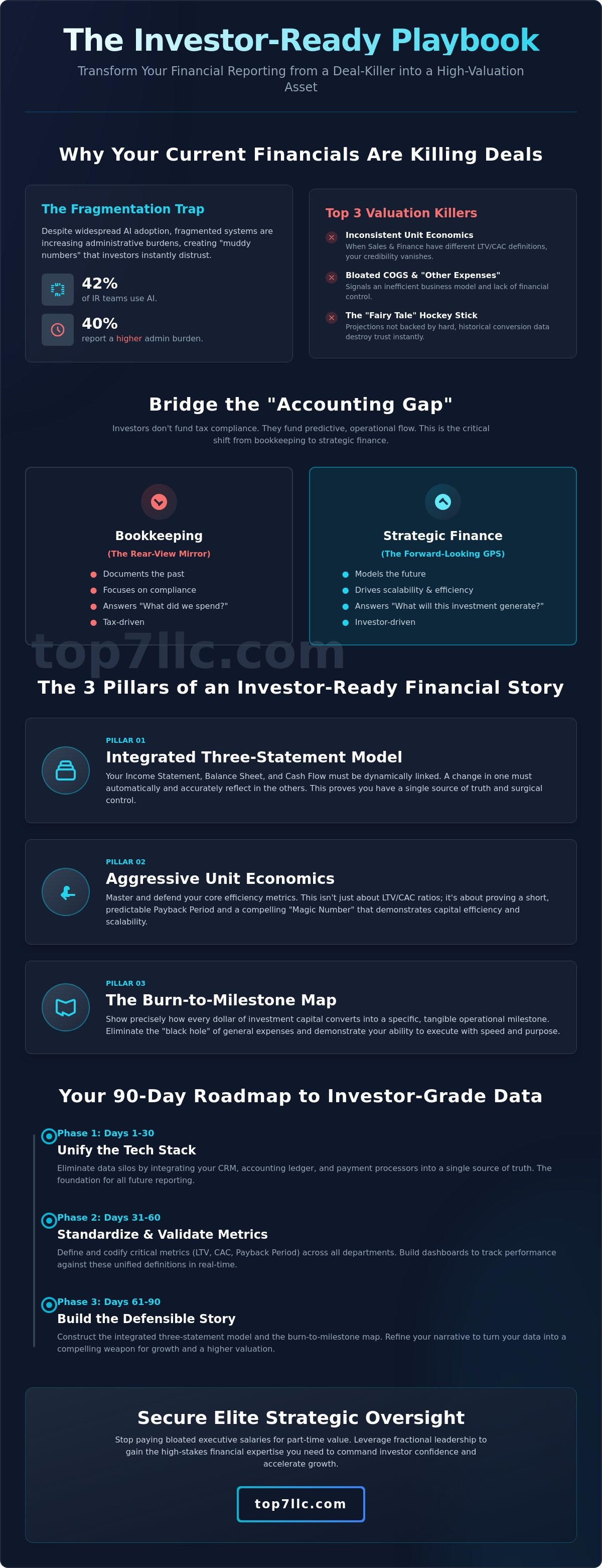
The 90-Day Roadmap to Audit-Proof, Investor-Grade Data
Most founders panic when a Term Sheet finally hits their inbox. They know their data is a mess, and they know the due diligence process will expose every loose thread. You cannot fix a year of financial neglect in a weekend. To secure the valuation you want, you need a surgical, 90-day execution plan. This roadmap transforms your back office into a fortress of investor-ready financial reporting. It isn't about "trying harder" with your current team. It's about re-engineering the entire pipeline of information.
Step 1: The Organizational Audit. We identify exactly where your data is leaking. Is it in the sales CRM, the billing portal, or the manual spreadsheets your bookkeeper maintains?
Step 2: System Integration. We connect your tech stack for a single source of truth. If your sales data doesn't flow automatically into your ledger, you're inviting human error.
Step 3: Historical Cleanup. We standardize the last 24 months of data to GAAP standards. Investors will look back. We make sure they don't find skeletons.
Step 4: Scenario Modeling. We build the "Low, Mid, and High" growth cases. This proves you've planned for the business you have, not just the one you're dreaming of.
Step 5: The Investor Narrative. We turn the cleaned data into a compelling growth story. Data without a narrative is just a math problem; data with a narrative is a deal-closer.
Month 1: Diagnostic and Systems Alignment
Execution starts by mapping the flow of a single dollar from the initial lead to the final bank deposit. Most companies find three or four points of failure in this exercise alone. We identify the bottlenecks in your current month-end close process to ensure you aren't flying blind. An Operational Audit is the first step to financial transparency. If you don't know where the friction is, you can't achieve flow. Our Fractional CFO services specialize in finding these hidden leaks before they drain your valuation.
Month 3: The Stress Test and Pitch Readiness
By the third month, you must conduct a "Mock Due Diligence." We find the holes in your story before a skeptical VC does. We refine your executive dashboard for real-time decision making, ensuring you can answer any question in a pitch meeting without hesitation. Finally, we prepare the "Data Room" for seamless investor access. When a lead investor asks for a specific cohort analysis, you should be able to provide it in minutes. This level of precision doesn't just win deals. It wins the best possible terms.
Leveraging Fractional Leadership for High-Stakes Growth
Mid-market companies from Boston to Austin are finally ditching the ego of the full-time C-suite hire. Why burn $300,000 or more on a full-time executive salary when you only need high-stakes strategic precision? In 2026, the smart money is on fractional leadership. This model allows you to deploy elite expertise exactly where it is needed without the overhead or the long-term liability of a permanent hire. It is the ultimate tactical move for CEOs who prioritize profit and agility over headcount and status.
Achieving investor-ready financial reporting requires more than just a clean ledger. It demands an executive presence that can defend your data under the most brutal scrutiny. A full-time CFO often gets bogged down in administrative noise or internal politics. A Fractional CFO from Top7 remains focused on the mission: building a high-velocity strategic asset that wins over skeptical investors. We don't just provide a service. We provide the strategic dominance necessary to bridge the gap between your current state and the requirements of your next capital round. Investors buy flow and predictable execution; we ensure your leadership team reflects that reality.
Fractional CFO Services for the US Mid-Market
We support growth in the trenches of Dallas, Austin, and the West Coast. These tech hubs move too fast for traditional, sluggish leadership models. Having a seasoned professional embedded in your team means you get immediate access to advanced project management and strategic planning. We don't just report the numbers. We fix the underlying business mechanics that cause those numbers to lag in the first place. This is about transforming your back office into a weapon for market share acquisition. You get the benefit of an expert who has seen hundreds of due diligence cycles and knows exactly where the traps are hidden.
Ready for Action? Your Velocity Starts Here.
Stop guessing about your runway. Stop hoping your data is accurate enough to survive due diligence. Start leading with the confidence that comes from surgical precision. You have seen the 90-day roadmap. You know the three pillars of investor-ready financial reporting. Now it is time to execute. Move from operational friction to efficient flow before your next round of funding becomes a fight for survival. If you are ready to stop killing your deals with muddy data and start commanding the valuation you deserve, we are ready to lead the charge. Schedule a call with a Top7 Executive today and let's turn your financial data into your greatest strategic advantage.
Command Your Valuation with Precision
You've seen the cost of muddy data. It isn't just a headache; it's a deal-killer that signals a lack of control to the very people you need to impress. Realizing investor-ready financial reporting is the difference between begging for capital and commanding it. By implementing the three pillars and following a 90-day execution roadmap, you move from operational friction to a state of high-velocity flow. You stop reporting on the past and start engineering the future of your mid-market growth company.
Top7 brings seasoned professionals with deep C-suite experience directly into your trenches. We utilize our proprietary Velocity-7 Adaptive Framework to ensure your financials finally match your operational reality. Don't let another quarter slip away with siloed data and uncertain runways. It's time to lead with the surgical precision your business deserves. Stop guessing and start scaling; Schedule your Top7 audit today. Your next round of funding is waiting for a story you can actually defend. Let's build it together.
Frequently Asked Questions
What exactly makes financial reporting 'investor-ready'?
Investor-ready financial reporting is a state where your numbers tell a clean, defensible story of growth and control. It requires an integrated three-statement model where your income statement, balance sheet, and cash flow are perfectly tethered. Beyond the math, it signals to investors that you have surgical control over your business engine. If you can't defend your unit economics in under two minutes, you aren't ready for a high-stakes deal.
How long does it take to prepare for a Series B or C round?
You should plan for a 90-day execution window to fully re-engineer your finance function. This timeline allows for a deep organizational audit, historical cleanup of the last 24 months, and a rigorous mock due diligence stress test. Rushing this process usually leads to muddy data that falls apart under scrutiny. Three months is the minimum time needed to move from operational friction to investor-grade flow.
Why isn't my current CPA or bookkeeper enough for this process?
Your bookkeeper is focused on the rear-view mirror and tax compliance. That's the Accounting Gap that kills deals. A Fractional CFO focuses on the windshield, using historical data to model the future and drive capital strategy. Investors don't just want to know you paid your taxes. They want to know how you'll deploy their capital to hit the next value inflection point with precision.
What are the specific financial metrics SaaS investors look for in 2026?
In 2026, investors have ditched vanity metrics for hard efficiency data. They look for LTV/CAC ratios, the Magic Number, and payback periods that prove scalability. Specifically, they want to see cohort-based retention and contribution margins rather than just gross profit. Your reporting must prove that your growth isn't just bought at an unsustainable loss, but built on a repeatable, profitable engine.
How much does a Fractional CFO cost compared to a full-time hire in cities like Boston or Chicago?
A Fractional CFO provides the strategic dominance of a $300,000+ executive without the permanent overhead or equity drain. In high-cost hubs like Boston or Chicago, full-time hires come with massive liability and recruitment lag. By choosing a fractional model, you pay only for the high-impact strategic execution you need. It's a tactical move that prioritizes capital efficiency while securing elite leadership for your board meetings.
Can Top7 help if our operational data is currently a mess?
We thrive on cleaning up data messes. Our team starts with an organizational audit to identify exactly where your data is leaking between the CRM and the ledger. We then handle the system integration to connect your tech stack into a single source of truth. If your operational data is currently a disaster, we'll fix the underlying mechanics before you ever step into a pitch room.
What is the Velocity-7 Adaptive Framework and how does it help with fundraising?
The Velocity-7 Adaptive Framework is our proprietary system for aligning your strategy with your operational execution. It helps with fundraising by proving Flow, which is the predictable execution of your strategic roadmap. Investors use this framework to see if you have eliminated operational friction. It turns your back office into a high-velocity asset that justifies a higher valuation through data clarity and proven speed.
Do you provide interim leadership for companies in an executive transition?
Yes, Top7 provides Interim Leadership for companies navigating high-stakes executive transitions. Whether you've lost a key leader or are scaling faster than your current team can handle, we embed seasoned professionals directly into your executive suite. This ensures your data integrity remains intact and your strategic planning doesn't stall. We bridge the gap so your business maintains its momentum and stays deal-ready at all times.


Comments