
Strategic Financial Planning Services: Stop Reporting History, Start Engineering Growth

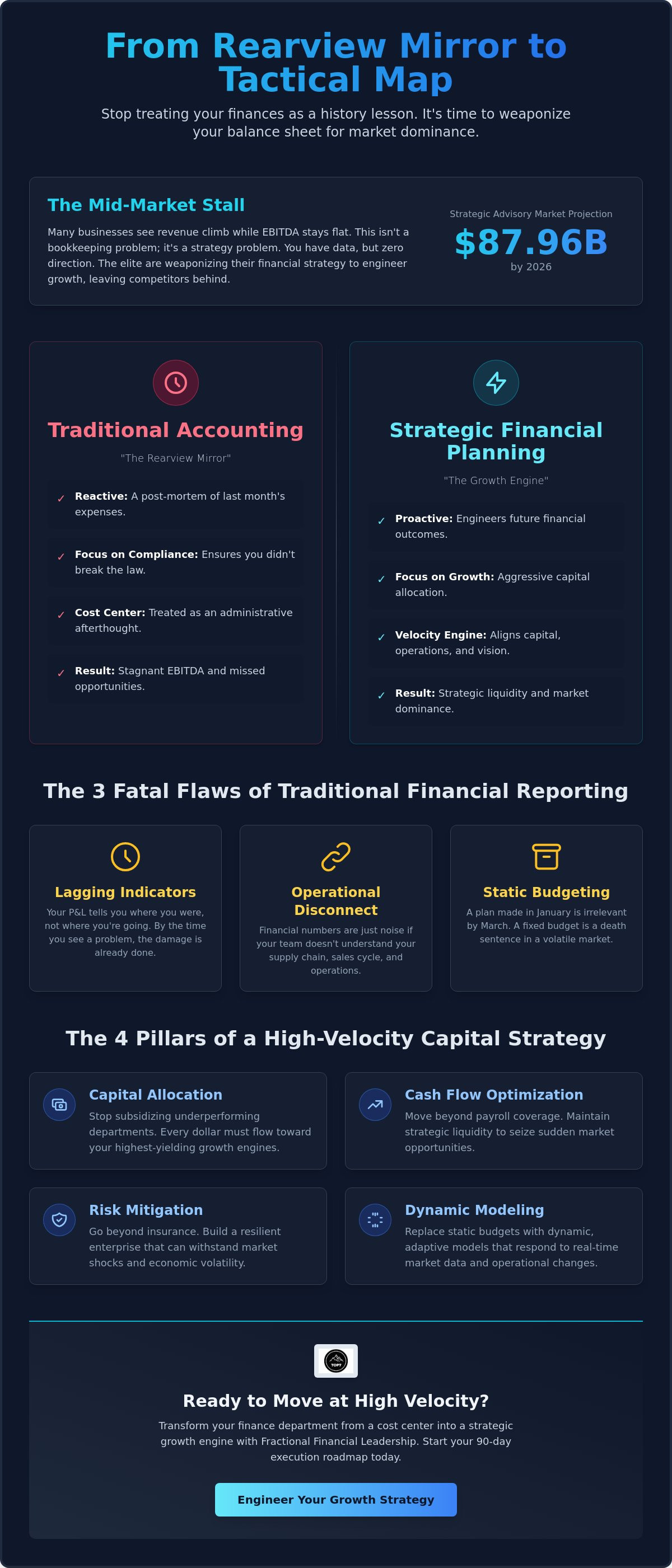
Your accounting team isn't helping you scale; they're just writing the obituary of last month's expenses. If you're tired of watching revenue climb while your EBITDA stays flat, you don't have a bookkeeping problem. You have a strategy problem. With the strategic advisory market projected to hit $87.96 billion in 2026, the winners are already weaponizing their data to leave competitors behind. Most mid-market firms treat strategic financial planning services as a reactive chore, but the elite use them to engineer market dominance. It's time to stop looking in the rearview mirror and start engineering the future of your balance sheet.
You likely feel the weight of cash flow surprises that halt your operations just as you're ready to strike. You want a roadmap that leads to a higher valuation and a capital strategy that makes banks and investors say yes. This article reveals how to transform your finance department from a stagnant cost center into a high-velocity growth engine. We'll explore how fractional leadership and the Velocity-7 Adaptive Framework give you the tactical edge you need to win.
We're stripping away the jargon to focus on the raw business reality of scaling. You'll learn how to secure predictable cash flow and build a financial foundation that supports aggressive expansion. It's about precision, execution, and moving at a speed your competitors can't match. Let's get to work.
Key Takeaways
Stop treating your balance sheet as a history book and start using it as a tactical map to navigate the 2026 market.
Discover how strategic financial planning services shift your focus from passive tax compliance to aggressive capital allocation that fuels growth.
Learn why a fractional CFO provides significantly more ROI than a traditional accountant by focusing on strategic liquidity and operational scaling.
Follow a 90-day execution roadmap to align your financial resources with the Velocity-7 Adaptive Framework for maximum market velocity.
Table of Contents
Why Your Business is Stalling: The Difference Between Accounting and Strategic Financial Planning
Fractional CFO vs. Traditional Accountant: Which One Actually Drives ROI?
Weaponizing Your Balance Sheet: A 90-Day Roadmap to Financial Flow
Fractional Financial Leadership: How Top7 Executes Strategic Growth
Why Your Business is Stalling: The Difference Between Accounting and Strategic Financial Planning
Most CEOs think a clean audit and a timely tax return mean their business is healthy. They're wrong. A clean set of books just means you didn't break the law; it doesn't mean you're actually making money or building value. Accounting is inherently reactive. It's a post-mortem of where your cash went last month. If you're relying on your CPA to tell you how to scale, you're looking in the rearview mirror while driving at 100 mph. You won't see the wall until you hit it.
True strategic financial planning services aren't about compliance. They're about engineering. They represent the aggressive alignment of your capital, your operations, and your long-term vision. In high-stakes markets like Boston or Chicago, mid-market companies stall because they treat finance as an administrative afterthought. They have plenty of data but zero direction. Effective Strategic financial management requires a shift from passive observation to active tactical execution. You don't need someone to tell you what happened. You need someone to tell you what's going to happen if you don't pivot now.
To better understand how this shift transforms your bottom line, watch this breakdown of the planning process:
The 3 Fatal Flaws of Traditional Financial Reporting
Your P&L is lying to you. It's built on lagging indicators that tell you where you were, not where you're going. By the time you see a dip in margins on a standard report, the damage was done weeks ago. Second, there's a massive disconnect between the balance sheet and the operational floor. If your financial team doesn't understand your supply chain or your sales cycle, their numbers are just noise. Finally, static budgeting is a death sentence in the volatile 2026 market. A plan made in January is irrelevant by March. You need dynamic modeling, not a fixed document gathering dust in a drawer.
Moving from Operational Friction to Financial Flow
Stagnant EBITDA is usually the result of "leaky" finances. These are the small, systemic inefficiencies that drain your liquidity before it can be reinvested. High-velocity strategic financial planning services identify these bottlenecks before they cost you a quarter of growth. We use the Velocity-7 Framework to map your financial resources directly to the seven dimensions of growth. This eliminates the friction between "having money" and "using money." It's about moving from a state of survival to a state of strategic liquidity where every dollar is an employee with a specific job to do.
The 4 Pillars of a High-Velocity Corporate Capital Strategy
Most financial plans are built for survival, not dominance. If your current strategy focuses primarily on "not losing money," you've already lost. High-growth firms treat capital as ammunition. To win, you must master the core components of financial planning from an offensive perspective. This isn't about personal wealth management; it's about corporate warfare. Professional strategic financial planning services focus on four non-negotiable pillars to turn your balance sheet into a weapon.
Capital Allocation: You must stop subsidizing underperforming departments. Every dollar should flow toward your highest-yielding growth engines.
Cash Flow Optimization: Moving beyond "having enough to cover payroll" to maintaining strategic liquidity for sudden market opportunities.
Risk Mitigation: This isn't just insurance. It's about building an enterprise that can withstand 2026 market shocks without killing your ability to innovate.
Valuation Engineering: You don't wait for an exit to think about your multiple. You build every process today to maximize the acquisition price of tomorrow.
If these pillars aren't the foundation of your monthly board meetings, you're just playing house. Real growth requires a fractional CFO who understands tactical execution rather than just bookkeeping.
Weaponizing Your Cash Flow
Velocity is the only metric that matters when you're scaling. Your Cash Conversion Cycle (CCC) determines how fast you can reinvest in your own success. If your CCC is sluggish, you're essentially giving your customers interest-free loans while your own growth starves. Shortening your receivables and aggressively optimizing your payables isn't just "good practice." It's the difference between owning your market and being a footnote in it. The Cash Gap represents the dangerous delay between paying for production and receiving customer payments, a gap that has become a lethal liability in the 2026 high-interest rate environment.
Capital Structure and Funding the Future
Stop guessing about your debt-to-equity ratio. Finding the optimal mix depends entirely on your specific growth stage and your sector's volatility. Lenders in the Northeast and West Coast have tightened their requirements for 2026. They don't want to see "potential"; they want to see a "Bank-Ready" state with clean, predictable data and a clear capital strategy. When you pull the trigger on a new market entry or a massive R&D push, that capital should already be structured to support the weight of that expansion. Anything less is just gambling with your company's life.
Fractional CFO vs. Traditional Accountant: Which One Actually Drives ROI?
Your accountant is a historian. They excel at documenting how you spent money three months ago. That is fine for taxes, but it is useless for scaling. A Fractional CFO is an engineer. While the accountant ensures you stay out of jail, the CFO ensures you stay in business and grow. This is where strategic financial planning services move from a line-item expense to a massive ROI generator. You don't need someone to count the beans; you need someone to grow the field.
The math is simple. A top-tier full-time CFO in 2026 demands a salary starting at $150,000, often climbing much higher when you factor in benefits and equity. Most mid-market companies in Austin, Dallas, or Florida can't justify that overhead, yet they desperately need that level of expertise to bridge the talent gap. A fractional leadership model provides that same executive-level brainpower for a monthly retainer that actually fits your budget. You aren't paying for a person's time. You're paying for a result.
At Top7, we don't act as external consultants who merely "advise" from the sidelines. We are embedded leaders. We work inside your business, aligning with your operational heads to ensure every dollar spent is a dollar invested in market dominance. We don't just send you a report and wish you luck; we sit at the table and help you execute the play.
The ROI of Strategic Financial Oversight
Strategic oversight isn't a luxury. It is a profit center. When a fractional leader steps in, the primary goal is EBITDA margin expansion. In one recent engagement, a fractional CFO identified $200,000 in annual operational waste within the first 30 days. This wasn't magic; it was the result of looking at the numbers through a tactical lens rather than a compliance lens. For the CEO, the biggest return is often psychological. You stop being the Chief Financial Worrier and return to being the Visionary who drives the company forward. That clarity alone is worth the investment.
When to Hire: Signs You Have Outgrown Your Controller
A controller manages the process. A CFO manages the future. You've outgrown your current setup if you recognize these patterns:
You have plenty of spreadsheets but zero actionable insights.
You're making hiring or CAPEX decisions based on a "gut feel" because the data is too slow or too messy.
Your growth has hit a plateau that sales volume alone cannot fix.
If your finance department is just a cost center, you're doing it wrong. It should be the engine room of your expansion. Stop settling for historians and start hiring engineers.
Weaponizing Your Balance Sheet: A 90-Day Roadmap to Financial Flow
Theoretical strategy is a liability. If your roadmap doesn't lead to immediate capital efficiency, it's just a stack of paper. To transform your finance department into a high-velocity engine, you need a tactical execution plan that moves at the speed of the 2026 market. Integrating high-level strategic financial planning services isn't a one-time event; it's a 90-day sprint to operational clarity. We don't believe in five-year plans that are obsolete by month six. We believe in weaponizing your data to command your market position today.
Our roadmap follows a disciplined, four-phase trajectory designed for maximum impact:
Phase 1: The Organizational Audit. We hunt for friction. We identify every point in your current stack where data stalls or capital leaks.
Phase 2: The Velocity-7 Alignment. We map your financial resources directly to the seven dimensions of growth. If an expense doesn't fuel one of these dimensions, it's a target for elimination.
Phase 3: Execution and Monitoring. We deploy a 2026 real-time dashboard. You stop waiting for month-end reports and start seeing the business as it actually exists in the moment.
Phase 4: Continuous Optimization. Data is only useful if it drives action. We implement monthly strategy pivots based on agile, high-integrity data.
If you're ready to stop guessing and start engineering, it's time to deploy fractional leadership that executes this roadmap for your business.
The 30-Day Diagnostic: Finding the Leaks
The first 30 days are about radical honesty. We review every single line item through a binary lens: is this growth or is this waste? There's no middle ground. We also audit your tech stack with a critical question: is your ERP an asset or a bottleneck? Most legacy systems are just expensive filing cabinets that slow down your execution speed. By identifying these friction points early, we can make initial capital strategy adjustments that provide immediate cash relief, giving you the breathing room to build for the long term.
The 90-Day Execution: Building the Engine
Once the leaks are plugged, we build. We implement the Velocity-7 Adaptive Framework to ensure your financial reporting actually reflects your operational reality. This phase involves training your internal team to stop being data entry clerks and start being data analysts. We move the culture from "what happened?" to "what's next?" The 90-day pivot represents the new gold standard for strategic agility, allowing a company to reallocate capital before a market shift becomes a fiscal crisis. By day 90, your finance department isn't just counting money; it's creating it.
Fractional Financial Leadership: How Top7 Executes Strategic Growth
Most consulting firms sell you a binder full of "best practices" and then disappear before the first invoice is due. We find that approach offensive. At Top7, we don't just provide strategic financial planning services; we provide the executive horsepower to execute them. Our methodology is built on the Velocity-7 Adaptive Framework, the only system designed to handle the volatility of the 2026 market. If your strategy can't pivot in 48 hours, it isn't a strategy. It's a suicide note.
Our team consists of seasoned executives who have sat in the chair. We've managed P&Ls through recessions, handled aggressive acquisitions, and navigated high-stakes exits. We aren't career consultants who read about business in a textbook. We're practitioners who know that a spreadsheet is only as good as the leader willing to act on it. From Boston to the West Coast, we serve high-ambition companies that are tired of playing small and ready to dominate their category.
We don't just hand you a PDF and wish you luck. We embed ourselves in your operations, working alongside your leadership to ensure the transformation actually takes hold. This is about more than just numbers; it's about shifting the DNA of your organization to focus on high-velocity execution. When we sit at your table, we're there to win, not just to report.
Accessing C-Suite Talent Without the Overhead
Hiring a full-time CFO is a massive risk and a slow process. It often takes six months to find the right person and another six for them to truly understand the business. You don't have that kind of time. A fractional model gives you instant access to elite talent through a flexible monthly retainer. Whether you're bridging a gap during an executive transition or navigating a sudden liquidity crisis, we provide the stability you need. The Top7 promise is simple: we move you from operational friction to efficient flow, ensuring your capital is always working as hard as you are.
Getting Started: Your Growth Obstacle Audit
We don't start with small talk. We start with a radical diagnostic of your current state. In your first discovery call with Michael J. DiPiano Jr. or our senior team, we'll identify the "sacred cows" that are holding your EBITDA hostage. This is an objective, ruthlessly honest look at your internal bottlenecks. We'll find where your cash is stalling and show you exactly how to restart the engine. Don't let another quarter slip away while you report on the past. You can audit your growth obstacles with a Top7 Fractional CFO today and start engineering your future.
Stop Playing Catch-Up and Start Leading Your Market
The numbers don't lie, but they also don't lead. If you continue to treat your finance department as a historical archive, you'll remain a spectator in your own business. Real growth requires a move from passive reporting to active engineering. You've seen how strategic financial planning services can weaponize your balance sheet, shorten your cash conversion cycle, and transform your EBITDA from a stagnant metric into a growth engine. It's about moving at market speed with the precision of a seasoned practitioner.
At Top7, we don't deal in theoretical advice. We deploy our proprietary Velocity-7 Adaptive Framework through C-suite leaders who have actually sat in the chair. Whether you're scaling in Boston, Dallas, Chicago, or Austin, we provide the tactical edge needed to win. We don't just identify the leaks; we plug them and build the infrastructure for what's next. Your competition isn't waiting for the next quarter to pivot, and neither should you.
Stop leaking profit. Schedule your Strategic Planning Audit with Top7.
The path to a higher valuation and predictable liquidity starts with a single decision to stop looking back. It's time to build the high-velocity engine your vision deserves.
Frequently Asked Questions
What is the difference between a financial advisor and strategic financial planning services?
A financial advisor typically focuses on personal wealth management, retirement planning, and individual tax strategies. In contrast, strategic financial planning services are built for the corporate battlefield. They focus on EBITDA expansion, capital allocation, and engineering your business for a higher valuation. One manages your personal bank account; the other transforms your company into a high-velocity growth engine.
How much does a fractional CFO cost for a mid-market company in 2026?
While costs vary based on the complexity of your operations, a fractional CFO is a fraction of the overhead of a full-time executive. Industry data shows that high-growth companies with revenues between $5 million and $50 million increasingly use fractional models to access C-suite talent without the $150,000 plus base salary. You're paying for tactical execution and results rather than just a body in a chair.
Can strategic financial planning help my company secure a bank loan or VC funding?
Yes, by moving your firm to a "Bank-Ready" state that commands respect from lenders and investors. In the 2026 credit environment, banks in hubs like Boston and Chicago demand more than just potential. They want to see a rigorous capital strategy and predictable cash flow models. We build the financial narrative that proves your business is a low-risk, high-return investment.
How long does it take to see results from a strategic financial overhaul?
You should expect to see "leaks" plugged and initial cash relief within the first 30 days of a diagnostic audit. Our 90-day roadmap is the standard for building a fully optimized financial engine. By the end of the first quarter, your team will move from reactive data entry to proactive analysis, allowing you to make decisions based on real-time insights.
Does Top7 provide interim leadership during a CFO transition?
Yes, we provide Interim Leadership to ensure your company doesn't lose momentum during an executive search or a sudden crisis. We don't just keep the seat warm; we use the transition period to implement the Velocity-7 Adaptive Framework. This leaves your organization in a stronger, more disciplined position for whoever eventually takes the permanent role.
Is the Velocity-7 Framework applicable to non-tech industries?
Absolutely. The seven dimensions of growth are universal, whether you're in manufacturing, logistics, or professional services. Every business faces market volatility and operational friction. Our framework is designed to align capital with operations in any sector where speed and precision determine the winner. If you have a balance sheet, you can weaponize it.
What is operational friction and how does it affect my financial planning?
Operational friction is the collection of systemic inefficiencies, like outdated ERP systems or siloed departments, that drain your EBITDA. It makes strategic financial planning services difficult because your data becomes disconnected from reality. When your finance team doesn't understand the operational floor, your budgets are just guesses. We eliminate this friction to create a seamless flow of information.
Do I need to fire my current accountant to work with a fractional CFO?
No, you don't. Your accountant handles the history and tax compliance; our fractional CFOs handle the future and the strategy. We often work alongside existing accounting teams to elevate their performance. We move them away from just documenting the past so they can provide the high-integrity data we need to engineer your growth.



Comments