

When to Hire a Fractional CFO: Stop Outgrowing Your Financial Visibility
- Robert Fitzgerald
- 1 day ago
- 13 min read

Your accountant is a historian, not a strategist. They're excellent at telling you how much money you lost last month, but they're useless at predicting how much you'll actually have in the bank six months from now. If your decision-making feels like high-stakes guesswork, you've already hit the wall. Understanding when to hire a fractional cfo isn't about hitting a random revenue number. It's about recognizing when your operational friction is officially eating your margins and your financial visibility has vanished.
You likely feel the weight of "backward-looking" data every time you try to plan a new hire or an expansion. We agree that running a growth-stage company on rearview-mirror spreadsheets is a recipe for a crash. This article will show you the exact triggers that signal your business has outpaced its current financial leadership. You'll learn how to bridge the gap with a strategic partner who delivers future cash flow visibility and M&A readiness, all without the $300k salary of a full-time executive. We're stripping away the financial noise to show you how to move from reactive bookkeeping to proactive financial dominance.
Key Takeaways
Stop burning cash on a $300k salary and learn why the 2026 market demands agile, fractional leadership instead of a full-time executive liability.
Identify the five non-negotiable triggers that dictate when to hire a fractional cfo, including the dangerous mismatch between sales growth and your actual bank balance.
Stop confusing compliance with strategy by understanding the critical gap between what your accountant records and what a Fractional CFO predicts.
Discover how to leverage the Velocity-7 Adaptive Framework to turn financial friction into a growth engine that syncs with your sales and tech operations.
Use a tactical CEO checklist to audit your current friction points and hire a strategic partner with the industry fluency required for your specific business model.
Table of Contents
What is a Fractional CFO and Why Does 2026 Demand One?
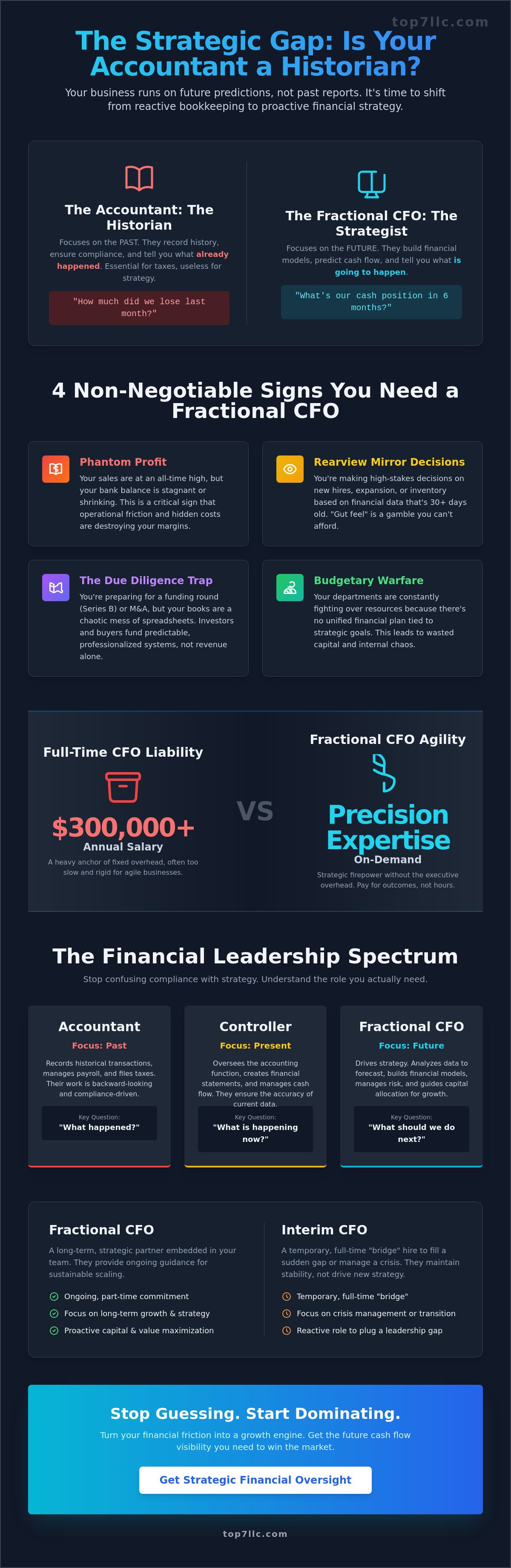
A Fractional executive is a strategic architect, not a remote bookkeeper who only cares about your tax filings. While your accountant is busy documenting the past, a fractional partner is busy engineering your future. In 2026, the traditional model of hiring a full-time, $300k+ CFO has become a liability for agile mid-market firms. These legacy hires are often too slow, too expensive, and too rigid for a market that demands instant pivotability. Knowing exactly when to hire a fractional cfo is the difference between tactical dominance and operational bankruptcy.
To better understand this concept, watch this breakdown of the role:
The 2026 market has seen a 310% surge in demand for fractional leadership because businesses have realized that "steering the ship" requires a different skill set than "keeping the books." You don't need someone to sit in an office 40 hours a week to tell you that your margins are shrinking. You need a precision-strike expert who identifies the leak, plugs it, and reallocates that capital into growth engines. This is the core of our Velocity-7 Adaptive Framework; using high-level expertise to accelerate growth without the anchor of executive overhead.
The Fractional vs. Interim Leadership Nuance
Don't confuse these two roles. A Fractional CFO provides an ongoing, strategic, part-time commitment designed for long-term scaling. They are part of your core team, just not on the full-time payroll. In contrast, an Interim CFO is a full-time, temporary "bridge" hire typically brought in during a crisis, a sudden departure, or a messy transition. In high-growth hubs like Boston and Austin, tech firms are aggressively pivoting to fractional models. It's a tactical move to preserve runway while keeping the strategic firepower needed to impress VCs or prepare for an exit.
The ROI of Strategic Financial Oversight
If you're still asking "What happened last month?", you're already behind. Strategic oversight shifts the conversation to "What is going to happen next quarter?" A Fractional CFO's primary goal is maximizing enterprise value through strategic capital allocation. They pay for themselves by identifying margin leaks that your bookkeeper would never see. Deciding when to hire a fractional cfo often comes down to the moment you realize that your internal data is 30 days old and your gut feeling is no longer enough to win the market. Whether it's restructuring debt or optimizing tax strategies, their presence ensures every dollar spent is a calculated move toward market dominance.
5 Non-Negotiable Signs You Need a Fractional CFO Right Now
Growth is a double-edged sword. If you're waiting for a total system failure to change your financial strategy, you've already let the competition win. Most mid-market CEOs wait too long to realize they've outgrown their infrastructure. They treat financial oversight as a luxury rather than a tactical necessity. If you're seeing these specific triggers, the question isn't if you should scale your leadership, but how fast you can move. Knowing when to hire a fractional cfo is about identifying these leaks before they sink the ship.
Phantom Profit: Your sales are hitting record highs, yet your bank balance remains stagnant. If you have product-market fit but can't find the cash, your margins are being eaten by invisible operational friction.
Rearview Mirror Decision-Making: You're making high-stakes bets based on data that is 30 days old. In a 2026 economy, "gut feel" is just another word for gambling with your shareholders' equity.
The Due Diligence Trap: You're eyeing a Series B or an M&A exit, but your books are a mess of spreadsheets and manual entries. Investors don't just buy revenue; they buy predictable, professionalized systems.
Budgetary Warfare: Departments are fighting over resources because there's no unified strategic plan. When Sales, Tech, and Ops are siloed, capital allocation becomes a political game instead of a growth lever.
The Reactive CPA: Your accountant is great at keeping you out of jail, but they only call when taxes are due. They record the past. They don't engineer your future.
If these scenarios sound familiar, it's time to stop treating your finance department like a filing cabinet and start treating it like a command center. You can explore how strategic planning integrates these functions to eliminate the noise and focus on profit.
The 'Growth Blind Spot' Test
Ask yourself three questions. Can you accurately predict your cash position six months from today? Do you know your true customer acquisition cost (CAC) versus the actual Lifetime Value (LTV) of those accounts? If the answer is "no," you're flying blind. 72% of CEOs in 2026 are already planning to increase their use of fractional executives to solve this exact lack of visibility. Don't be the outlier who ignores the data until the runway disappears.
Fundraising and Capital Strategy Triggers
Venture debt and equity rounds require a "CFO-level" narrative. Investors want to see a cap table that isn't a disaster and a financial model that survives stress testing. A Fractional CFO professionalizes the finance function, moving you from "scrappy startup" to "enterprise-grade" in the eyes of external capital. They don't just provide a spreadsheet; they provide the strategic story that justifies a higher valuation. This level of fractional leadership ensures your capital strategy is an offensive weapon, not a defensive scramble.
Accountant vs. Controller vs. Fractional CFO: The Deadly Confusion
Most CEOs think they're being "frugal" when they promote their bookkeeper to a CFO role. It's not frugal; it's a strategic suicide mission. You're asking a historian to become an architect. These roles aren't just different rungs on a ladder; they require entirely different cognitive frameworks and operational skill sets. If you don't understand the wall between compliance and strategy, you'll never truly know when to hire a fractional cfo until your margins have already evaporated. Let's kill the confusion right now.
The Accountant: This is your historian. Their job is to record the past with surgical precision. They focus on compliance, tax filings, and making sure you don't end up in an audit. They tell you what happened, but they have no idea how to make it happen again.
The Controller: This is your guardian of the present. They manage accuracy, internal controls, and the day-to-day "plumbing" of your finance department. They ensure the numbers are right today, but they aren't looking at the horizon.
The Fractional CFO: This is the architect of your future. They focus on strategy, capital allocation, and "Flow." They don't just report the numbers; they use them as a weapon to increase enterprise value and capture market share.
Promoting a bookkeeper to CFO because they "know the books" is like asking a librarian to design a skyscraper just because they've seen the blueprints. It doesn't work. The result is always the same: a finance department that is perfectly compliant but strategically bankrupt.
Why Your CPA Isn't Your Strategic Partner
CPAs are trained to look for what's wrong. They're built for audit and tax defense. CFOs are trained to look for what's possible. There's a fundamental conflict of interest here. The person checking your numbers for errors shouldn't be the same person designing the high-risk growth strategy. Compliance is a baseline, not a strategy. If your primary financial advisor only calls you to discuss tax liabilities, they aren't helping you scale; they're just helping you survive.
The Mid-Market 'Leadership Gap'
Companies with revenues between $5M and $50M often fall into a "no-man's land." You're too big to rely on a part-time bookkeeper, but you're too small to justify a $300k full-time executive salary. This is the deadly gap where growth stalls because of financial noise. 72% of companies in this revenue bracket are now pivoting toward fractional models to bridge this exact divide. A Fractional CFO provides the "Goldilocks" solution: elite-level strategic firepower at a cost that doesn't cannibalize your growth capital. Understanding when to hire a fractional cfo means recognizing that you need a navigator, not just a record-keeper, to cross that $10M or $20M threshold.
The Top7 Approach: Financial Strategy via the Velocity-7 Framework
Most financial advice is delivered in a vacuum. You get a report, a few charts, and a hefty invoice, but nothing actually changes in your day-to-day operations. This is where the Velocity-7 Adaptive Framework breaks the mold. We don't view finance as a standalone department. It's one of seven critical dimensions of growth that must work in perfect sync. When you decide when to hire a fractional cfo through Top7, you aren't just getting a numbers person; you're getting a strategic leader who understands how Sales, Tech, and Ops impact your bottom line.
Our executives don't act as external consultants who lob advice over a wall. They embed directly into your leadership team. They take ownership of the outcomes. In the first 90 days, a Top7 Fractional CFO moves through a high-velocity roadmap: auditing the friction points in month one, re-engineering the cash cycle in month two, and establishing a proactive scaling strategy by month three. It's about moving from financial noise to systematic flow.
Eliminating Operational Friction in Finance
Process leaks are silent profit killers. We look specifically at the sales-to-cash cycle to see where your money is getting stuck. If your sales team is closing deals but your finance team is lagging on billing or collections, your growth is actually hurting your liquidity. Using the Velocity-7 approach, we've seen firms, like a Chicago-based manufacturing company, reclaim 15% of their margin simply by aligning their operational workflows with their financial reporting. We stop the leakage so your revenue actually reaches the bank.
Strategic Execution Support
A vision without execution is just a hallucination. Most CEOs have a clear goal but lack the financial roadmap to get there safely. Our CFOs bridge this gap. They are battle-hardened mentors who have navigated Series B rounds, complex M&As, and aggressive market expansions. They don't just tell you what to do; they help your team implement the tools and processes needed to win. They turn the CEO's vision into a mathematically sound reality.
If you're ready to stop guessing and start executing, it's time to see how our Velocity-7 Adaptive Framework can transform your financial leadership from a bottleneck into a competitive advantage. We provide the strategic clarity you need to stop outgrowing your visibility and start owning your market share. Don't let your financial data remain a backward-looking report when it should be your most powerful offensive weapon.
Hiring the Right Fractional CFO: A CEO's Tactical Checklist
Hiring is a high-stakes gamble when you don't have a scorecard. If you've identified that your business has outgrown its current visibility, you're at a crossroads. You can either hire a resume or you can hire a tactical asset. Finding when to hire a fractional cfo is only half the battle; the real victory lies in selecting someone who can survive the operational trenches of a growth-stage company. Don't look for a "finance guy." Look for a strategic partner who views your P&L as a map for market conquest.
Audit the Leaks: Before you interview anyone, identify exactly where you're losing time and money. Is it a slow sales-to-cash cycle? Is it a lack of fundraising narrative? Know your pain points so you can test their solutions.
Demand Industry Fluency: A retail CFO understands inventory turnover, but they'll be lost in a SaaS environment focused on churn and LTV. Don't waste time teaching a generalist your business model.
Test for Strategic Grit: Anyone can manage a surplus. Ask about the cash crunches, the failed mergers, and the high-pressure pivots. You need someone who has been battle-tested in the 2026 economy.
Verify the System: If they're winging it, they're a liability. Ask if they use a proven framework like our Velocity-7 Adaptive Framework. A system ensures results are repeatable and scalable.
The Battle-Readiness Test: Use a discovery call to assess cultural fit. If they don't challenge your assumptions in the first twenty minutes, they aren't the leader you need.
Questions to Ask in the Interview
Stop asking about their education. Start asking about their execution. Ask: "How will you translate our messy operational data into a 12-month capital strategy that actually survives a market shift?" Follow up with: "What is the first friction point you look for in a mid-market P&L to find hidden margin?" Pay attention to their vocabulary. If they talk more about "reconciling" and "reporting" than "revenue" and "strategy," you're looking at a controller in a CFO's suit. Keep looking.
The Top7 Difference: Results, Not Payroll
We don't just provide a person; we provide a growth engine. When you partner with us, you aren't just filling a seat. You're gaining access to a "battle-hardened" network of Fractional CTOs, COOs, and CEOs who can round out your entire leadership team. We understand that deciding when to hire a fractional cfo is a pivot point for your company's valuation. We ensure that pivot leads to dominance, not just survival. Stop the leaks. Schedule your Velocity-7 Financial Audit with Top7 today.
Stop Managing the Past and Start Engineering the Future
Your business is either a system of growth or a collection of friction points. If you're still relying on backward-looking data to make forward-looking bets, you're gambling with your company's future. You've seen the signs; the gut-feel decisions, the shrinking margins, and the confusion between compliance and strategy. Understanding when to hire a fractional cfo isn't just a financial milestone. It's a tactical shift from surviving the market to dominating it.
At Top7, we don't just hand you a report and walk away. Our seasoned professionals use the proprietary Velocity-7 Adaptive Framework to embed directly into your team, ensuring seamless execution and measurable results. We bring mid-market expertise that turns your finance department into a strategic command center. You've outgrown your visibility; now it's time to reclaim it.
Ready to scale? Book your Discovery Call with a Top7 Executive.
The market won't wait for you to catch up. Take control of your capital strategy today and build the enterprise value your hard work deserves.
Frequently Asked Questions
What is the typical cost of a fractional CFO in 2026?
Industry data from June 2026 indicates that fractional CFO services typically range between $3,000 and $15,000 per month. Most mid-market firms find their "Goldilocks" zone between $5,000 and $8,000 monthly. This represents a tactical saving of 60% to 80% compared to a full-time executive hire. Understanding when to hire a fractional cfo allows you to deploy that saved capital into direct growth engines instead of executive overhead.
How many hours a week does a fractional CFO actually work?
Engagement levels are outcome-based but usually range from five to ten hours per week for steady-state growth. High-velocity periods like a Series B round or a complex merger may require more intensive involvement. We don't focus on punching a clock; we focus on eliminating friction. The goal is providing maximum strategic impact through high-leverage decision support rather than filling a seat for 40 hours.
Can a fractional CFO help with my upcoming Series A or B fundraising?
Yes, they are the primary architects of your fundraising narrative and capital strategy. A fractional CFO professionalizes your finance function so your data survives the scrutiny of institutional due diligence. They clean up cap tables and build the financial models that justify your valuation to VCs. Don't walk into a pitch with a bookkeeper's report when you need an executive-level roadmap.
What is the difference between a fractional CFO and an outsourced accounting firm?
Accountants are historians who record the past; CFOs are architects who engineer the future. An accounting firm handles compliance, tax filings, and basic bookkeeping to keep you out of trouble. A fractional CFO uses that data to drive capital allocation and margin expansion. Knowing when to hire a fractional cfo means recognizing that compliance is just the baseline, not a strategy for market dominance.
Do I need to be located in Boston or Dallas to work with a Top7 CFO?
No, we operate as a remote-first leadership layer that integrates into your team regardless of your physical headquarters. While many of our clients are based in tech hubs like Boston, Austin, or Dallas, our direct embed model works across any geography. We use modern communication stacks to stay as connected to your operations as an in-house hire. Strategic dominance isn't restricted by your zip code.
How quickly can a fractional CFO start making an impact on my cash flow?
You should see actionable visibility into your cash position within the first 30 days of the engagement. The first month focuses on a "friction audit" to identify where your money is getting stuck in the sales-to-cash cycle. By the 90-day mark, the Velocity-7 framework will have re-engineered your processes to turn financial data into a proactive growth engine. We prioritize immediate execution over long onboarding cycles.
What happens if I outgrow my fractional CFO and need a full-time hire?
We build the infrastructure so the transition to a full-time hire is a seamless handoff, not a crisis. A fractional partner's job is to professionalize your finance department so it's ready for a permanent executive when you hit the $50M+ revenue mark. We can even help you vet and interview your full-time replacement to ensure they have the strategic grit and industry fluency your business requires.
Is a fractional CFO responsible for my company's taxes?
No, tax filing is the specific domain of your CPA or tax accountant. The CFO provides the strategic oversight to ensure your tax planning aligns with your long-term capital goals and cash flow needs. They work alongside your tax professionals to ensure you aren't leaking margin through poor planning. Their focus remains on maximizing enterprise value and operational flow, not just filling out government forms.


Comments