
Digital Transformation Strategy for Mid-Market Companies: The 2026 Execution Blueprint
- Robert Fitzgerald
- Jun 10
- 12 min read

Updated: Jun 20
Most mid-market digital transformation projects are nothing more than expensive, multi-year suicide notes signed by leaders who prioritize "vision" over velocity. You've likely felt the friction already. Technical debt is choking your service delivery, and your board is screaming for you to do something with AI before your competitors automate you out of existence. Building a digital transformation strategy for mid-market success in 2026 isn't about chasing shiny objects or paying a traditional agency for a 200-page slide deck that collects dust.
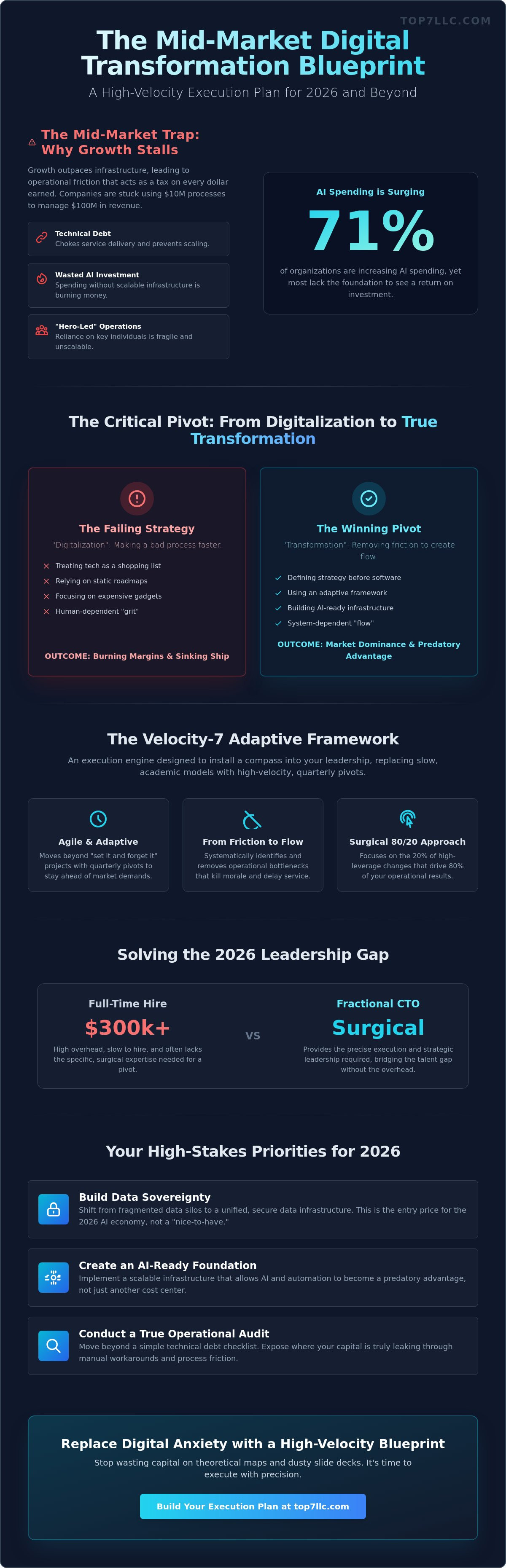
It's time to stop wasting capital on theoretical maps and start executing. You know that 71% of organizations are increasing AI spending this year, but without a scalable infrastructure, that investment is just fuel for a fire that's already burning your margins. This article promises to replace your digital anxiety with a high-velocity execution blueprint that eliminates operational friction and drives market dominance. We will preview the exact roadmap to clear your technical bottlenecks, scale your operations, and implement an adaptive framework that turns your technology from a cost center into a predatory advantage.
Key Takeaways
Stop treating technology as a shopping list. Learn how to define transformation as the systemic removal of friction to protect your margins.
Replace static roadmaps with the Velocity-7 Adaptive Framework to ensure your operations keep pace with 2026 market demands.
Bridge the talent gap without the $300k overhead. See how Fractional CTO leadership provides the surgical precision your execution plan lacks.
Build a digital transformation strategy for mid-market dominance that focuses on data sovereignty and infrastructure for the 2026 AI economy.
Conduct an organizational audit that exposes where your money is actually leaking, moving beyond simple technical debt to true operational flow.
Table of Contents
Beyond the Buzzwords: Defining Mid-Market Digital Transformation in 2026
The Velocity-7 Framework: A Strategic Engine for Operational Flow
Fractional CTO vs. Full-Time Hire: Solving the 2026 Leadership Gap
Building Your 3-Year Transformation Roadmap: Priorities for 2026
Executing the Pivot: Why Top7 is the Choice for High-Stakes Transformation
Beyond the Buzzwords: Defining Mid-Market Digital Transformation in 2026
Stop using "digital transformation" as a convenient synonym for "we finally bought a new CRM." In the 2026 business climate, that definition is not just lazy; it's a liability. True transformation is the systemic removal of operational friction through technology. It is the hard work of re-engineering how your company breathes, moves, and scales. If you aren't fundamentally changing your operating model to extract more profit with less manual effort, you aren't transforming. You're just decorating a sinking ship with expensive gadgets.
Most mid-market leaders get lost in the jargon. They ask, "What is Digital Transformation?" and receive answers filled with cloud-first platitudes. For a company fighting for market share, the answer is simpler: it is the pivot from human-dependent grit to system-dependent flow. By 2026, the baseline requirements have shifted. Data sovereignty and AI-ready infrastructure are no longer "nice-to-haves" for the Fortune 500. They are the entry price for any mid-sized firm that intends to remain relevant in an automated economy.
To better understand the strategic shift required for this evolution, watch this helpful video:
The Mid-Market Trap: Why Growth Stalls
We see it constantly. A company hits $100M in revenue but tries to operate using the same $10M processes that got them through their first five years. This is the "Mid-Market Trap." Your growth has outpaced your infrastructure. You're likely relying on "hero-led" operations where a few key employees hold the entire business together through sheer force of will. This creates invisible costs: manual workarounds, fragmented data silos, and service delays that frustrate your best customers. Operational friction is the primary barrier to mid-market scaling; it acts as a tax on every dollar you earn.
Digitalization vs. Strategic Transformation
Moving your files to the cloud is a tactic, not a digital transformation strategy for mid-market success. Digitalization is simply making a manual process digital. Strategic transformation, however, asks why that process exists in the first place. Are you optimizing for speed, accuracy, and scalability, or are you just making a bad process faster? We use the Velocity-7 approach to identify these high-stakes outcomes first. Don't fall for the lie that software solves problems. Strategy solves problems; software just accelerates the results. Focus on the business outcome, or prepare to watch your capital vanish into a black hole of "implementation fees" that never deliver a return.
The Velocity-7 Framework: A Strategic Engine for Operational Flow
Academic models and "pillar-based" strategies are often where mid-market growth goes to die. They're too slow, too heavy, and too detached from the reality of your daily operations. The Velocity-7 Adaptive Framework is different. It's a proprietary execution engine built for the specific pressures of mid-market evolution. We don't just hand you a map; we install a compass into your existing leadership structure. By 2026, 71% of organizations plan to increase AI spending. Without a framework that adapts to these shifts in real-time, that capital is wasted on systems your team will eventually bypass or ignore.
Moving from Friction to Flow
Flow is the ultimate competitive advantage. It's the state where your technology enables your team to sell and deliver without fighting the tools they're given. Most companies are drowning in technical debt that causes service delays and kills morale. Our framework uses a surgical approach to identify the high-leverage 20% of tech changes that drive 80% of your operational results. We focus on agile-based transformation. This isn't a "set it and forget it" project. It's a series of quarterly pivots that keep your digital transformation strategy for mid-market dominance sharp and effective. While academic research often cites various Elements of Digital Transformation, we prioritize the ones that actually impact your EBITDA today.
Why an Adaptive Framework Beats a Static Roadmap
The 5-year IT roadmap is dead. In an age where the Agentic AI market is expected to hit $93.2 billion by 2032, a static plan is just a documented way to fail. Traditional consulting agencies love thick strategy binders because they're expensive to produce and hard to disprove. We hate them. They collect dust while your competitors eat your lunch. Velocity-7 relies on "continuous discovery." Your tech leadership must be as dynamic as the market. We value execution over theory every single time. If you're tired of "vision" and ready for a system that actually moves the needle, our Velocity-7 Adaptive Framework provides the operational engine you've been missing. We don't just plan for 2026; we build the infrastructure to survive whatever comes after it.
Fractional CTO vs. Full-Time Hire: Solving the 2026 Leadership Gap
Most mid-market CEOs tell us the same lie: "We can't find a top-tier CTO, and we definitely can't afford one." They're right about the price tag but wrong about the solution. Chasing a full-time executive with a $350,000 salary plus equity is a legacy move that stalls your digital transformation strategy for mid-market dominance. In 2026, you don't need a permanent fixture in the office. You need surgical expertise to execute a high-velocity blueprint. A Fractional CTO delivers that C-suite authority at a fraction of the overhead, providing the leadership required to eliminate operational friction without the long-term executive baggage.
Top7 provides embedded leadership. We don't sit on the sidelines offering "suggestions." We step into your leadership structure to drive the Velocity-7 framework. This model solves the talent gap by giving you access to veterans who have already scaled companies through the same technical debt you're currently fighting. It's about results, not headcount. If your growth is currently capped by a lack of technical direction, you don't have a hiring problem. You have a leadership architecture problem.
The Hidden Costs of the Wrong C-Suite Hire
Hiring a "Technical CTO" who doesn't understand your P&L is a fast track to bankruptcy. You don't need a glorified coder in a suit; you need a strategist who knows how technical debt causes service delays and eats your margins. Full-time tech leaders in the mid-market are burning out at record rates because they're expected to be both the architect and the builder. Fractional leadership provides interim stability during high-growth phases. It allows you to stabilize the ship and build a system-led flow before committing to a permanent hire that might not fit your 2027 reality.
Why Fractional Leadership Beats Agency Outsourcing
Traditional consulting agencies have a fundamental conflict of interest. They want to sell you more billable hours and more junior staff to "manage" your account. A Fractional CTO has a partner mindset, not a vendor mindset. Our only goal is to solve the problem and move to the next strategic milestone. We operate in major hubs like Dallas, Austin, and Chicago, bringing local market context to global technology shifts. We focus on execution over thick, ignored strategy binders. While agencies want to keep you on a retainer, a Fractional CTO wants to build a scalable infrastructure that eventually runs without them. That's the difference between buying a service and building an asset.
Building Your 3-Year Transformation Roadmap: Priorities for 2026
Stop looking at 3-year roadmaps as static documents. By the time you finish the PDF, the market has moved. A real digital transformation strategy for mid-market firms in 2026 is a rolling execution plan that prioritizes high-velocity wins while securing your long-term data assets. You don't need a vision; you need a sequence. Success requires a ruthless focus on five specific priorities: an organizational audit that exposes friction, the establishment of data sovereignty, process automation via the Velocity-7 framework, deep AI integration into workflows, and a governance model that actually holds leaders accountable. If you miss even one of these, you aren't transforming; you're just spending money to stay in the same place.
Phase 1: Friction Audit and Foundation
The first 90 days of your roadmap must be about momentum. You cannot fix everything at once. We start with a friction audit to identify where the technical debt is actually hurting your EBITDA. This is where you find the "low-hanging fruit" that provides immediate relief to your team and your customers. More importantly, this phase is about cleaning your "dirty data." You cannot build an AI-driven future on a foundation of fragmented, inaccurate spreadsheets. Foundation-building is the most skipped step in failed transformations because leaders prioritize the optics of progress over the mechanics of profitability. Don't be that leader. Own your data infrastructure now, or prepare to be owned by your competitors later.
Phase 2: Scaling with AI and Automation
Once the foundation is stable, the focus shifts to scaling. By 2026, over 80% of enterprises will have GenAI-enabled applications in production. To stay ahead, your digital transformation strategy for mid-market relevance must move beyond "AI pilots" and into "AI-integrated workflows." We use Advanced Project Management to ensure every tech implementation delivers a measurable ROI. The primary beneficiaries here are your sales guidance and financial strategy. Automation should be doing the heavy lifting, allowing your humans to focus on high-value decision-making. This is the moment your IT department stops being a cost center and starts being a revenue driver. We don't just automate for the sake of technology; we automate to create a system-led flow that can handle double the volume with half the friction. If your roadmap doesn't lead to a leaner, faster, and more aggressive organization, it's the wrong roadmap.
Step 1: Conduct a 30-day Friction Audit to expose operational leaks.
Step 2: Centralize data sovereignty to prepare for Agentic AI.
Step 3: Apply the Velocity-7 framework to the top 20% of manual bottlenecks.
Step 4: Transition from experimental AI to margin-driving workflows.
Step 5: Implement a governance structure that rewards system-led results.
Executing the Pivot: Why Top7 is the Choice for High-Stakes Transformation
Planning is a sedative for leaders who are afraid to act. If your digital transformation strategy for mid-market success is still stuck in the "discovery phase," you've already lost. The market doesn't wait for your board to feel comfortable. Top7 exists because traditional consulting is broken. We don't deliver binders; we deliver results. Our Velocity-7 Adaptive Framework isn't a suggestion. It's an operating system designed to pivot at the speed of 2026 technology while keeping your operational costs from spiraling out of control. We don't just plan for the future. We build the engine that drives you there.
We provide Fractional Leadership across the Northeast, West Coast, and Midwest markets because local context matters in a global economy. You don't need a vendor who checks in once a month. You need an execution partner who understands the specific friction points of your region and your industry—much like how a firm in the UK might leverage managed IT services Teesside to ensure their local infrastructure supports global ambitions. Whether you're fighting for talent in Austin or scaling operations in Chicago, our team embeds directly into your C-suite to turn your technical debt into a competitive weapon.
Embedded Leadership: We Don’t Just Consult
Top7 professionals don't sit on the sidelines. We solve complex problems by becoming part of your executive team. This isn't about giving advice; it's about taking ownership. Our fractional executives bring cross-functional expertise in financial strategy, sales, and technology to ensure every move you make impacts the bottom line. We have a heavy local presence in Dallas, Austin, and the East Coast to provide the high-touch service that mid-market firms require. We don't sell hours. We buy back your time by fixing the processes that are currently slowing you down.
From Strategy to Market Dominance
Digital transformation isn't a survival tactic. It's a strategy for winning your market—and once your operations are streamlined, you can discover Exclusive Business Marketing to help translate that internal efficiency into aggressive outward growth. If you're still treating IT as a cost center, you're inviting your competitors to eat your lunch. The 2026 blueprint requires a ruthless focus on execution and a leadership structure that can handle high-velocity change. Stop wasting capital on "vision" and start flowing with a Velocity-7 audit. It's time to stop talking about what's possible and start building what's profitable. Are you ready to stop the bleeding and start scaling?
Seize Your Competitive Edge in 2026
The era of theoretical business models and endless "vision" meetings is over. If your digital transformation strategy for mid-market dominance isn't actively removing operational friction right now, it's just an expensive distraction. You've already seen why static roadmaps fail and how fractional leadership bridges the critical talent gap. Now, you face a choice. You can continue managing technical debt, or you can start scaling with surgical precision.
Top7 doesn't just offer advice; we provide a proprietary Velocity-7 Adaptive Framework and seasoned C-suite professionals who embed directly into your executive team. We bring national reach with deep local expertise in Boston, Dallas, Austin, and Chicago to ensure your infrastructure becomes a predatory advantage rather than a cost center. We don't just help you survive the shift to an AI-driven economy; we give you the tools to own it.
Don't let legacy processes dictate your ceiling for another quarter. Get Your Velocity-7 Friction Audit Today and transform your operations into a high-velocity engine for growth. It's time to stop planning and start winning.
Frequently Asked Questions
What is the primary difference between a digital transformation strategy and a simple IT upgrade?
An IT upgrade is a tactical patch that replaces old tools; a digital transformation strategy for mid-market companies re-engineers your entire business model to remove systemic friction. Upgrades focus on the software itself. Transformation focuses on how that software drives revenue, eliminates manual bottlenecks, and creates a scalable infrastructure for the 2026 economy.
Why do digital transformation projects frequently fail in mid-market companies?
Most projects fail because leadership prioritizes "vision" over high-velocity execution. Mid-market firms often fall into the trap of trying to run $100M operations on $10M processes. Without an adaptive framework and the right C-suite expertise, these companies end up with expensive "shelfware" that fails to address the underlying operational friction slowing down their growth.
How much does a Fractional CTO cost compared to a full-time hire?
A Fractional CTO delivers the same level of strategic C-suite expertise at a fraction of the total overhead. You avoid the massive salary, equity requirements, and benefits packages associated with a $350,000 per year executive. This model allows you to buy the strategic outcome you need without bloating your payroll with a permanent headcount you might not require full-time.
How long does a typical mid-market digital transformation take to show ROI?
You should see measurable improvements in operational flow and a reduction in technical debt within the first 90 days. While a comprehensive roadmap spans three years, a high-velocity strategy targets "low-hanging fruit" immediately to build momentum. If your current initiatives aren't delivering a boost in margin or customer satisfaction by the end of the first quarter, your execution is stalled.
Can the Velocity-7 framework be applied to non-tech industries like manufacturing or logistics?
The Velocity-7 Adaptive Framework is specifically designed for any sector where operational friction kills profitability, including manufacturing and logistics. Friction is industry-agnostic. Whether you are managing supply chain data or production workflows, the goal remains the same: transition from human-dependent grit to a system-led flow that can handle double the volume with half the effort.
What role does AI play in a 2026 digital transformation roadmap?
AI is the baseline requirement for any digital transformation strategy for mid-market dominance in 2026. It has moved from experimental pilots to integrated workflows that drive actual margin. In this landscape, AI acts as the decision engine for your data sovereignty, ensuring your company can anticipate needs and act proactively rather than just reacting to market shifts.
Is my company too small for a fractional executive leadership team?
If your growth is currently capped by technical debt or service delays, you aren't too small; you are under-led. Fractional leadership is built for mid-sized firms that require high-level strategy but don't need a full-time executive in the office every day. It provides the surgical precision needed to scale operations without the risk of a bad full-time hire.
How does Top7 handle the transition from interim leadership to a permanent hire?
Top7 builds the scalable infrastructure so your eventual permanent hire inherits a high-velocity system instead of a technical mess. We stabilize your operations and define the exact requirements for the role based on real data. When you are ready for a full-time executive, the transition is seamless because the processes and governance are already functioning at peak performance.


Comments