
The $240,000 Mistake: The Real Cost of a Bad Technology Hire in 2026
- Robert Fitzgerald
- Jun 9
- 13 min read

Updated: Jun 20
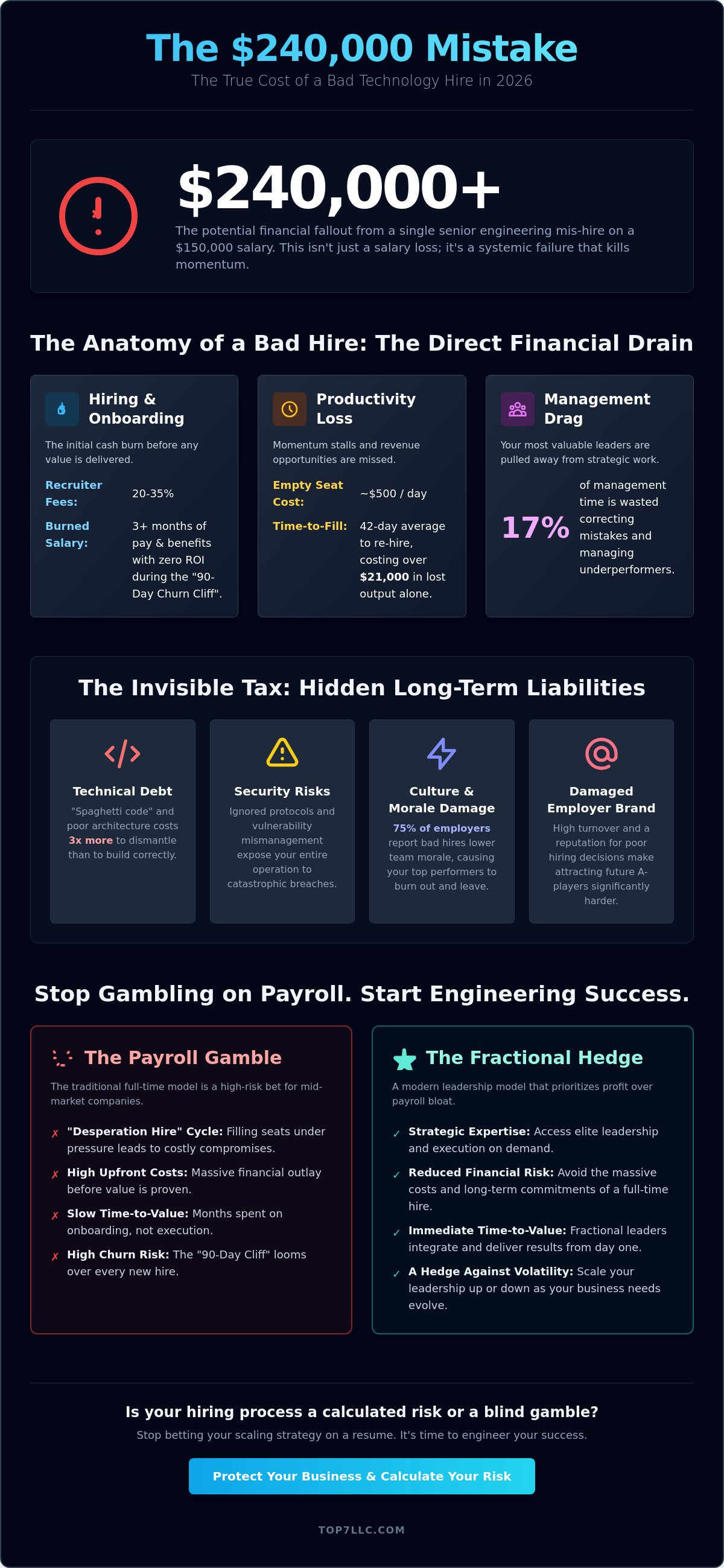
You just wrote a check for $240,000, but you didn't get a visionary leader; you bought a mountain of technical debt and a demoralized engineering team. Most executives treat recruitment like a calculated risk, yet they consistently ignore the math that proves they're actually gambling with the company's future. The true cost of a bad technology hire in 2026 isn't just the wasted recruiter fee or the three months of salary you'll never get back. It's the 17% of management time spent fixing amateur mistakes and the $500 you lose every single day a critical seat sits empty.
You know the feeling of watching a product roadmap stall while your best developers burn out covering for an incompetent hire. It's frustrating, expensive, and entirely avoidable if you stop following outdated hiring dogmas. This article strips away the HR fluff to reveal the brutal financial and operational reality of mis-hiring. You'll learn how to quantify your specific risk, protect your culture from the "90-day churn cliff," and discover a stable leadership model that prioritizes time-to-value over payroll bloat. Stop betting your scaling strategy on a resume and start engineering your success.
Key Takeaways
Stop looking at salary alone. Learn how to calculate the true cost of a bad technology hire by factoring in recruitment fees, lost productivity, and management overhead.
Identify the "invisible taxes," such as spaghetti code and security vulnerabilities, that incompetent hires leave behind long after they have exited the building.
Break the "Desperation Hire" cycle by recognizing why the traditional full-time payroll model is an unnecessarily high-risk gamble for mid-market companies.
Discover how a Fractional CTO and the Velocity-7 Adaptive Framework provide a strategic hedge against hiring volatility and operational friction.
Implement a three-step risk assessment framework to benchmark your tech turnover and ensure your leadership model drives profit, not debt.
Table of Contents
The Math of Failure: Quantifying the Direct Cost of a Bad Tech Hire
In 2026, a "bad hire" isn't just the person who quits after two weeks. It's the "quiet quitter" who sits in a senior seat while delivering junior-level output. It's the incompetent lead whose architectural choices create bottlenecks that paralyze your entire product roadmap. When you calculate the true cost of a bad technology hire, you're looking at a systemic failure that drains your capital and kills your momentum. You aren't just losing a salary; you're losing your competitive edge.
The U.S. Department of Labor estimates the baseline cost of a bad hire at 30% of first-year earnings. For senior technical roles, that's a dangerous understatement. Industry data suggests the real figure for executives and senior engineers often scales to 150% or even 200% of their annual salary. If you're paying a Senior Engineer $150,000, a mistake doesn't cost you $45,000. It can easily balloon to $240,000 or more once you factor in the six months it typically takes for a new hire to reach a productivity break-even point. You're paying for a learning curve that may never actually peak.
To visualize the compounding weight of these numbers, watch this breakdown of the financial impact:
Recruitment fees are the most visible part of this wreckage. Most agencies charge between 20% and 35% for specialized tech roles. On a $150,000 salary, that's up to $52,500 gone before the candidate even logs into Slack. If they wash out within the "90-day churn cliff," you've essentially burned that cash for zero ROI. Stop treating these fees as a cost of doing business; they're a penalty for a flawed strategy.
The Salary and Benefits Leak
Every month an underperformer stays on your payroll, you're losing more than just their base pay. You have to factor in the 1.2x to 1.4x multiplier for taxes, benefits, and office overhead. Then there's the severance and legal risk. Terminating a high-level hire isn't always clean. Legal fees and settlement costs can quickly turn a bad situation into a financial catastrophe. These are the direct costs of employee turnover that most mid-market companies fail to track until the damage is irreversible.
The Recruitment Rework Penalty
The damage doesn't stop when the bad hire leaves. You're back at square one, but with a damaged employer brand and a team that's now carrying the extra load. The average time to fill a tech role is 42 days. Every day that seat is empty costs your business roughly $500 in lost output. This "Time-to-Fill" penalty is a silent revenue killer that stalls product launches and scares off investors who want to see execution, not expensive excuses. Can your roadmap really afford another 42-day delay?
The Invisible Tax: Technical Debt, Security, and Culture Rot
The $240,000 cash drain discussed in the previous section is just the tip of the iceberg. While you're staring at the bank statement, a much more dangerous "invisible tax" is eating your company's value from the inside. This is where the true cost of a bad technology hire becomes a long-term liability rather than a one-time expense. You aren't just losing money; you're losing the ability to move fast.
Technical debt isn't just a developer's complaint. It's a high-interest loan your business never agreed to take out. When an incompetent hire writes "spaghetti code" or makes poor architectural choices, they aren't just being slow. They're building a structural cage that will cost you three times more to dismantle than it would have cost to build correctly the first time. Beyond the code, consider your security posture. A single engineer who ignores protocols or fails to understand modern vulnerability management can expose your entire operation to ransomware. Is your business continuity worth the risk of a "budget" hire?
Rather than gambling on a single internal hire for critical infrastructure, many leaders turn to Mytech Partners for managed IT services and strategic consulting that ensures long-term stability and security.
Then there's the morale multiplier. Research shows that over 75% of employers report bad hires lower team morale. Your top 20% performers don't leave because the work is hard. They leave because they're tired of babysitting someone who shouldn't have been hired in the first place. This culture rot is one of the seven ways bad hires can cost you, and it's often the hardest to reverse. Every hour your A-players spend fixing a mis-hire's mistakes is an hour they aren't spent launching the projects that actually drive revenue. That opportunity cost is the real profit killer.
The Compound Interest of Bad Code
Technical Debt is a financial liability on the balance sheet, period. It represents the future cost of rework caused by choosing a messy solution now instead of a better approach that takes slightly longer. A bad tech hire doesn't just create debt; they lock you into a "Legacy System" trap. They choose tech stacks they know rather than what the business needs. This forces you to pay "interest" in the form of slower deployments and constant bug fixes for years to come. If you're tired of the payroll gamble, a Fractional CTO can help you transition from friction to flow without the risk of a permanent mis-hire.
Operational Friction and Team Burnout
Operational friction is the silent killer of scaling. When your best engineers spend 17% of their week correcting an underperformer's work, your innovation stops. You aren't moving toward a state of "flow"; you're stuck in a cycle of damage control. This friction leads to burnout and the eventual loss of your most valuable institutional knowledge when your veterans finally give up. When that mis-hire inevitably leaves, they take the context of their messy work with them, leaving your remaining team to reverse-engineer a disaster.
The 'Desperation Hire' Trap: Why Mid-Market Companies Fail
The board is breathing down your neck. Your product roadmap is six months behind. You need a leader, and you need one yesterday. This is the "Warm Body" syndrome, and it's the fastest way to double the cost of a bad technology hire. When you hire out of panic to meet a looming deadline, you stop looking for a strategic partner and start looking for anyone who can pass a basic technical screen. This desperation creates a massive blind spot that incompetent candidates are happy to exploit.
Mid-market companies often fall into the trap of believing that every problem requires a full-time, 40-hour-a-week payroll commitment. This obsession is a relic of a pre-fractional era. In reality, most scaling firms don't need a full-time executive to sit in meetings all day. They need high-level strategic guidance to set the direction and then get out of the way. When you hire a full-time "doer" to solve a "strategist" problem, you're paying a premium for someone who will likely build the wrong things faster. You don't just need a person; you need a framework like the Velocity-7 Adaptive Framework to ensure your talent actually aligns with your operational goals.
Misaligned Incentives in Recruiting
Contingency recruiters aren't your friends. Their business model is built on volume, not long-term retention. They get paid when a body hits a chair, regardless of whether that body can actually swim in your deep end. This creates a dangerous environment where "resume padding" is rampant. In 2026, candidates are getting better at being "interview-smart" while remaining "execution-dumb." They use the right buzzwords in AI and Cybersecurity to mask a lack of fundamental competence. If your hiring process doesn't include a rigorous, strategy-first filter, you're just paying a headhunter to deliver your next $240,000 headache.
Recruiters prioritize the close over the cultural or technical fit.
AI-generated resumes make it nearly impossible to spot incompetence through traditional screening.
Interview-smart candidates can fake strategic depth for 60 minutes but fail in 60 days.
The Leadership Gap Analysis
Before you post that job description, ask yourself if you actually have 40 hours of "CTO-level" work every single week. For most mid-market companies, the answer is no. You likely have 10 hours of high-stakes strategic decision-making and 30 hours of operational management. A $250,000-a-year CTO is an expensive way to manage JIRA tickets. By utilizing a Fractional CTO, you bridge the leadership gap without the permanent financial weight of a full-time executive salary. This model forces you to focus on results rather than just "filling the seat," protecting your capital and your culture simultaneously. For professionals aiming to transition into such high-impact roles, trainerterry.com provides the strategic guidance and career coaching needed to succeed.
Calculating Your Risk: A Framework for Tech Leadership
Stop treating recruitment like a game of chance. If you can't quantify the risk of your next hire, you shouldn't be making one. To understand the true cost of a bad technology hire, you need a cold, hard framework that looks beyond the recruiter's invoice. Most executives fail because they only see the tip of the iceberg. You need to look at the three pillars of hiring risk: Direct Salary, Productivity Gap, and Strategic Delay. If these numbers don't align, you're just writing a check for your own downfall.
Benchmarking your risk in 2026 requires looking at the "90-day churn cliff." Statistics show that 30% of new hires are terminated or quit within the first three months. If your "Break-Even" calculator shows that it takes six months for a hire to pay for themselves, you're operating in a three-month deficit of pure risk. This isn't just about whether they can code. It's about whether their "Capability Fit" produces a return faster than their "Culture Fit" causes friction. If the ROI doesn't hit positive territory by month four, you've already lost the battle.
The Total Cost of Ownership (TCO) for Talent
Hiring a senior developer is exactly like buying a sophisticated piece of machinery; the purchase price is only the beginning. You must calculate the TCO to see the full financial impact on your department. The 'Productivity Gap' is the net loss of output during the first 90 days of a hire as they consume more resources through training and oversight than they actually produce for the company. Use the Velocity-7 Adaptive Framework to audit your current leadership efficiency and stop the bleed before it starts.
Equipment and Infrastructure: High-end hardware and secure home-office setups.
Software Licenses: Enterprise-grade seats for IDEs, security tools, and SaaS platforms.
Training and Onboarding: The hourly cost of your existing team's time spent in knowledge transfer.
Management Overhead: The 17% of weekly time managers spend correcting underperformer errors.
Strategic Errors: The financial weight of poor architectural choices that require future rework.
Hedging Your Hiring Bets
Why commit to a $250,000 mistake when you can hedge your risk? Smart companies are moving toward a "Try Before You Buy" model by utilizing Interim Leadership to stabilize operations before making a permanent commitment. This allows you to transition from a leadership crisis to operational stability in as little as 30 days without the long-term baggage of a bad hire. Set ruthless KPIs for the first 30, 60, and 90 days. If the candidate isn't hitting specific velocity benchmarks by day 30, trigger the termination clause. It's not personal; it's business survival. If you're ready to stop gambling and start executing, it's time to rethink your leadership structure.
The Fractional Hedge: Why Top7 Beats the Payroll Gamble
Are you still waiting for a recruiter to solve your leadership crisis? The math we have uncovered is brutal. You can keep playing the payroll lottery, or you can eliminate the $240,000 cost of a bad technology hire by switching to a model designed for execution. The Fractional Hedge isn't just a clever alternative; it's a strategic shield. By utilizing a Fractional CTO, you get the high-level expertise of a seasoned executive without the permanent financial weight that sinks mid-market companies.
Traditional hiring focuses on filling a seat. We focus on accelerating your results. With the Velocity-7 Adaptive Framework, we move your organization from operational friction to efficient flow. We don't just give advice; we embed with your team to solve complex architectural problems and clear the technical debt left by previous mis-hires. There are no $50,000 recruitment fees. There are no long-term severance liabilities. You get high-level strategic execution on day one, not day ninety. Why bet your company's valuation on a headhunter's intuition when you can hire a proven system instead?
Strategic Guidance Without the C-Suite Salary
Our monthly retainer model gives you access to professionals who have built and scaled multiple tech stacks. This "outside-in" perspective is something a full-time hire simply cannot provide. A payroll employee is incentivized to protect their job; a Fractional CTO is incentivized to deliver a result. We recently stepped into a firm where a "desperation hire" had stalled their product launch by eight months. Within 30 days, we used our Strategic Planning services to scrap the failing roadmap and replace it with a lean, executable path to market. That is the difference between a body in a chair and a strategist at the helm.
Immediate access to executive-level technical leadership.
Zero risk of the "90-day churn cliff" or expensive severance packages.
Objective, data-driven decisions unclouded by internal office politics.
Scalable support that grows or shrinks based on your actual project needs.
Next Steps: Stop the Bleeding
Is your current tech leadership an asset or a bottleneck? If you're spending more time fixing mistakes than launching features, you already know the answer. It's time to stop the bleeding and audit your risk before the next quarter's roadmap becomes another expensive casualty. You can continue to gamble with your capital, or you can schedule a strategic planning session with a Top7 executive to see what real velocity looks like. Don't wait for the next $240,000 mistake to happen. Take control of your trajectory and Audit Your Tech Leadership Risk with Top7 today.
Eliminate the Hiring Risk and Accelerate Your Growth
The $240,000 price tag isn't just a number on a spreadsheet; it's a warning shot for every mid-market company. You've seen how the true cost of a bad technology hire extends far beyond recruitment fees, infecting your code, your culture, and your competitive timeline. If you're still relying on the outdated payroll model to solve leadership gaps, you're essentially gambling with your company's equity. You don't need another expensive liability. You need a system that prioritizes strategic output over headcount.
By leveraging the Velocity-7 Adaptive Framework, you replace operational friction with high-precision execution. Our seasoned professionals bring decades of C-suite experience to your team, providing the strategic clarity that permanent hires often lack. Whether you need immediate interim leadership or fixed-price project consulting for a predictable ROI, the fractional model is your most effective hedge against market volatility. Stop letting recruitment failures dictate your product roadmap. It's time to build on a foundation of proven expertise and win the market.
Stop gambling on your C-suite. Get a Fractional CTO who delivers results.
Frequently Asked Questions
What is the average cost of a bad tech hire in 2026?
The average cost of a bad technology hire for senior or executive positions can reach as high as $240,000. While a baseline estimate starts at 30% of the employee's first-year earnings, specialized roles often see costs ballooning to 150% or 200% of their annual salary. These figures account for recruitment fees, onboarding expenses, and the massive loss of productivity during the vacancy and learning curve periods.
How do you calculate the ROI of a new technology hire?
Calculate ROI by subtracting the total cost of the hire from the net value they generate, then dividing by the total cost. You must factor in the "Productivity Gap," which is the period during the first 90 days where a new hire consumes more management resources than they produce. If a hire fails to reach a productivity break-even point within six months, the investment is likely a net loss for the business.
Why is technical debt considered a cost of a bad hire?
Technical debt is a deferred financial liability that compounds every time an incompetent hire writes "spaghetti code" or makes poor architectural choices. It's a hidden cost of a bad technology hire because you'll eventually pay three times more to fix the mess than it would have cost to build it correctly. This debt slows down your product roadmap and forces your A-players to waste 17% of their week on damage control.
Can a Fractional CTO replace the need for a full-time hire?
A Fractional CTO is often a more effective solution for mid-market companies that don't actually have 40 hours of high-level strategic work per week. This model provides the same seasoned leadership and decades of C-suite experience without the $240,000 risk of a permanent payroll mistake. You get the strategic planning you need to scale while avoiding the bloated overhead and recruitment fees of a full-time executive.
What are the early warning signs of a bad technology hire?
Watch for the "90-day churn cliff" indicators, such as a sudden drop in team morale or a consistent failure to meet established velocity benchmarks. A major red flag is a candidate who is "interview-smart" but "execution-dumb," using AI buzzwords to mask a lack of fundamental competence. If your senior engineers are constantly "babysitting" the new hire, you've likely made a desperation hire that will eventually fail.
How does the Velocity-7 framework reduce hiring risk?
The Velocity-7 Adaptive Framework reduces risk by moving your organization from operational friction to efficient flow. It audits your current leadership efficiency and aligns technical talent with measurable strategic outcomes rather than just filling seats. This data-driven approach ensures that your leadership structure is an asset that drives profit, not a bottleneck that generates technical debt and team burnout.
Is it cheaper to hire a Fractional CTO than a full-time executive?
It is significantly more cost-effective because you eliminate the 20% to 35% recruitment fee and the 1.2x to 1.4x multiplier for benefits and taxes. You also remove the financial risk of severance and the long-term "invisible tax" of a bad cultural fit. You're paying for high-level execution and strategic guidance on your terms, ensuring you only pay for the value delivered to the company.
What should I do if I realize I've made a bad tech hire?
Terminate the relationship immediately to stop the financial and cultural bleed. Every day an underperformer stays in a senior seat costs your business an estimated $500 in lost output and compounds your technical debt. Cut your losses, protect your top performers from burnout, and transition to interim leadership or a fractional model to stabilize your operations and fix the strategic roadmap.


Comments