
Signs of Poor Financial Management in a Business: Is Your Growth a Mirage?

Why is your bank account shrinking while your revenue hits record highs? If you're forced to lean on variable-rate loans reaching 11.5% APR just to keep the lights on, your growth isn't a success story; it's a dangerous mirage. Most mid-market leaders ignore the blatant signs of poor financial management in a business until the operational friction becomes a terminal stall. You've likely felt the sting of financial reports that arrive weeks too late to be actionable. It's a frustrating cycle where you're winning deals but losing the war for liquidity.
We're here to stop the guesswork and the excuses. This guide identifies the lethal red flags currently strangling your progress and shows you exactly how to pivot from friction to capital efficiency. You'll learn to stop treating your accounting as a history lesson and start using it as a tactical weapon. We're moving you from the mess of reactive bookkeeping to a proactive strategy that delivers higher margins and predictable cash flow. It's time to stop playing defense with your data and start demanding the strategic clarity your business deserves.
Key Takeaways
Stop confusing "clean books" with strategic health and learn why profitless revenue is a death sentence for mid-market companies.
Identify the lethal signs of poor financial management in a business, from chronic cash flow crises to the dangerous debt spiral.
Uncover how operational friction drains your capital and why chasing more sales is often the wrong solution for a leaking bottom line.
Implement the Velocity-7 Adaptive Framework to execute a high-precision audit and rebuild your financial strategy for maximum efficiency.
Leverage the Fractional CFO model to gain elite-level financial leadership and surgical intervention without the $300k overhead.
Table of Contents
What is Financial Mismanagement in 2026? Beyond the Spreadsheet
Most CEOs treat their balance sheet like a participation trophy. If your revenue is climbing but your cash reserves are evaporating, you're looking at the primary What is Financial Mismanagement. It's not just about messy books. It's a systemic failure to convert your top-line hustle into sustainable, liquid profit. You can't lead a company based on gut feelings when your capital is leaking through the floorboards.
Real financial health isn't about having a tidy folder for your tax preparer. That's reactive bookkeeping; a rearview mirror that tells you how you crashed last month. In 2026, you need a GPS. Strategic financial health means your capital is a tool for expansion, not a fire extinguisher for daily crises. When you can't fund a new project without looking at SBA 7(a) loans with variable rates hitting 11.5% APR, you've got capital leakage. Your money is bleeding out through operational friction before it ever hits your pocket.
To better understand how these control failures manifest in a mid-market setting, watch this analysis:
The High Cost of Reactive Leadership
Waiting for year-end reports is business suicide. In a market where 75.6% of business owners report higher operating costs than last year, you can't afford to be a month late on your data. There's a massive difference between spending money on growth and burning capital on inefficiency. Spending is an investment with a projected ROI; burning is what happens when your overhead scales faster than your margins. With US market volatility swinging from the tech-heavy West Coast to the industrial East, agile financial pivoting isn't a luxury. It's survival.
Vanity Metrics vs. Reality
Top-line growth is the ultimate drug. It feels good and looks great on a slide deck, but it's completely meaningless if your net margin is a rounding error. This Profit Illusion occurs when your P&L shows a surplus while your bank account sits empty because your cash is trapped in receivables or bloated inventory. With 20.4% of businesses failing within their first year, often due to these hidden signs of poor financial management in a business, you must look deeper. Financial mismanagement is a failure of strategic flow, not just a math error.
5 Lethal Signs Your Business is Mismanaged Financially
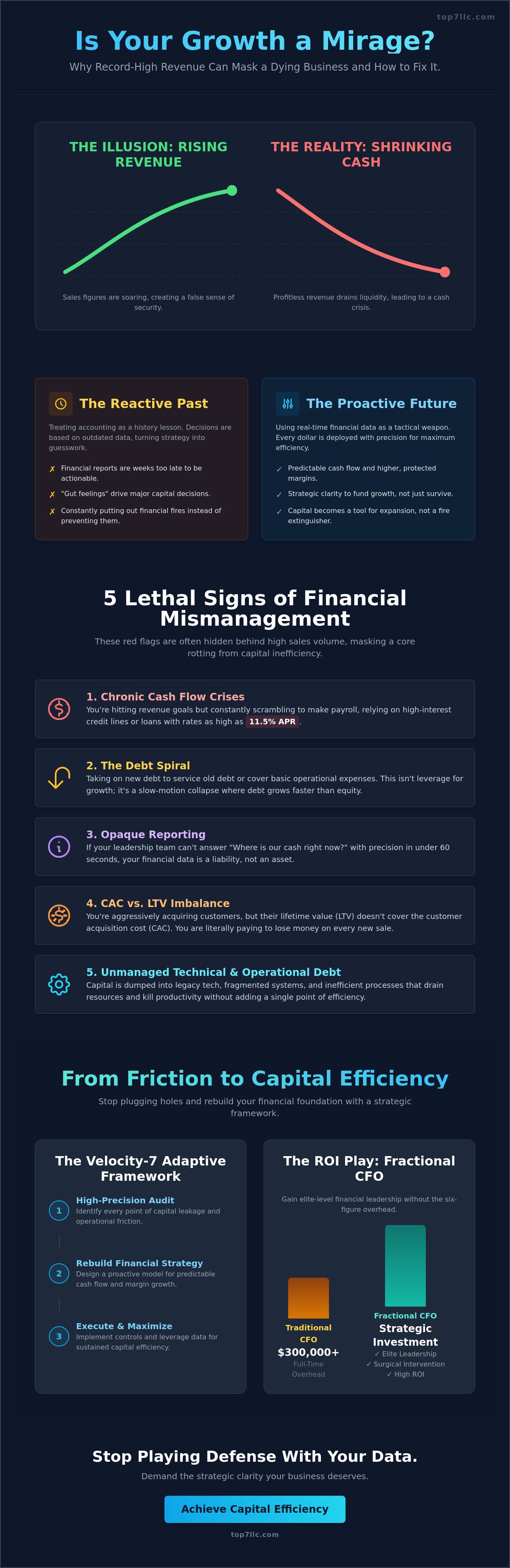
Growth is a seductive liar. Many mid-market leaders assume that as long as the "Sales" column is green, the company is healthy. This is a dangerous delusion. These signs of poor financial management in a business are often hidden behind high sales volume, masking a core that's rotting from capital inefficiency. If you aren't tracking your metrics with surgical precision, you're just waiting for the market to expose your weaknesses.
Chronic Cash Flow Crises: You're hitting record revenue, yet you're leaning on credit lines or SBA 7(a) loans with variable rates as high as 11.5% APR just to meet payroll.
The Debt Spiral: You're taking on fresh debt to pay off old operational expenses. This isn't leverage; it's a slow-motion collapse.
Opaque Reporting: If your leadership team can't answer "where is our cash right now?" in under 60 seconds, your data is a liability.
CAC vs. LTV Imbalance: You're burning through cash to acquire customers whose lifetime value doesn't even cover the acquisition cost. You're literally paying to lose money.
Unmanaged Technical Debt: You're dumping capital into legacy tech or fragmented systems that don't drive a single percentage point of efficiency.
The Payroll Panic and Credit Dependency
The "Friday Afternoon Scramble" is the ultimate red flag. If your team is moving funds between accounts like a shell game to cover salaries, your cash forecasting is broken. Relying on short-term debt for long-term growth initiatives is a recipe for disaster. You don't need an MBA to audit your debt-to-equity ratio. If your debt is growing faster than your equity, you're losing control. Before the next payroll crisis hits, consider how professional strategic planning can realign your capital for actual stability.
The "Invisible" Loss: Technical and Operational Debt
Outdated systems in major hubs like Chicago or Dallas are quiet margin killers. When your processes aren't automated, you're paying for human friction that competitors have already eliminated. This leads to a state of poor financial health where your overhead swallows your profit. "Saving money" by refusing to hire an expert for your infrastructure is a false economy. It costs you 10x more in lost productivity and missed opportunities. Identify your friction costs now, or watch your margins vanish into the void of operational debt.
Operational Friction: The Hidden Financial Killer
Most mid-market leaders suffer from a dangerous delusion: they believe revenue is a cure-all. It isn't. Pumping more sales into a fractured operation is like trying to fill a bucket with holes by using a larger hose. You just lose more water, faster. Operational friction is the silent predator of your bottom line, and it's one of the most overlooked signs of poor financial management in a business. If your processes are broken, every new dollar of revenue actually costs you more to service, shrinking your margins until they vanish.
Consider the "Sales-Marketing Gap." When these departments aren't aligned, you're burning capital on leads that your sales team can't close or shouldn't be chasing. This isn't just a communication issue; it's a strategic drain. In the 2026 economy, where 58% of businesses have already adopted AI to slash friction, clinging to manual processes is a choice to lose money. If your tech stack is a mess, your margins will follow. A Fractional CTO doesn't just fix code. They fix the financial bleed caused by inefficient systems that fail to scale.
When Sales Cannot Outrun Bad Systems
Scaling a mismanaged business only accelerates its failure. If your branch in Austin or your distribution hub in Florida is struggling with localized bottlenecks, those aren't "growing pains." They are localized financial drains. Manual workarounds, the "quick fixes" your staff uses to bypass broken software, carry a massive hidden price tag. You're paying for human hours to do what automated systems should handle in seconds. In an environment where 75.6% of owners report rising costs compared to last year, this inefficiency is a terminal condition. You can't out-sell a high burn rate caused by operational incompetence.
Leadership Gaps and Decision Paralysis
Operating without a Fractional CFO or elite Strategic Planning means you're making "gut-feeling" decisions. In a high-stakes market, your gut is a liability. Decision paralysis or, worse, making the wrong move because your data is 30 days old, kills cash flow. A missing C-suite strategy creates a vacuum where capital is allocated based on who yells the loudest, not on what drives the highest ROI. Every operational bottleneck has a dollar value attached to it. Right now, that value is being deducted directly from your net profit because you lack the leadership to plug the holes.
The Velocity-7 Framework for Financial Recovery
Identifying the signs of poor financial management in a business is only the first step. Knowing you're bleeding is useless if you don't know how to apply the tourniquet. The Velocity-7 Adaptive Framework is the antidote to the systemic friction currently killing your margins. It moves your company away from reactive "firefighting" and into a state of high-precision capital efficiency. We don't care about activity; we care about velocity. Activity is just movement. Velocity is movement with a specific, profitable direction.
The framework begins with a brutal Step 1: the Financial Audit and Friction Identification. We hunt for every dollar lost to manual workarounds and fragmented tech. Step 2 involves aligning your capital strategy with your operational flow. Your cash must fuel your engine, not just lubricate broken gears. Finally, Step 3 implements Agile Financial Pivots. In a market where 75.6% of firms face rising costs, you must be able to reallocate capital in real-time based on data, not wait for a quarterly meeting that happens too late to matter.
Moving from Friction to Flow
To achieve sustainable growth, you must master the Seven Dimensions of Growth within your financial structure. This requires an Agile transformation of your finance department. Forget the five-year static budget; it's a relic of an era that didn't move this fast. In 2026, a 90-day tactical roadmap is your most powerful weapon. It allows you to adjust to shifting interest rates and market demands without breaking your long-term strategy. When you align your team around 90-day sprints, you eliminate the decision paralysis that leads to capital stagnation. You stop guessing and start executing with mathematical certainty.
Strategic Planning for High-Stakes Markets
Your strategy must account for the specific US regulatory environment to maximize your bottom line. For instance, the Section 179 expensing limit for 2025 and 2026 sits at $2.5 million, with 100% bonus depreciation permanently restored. If your finance team isn't aggressively leveraging these tools, they're leaving your money on the table for the IRS. We've seen firms in the Northeast plug $500,000 leaks simply by shifting from "Activity" to "Velocity." They stopped doing more things and started doing the right things at the right time.
Stop letting operational friction dictate your profit margins. Take control of your trajectory by implementing a Velocity-7 Adaptive Framework that turns your financial data into a competitive advantage.
Plugging the Holes: Why a Fractional CFO is the ROI Play
Hiring a full-time CFO is a $300,000 mistake for most mid-market companies. You don't need a six-figure executive sitting in an office 40 hours a week to manage your strategy. You need a surgical intervention. A Fractional CFO provides elite-level financial leadership that embeds with your team to solve complex problems without the bloated overhead. It’s the ultimate ROI play for leaders who have recognized the signs of poor financial management in a business and want to stop the bleeding immediately.
While your internal team handles the day-to-day, a fractional leader focuses on the high-stakes moves: capital raising, cash forecasting, and operational alignment. They aren't there to "help out"; they are there to execute. They identify where your capital is being incinerated by friction and reallocate it toward growth. This isn't about bookkeeping. It's about weaponizing your balance sheet to win market share. You get the expertise of a veteran executive at a fraction of the cost, allowing you to deploy that saved capital back into your core operations.
Fractional CFO vs. Traditional Accountant
Your accountant is great at keeping you out of jail. They handle tax filings and historic reports with precision. But an accountant is a historian, not a strategist. They won't tell you how to fund a $5 million expansion using the "One, Big, Beautiful Bill Act" tax credits or how to navigate SBA 504 loans with fixed rates between 6.5% and 7.5%. A Fractional CFO bridges the gap between "clean books" and "strategic growth." They deliver actionable cash forecasting and capital strategies that your tax preparer simply isn't equipped to handle. They look forward, while your accountant only looks back.
Immediate Steps to Stop the Bleeding
If your growth feels like a mirage, you need answers now. Ask your finance lead these three questions today: What is our exact cash runway if sales stall for 30 days? Which specific service line has the highest net margin after accounting for operational friction? How much capital is currently trapped in our unautomated processes? If they can't answer in 60 seconds, you're flying blind and risking a terminal stall.
Crisis requires a 90-Day Stability Plan, not a five-year wish list. We focus on immediate liquidity, friction removal, and margin protection. Stop guessing about your future and start demanding data-driven results. Schedule your Velocity-7 Financial Audit with Top7 and turn your financial health from a liability into your greatest competitive advantage.
Stop Scaling Inefficiency and Start Building Real Equity
Your record-breaking revenue is a lie if your bank account stays empty. We've exposed the lethal signs of poor financial management in a business, from the trap of credit dependency to the silent margin-killer of operational friction. In the 2026 market, leading by gut feeling is a terminal mistake. You need a capital strategy that aligns with your operational flow and elite leadership that knows how to pivot with precision. Static budgets are dead; agile, data-driven execution is the only path to survival.
Top7 provides seasoned professionals who embed directly into your operations to deploy our proprietary Velocity-7 Adaptive Framework. We specialize in US mid-market firms that are tired of operational drag and ready for surgical financial intervention. We don't just hand over a report; we fix the systems that are strangling your profit. It's time to stop playing defense with your data and start demanding the strategic clarity your business deserves. You've built the revenue engine. Now, make sure it actually generates wealth.
Stop the leaks and master your cash flow with a Top7 Fractional CFO
Frequently Asked Questions
How do I know if my business has poor financial management if we are still profitable?
Profitability often masks the early signs of poor financial management in a business. If your P&L shows a surplus while you struggle to fund basic operations without high-interest credit, your profit is an accounting ghost. Real health is measured by liquidity and the speed of your cash conversion cycle, not just the bottom line of a monthly report. You must look at whether your profit is actually translating into accessible cash reserves.
What is the most common sign of financial trouble in a mid-market company?
The most common sign of trouble is a chronic reliance on short-term debt to cover recurring operational costs like payroll. When you're using variable-rate lines of credit currently hitting 11.5% APR to bridge gaps despite growing sales, you're in a debt spiral. This indicates that your revenue isn't translating into usable capital fast enough to sustain your growth. It's a clear signal that your capital strategy is disconnected from your operational reality.
Can a Fractional CFO really fix a cash flow crisis faster than a full-time hire?
A Fractional CFO fixes crises faster because they skip the six-month recruitment and onboarding lag associated with full-time hires. These are seasoned professionals who embed directly into your operations with a surgical focus on immediate stability. They apply proven frameworks immediately to plug capital leaks, whereas a traditional hire often spends the first quarter just learning the culture. You get elite-level intervention the moment you need it most.
Is poor financial management always the fault of the CEO?
Financial mismanagement is a leadership failure, but it's rarely a matter of individual incompetence. It usually stems from a CEO lacking the specialized strategic support needed to manage mid-market complexity. While the CEO is ultimately responsible for the outcome, the root cause is often a missing C-suite strategy that fails to align operational flow with capital efficiency. Success requires professional financial leadership that most CEOs don't have the time to perform themselves.
How much does a financial mismanagement audit cost?
The cost of a financial audit varies based on the complexity and scale of your operations. Instead of focusing on the fee, consider the cost of inaction. If you're losing a significant portion of your margin to operational friction, an audit pays for itself by identifying exactly where that capital is leaking. Professional advisory services focus on the ROI of the intervention rather than a flat transactional price, ensuring the recovery far outweighs the initial investment.
What is the difference between operational friction and financial mismanagement?
Operational friction is the broken process, while financial mismanagement is the systemic failure to control the resulting losses. Friction includes manual workarounds or technical debt that slows your team down. These inefficiencies become signs of poor financial management in a business when leadership fails to identify their dollar value and allows them to erode net margins over time. Friction is the cause; mismanagement is the failure to address it.
How does the Velocity-7 framework help with debt management?
The Velocity-7 Adaptive Framework manages debt by auditing your capital structure and prioritizing high-velocity revenue streams. It identifies if you're using expensive variable-rate debt to fund low-margin activities. By aligning your capital strategy with operational flow, the framework ensures that every dollar borrowed is a tactical investment with a clear path to repayment. It moves you from defensive borrowing to strategic capital allocation that fuels actual growth.
How often should a mid-market company review its capital strategy?
Mid-market companies should review their capital strategy every 90 days. A five-year plan is a fantasy in a volatile market where operating costs are rising for over 75% of business owners. Quarterly reviews allow for agile pivots, ensuring you leverage new tax laws like Section 179 expensing or bonus depreciation before your competitors do. If you aren't adjusting your strategy every quarter, you're operating on outdated assumptions that could kill your margins.



Comments