
What Does a Fractional Executive Do? Strategic Leadership Without the Payroll Bloat

Hiring a full-time C-suite executive is often the most expensive mistake a mid-market CEO can make. You’re likely burning $25,000 every month on a "savior" who spends half their time in meetings that don't move the needle. When business owners ask, "what does a fractional executive do," they’re usually looking for a way out of the $300,000 payroll trap that kills cash flow. Recent industry reports indicate that 40% of executive hires fail within 18 months, leaving companies with nothing but a massive bill and broken processes.
You know your growth has hit a ceiling and your current team is redlining. It's frustrating to watch operational friction eat your margins while you wait for a full-time hire to finally get up to speed. You deserve Tier-1 talent that delivers results on day one. This article shows you how to deploy elite leadership to eliminate bottlenecks and scale your operations with surgical precision. We'll break down the fractional framework, the cost-to-value ratio, and the exact steps to install a growth engine without the traditional executive bloat.
Key Takeaways
Stop paying for advice and start paying for execution by understanding how embedded leaders own your KPIs instead of just handing over a report.
Slash your overhead by replacing the $300k+ full-time executive burden with a high-impact retainer that kills operational friction from day one.
Discover exactly what does a fractional executive do to integrate battle-tested playbooks into your existing team without the typical onboarding lag.
Identify the "founder bottleneck" and other critical signs that your mid-market company is ready for a strategic strike team to ignite stalled revenue.
Learn the "skin in the game" difference between a consultant who talks and a fractional leader who delivers measurable market dominance.
Table of Contents Defining the Fractional Executive: More Than Just a Part-Time Hire The Mechanics of Execution: How Fractional Leaders Kill Operational Friction Why US Mid-Market Companies are Choosing Fractional over Full-Time Fractional Executive vs. Business Consultant: Know the Difference Is Your Organization Ready for a Fractional Strike Team?
Defining the Fractional Executive: More Than Just a Part-Time Hire
Stop wasting money on consultants who drop a 50-page slide deck on your desk and vanish before the real work begins. If you want to scale, you don't need more suggestions; you need execution. A fractional executive is a battle-tested C-suite veteran, often a CTO, COO, or CFO, who embeds themselves into your leadership team on a retainer basis. They aren't outside observers. They own your KPIs, manage your staff, and take full responsibility for the results. When you ask what does a fractional executive do, the answer is simple: they provide the strategic "how-to" and the tactical "do-it" simultaneously.
For mid-market companies in the US Northeast or West Coast scaling from $5M to $50M, this model is a survival requirement. You can't afford the $350,000 base salary plus equity a full-time heavy hitter demands, but you also can't afford to let a junior manager handle your scaling strategy. According to the standard fractional executive definition, these professionals offer high-level leadership without the payroll bloat. They give you the firepower of a veteran with the flexibility of a contractor.
The Core Roles: From Fractional CTO to CEO
In tech-heavy hubs like Boston, a Fractional CTO doesn't just talk about "the cloud." They aggressively kill technical debt and rebuild architecture to handle 10x traffic spikes. In the Midwest, a Fractional COO focuses on destroying operational friction and streamlining supply chains that have been bleeding cash for years. Meanwhile, in the Austin startup scene, a Fractional CFO is the architect of capital strategy, navigating complex audits and prepping the books for a Series B exit. These aren't generalists; they are specialists hired to win specific battles.
Why the Fractional Model is Exploding in 2026
By 2026, the business world has shifted from "owning" talent to "accessing" expertise. Companies in Florida and along the East Coast are using fractional roles to move faster than competitors who are still stuck in six-month hiring loops. Consider the risk: a bad $350,000 hire doesn't just cost you a salary. It poisons your culture and stalls your growth for a year. The fractional model eliminates that catastrophe. You get elite talent that has already seen your specific problems five times over at other companies. You aren't paying for their learning curve; you're paying for their scars and their wins.
Direct Management: They lead your existing team, they don't just "advise" them.
KPI Ownership: If the numbers don't move, they've failed.
Rapid Integration: They start producing value in days, not months.
Cost Efficiency: You get 100% of the brainpower for 30% of the full-time cost.
The Mechanics of Execution: How Fractional Leaders Kill Operational Friction
Stop paying for potential and start paying for performance. Most CEOs hire for the title and hope for the results. That's a losing bet. So, what does a fractional executive do that a full-time hire doesn't? They arrive with a battle-tested playbook, not a blank slate. They don't need a three-month discovery phase to find their way to the bathroom. They identify the rot in your systems within hours, not weeks.
Integration happens at lightning speed. Within 48 hours, they're in your Slack channels, your email ecosystem, and your weekly cadences. There's no getting up to speed period. They operate with a Marketing-Commando mindset. This means precision execution over bureaucratic fluff. They don't care about your office politics. They care about the 15% increase in lead velocity or the 22% reduction in churn. They set North Star metrics within the first 30 days, creating a culture of radical accountability where performance is the only currency that matters.
The Velocity-7 Adaptive Framework
We don't guess; we map. Our proprietary Velocity-7 Adaptive Framework moves your business from friction to flow by analyzing seven specific dimensions of growth. This isn't just for tech teams. We apply agile-based transformation to Sales and Ops departments where 68% of bottlenecks usually hide. By mapping these dimensions, we pinpoint exactly where your revenue is leaking. It's about building a conversion machine that runs without your constant intervention.
The First 90 Days: A Fractional Roadmap
Days 1-30: Audit and Friction Identification. We strip the engine. We look at the data, interview the players, and find the 3-5 critical friction points stalling your growth.
Days 31-60: Implementation of Adaptive Systems. We stop talking and start building. This involves deploying automated workflows and refining your sales scripts based on real-world feedback.
Days 61-90: Measuring ROI and Scaling the Wins. By day 90, the math must work. We measure the delta in your KPIs and prepare the system for aggressive scaling.
If you're still wondering what does a fractional executive do, the answer is simple. They provide the surgical precision required to win in a market that eats slow companies for breakfast. No bloat. No excuses. Just results.
Why US Mid-Market Companies are Choosing Fractional over Full-Time
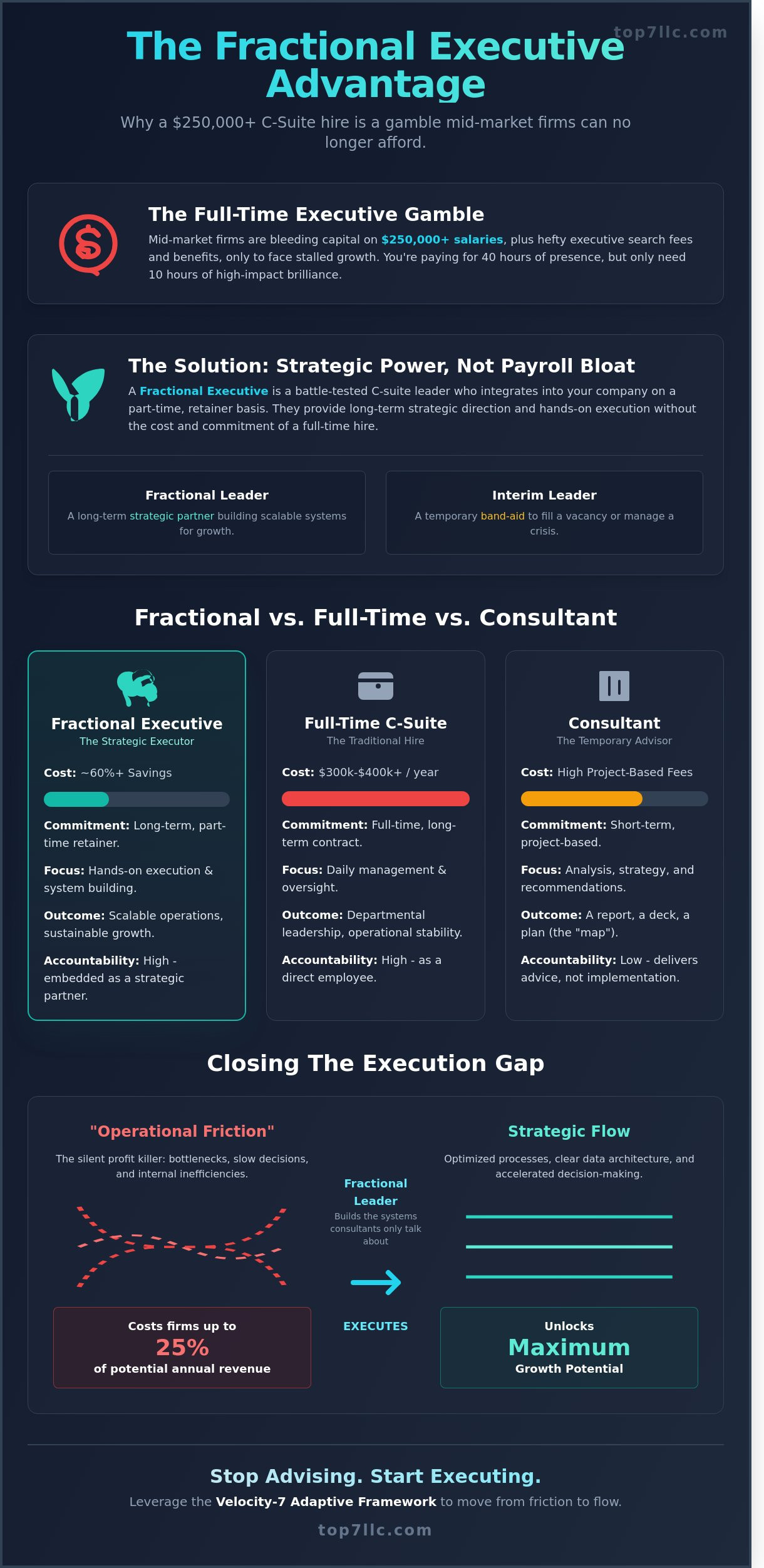
Hiring a full-time C-suite leader is a $400,000 gamble you can't afford to lose. While a $250,000 base salary looks manageable on paper, the math changes quickly. Once you add 25% for benefits, 401k matching, payroll taxes, and equity stakes, your "affordable" hire just vaporized your Q4 profit margin. If that executive isn't a perfect fit, the cost of firing them including severance and the 30% recruitment fee for a replacement can cripple a mid-market firm.
Stop paying for an executive's learning curve. A traditional hire takes six months to integrate and understand your culture. A fractional leader produces measurable ROI in 48 hours. So, what does a fractional executive do to move the needle so fast? They skip the office politics and go straight to the bottlenecks. They audit your systems, kill underperforming projects, and stabilize your cash flow before a full-time hire would even have their login credentials.
The Cost-Benefit Analysis
You're buying "Grey Hair" experience on a project-based budget. This isn't about hiring a consultant to write a report; it's about embedding a battle-tested veteran into your leadership team. You get the flexibility to scale their hours up during a merger or dial them back during steady-state operations. You aren't just hiring one brain. You're gaining access to their "RED Team" network. If your fractional CMO needs a high-level data architect, they have one on speed dial. One retainer gives you an entire strike team of specialists.
Zero Overhead: No health insurance, no office space, and no golden parachutes.
Immediate Impact: Execution starts on day one, not month six.
Variable Costs: You pay for results, not for someone to sit in meetings and eat your snacks.
Regional Market Pressures
In the Silicon Hills of Austin or the Northeast tech corridor, you're competing with tech giants for talent. You'll lose that bidding war every time. Smart firms in Dallas and Chicago are skipping the war entirely. They use fractional leaders to stay lean while their competitors drown in payroll debt. In Florida, where 2023 saw a massive surge in new business formations, companies are using fractional CFOs to manage 40% year-over-year growth without over-leveraging. Don't build a bloated bureaucracy. Build a high-velocity conversion engine that wins. What does a fractional executive do for your specific region? They provide the local market intelligence and the global strategy required to dominate your niche without the permanent anchor of a massive salary.
Fractional Executive vs. Business Consultant: Know the Difference
Stop confusing advice with execution. Most business owners treat consultants and fractional leaders as interchangeable. They aren't. A consultant sells you a 50 page PDF and wishes you luck. A fractional executive takes the wheel. If you want to know what does a fractional executive do, look at the bottom line. Consultants identify problems; fractional leaders kill them. One is a spectator. The other is on the field, sweat and all.
The difference comes down to skin in the game. Research from the Harvard Business Review shows that 70% of large scale change programs fail. This happens because advice doesn't equal implementation. A consultant gets paid for the report, regardless of whether your revenue grows. A fractional executive owns the outcome. They don't just suggest a new sales process; they hire the team, set the KPIs, and hold people accountable. They aren't there to be your friend. They're there to win.
The Consultant Trap
Traditional consulting is a hit and run business. They drop in, create friction by ignoring your company culture, and hand over "shelf-ware" that gathers dust. They don't understand the nuances of your operations because they don't have to live with the consequences of their expert suggestions. In the real world, advice is cheap. Execution is the only currency that matters. If you're tired of paying for theories that never reach the front lines, you're stuck in the trap.
The Embedded Leader Advantage
A fractional leader doesn't just manage; they mentor. They turn your junior staff into high performing assets by implementing the same precision we use to dominate markets. They build sustainable systems that remain functional long after the contract ends. This isn't a temporary fix. It's a structural upgrade that increases the enterprise value of your company.
There's also a psychological edge for the owner. A 2023 study found that 82% of CEOs feel lonely in their roles. Having a peer who shares the strategic burden is a survival tactic, not a luxury. You get a partner who speaks the language of profit and isn't afraid to tell you when your plan is flawed. Can a part-time leader really lead your team? If they're focused on results instead of clock-watching, they'll do more in ten hours than a mediocre full-time hire does in forty. Speed and clarity beat presence every time.
Stop paying for empty reports and start investing in measurable growth.
Is Your Organization Ready for a Fractional Strike Team?
Stop waiting for a market miracle. If your revenue has stayed flat for more than 180 days, you don't have a product problem; you have a leadership gap. Most founders reach a point where their own involvement becomes the primary obstacle to scaling. This is the classic Founder Bottleneck. You're working 14-hour days, yet the business isn't moving. Understanding what does a fractional executive do is the first step toward reclaiming your time and scaling your profit margins.
When you look into what does a fractional executive do, ignore the fluff. You aren't hiring a part-time cheerleader. You're hiring a precision instrument designed to cut through operational friction. Vetting a candidate based on a resume alone is a rookie mistake. Resumes are historical artifacts. Instead, look for a repeatable framework. You need a leader who brings a battle-tested system that can be installed into your specific business model immediately to generate measurable ROI.
The Readiness Checklist
If you're unsure if you're ready for this level of intervention, run through this checklist. Be honest with yourself. Friction is just lost profit in disguise.
The Growth Gap: You've set a $5 million or $10 million revenue goal, but your current strategy is just "work harder" without a documented roadmap.
The Direction Deficit: Your mid-level managers are talented, but they're wasting 35% of their weekly capacity on low-impact tasks because nobody is steering the ship.
The Transparency Test: You're finally ready to let an expert look under the hood and tell you the raw truth about your conversion engine, even if it bruises your ego.
Engaging with Top7
Top7 doesn't just consult from the sidelines. We embed to win. We use our proprietary Velocity-7 framework to identify and exploit your specific US regional market advantage. Whether you're competing in high-density urban hubs or specialized niche territories, we turn your marketing into a high-precision conversion machine. We don't care about "brand awareness" if it doesn't result in a direct impact on your bottom line.
The process starts with our No-Fluff discovery call. We don't do 90-minute slide decks or vague introductions. We give you 30 minutes of high-intensity analysis to identify your primary friction points. We find where you're bleeding cash and show you how to stop it. If you're tired of operational drag and ready for efficient flow, it's time to stop playing small and start dominating your sector.
Take Action:Stop guessing and start growing with Top7 Fractional Leadership. Move from chaos to market dominance today.
Stop Renting Talent and Start Buying Market Dominance
Your mid-market firm doesn't need more bloated payroll; it needs precision execution. We've redefined what does a fractional executive do by stripping away the fluff of traditional consulting and replacing it with direct, embedded leadership. These aren't theorists. They're seasoned professionals with over 20 years of C-suite experience who step into your foxhole to kill operational friction. While competitors waste months on onboarding, a fractional strike team delivers results in weeks by focusing on the raw business reality of profit and scale.
Success in the US mid-market requires more than just a part-time hire. It demands our proprietary Velocity-7 Adaptive Framework to dismantle the dogmas holding your growth hostage. You're either building a conversion engine or you're falling behind the pack. It's time to decide if you want to join the elite club of market leaders who prioritize measurable data over corporate jargon. We don't offer suggestions; we offer a battle plan for your organization's future.
Don't let invisible friction stall your momentum. Get the Velocity-7 Audit: Find the Friction in Your Leadership Team and see exactly where your strategy is leaking cash. Your path to a leaner, faster organization starts today.
Frequently Asked Questions About Fractional Leadership
Is a fractional executive the same as an interim executive?
No, they serve completely different strategic purposes. An interim executive is a full-time placeholder who keeps the seat warm for 3 to 6 months during a leadership search. A fractional executive is a long-term partner who stays for 12 to 24 months to build systems and drive growth. You're hiring a builder, not a babysitter.
How many hours a week does a fractional executive typically work?
Most fractional leaders dedicate 5 to 15 hours per week to your specific business objectives. This isn't about "putting in time" at a desk or filling a chair. You're paying for 20 years of battle-tested experience focused into a 10-hour surgical strike on your biggest bottlenecks. Do you want 40 hours of mediocrity or 10 hours of pure market dominance?
Can a fractional executive manage my existing full-time employees?
Yes, they take full ownership of your team's performance and accountability. When you ask what does a fractional executive do, the answer includes hiring, firing, and mentoring your staff. They don't just give advice from the sidelines. They lead your 5 or 50 employees to ensure your strategic vision actually hits the ground running and produces results.
What is the average cost of a fractional executive in the US?
You should budget between $3,000 and $10,000 per month for a high-tier fractional leader. Industry data from 2023 shows this typically saves companies 60% to 75% compared to a full-time C-suite salary. You get the $250,000 brain without the $250,000 payroll bloat. It's a calculated move for maximum profit retention and faster scaling.
Which C-suite roles are most commonly hired as fractional?
Fractional CFOs, CMOs, and CTOs dominate the market for growing firms. Recent surveys indicate that 70% of fractional placements fall into these three categories. These roles provide the financial discipline and technical infrastructure you need to scale. Why hire a junior full-timer when you can afford a veteran for the same price? It's about buying expertise, not just labor.
How do you measure the ROI of a fractional leadership engagement?
You measure ROI by tracking hard metrics like a 20% increase in lead conversion or a 15% drop in operational costs. Stop looking at "activity" and start looking at the scoreboard. A successful engagement pays for itself within the first 180 days. If they aren't moving the needle on your bottom line, they're just an expensive consultant you don't need.
Does a fractional executive need to be local to my city?
No, 85% of successful fractional engagements now happen in a remote or hybrid environment. Restricting your search to a city like Boston or Dallas limits your talent pool to whoever happens to live nearby. You need a winner, not a neighbor. Digital infrastructure allows a world-class leader to run your department from anywhere on the map with zero loss in efficiency.
What happens when my company grows too big for a fractional leader?
Your fractional executive will lead the search for their full-time replacement. What does a fractional executive do when their job is done? They build a repeatable system, document the processes, and hand over the keys to a permanent hire. They're there to scale you to the point where a 40-hour executive finally makes financial sense for your growing empire.



Comments