
What Does a Fractional CTO Help With? The Executive Guide to Scaling Tech Without the Overhead
- Robert Fitzgerald
- May 29
- 12 min read

Stop treating your technology like a necessary evil and start treating it like a weapon. Most executives are drowning in technical debt and burnout because they're trying to manage developers without a strategic map. You've likely wondered, what does a fractional cto help with beyond just being a part-time expensive hire? The reality is that they aren't just an advisor; they're a strategic assassin brought in to kill operational friction and align your architecture directly with your bottom line. Hiring another senior developer won't fix a broken strategy, but the right leadership will.
You're right to be frustrated when product launches stall and technical requirements get lost in translation. It's exhausting to lead a team when you don't speak their language or understand why the roadmap keeps shifting. This guide reveals how a Fractional CTO eliminates that disconnect, giving you a clear technology roadmap aligned with revenue. We'll explore how to access elite C-suite expertise at 30% of the cost of a full-time hire and transform your tech stack into a high-velocity growth engine. It's time to stop guessing and start executing with precision.
Key Takeaways
Identify the symptoms of technical friction, such as technical debt paralysis, that are currently stalling your product launches and revenue growth.
Discover exactly what does a fractional cto help with by shifting from passive advisory to active, in-the-trenches execution and technical leadership.
Learn how to replace the "Black Box" of development with a clear technology roadmap that translates business ambition into scalable, profitable code.
Leverage the Velocity-7 Adaptive Framework to professionalize your engineering team and transform your technology into a high-velocity growth engine.
Table of Contents
Beyond the Buzzword: What Does a Fractional CTO Help With?
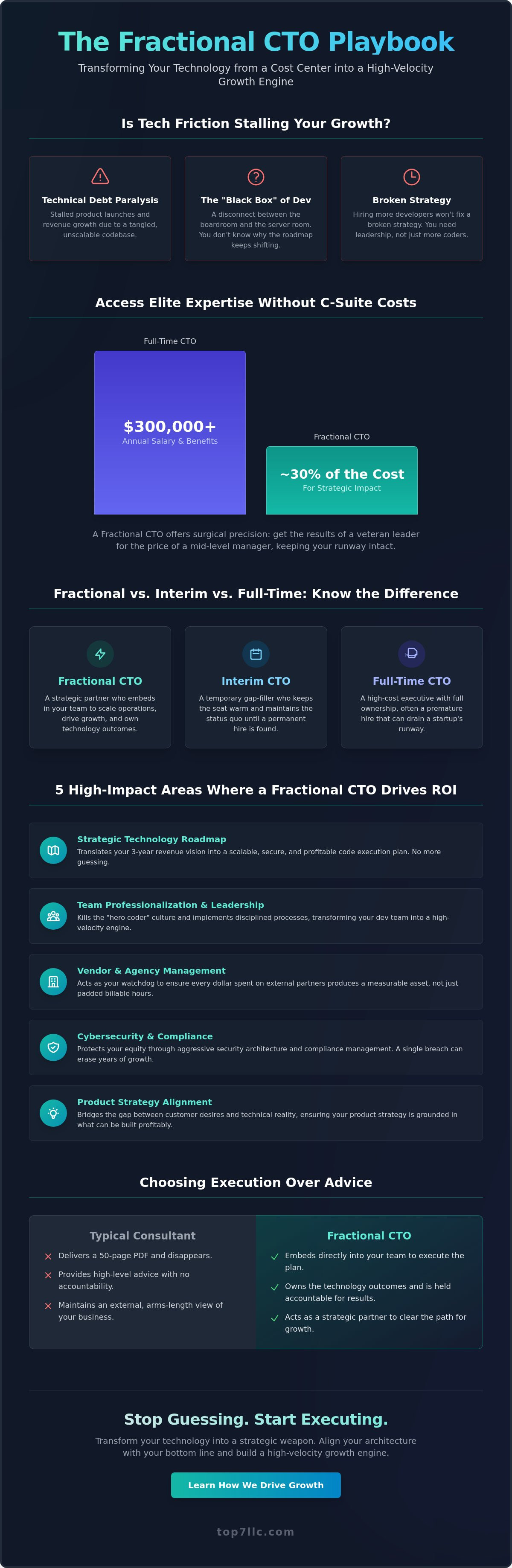
Stop confusing strategic leadership with expensive babysitting. A Fractional CTO is a high-level executive who owns your technology outcomes without the $300k+ price tag that usually comes with a top-tier hire. While the traditional Chief Technology Officer role is well-defined in enterprise circles, many startups fail because they hire for the title rather than the result. The core mission here is clear: translating raw business ambition into scalable, secure, and profitable code.
For companies in high-growth hubs like Boston or Austin, the fractional model is the only efficient choice. You get the same heavy-hitting expertise as the competition, but you keep your runway intact. Most leaders asking what does a fractional cto help with are looking for execution, not just advice. You don't need a consultant who hands you a 50-page PDF; you need a leader who embeds into your team and clears the path for growth.
To understand how this executive role functions in a real-world business environment, watch this breakdown:
High-growth tech centers are littered with the corpses of startups that over-hired too soon. They spent their Series A on a full-time C-suite and ran out of cash before they hit their second milestone. The fractional model fixes this. It provides the strategic oversight needed to professionalize a dev team while keeping the burn rate manageable. This isn't just about saving money; it's about maximizing the ROI of every line of code written.
The Strategic Bridge Between Business and Code
Developers love building things, but they don't always build what makes money. A Fractional CTO ensures your technical roadmap is a direct reflection of your 3-year revenue vision. They act as the buffer between the server room and the boardroom, explaining complex tech risks to non-technical stakeholders without the fluff. They don't just manage people; they manage risk. Every new feature is a potential liability if it isn't secure or scalable. The Fractional CTO is a strategic architect of business velocity.
Fractional vs. Interim vs. Full-Time
Understand the difference before you sign a contract. An interim leader is just a gap-filler who keeps the seat warm until you find a permanent replacement. A fractional CTO is a strategic partner who scales your operations from $5M to $50M. Avoid the "Full-Time Trap" at all costs. Hiring a $250k executive too early is a death sentence for your runway. When you consider what does a fractional cto help with, remember it's about surgical precision. You're buying the results of a veteran leader for the price of a mid-level manager.
The 5 High-Impact Areas Where a Fractional CTO Drives ROI
Stop viewing technology as a line item on your P&L. It's either your greatest multiplier or your heaviest liability. Most founders realize too late that their lead dev is just a coder, not a strategist. When you dig into what does a fractional cto help with, you find they don't just write scripts; they architect profit. They turn "we need an app" into a phased, budget-conscious execution plan that actually hits the market before your competitors do.
A fractional leader brings a level of discipline that internal teams often lack. They professionalize your dev team and kill the hero coder culture that makes your business vulnerable to a single person's whims. They also act as your watchdog for vendor and agency management. Too many companies bleed cash because they can't tell if an agency is delivering value or just padding billable hours. Your CTO ensures every dollar spent on external partners produces a measurable asset.
Beyond the code, they protect your equity through aggressive cybersecurity and compliance. A single data breach or regulatory fine can erase years of growth. By bridging the gap between customer desires and technical reality, they ensure your product strategy is grounded in what can actually be built profitably. This high-level alignment is exactly what our fractional leadership services provide to companies ready to stop playing small.
Optimizing the Tech Stack for Profit
Your tech stack is likely riddled with SaaS bloat. Redundant licenses and "shiny object" tools drain your runway without adding a cent of value. A Fractional CTO conducts a brutal audit to eliminate waste. They select technologies that allow for rapid scaling in hyper-competitive markets like Silicon Valley or New York. Most importantly, they ensure your stack supports future integrations with Fractional CFO or COO initiatives, creating a unified data environment for the entire C-suite.
Building High-Performance Engineering Cultures
Shipping features slowly is a symptom of a broken culture. We implement agile-based transformations that focus on velocity and accountability. We set KPIs for developers that actually matter to the business, like deployment frequency and lead time for changes, rather than useless metrics like lines of code. This professional environment reduces turnover. Senior developers stay because they respect the high-level mentorship and the lack of operational chaos that a veteran leader brings to the table.
Fractional CTO vs. Consulting: Choosing Execution Over Advice
Consultants are professional talkers. They arrive, interview your team, and drop a 50-page PDF on your desk that gathers dust while your developers continue to struggle. A Fractional CTO is the opposite. They are strategic assassins who embed themselves in your trenches, manage your team, and own the "Go-Live" date. You aren't paying for a report. You're paying for the total elimination of technical friction.
If you're still asking what does a fractional cto help with, look at your last consulting bill. Did it result in a faster product launch? Probably not. Project-based agencies are incentivized to prolong engagements and inflate billable hours. A retainer-based leader from Top7 is different. We're invested in your long-term success because our reputation is tied to your growth. We don't sit on the sidelines. We integrate into your Slack, lead your stand-ups, and become an inseparable part of your leadership culture.
Accountability is the only metric that matters in the C-suite. A consultant leaves when the slides are finished. A CTO stays until the system is stable and the revenue is flowing. You don't need more opinions; you need someone to own the outcomes.
Why Agencies Aren’t Your Technical Leaders
Stop letting the fox guard the henhouse. Agencies have a fundamental conflict of interest. They want to sell more hours. A CTO wants to optimize for efficiency. If your only technical "leader" is the account manager at your dev shop, you've already lost control of your roadmap. You're just a ticket in their queue.
IP ownership is survival. A Fractional CTO ensures that critical technical knowledge stays inside your company, not locked away in a vendor’s proprietary system. They act as the "manager of the manager," holding your development agency accountable for every sprint. They ensure you get what you pay for, not just what the agency finds easiest to build.
The Velocity of Embedded Leadership
Transformation doesn't happen through a monthly Zoom call. It happens through direct intervention. We move your organization from operational friction to efficient flow by sharing the cognitive load of technical decision-making. The psychological relief for a CEO is immediate. You finally have a "Technical Co-Pilot" who speaks both business and code.
Our Fractional CTO services differ from traditional IT outsourcing because we don't just provide hands. We provide the brain that directs them. We don't just fill a gap. We build a high-performance engine that drives your business forward. Stop outsourcing your strategy to people who don't care about your bottom line.
Signs Your Growth is Stalling Due to Tech Friction
Stop playing guessing games with your payroll. If you can't explain exactly what your developers are doing this week, you have a "Black Box" problem. You're pouring capital into a department that returns vague updates and missed deadlines. This lack of visibility isn't just a communication breakdown; it's a structural failure that threatens your entire roadmap. When executives finally ask what does a fractional cto help with, they're usually looking for a way to turn the lights on in a room that's been dark for months.
Technical debt paralysis is the next stage of this collapse. You want to launch a game-changing feature to crush a competitor, but your team says it will take six months because the "foundation needs work." Every new line of code breaks three old ones. You've reached a point where the system's weight is greater than its value. This friction isn't just a developer issue; it's a direct hit to your market share. You're paying for a race car that's stuck in second gear.
Then there's the fear of success. It's the silent killer of high-growth companies. You're actually afraid to close a high-ticket client because you know the infrastructure might crash under the load. If your growth is capped by your server capacity or a brittle architecture, you don't have a scalable business. You have a ticking clock. If these symptoms sound familiar, it is time to implement strategic technical leadership before the friction becomes permanent.
Identifying Technical Bottlenecks
Audit your current speed-to-market with brutal honesty. Are your competitors in Chicago or Dallas out-shipping you? If they're moving faster with similar resources, your architecture is the bottleneck. We also see the "CEO as CTO" trap far too often. If the founder is still approving pull requests or making granular tech decisions, the business is at extreme risk. You're a bottleneck, not a leader. Real operational flow only happens when you stop managing tasks and start leading a strategy. Recognizing that "Operational Friction" is actually a technical architecture problem is the first step toward recovery.
The Cost of Doing Nothing
Inaction is a choice, and it's a costly one. Calculate the lost revenue from delayed product launches and the potential fallout from system downtime. It's not just about missed targets; it's about the catastrophic risk of a "Security Event" when no one is at the helm of your technical strategy. Without an executive owning the outcomes, you're leaving your most valuable assets exposed. What does a fractional cto help with in this scenario? They provide the defensive shield your equity requires. Inaction is the most expensive technical debt you can carry.
The Velocity-7 Advantage: Transforming Tech into a Growth Engine
Technology is a force multiplier, but only if it's connected to the rest of the machine. Most firms fail because they isolate their tech stack from their revenue goals. We don't. The Velocity-7 Adaptive Framework is our answer to the chaos described in previous sections. It's a system designed to move your organization from friction to flow across seven critical business dimensions. When you ask what does a fractional cto help with at this level, the answer is total organizational alignment. We don't just fix servers; we fix the engine of your business.
Our Fractional CTOs use Agile-based transformation to gut broken technical departments and rebuild them for speed. This isn't just about writing better code. It's about ensuring your technical strategy is in lockstep with Sales, Finance, and Operations. If your tech doesn't talk to your CRM or reflect your P&L, it's a vanity project. We eliminate that isolation. We bridge the gap so that every technical decision serves a commercial objective. The result is a high-velocity growth engine that leaves your competitors wondering how you scaled so fast.
The journey starts with a brutal organizational audit. We identify the deadweight in your processes and your stack. From there, we build a 90-day execution roadmap that focuses on immediate wins and long-term stability. You don't have time for a year-long discovery phase. You need results this quarter. That's exactly what does a fractional cto help with when they're backed by a proven framework like Velocity-7.
The Top7 Execution Model
We don't sit on the sidelines. We embed seasoned professionals directly into your leadership team. Our 90-day turnaround isn't a suggestion; it's our standard. In the first quarter, we professionalize your dev team and stabilize your infrastructure. We shift the focus from "adding more features" to "efficient flow." Feature bloat is a silent killer of profit. We ensure your team ships what matters, when it matters. You'll move from reactive firefighting to proactive, strategic execution.
Is Your Business Ready for Velocity?
This isn't for everyone. We work with mid-market companies that are ready to stop playing small and start scaling their technical leadership. Regional leaders from the East Coast to the West Coast trust the Top7 framework because it's built on raw business reality, not academic theory. If you're tired of technical friction holding back your revenue, it's time to act. Plug the holes in your technical strategy—Schedule a call with Top7.
Dominate Your Market with Technical Precision
Stop letting technical debt and operational friction dictate your company's ceiling. You've seen the symptoms of a stalling engine: missed deadlines, brittle code, and a CEO acting as a part-time project manager. It's time to professionalize your engineering culture and turn your tech stack into a profit center. When you understand what does a fractional cto help with, you realize it's not about hiring a part-time advisor. It's about installing a strategic leader who owns your technical outcomes.
Our proprietary Velocity-7 Adaptive Framework is built for mid-market companies that need immediate results. We don't just provide advice; we embed seasoned executives into your leadership team to drive agile transformation. We've proven this model works by replacing "Black Box" development with transparent, revenue-aligned roadmaps that scale. Don't settle for another dusty consultant's report that offers no path to execution.
Stop letting tech bottlenecks kill your growth; Partner with a Top7 Fractional CTO today.
The path from technical chaos to efficient flow is clear. You have the ambition; we have the framework and the proven track record to make it a reality. Let's get to work and build the high-velocity engine your business deserves.
Frequently Asked Questions
How many hours a week does a Fractional CTO typically work?
Engagement levels vary, but most Fractional CTOs dedicate between 5 and 20 hours per week to a single client. This isn't about punching a clock; it's about high-impact strategic intervention. You're paying for decades of experience squeezed into the hours that actually move the needle. If your tech leader needs 40 hours just to keep the lights on, you have a process problem, not a capacity problem.
What is the average cost of a Fractional CTO compared to a full-time hire?
Hiring a fractional executive typically saves you 50% to 70% compared to a full-time hire. According to 2026 industry data, the total first-year cost of a full-time CTO can exceed $400,000 when you factor in benefits and bonuses. A fractional leader provides the same C-suite expertise without the massive overhead, allowing you to reinvest that capital into your product roadmap or marketing spend.
Can a Fractional CTO help with hiring a permanent full-time CTO later?
Yes, a Fractional CTO is perfectly positioned to help you transition to a full-time hire when the time is right. They define the technical requirements, professionalize the department, and then vet candidates to ensure your permanent leader isn't a "hero coder" but a true strategist. They ensure you don't fall into the 40% of C-suite hires who fail within 18 months by building a stable foundation first.
Does a Fractional CTO actually write code?
A true Fractional CTO focuses on strategy and leadership rather than hands-on coding. If you're paying an executive-level rate for someone to fix CSS bugs, you're wasting money. Their job is to architect the system and lead the team that writes the code. When you ask what does a fractional cto help with, remember they are the brain of the technical department, not the hands.
How does a Fractional CTO manage an existing outsourced development agency?
They act as the "manager of the manager" to ensure your outsourced partners deliver value instead of just billable hours. A Fractional CTO audits agency performance, enforces technical standards, and ensures your IP stays within your company. They stop the "Black Box" problem by holding vendors accountable to business-centric KPIs and ensuring the technical roadmap aligns with your revenue goals.
What is the difference between a Fractional CTO and a Technical Advisor?
The difference lies in ownership and execution versus passive advice. A Technical Advisor gives you opinions and a list of suggestions; a Fractional CTO embeds in your leadership team and owns the results. When considering what does a fractional cto help with, look for the leader who manages the team and takes responsibility for the "Go-Live" date, rather than someone who just provides a monthly consultation.
How long does a typical Fractional CTO engagement last?
Engagements typically last between 6 and 18 months, depending on the complexity of your technical debt and growth goals. Some companies use a fractional leader as a long-term strategic partner, while others use them to bridge the gap during a specific scaling phase. The goal is always to move from operational friction to efficient flow, regardless of the specific timeframe.
What happens if our company needs more time than the fractional agreement allows?
Most fractional agreements are designed with scalability in mind to handle periods of high intensity or rapid growth. If your company hits a critical milestone that requires more oversight, the engagement can be adjusted to meet the new demand. The model is adaptive by nature, ensuring you have the right level of leadership at every stage of your business evolution without being locked into a rigid, full-time contract.


Comments