
Fractional CTO for Non-Technical Founders: Stop Getting Steamrolled by Tech

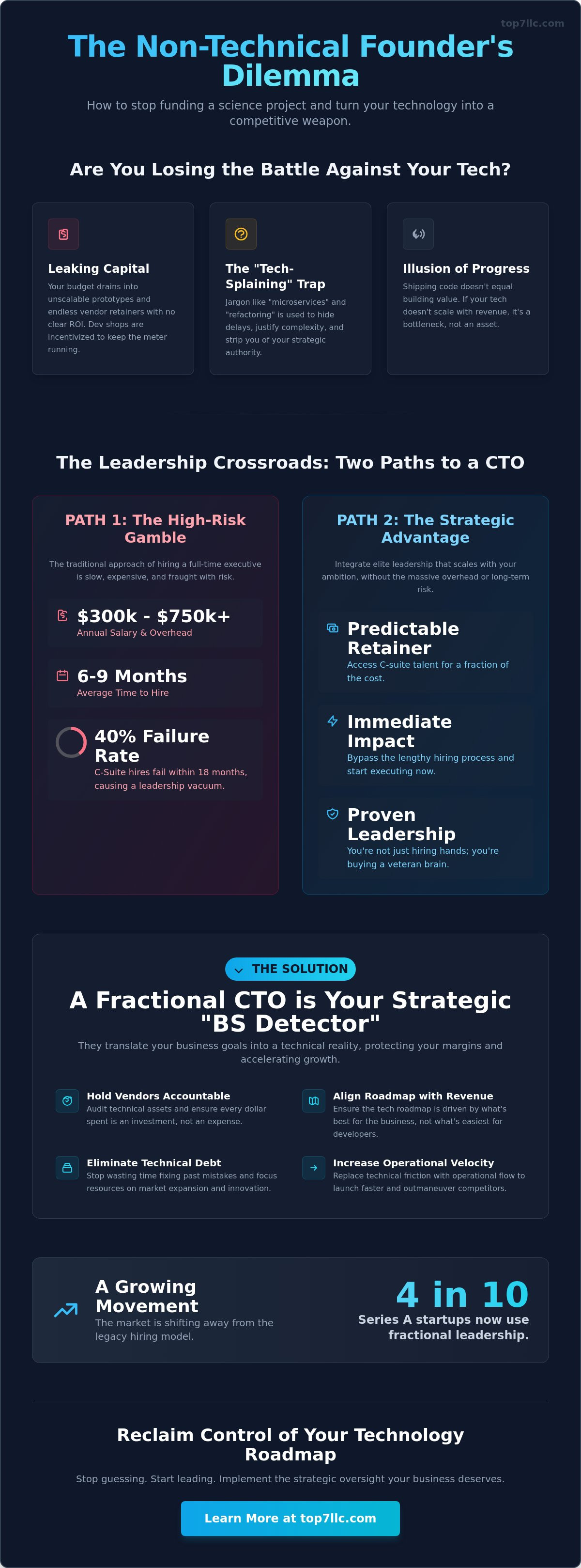
Why are you letting your developers dictate your business strategy? It's a common trap for growth-minded leaders. You've built a vision, but now you're being steamrolled by technical jargon while your capital leaks into unscalable prototypes. If you feel like you're losing the battle against dev shops that won't take accountability, you aren't alone. Research shows that roughly 40% of C-suite hires don't even last 18 months, yet many founders still chase the $500,000 full-time executive as a silver bullet. It's a high-risk gamble you don't need to take.
You deserve a technology roadmap that actually aligns with your revenue goals. Integrating a fractional cto for non-technical founders allows you to eliminate technical friction and reclaim strategic control without the massive overhead of a permanent hire. This article breaks down how to stop the bleeding and install veteran leadership that scales with your ambition. We'll show you how to implement a reliable BS detector for your vendors, increase operational velocity, and finally turn your tech stack into a competitive weapon rather than a bottleneck.
Key Takeaways
Stop letting dev shops drain your budget by learning how to audit your technical assets and hold vendors accountable without writing a single line of code.
Discover how a fractional cto for non-technical founders provides the strategic "BS detector" you need to protect your profit margins from hidden technical debt.
Replace technical friction with operational flow by implementing the Velocity-7 Adaptive Framework to align your roadmap with measurable business outcomes.
Learn why the $300k full-time hire is a legacy trap and how to access elite leadership at a predictable, fixed monthly retainer.
Table of Contents
The Non-Technical Founder’s Dilemma: Why Your Tech is a Bottleneck, Not an Asset
What is a Fractional CTO and Why Is It the Smartest First Hire?
The BS Detector: Why Dev Shops and Agencies Are Draining Your Capital
The Velocity-7 Framework: Turning Technical Friction into Operational Flow
Scaling Without the 0k Salary: Implementing Fractional Leadership in 2026
The Non-Technical Founder’s Dilemma: Why Your Tech is a Bottleneck, Not an Asset
You're the CEO, but you often feel like a guest in your own company's technical discussions. When you ask for a simple update, you're met with a wall of jargon about microservices, refactoring, and database migrations. This is the "Tech-Splaining" trap. It's a defensive mechanism developers and agencies use to hide delays or justify complexity you didn't ask for. It strips you of your authority. If you can't challenge the technical narrative, you aren't leading your company; you're just funding a science project.
The traditional solution is to hire a Chief Technology Officer (CTO), but the price tag for elite talent is often out of reach for growing firms. This is exactly where a fractional cto for non-technical founders becomes the ultimate strategic lever. Without this leadership, your roadmap is likely driven by what's easiest for the devs to build, not what's best for your bottom line. In 2026, technical debt isn't just a nuisance; it's a direct erosion of your profit margins. Every hour spent fixing "guessing" mistakes from six months ago is an hour stolen from your market expansion.
To better understand how this strategic leadership changes the game for your business, watch this helpful video:
The Illusion of Progress in Technical Projects
Don't confuse "shipping code" with "building value." Your dev shop is incentivized to keep the meter running. They want more hours and more features, even if those features don't move the needle for your customers. This creates a false sense of security. You see Jira tickets moving, but your operational velocity is stalling. True progress is measured by how effectively your technology solves business problems, not how many lines of code were written this week. If your tech doesn't scale with your revenue, it's a liability, not an asset.
The ROI of Technical Clarity
What does a six-month delay in a product launch actually cost you? It isn't just the developer salaries. It's the lost market share, the frustrated customers, and the missed opportunity to beat a competitor. Strategic tech leadership transforms this dynamic. Having a fractional cto for non-technical founders gives you a permanent "BS detector" in the room. They audit the code, hold vendors accountable, and ensure every dollar spent on technology is an investment in future growth. The psychological relief of knowing you aren't being lied to is valuable, but the measurable impact on your ROI is what wins the market.
What is a Fractional CTO and Why Is It the Smartest First Hire?
Hiring a developer is a tactical move. Hiring a fractional cto for non-technical founders is a strategic strike. Most founders think their problem is a lack of code. It isn't. Your problem is a lack of direction. A fractional CTO provides the high-level leadership of a veteran executive without the $500,000 to $750,000 annual price tag of a full-time hire. You're buying the brain, not just the hands. This role bridges the gap between your business goals and the technical execution that actually delivers them. It's about strategic alignment, not just "getting things done."
The math is simple. A full-time CTO search takes an average of 6 to 9 months, and roughly 40% of those hires fail within the first year and a half. Can your business survive a nine-month delay followed by a leadership vacuum? Probably not. Statistics show that 4 in 10 Series A startups are now bypassing the traditional hiring route in favor of fractional leadership. This model allows you to scale your technical maturity at the same pace as your revenue. You get the strategy, execution, and governance needed to dominate your niche without the long-term liabilities of a C-suite contract.
Strategic Tech Oversight for Non-Technical Founders
You have a vision. Your developers have a keyboard. A fractional leader translates your business goals into technical requirements that don't change every two weeks. They build an internal engineering culture that values results over activity. When it's time for investor due diligence, you won't be scrambling to explain your architecture. You'll have a credible, professional tech story backed by a veteran who has been there before. If you want to move from chaos to a disciplined roadmap, you need fractional leadership that understands the stakes.
The Embedded Leadership Advantage
There's a massive difference between a consultant and a fractional executive. A consultant gives you a slide deck and leaves. A fractional CTO sits at your decision-making table. They are embedded in your structure, making hard choices about your stack and your team. This isn't about "advising" from the sidelines; it's about taking ownership of the technical outcomes. They move from high-level planning to ground-level execution, ensuring that every project aligns with the Velocity-7 Adaptive Framework. You don't need another opinion. You need an executive partner who treats your capital like their own.
The BS Detector: Why Dev Shops and Agencies Are Draining Your Capital
Your development agency isn't your partner. It's a service provider designed to maximize its own billable hours, not your company's exit value. When you lack a technical background, every "critical infrastructure update" or "necessary refactor" sounds like a mandatory expense. It usually isn't. Most of the time, it's just bloatware or a lack of discipline that keeps you tethered to their ecosystem. This is why a fractional cto for non-technical founders is a requirement, not a luxury. They dismantle the information asymmetry that allows vendors to drain your capital through manufactured complexity.
Agencies want to build. You want to solve. This fundamental conflict of interest is why so many prototypes in 2026 are over-engineered disasters that can't handle real-world traffic. They'll sell you a Ferrari when you only needed a bicycle to get to the next funding round. Without an expert "BS detector" on your side, you're essentially handing your checkbook to someone whose primary goal is to keep their developers busy. You need someone who can look at a contract and identify exactly where the "padding" is before you sign away your runway.
Auditing Your Technical Assets
You can't manage what you don't understand. A fractional leader performs a deep-tissue audit of your current stack to identify where your money is actually going. Are you paying for enterprise-grade tools that your three-person team doesn't use? Do you actually own your source code, or is it locked in a proprietary repository you can't access? Technical debt is the gap between current code and future scale. If that gap is too wide, your profit margins will vanish as you spend more time fixing the past than building the future. Ensuring you own your IP is the first step in reclaiming your company's sovereignty.
Managing the Agency Relationship
Stop measuring progress by "sprints" or "story points." Those are developer metrics that don't pay the bills. You need to set KPIs that align with business outcomes, like user retention, system uptime, and feature deployment velocity. Your fractional cto for non-technical founders acts as your representative in technical disputes, ensuring that the agency delivers what was promised. They provide the leverage needed to negotiate contracts from a position of power. If an agency knows an expert is watching their every move, their performance miraculously improves. When it's finally time to move from an agency to an in-house team, your fractional leader handles the transition to ensure zero downtime and total knowledge transfer.
The Velocity-7 Framework: Turning Technical Friction into Operational Flow
Most consultants treat tech leadership like a therapy session. They give you "best practices" and vague advice that doesn't scale. To win, you need a repeatable system that turns your technical bottleneck into a high-speed engine. The Velocity-7 Adaptive Framework is that system. It isn't just a set of rules; it's an embedded operational methodology designed specifically for a fractional cto for non-technical founders to execute with precision. We don't just tell you what's wrong. We install the solution and stay to ensure it works.
Step one is diagnosing the 7 dimensions of technical friction. We look at everything from code quality to team communication and deployment pipelines. Most firms are leaking capital in at least four of these areas without even knowing it. Once the friction points are identified, we move to step two: aligning your tech architecture with the Velocity-7 roadmap. This ensures every server you pay for and every feature you build is a direct response to a business requirement. Step three involves an agile-based transformation that reaches beyond the engineering department. Finally, step four achieves operational flow, where technology stops being a discussion and starts being a silent, powerful driver of revenue.
Agile Isn't Just for Tech
If your developers are agile but your leadership team is stuck in a waterfall mindset, you have a collision waiting to happen. We apply Velocity-7 principles to your entire executive suite. This breaks down the toxic silos between product, sales, and engineering. When everyone speaks the same language of delivery, you can use data-driven feedback loops to pivot faster than your competitors. Speed is your only real advantage in a crowded market. Don't waste it on internal friction. You can implement the Velocity-7 framework today to start reclaiming your operational speed.
Measuring What Matters
Stop falling for vanity metrics. Your dev shop might show you "story points" or "commits per day," but those numbers are easily manipulated. They don't tell you if you're actually getting closer to your goals. We track Velocity as a core business KPI. It measures the actual rate at which your team delivers validated business value. The Top7 approach to transparent technical reporting gives CEOs a clear view of the battlefield. You'll know exactly what's being built, why it matters, and how much it's actually costing you in real-time. No more guessing. Just data.
Scaling Without the $300k Salary: Implementing Fractional Leadership in 2026
Why are you still paying for potential when you can pay for performance? In the old world, you had to gamble $500,000 on a full-time executive and hope they didn't quit after a year. In 2026, the lean, executive-led mid-market company is the new standard for efficiency. By utilizing a fractional cto for non-technical founders, you gain elite-level expertise at a fixed monthly retainer. This isn't just about saving money. It's about strategic superiority. You get the same caliber of leadership found in the boardrooms of Boston, Austin, and Chicago without the bloated overhead or long-term liabilities of a legacy C-suite contract.
Top7 doesn't just "advise" from the sidelines. We embed veterans directly into your operations to drive measurable results. Our leadership is localized and tactical, focusing on the specific pressures of US-based mid-market firms. We don't believe in long-term discovery phases that lead nowhere. We believe in surgical interventions that restore your operational velocity. If your technology isn't currently a weapon used to seize market share, it's a weight pulling you down. It's time to cut the anchor.
Your 90-Day Technical Turnaround
The first three months of a fractional engagement are designed to stop the bleeding and start the growth. During Days 1 to 30, we conduct a brutal technical audit and friction diagnosis. We find the leaks in your capital and the rot in your code. From Days 31 to 60, we shift to roadmap alignment and vendor accountability. We ensure your dev shop is finally answering to your business goals, not their own billable hours. By Days 61 to 90, we establish the Velocity-7 cadence. This creates a sustainable, long-term growth engine that operates with precision and total transparency.
Ready to Stop Guessing?
Is your current tech lead a visionary or a bottleneck? If you can't answer that question with data, you already have your answer. A 'Fractional First' strategy allows you to bypass the 9-month hiring cycle and install leadership that produces ROI on day one. You don't need more developers. You need a partner who understands how to turn code into cash flow. Stop being a spectator in your own company's technical evolution. Schedule your technical friction audit with a Top7 executive today and reclaim the control your vision deserves.
Stop Being a Spectator in Your Own Technical Evolution
Technology is either your greatest weapon or your most expensive bottleneck. You can't afford to stay in the dark while dev shops drain your runway with unscalable prototypes and manufactured complexity. We've shown you that the path to operational flow isn't about hiring more developers; it's about installing veteran leadership that understands the "BS detector" is as vital as the code itself. Integrating a fractional cto for non-technical founders gives you the strategic dominance needed to turn technical friction into a scalable revenue engine.
Top7 brings the Velocity-7 Adaptive Framework directly to your team. Our seasoned professionals are embedded in hubs across Boston, Austin, Chicago, and nationwide to ensure your roadmap finally serves your business goals. You have the vision. We provide the technical precision to execute it without the $500,000 full-time liability. It's time to stop guessing and start winning.
Ready to reclaim control?Book a Discovery Call to Audit Your Technical Velocity and see how elite leadership transforms your bottom line. Your growth is waiting.
Frequently Asked Questions
What exactly does a Fractional CTO do for a non-technical founder?
A fractional cto for non-technical founders acts as your strategic representative in all technical matters. They don't just oversee code; they build a roadmap that aligns with your revenue goals. They translate your business vision into technical requirements, audit your vendors, and ensure your capital isn't being wasted on over-engineered features you don't need. They are your primary defense against technical jargon and vendor exploitation.
How is a Fractional CTO different from a technical co-founder?
Technical co-founders often own a massive chunk of your equity and may be learning how to lead as they go. A fractional CTO is a veteran executive you hire for specific, measurable outcomes without giving up ownership of your company. You get decades of experience and a proven "BS detector" on day one. It's about buying the result, not the person or their potential.
When is the right time for a mid-market company to hire a Fractional CTO?
The right time is when your technology starts feeling like a bottleneck instead of an accelerator. If you can't hold your dev shop accountable or you're losing sleep over "tech-splaining," you're already behind. Most companies hire a fractional leader when they need to scale past their current technical maturity but aren't ready for the massive overhead of a permanent C-suite executive.
How much does a Fractional CTO cost compared to a full-time hire in 2026?
Research from May 2026 shows that a full-time CTO's first-year cost typically ranges from $500,000 to $750,000 including benefits and recruiting fees. A fractional engagement annualizes to between $180,000 and $300,000. This model allows you to access elite talent for roughly 50% to 70% less than a full-time hire. You pay for the strategic impact, not the office space.
Can a Fractional CTO help me fire my current dev shop or agency?
Yes. A fractional leader audits your current technical assets to ensure you actually own your source code and IP before any transition begins. They handle the difficult conversations and manage the knowledge transfer to a new team. This ensures your business continues to run without downtime while you move away from a toxic or underperforming vendor relationship.
Does a Fractional CTO manage my developers day-to-day?
They provide the leadership, standards, and governance your developers must follow. While they aren't micromanaging every Jira ticket, they set the operational cadence and hold the team accountable for delivery velocity. This creates a disciplined engineering culture where developers focus on building value rather than just shipping code. The goal is to move from chaos to a predictable, high-performance flow.
How does the Velocity-7 framework apply to non-technical industries?
The Velocity-7 framework is about operational flow, which is universal to any business that uses technology to deliver value. Whether you're in manufacturing, professional services, or retail, technical friction causes delays and erodes margins. We identify the seven dimensions where your tech is fighting your business goals and remove them. It's a tactical methodology for winning market share, regardless of your industry.
What cities does Top7 provide Fractional CTO services in?
Top7 provides embedded professionals in major hubs like Boston, Austin, and Chicago. We also serve mid-market firms nationwide through our adaptive leadership model. Our experts are localized to the US market to ensure they understand the specific competitive pressures and regulatory environments your company faces. We don't just advise; we lead from within your organization.



Comments