

5 Brutal Signs Your Company Needs a Fractional CTO to Survive 2026
- Robert Fitzgerald
- May 28
- 12 min read

Your developers are burning through capital at an alarming rate, yet your system still buckles under the slightest pressure. It's a common tragedy. You're trapped between a technical team that can't communicate and investors who demand answers you don't have. If you can't explain your technical roadmap without stuttering, you're already behind. Recognizing the brutal signs your company needs a fractional cto is no longer optional; it's the difference between scaling and total stagnation in a 2026 market defined by agentic AI and aggressive regulatory shifts like the EU Cyber Resilience Act.
You know the frustration of watching progress stall while operational friction climbs. We're going to fix that. This guide identifies the specific technical bottlenecks strangling your growth and reveals how fractional leadership transforms your tech stack from a bloated cost center into a lean revenue engine. We'll dive into the five red flags that signal it's time to stop throwing money at more developers and start investing in strategic execution that actually aligns with your sales goals.
Key Takeaways
Stop viewing technology as a cost center and start treating it as a strategic engine for business velocity.
Recognize the critical signs your company needs a fractional cto, from system crashes during peak growth to the dangerous "Founder Bottleneck."
Cut the $250k+ financial weight of a full-time executive while avoiding dev agencies that prioritize their own billable hours over your profit.
Use the Velocity-7 Adaptive Framework to dismantle operational friction and turn your technical roadmap into a predictable revenue driver.
Learn how embedding cross-functional leadership into your C-suite ensures your tech stack finally supports your most aggressive sales targets.
Table of Contents
Beyond the Buzzword: What is a Fractional CTO in 2026?
If you think a CTO is just a senior developer with a fancy title, you're already losing the market share battle. In 2026, technology isn't a support function; it's the heartbeat of your business strategy. A fractional executive in the CTO role isn't there to fix your broken printer or review every line of CSS. They are strategic architects. They design the systems that allow your company to scale without the infrastructure collapsing under its own weight.
Most founders confuse tactical IT management with high-level technology leadership. Tactical management keeps the lights on. Strategic leadership drives business velocity. It's about ensuring every dollar spent on code translates into a dollar of revenue. If your tech team is busy building "cool features" while your sales goals are stalling, you're missing a bridge. That's one of the clearest signs your company needs a fractional cto who understands commerce as well as they understand containers. You need an executive who translates board-level goals into technical execution plans that actually work.
To better understand how this role functions in a modern business environment, watch this breakdown:
The Evolution of Technical Leadership
The "all-rounder" developer who handles everything from database architecture to frontend UI is a relic of 2015. In 2026, technical complexity has exploded. A Tech Lead manages a team to build a specific product. A Strategic CTO manages the technology's impact on the company's P&L. With the agentic AI revolution and strict new data regulations like the EU Cyber Resilience Act, mid-market firms can't afford a leader who "figures it out" on the fly. You need someone who has seen these patterns before and can deploy them with surgical precision to maintain your competitive edge.
Fractional vs. Interim: Which Do You Need?
Don't confuse these two roles. An Interim CTO is a bridge. You hire them during a crisis or a leadership transition to keep the ship from sinking. They're temporary fixes. A Fractional CTO is a long-term, high-impact strategic partner. They provide the executive-level oversight you need without the $400,000+ price tag of a full-time hire. If you're in a growth phase, you don't need a temp; you need a partner who scales with you. Identifying the signs your company needs a fractional cto early saves you from the "scale-up gap," where technical debt finally chokes your cash flow and stops your expansion cold.
5 Red Flags: Signs Your Company is Strangled by Technical Debt
Is your technology an asset or a liability? For most mid-market firms, it’s a silent killer. You see the symptoms every day, but you’ve been conditioned to think they’re just "growing pains." They aren't. They are structural failures that erode your profit margins. Recognizing the signs your company needs a fractional cto is the first step toward reclaiming your business velocity. If you wait until the system completely fails, you aren't scaling; you're just managing a slow-motion wreck.
The Founder Bottleneck: You are the CEO, not the architect. If you're still approving database migrations or choosing tech stacks based on a blog post you read, you've become the single point of failure. You're making technical decisions you don't fully understand, and that's a recipe for disaster.
Scaling Friction: Your marketing team finally hits a home run, but the system crashes at 1,000 concurrent users. If your infrastructure can't handle success, your leadership has failed to plan for it. This isn't a server problem; it's a strategy problem.
The Black Box Problem: Dev costs are rising, but feature delivery is slowing. You have no idea what your team does all day, and you lack the technical depth to hold them accountable. You're paying for output you can't measure.
Vendor Hostage: You’re trapped by a dev agency that owns your IP and charges for every minor tweak. Without internal executive oversight, you’re just a cash cow for their billable hours. They prioritize their margins over your ROI.
Investor Pressure: Series B investors are asking for a 24-month technical roadmap. If your answer is "we're working on it," you’re signaling that your company is a high-risk gamble. Investors hate uncertainty. They want a clear, executable plan.
If these flags look familiar, you're already in the "scale-up gap." You can't afford to keep guessing. A Fractional CTO provides the surgical intervention needed to stop the bleeding and realign your tech with your revenue targets.
The Hidden Cost of "Good Enough" Tech
Technical debt isn't just messy code. It's the gap between your current technical capability and what the market actually demands. Every day you ignore it, you pay a hidden tax. Inefficient development cycles can burn up to 40% of your engineering budget on "keep-the-lights-on" tasks rather than innovation. You're paying premium salaries for developers to patch holes in a sinking ship. This burn rate is invisible until it's too late to pivot.
When Your Tech Lead Hits the Ceiling
Your best developer isn't necessarily your best leader. This is the Peter Principle in action. Promoting a top coder to a management role often results in losing a great engineer and gaining a mediocre manager. They lack the executive presence to sit in the C-suite and the strategic vision to link code to commerce. This creates a leadership vacuum that leaves your team directionless and your systems fragile. You don't need another coder; you need a strategist who knows how to build teams that deliver results.
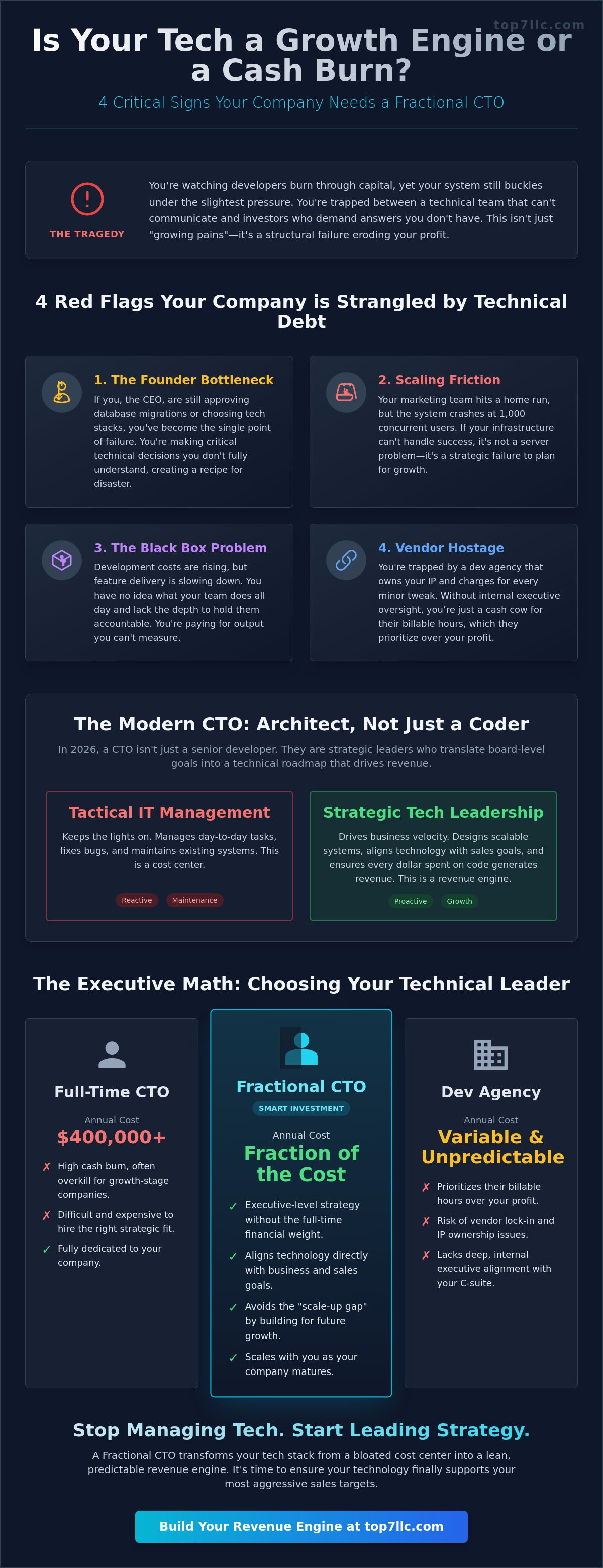
The Executive Math: Fractional CTO vs. Full-Time vs. Agencies
Business isn't about how many people you have on payroll. It's about the efficiency of your capital. For mid-market firms, hiring a full-time CTO in 2026 is often an act of financial self-sabotage. You're looking for leadership, but you're buying a massive overhead. When you spot the signs your company needs a fractional cto, you're at a crossroads. You can either bloat your balance sheet with a permanent executive or you can buy the specific outcomes you need at a fraction of the price. The math is simple, yet most founders get it wrong because they're stuck in legacy hiring mindsets.
A full-time CTO in the U.S. now commands a total compensation package between $387,500 and $695,000. That includes base salary, benefits, bonuses, and the inevitable recruiting fees. This doesn't even account for the 0.5% to 2.5% equity stake they'll demand. If your technical roadmap is still a mess, you're paying a premium for a leader who might not even fit your culture long-term. Fractional leadership cuts this waste. You gain 100% of the executive wisdom while only paying for the 20% of the time required to drive high-leverage decisions. It's about buying the result, not the person's presence in a Slack channel.
Total Cost of Ownership (TCO) Comparison
Hiring a full-time executive is a high-stakes gamble. If they fail, you lose the salary, the recruiting fee, and six to twelve months of progress. A fractional model operates on a predictable monthly retainer. This allows you to scale the engagement up during a heavy migration or down once the strategic foundation is solid. You aren't locked into a rigid contract that drains your cash flow during lean months. You're investing in Advisory Services and strategic execution that adapts to your actual growth pace, not a fixed HR budget.
Why Agencies Aren’t Leaders
Dev agencies are "order-takers" by design. Their business model relies on billable hours, which means they have a fundamental conflict of interest with your efficiency. They love technical debt because it generates more work. They don't care about your ROI; they care about their utilization rates. A Fractional CTO acts as your internal advocate. They vet the agencies, review the code, and ensure you aren't being held hostage by proprietary systems or vendor-locked tech stacks. They protect your intellectual property and ensure your technology is portable. If you don't have a strategic leader managing your vendors, you aren't a client. You're a cash cow. Identifying the signs your company needs a fractional cto means realizing that your current agency isn't going to lead you to the next level. They're just going to keep billing you for the status quo.
The Velocity-7 Audit: Diagnose Your Tech Leadership Gaps
Identifying the problem is only half the battle. If you've recognized the red flags, you're already ahead of the competition, but you're still flying blind without a system. Most CEOs try to fix technical issues by hiring more developers. This is a mistake. You don't need more hands; you need a better brain at the top. We use the Velocity-7 Adaptive Framework to strip away the noise and focus on one thing: removing operational friction to achieve efficient flow. If your technology isn't actively accelerating your sales, it's dead weight that's dragging down your valuation.
You can't manage what you can't measure. Run this 5-question diagnostic on your company today. Be honest. If you answer "no" to more than two, the signs your company needs a fractional cto are no longer just warnings; they are active threats to your survival.
Can you explain your 24-month technical roadmap in under two minutes without calling a developer?
Does your system uptime and performance correlate directly with your marketing spend?
Is your intellectual property secured and portable, or is it locked in a vendor's proprietary "black box"?
Can your current technical lead manage a $500k budget as effectively as they manage a code sprint?
Does your technology stack support your 2026 revenue goals, or are you running on a 2022 relic?
Stop guessing and start executing. Schedule your Velocity-7 Audit to identify exactly where your tech is failing your commerce.
Aligning Tech with the 7 Dimensions of Growth
Technology isn't a siloed department. It enables financial strategy and provides the sales guidance needed to dominate your niche. Within our framework, technology serves as the nervous system that connects every operational limb. It's the infrastructure that powers automation and drives organizational agile transformation. If the nervous system is damaged, the body can't move. A fractional leader ensures your tech stack isn't just "working," but is actively pushing the other six dimensions of your business toward peak performance.
Your 90-Day Fractional Roadmap
Execution requires a timeline, not a vague promise. A professional engagement follows a disciplined, 90-day trajectory. In Phase 1 (Days 1-30), we focus on audit and stabilization. We stop the bleeding and secure your assets. Phase 2 (Days 31-60) is about strategy and team alignment. We bridge the gap between your sales goals and your technical output. Finally, Phase 3 (Days 61-90) focuses on execution and scaling. This is where tech stops being a cost center and starts being a revenue engine that actually delivers measurable ROI.
Stop Managing Tech, Start Leading Strategy: The Top7 Advantage
You’ve seen the signs your company needs a fractional cto. You know the technical debt is mounting. You know your current team is hitting a ceiling. Now, you have a choice. You can hire a solo consultant who offers advice from the sidelines, or you can partner with a firm that embeds directly into your C-suite to drive real business velocity. Top7 doesn't just provide a part-time expert. We provide a strategic architect who uses the Velocity-7 Adaptive Framework to turn your technology from a liability into a high-performance revenue engine.
The solo consultant model is inherently flawed. If your consultant gets sick or hits a knowledge gap, your progress stops. Top7 operates as a cross-functional firm. When you engage our Fractional CTO services, you aren't just getting one person. You're getting the collective intelligence of an elite leadership team. We bridge the gap between code and commerce by ensuring your technical roadmap is perfectly aligned with your financial and sales goals. We've seen companies in high-growth US markets move from total operational friction to a state of "Efficient Flow" in under 90 days by simply placing the right leadership at the helm.
National Expertise, Local Execution
Scaling a mid-market company in 2026 requires more than just a good idea. It requires the ability to navigate complex digital transformations across multiple jurisdictions. From the tech hubs of Boston and Austin to the corporate corridors of Philadelphia, Top7 provides seasoned executive talent that understands local market dynamics and national scaling requirements. We specialize in helping businesses survive the "scale-up gap" by implementing rigorous Strategic Planning and advanced project management. Whether you're navigating the EU's Cyber Resilience Act or the latest US federal AI principles, we ensure your compliance is a competitive advantage, not a hurdle.
Take the First Step Toward Velocity
Stop paying for potential and start paying for performance. Our "Results, Not Payroll" philosophy means we focus on measurable outcomes that impact your bottom line today. You don't need another expensive executive taking up space in your office. You need a leader who can audit your current mess, stabilize your team, and execute a roadmap that wins market share. The signs your company needs a fractional cto are clear. The only question is whether you'll act before your competitors do.
Ready to stop the bleed? Schedule your technology leadership audit with Top7 and stop letting technical debt strangle your growth.
Secure Your Technical Dominance for 2026
Technology isn't waiting for your leadership to catch up. The market is shifting toward autonomous agents and aggressive compliance standards. If you don't pivot now, you're just managing an expensive museum of technical debt. We've exposed how the Founder Bottleneck kills growth and why a full-time executive hire is often a massive distraction from your actual sales goals. Strategic alignment is the only way to turn code into measurable profit.
Recognizing the signs your company needs a fractional cto gives you the tactical edge to stop being a passenger in your own technical journey. Top7 provides seasoned C-suite executives with over 20 years of experience to lead that charge. From Boston to Dallas and across the West Coast, our proprietary Velocity-7 Adaptive Framework ensures your infrastructure scales as fast as your ambition.
Stop the tech bleed. Schedule your Velocity Audit today.
You have the roadmap and the diagnostic tools to win. It's time to build the high-velocity powerhouse your vision deserves.
Frequently Asked Questions
What is the difference between a Fractional CTO and a consultant?
A Fractional CTO is an executive partner who takes ownership of your outcomes, while a consultant merely provides advice. Consultants point out problems and leave you to fix them. A Fractional CTO embeds into your C-suite, manages your technical team, and executes a strategy that aligns with your P&L. They are a part of your leadership team, not an outside observer.
How many hours a week does a Fractional CTO typically work?
Engagement levels typically range from 5 to 20 hours per week depending on your growth phase. We focus on high-leverage strategic decisions rather than punching a time clock. You're paying for decades of executive experience to remove operational friction, not for a seat warmer. The goal is maximum impact on your business velocity with minimal unnecessary overhead.
Can a Fractional CTO help with AI integration and digital transformation?
AI governance and digital transformation are mandatory requirements for technical leadership in 2026. We use the Velocity-7 framework to ensure your AI initiatives drive measurable revenue instead of just burning capital. We manage the shift toward agentic AI and ensure your systems comply with evolving regulations like the EU Cyber Resilience Act, keeping you ahead of the competition.
Will a Fractional CTO manage my existing offshore development team?
Yes, providing executive oversight for internal and offshore teams is a primary responsibility. A Fractional CTO sets technical standards, conducts code reviews, and holds vendors accountable for their delivery. If you recognize the signs your company needs a fractional cto, it's usually because your current team lacks the leadership to prioritize your ROI over their own billable hours.
Is a Fractional CTO suitable for a non-technical founder?
A Fractional CTO is essential for any non-technical founder who wants to scale without crashing. You shouldn't be making architecture decisions or choosing tech stacks based on guesswork. We act as your technical translator, turning your sales goals into executable roadmaps. This allows you to focus on leading the company while we ensure the technology actually supports your vision.
How long does a typical Fractional CTO engagement last?
Most engagements last between six and eighteen months, though many become long-term strategic partnerships. The duration depends on the complexity of your technical debt and your specific scaling targets. We stay as long as we're adding value and driving business velocity. You have the flexibility to scale the engagement up or down as your project phases evolve.
What happens if my company grows and I need a full-time CTO?
We manage the transition to ensure you don't make a $400,000 hiring mistake. A Fractional CTO helps define the permanent role, vets potential candidates, and handles the onboarding process. We stay in the seat until your full-time executive is fully integrated and your technical roadmap is stable. This protects your momentum during a critical leadership change.
Does Top7 provide Fractional CTOs for companies outside of Philadelphia?
Top7 provides elite leadership talent to high-growth companies across the entire United States. While we have a strong presence in Philadelphia, our seasoned executives serve major hubs including Boston, Dallas, Austin, and the West Coast. We handle multi-state scaling and digital transformation for mid-market firms regardless of where their headquarters are located. Strategic excellence has no geographic boundaries.


Comments