
Preparing for Series A Funding Round: Why Your Pitch Deck is a Lie Without Operational Flow
- Robert Fitzgerald
- Jun 15
- 12 min read

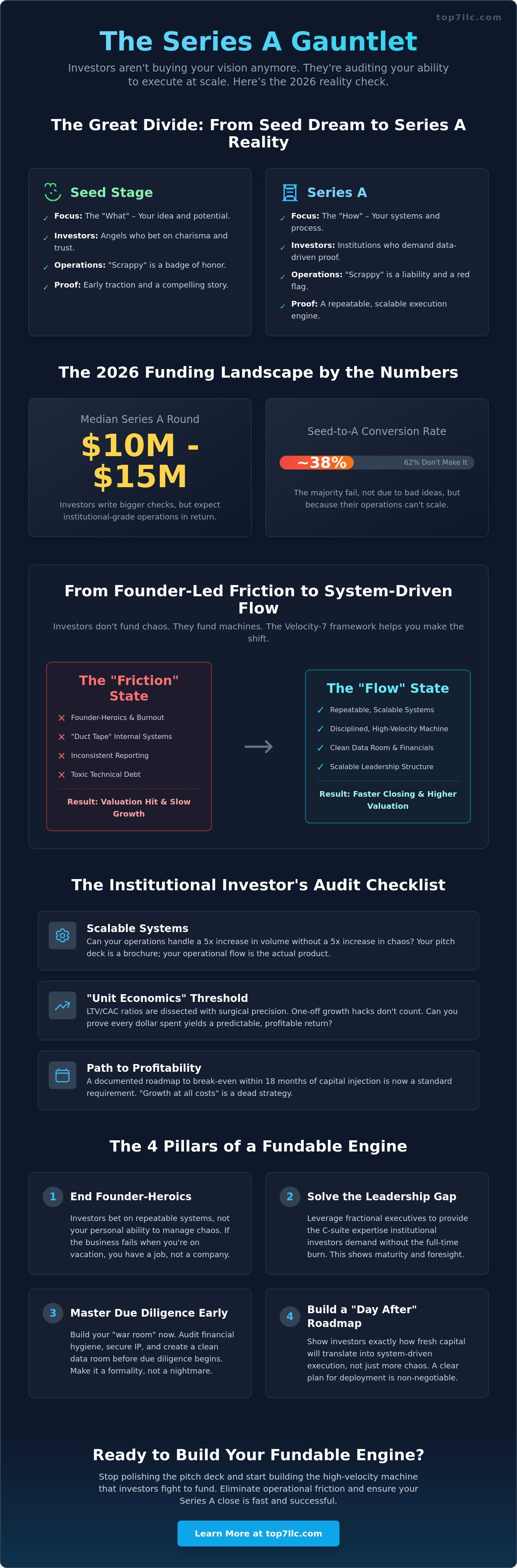
Your pitch deck is a work of fiction until your operations prove otherwise. Most founders preparing for a series a funding round spend weeks obsessing over slide transitions while their internal systems are held together by duct tape and hope. In 2026, the median Series A round has climbed to between $10 million and $15 million, but the conversion rate from Seed to Series A has plummeted to roughly 38%. Institutional investors aren't buying your vision anymore. They're auditing your ability to execute at scale without breaking. If your growth is currently fueled by founder burnout and technical debt, you aren't ready for a check. You're ready for a collapse.
It's time to stop polishing the surface and start building a fundable executive engine that survives the scrutiny of a $50 million valuation. This isn't about trying harder or working more hours. It's about implementing a scalable leadership structure and a clean data room that makes due diligence a formality rather than a nightmare. We'll show you how to eliminate operational friction and technical debt to ensure faster closing times. You'll learn exactly how to transform your startup from a chaotic project into a disciplined, high-velocity machine that investors fight to fund.
Key Takeaways
Stop relying on founder-heroics. Investors bet on repeatable, scalable systems, not your personal ability to manage chaos.
Implement the Velocity-7 Adaptive Framework to eliminate the operational friction that kills valuations and slows down growth.
Master the rigor of preparing for series a funding round by auditing financial hygiene and securing IP before due diligence begins.
Solve the leadership gap by leveraging fractional executives to provide the C-suite expertise institutional investors demand without the full-time burn.
Build a "Day After" roadmap to ensure fresh capital translates into system-driven execution rather than internal collapse.
Table of Contents
Beyond the Seed: The Brutal Reality of Series A Expectations in 2026
Eliminating Operational Friction: The Velocity-7 Approach to Scalability
Solving the Leadership Gap: Why Fractional Executives are the Secret Weapon
The Due Diligence War Room: Building Rigor into Your Data Room
From Funding to Flow: Executing Your Series A Roadmap with Top7
Beyond the Seed: The Brutal Reality of Series A Expectations in 2026
Seed funding was your reward for having a good idea and some early traction. Series A is a different beast entirely. It represents the first significant round of venture capital financing where the market stops caring about your potential and starts demanding proof of your process. While seed rounds focus on "What" you are building, preparing for series a funding round is strictly about "How" you will scale it. The 2026 VC landscape has shifted. Investors no longer tolerate burn rates that buy vanity metrics. They want efficiency. They want a repeatable engine, not a founder who works 100 hours a week just to keep the lights on.
To better understand the fundamental differences between these stages, watch this breakdown:
Investors aren't betting on your charisma anymore; they're betting on your systems. If your business collapses the moment you go on vacation, you don't have a company. You have a high-stress job. The "Founder-Hero" model is a liability at this stage because it doesn't scale. To win a $10 million check, you must demonstrate that your operations can handle a 5x increase in volume without a 5x increase in chaos. In this environment, your pitch deck is just a brochure. Your operational flow is the actual product.
The "Unit Economics" Threshold
Expect West Coast and Austin VCs to dissect your LTV/CAC ratios with surgical precision. They're looking for cracks in your foundation. Growth hacks and one-off viral moments don't count as sustainable revenue models in 2026. If you can't prove that every dollar you spend results in a predictable, profitable return, you're dead in the water. In 2026, a Series A profitability path requires a documented roadmap to break-even within 18 months of the capital injection.
Institutional Scrutiny vs. Angel Trust
The transition from angel investors to investment committees is a cold shower for most founders. Gut feelings are replaced by data-driven execution. You'll face different flavors of scrutiny depending on the zip code of your lead investor. Boston firms will grill you on stability and risk mitigation; Silicon Valley will demand a path to massive, aggressive scale. Moving from individual trust to institutional rigor means every claim in your deck must be backed by a "clean" data room and verifiable operational metrics. If the data doesn't match the story, the deal dies.
Eliminating Operational Friction: The Velocity-7 Approach to Scalability
Investors don't just buy your growth. They buy the efficiency of that growth. When you're preparing for series a funding round, "scrappy" is no longer a compliment. It's a synonym for technical debt and operational chaos. Most founders think they can fix the plumbing after they get the check. That's a fatal mistake. Institutional investors look for the Velocity-7 Adaptive Framework, a proprietary method designed to move a company from friction to flow. If your internal systems are held together by manual spreadsheets and founder-led heroics, your valuation will take a massive hit. You aren't selling a product anymore. You're selling a machine.
Operational friction is the silent killer of deals. It shows up as inconsistent reporting, slow customer onboarding, and a leadership team that spends 80% of its time putting out fires. To reach the level of Executing a Successful Fundraise, you must demonstrate that your business is a system, not a series of lucky accidents. "Scrappy" tech stacks that worked at Seed stage become toxic technical debt during Series A due diligence. VCs want to see that your architecture can handle a 10x surge in users without a total rebuild. Moving from friction to efficient flow must happen before the term sheet arrives, or you'll lose your leverage at the table.
Identifying the 7 Dimensions of Growth
Alignment isn't a buzzword. It's a requirement for survival. Your financial strategy, sales guidance, and technical leadership must work in a closed loop. If your product team builds features that sales can't sell, or if your CFO can't track the ROI of your marketing spend, your velocity is zero. We use the Velocity-7 framework to audit these dimensions. We identify the exact bottlenecks that scare away CTO-level due diligence teams. You can start this process by evaluating your current strategic planning maturity before your first investor meeting. A great product with a broken sales process won't get funded. Period.
Agile for Leadership, Not Just Software
Agile principles aren't just for developers. The Velocity-7 framework applies these concepts to C-suite decision-making to eliminate executive bottlenecks. Investors want to see that your leadership team can pivot and execute without breaking the entire organization. Reducing the time-to-market for new revenue streams is the ultimate proof of a scalable model. Flow directly impacts investor confidence because it proves you can deploy their capital into a high-performance engine rather than a black hole of inefficiency. When the data flows, the capital follows.
Solving the Leadership Gap: Why Fractional Executives are the Secret Weapon
Most founders fall into a classic Catch-22: you need a heavyweight C-suite to convince VCs you're a safe bet, but you need that VC check to pay their $300,000 salaries. Waiting until after the round to hire is a strategy for failure. In 2026, investors are more selective than ever. They don't want to hear about your "hiring plan" for the future. They want to see the leadership already in place to de-risk their $15 million investment. This is where fractional leadership becomes your most potent weapon while preparing for series a funding round. You get the expertise without the crippling burn rate.
Fractional executives signal "Institutional Readiness" to an investment committee. They prove you've moved past the "founder-hero" phase and are building a professional organization. By bringing in seasoned veterans, you eliminate the "Key Person Risk" that terrifies institutional investors. If your entire operational knowledge resides in your own head, you're a liability, not an asset. Distributing that knowledge across an experienced leadership bench proves your business can survive your absence and thrive under pressure. It's about fielding a winning team before you step onto the field.
Fractional CTO: Fixing the Tech Debt Before the Audit
Your lead developer is likely a brilliant coder, but they aren't a CTO. VCs know the difference immediately. A fractional CTO focuses on the technical roadmap, security protocols, and scalability audits that institutional standards demand. They ensure your architecture doesn't become a deal-breaker during technical due diligence. They clean up the "scrappy" messes that worked at Seed but will fail at Series A. Don't let unaddressed technical debt kill your valuation at the finish line.
Fractional CFO: Beyond the Accountant
Your tax accountant is fine for filing returns, but they can't build a 3-year financial model that survives a Series A analyst's interrogation. You need Strategic Financial Planning for Growth to defend your burn rate and your valuation. A fractional CFO handles strategic capital planning, ensuring you aren't asking for too much or too little. They build the rigor into your financial reporting that makes an investment committee feel comfortable. If you can't explain your unit economics with absolute precision, you aren't ready for a check. A CFO ensures you never have to guess.
The Due Diligence War Room: Building Rigor into Your Data Room
Due diligence isn't a polite request for information. It's a high-stakes interrogation where the "vision" of your pitch deck meets the cold reality of your operations. If you're preparing for series a funding round, your data room is your primary defense. Investors don't just want to see your growth. They want to see the scars, the structures, and the proof that you won't incinerate their capital. A messy data room doesn't just delay a deal. It kills it. Most founders fail here because they treat documentation as an afterthought rather than a strategic asset.
To survive the scrutiny of institutional analysts, you must build rigor into every folder of your war room. This process starts with five non-negotiable steps:
Audit your financial hygiene. GAAP compliance is no longer optional. If your books are a tangle of cash-basis entries and personal expenses, you'll be laughed out of the room.
Formalize IP and employment. Secure every line of code and every contract. Investors won't touch a company with "ownership leaks" or vague contractor agreements.
Document your Sales Playbook. Prove that your revenue is a repeatable system, not just the result of a single "star salesperson" who could leave tomorrow.
Stress-test your tech stack. You need to demonstrate that your infrastructure can handle 10x growth without a total meltdown.
Define your KPIs. Be ready to explain the "why" behind every number. If you can't defend your churn or CAC trends, you don't understand your business.
The Tech & Product Audit
Expect a deep dive into your code, architecture, and security protocols. VCs will hire outside experts to find the "spaghetti" in your backend. This is why a Fractional CPO is vital. They align your product roadmap with revenue goals and ensure your technical debt won't trigger a red flag. Common deal-killers include lack of documentation, poor security compliance, and a product vision that isn't backed by actual user data. If your lead developer can't explain the scaling plan, the deal is dead.
Financial Strategy and Governance
Move beyond manual spreadsheets. They're a massive red flag for Series A investors because they suggest a lack of control and a high risk of human error. You need to establish a formal Board of Directors or leverage professional Advisory Services to provide the oversight that institutional capital demands. Transparency is the highest currency in a due diligence war room. If you try to hide a flaw, they will find it, and your credibility will be gone forever.
Don't wait for the term sheet to start organizing. Build a bulletproof foundation today with our Fractional Leadership experts who have survived the due diligence trenches before.
From Funding to Flow: Executing Your Series A Roadmap with Top7
Winning the wire transfer isn't a victory lap. It's the moment the clock starts ticking toward your next milestone. Roughly 40% of Series A companies fail to ever reach a Series B round. This isn't usually a product failure. It's an operational collapse. When you spend months preparing for series a funding round, you focus on the "get." Once you have the capital, the challenge shifts to "spend." Without a rigorous system like the Velocity-7 Adaptive Framework, new capital just fuels old inefficiencies. It accelerates your burn rate without increasing your strategic output. You don't need more money to hide your problems; you need a system to solve them.
The sudden influx of capital often leads to a hiring frenzy that bloats the organization before the processes are ready. This is where interim leadership acts as a critical bridge. You need the expertise of "Big-Co" executives to build your foundation, but you don't necessarily need their $350,000 salaries on your permanent payroll yet. The monthly retainer model of fractional leadership provides surgical precision. You get the architect to design the system today, allowing you to hire the builders later. It's the only way to scale without incinerating your runway on executive overhead that isn't yet fully utilized.
Scaling Without Executive Burnout
Founder burnout is the result of trying to be the CEO, COO, and CTO simultaneously. It's impossible to maintain strategic agility when you're buried in operational noise. Fractional leaders offload the "how" so you can focus on the "why." They add the necessary layers of corporate structure without the suffocating bureaucracy of a legacy firm. The goal is a seamless transition. You use fractional expertise to build the playbook, then you bring in permanent hires once the role is clearly defined and the risk is mitigated. It's about controlled growth, not chaotic expansion.
Your Growth Partner in Every Major US Hub
Success in the Series A landscape requires more than just a remote consultant. You need seasoned professionals who have sat in the seat before and survived the scrutiny of top-tier VCs. Top7 maintains a dominant presence in every major innovation hub, from the stability-focused firms in Boston to the high-scale environments of Austin and the West Coast. We don't offer generic advice. We provide tactical execution and operational flow that turns your pitch deck's promises into measurable reality. The competition for market share is a kőkemény struggle. Don't go in unarmed.
Stop guessing and start scaling. Schedule a call with a Top7 Executive.
Stop Polishing Slides and Start Building Systems
Your vision is worthless if your engine is broken. Investors in 2026 are looking for systems, not stories. If you want to close a $15 million check, you need to prove you can handle the weight of institutional capital without collapsing. Preparing for series a funding round is a test of your operational maturity. It's the moment where you move past founder-led heroics and embrace the discipline of a professional C-suite.
Don't walk into the due diligence war room alone. We provide the strategic planning and interim leadership needed to de-risk your business and maximize your valuation. With our proprietary Velocity-7 Adaptive Framework and seasoned professionals across Boston, Austin, and the West Coast, we turn your scrappy chaos into a fundable executive engine. You've built something great. Now let's make sure it's scalable. It's time to stop guessing and start winning.
Get Your Series A Readiness Audit with Top7
Frequently Asked Questions
When should I start preparing for a Series A funding round?
Start your internal audit at least six months before you plan to pitch. By the time you're actively preparing for series a funding round, your data room should already be 80% complete. Desperation is a deal-killer that VCs smell instantly. You need this lead time to fix operational friction, clean up technical debt, and ensure your financial reporting is GAAP-compliant before an investment committee sees it.
What are the most important metrics for Series A in 2026?
Investors now prioritize efficiency over raw growth at all costs. You need an ARR between $1 million and $3 million with a clear roadmap to profitability within 18 months. VCs look for a LTV/CAC ratio above 3:1 and a Seed-to-Series A conversion rate that justifies the risk. If your unit economics are broken, no amount of top-line growth will convince an institutional analyst to sign.
Can a Fractional CTO really help during the due diligence process?
A Fractional CTO is your primary defense during the technical deep dive. They audit your architecture, secure your IP, and prepare the technical roadmap that institutional standards demand. They translate your lead developer's "scrappy" code into a narrative of enterprise-grade scalability. Without this leadership, you risk losing the deal because your tech stack looks like a liability rather than a scalable asset.
How much does it cost to hire a Fractional Executive for Series A prep?
The cost varies based on the complexity of your operations, but it's always a fraction of a full-time executive's salary and equity package. You're buying decades of C-suite experience on a monthly retainer, which preserves your precious runway. This model allows you to deploy more capital into growth while still presenting a professional, de-risked leadership structure to potential investors during the due diligence phase.
What is the biggest mistake founders make when preparing for Series A?
Relying on the "Founder-Hero" model is the most common deal-killer. Investors aren't betting on your ability to work 100 hours a week; they're betting on your systems. If the company breaks when you step away, it's a project, not a business. Failing to document processes or leaving "ownership leaks" in employment contracts are traps that kill deals at the finish line during the audit.
How long does the Series A due diligence process typically take?
The entire process from the first meeting to the wire transfer usually takes three to six months. Due diligence specifically consumes four to eight weeks of intense scrutiny. If you're preparing for series a funding round with a disorganized data room, expect delays that can stretch this timeline. Speed is a byproduct of being operationally ready before you ever step into the first investor meeting.
Is the Velocity-7 framework suitable for non-tech companies?
Yes, because the Velocity-7 Adaptive Framework is an operational system, not a software tool. It focuses on aligning leadership, financial strategy, and sales processes to eliminate friction. Any business aiming for repeatable growth needs these dimensions synchronized. Whether you're in SaaS or manufacturing, the requirement for efficient flow and system-driven execution remains identical in the eyes of a Series A investor.
Do VCs prefer full-time executives over fractional ones?
VCs prefer "Institutional Readiness" over specific payroll titles. While they eventually want a permanent team, they value the expertise a seasoned fractional executive brings to the scaling phase. Hiring the wrong full-time C-suite leader is a $500,000 mistake that can sink a startup. Fractional leadership proves you're disciplined enough to bridge the gap with proven professionals rather than rushing into a bad, permanent hire.


Comments