
Stop Scaling Chaos: Building a Scalable Operational Infrastructure for Mid-Market Growth

Updated: Jul 19
Is your growth actually a slow-motion train wreck? You’ve fought for the market share, but now that you have it, the wheels are coming off. Your delivery is lagging, your best people are hitting a wall, and you’re still the one putting out fires at 9 PM. Building a scalable operational infrastructure isn't a luxury for the future. It's the only way to survive the success that's currently suffocating your profit margins. You’re tired of wearing every hat in the building while growth stalls despite high demand.
You know that more headcount isn't the answer. You've tried that, and it just added more noise to the system. You need a repeatable framework that turns your vision into execution without requiring your constant intervention. This article will show you how to dismantle operational friction and install leadership-driven systems that sustain rapid growth without executive burnout. We'll explore the clear roadmap for technology and leadership scaling that reduces your personal workload and restores visibility into every department. It's time to stop managing chaos and start leading a machine.
Table of Contents
The Scalability Trap: Why Traditional Operations Fail at Scale
Growth is a trap if you don't have the foundation to support it. Most mid-market founders mistake hiring for scaling. You're just adding weight, not speed. Real Scalability is about how your systems handle increased load without a proportional increase in cost or chaos. Building a scalable operational infrastructure requires a brutal, honest look at the alignment between your leadership, your processes, and your technology stack. If these three pillars aren't locked in, you're just building a bigger fire that will eventually consume your margins.
To better understand how world-class leaders approach this level of structural design, watch this breakdown of infrastructure logic:
The "Growth Ceiling" is a mathematical reality. The manual workarounds and "hero-based" culture that got you to $5M will actively prevent you from reaching $50M. In competitive hubs like Dallas or Boston, the pressure is even higher. You can't out-hustle a broken system when your competitors are using precision-engineered operations to steal your market share. Every manual spreadsheet and "special favor" process is a leak in your profit bucket. Stop pretending your lack of structure is "agility." It's just friction.
The Difference Between Growth and Scaling
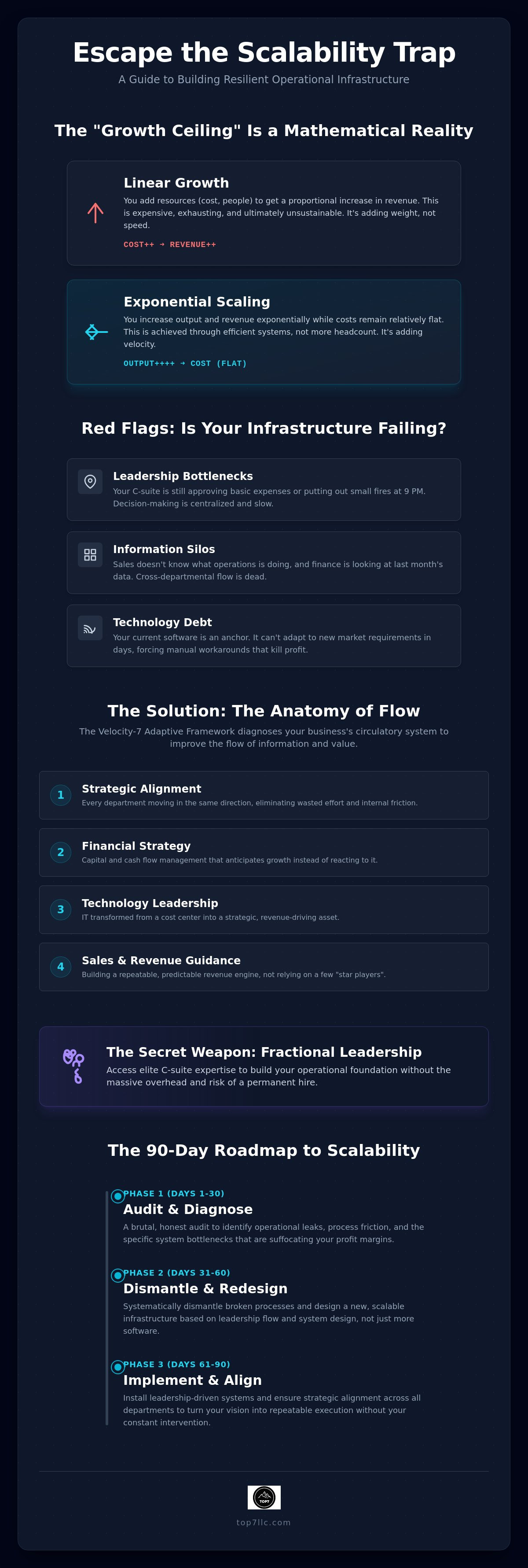
Growth is linear. You add a dollar of cost to get a dollar of revenue. It's expensive and exhausting. Scaling is exponential efficiency. It's about increasing your output while your costs remain relatively flat. If you're simply adding mass, you're becoming a slower, heavier version of your former self. We use the Velocity-7 Adaptive Framework to pivot companies from adding mass to adding velocity. It's the difference between a crowd of people running in different directions and a high-speed train on a fixed track.
Symptoms of a Broken Infrastructure
How do you know you're failing? Look at your C-suite. If your executives are still approving basic expenses or troubleshooting minor delivery delays, you have a decision-making bottleneck. Information silos are another red flag. When your sales team doesn't know what operations is doing, your cross-departmental flow is dead. Finally, there's technology debt. If your current software can't adapt to a new market requirement in days, not months, your infrastructure is an anchor. The true cost of building a scalable operational infrastructure is the ego you leave at the door when you stop being the "hero" and start being the architect.
The Anatomy of Flow: 7 Dimensions of Scalable Infrastructure
Dimension one is Strategic Alignment. Every single department must move in the same direction, or you're just paying for internal friction. Dimension two is Financial Strategy. Scaling requires capital and cash flow management that anticipates growth rather than reacting to it. Modern Operations management (OM) principles dictate that efficiency is born from this type of proactive structural design. If your finance team is still looking at last month's data to make next month's decisions, you're already behind the curve.
Dimension three is Technology Leadership. IT must stop being a cost center and start being a strategic asset that drives revenue. Dimension four is Sales & Revenue Guidance. You need a repeatable revenue engine, not a group of "star players" who keep their secrets in their heads. If your revenue isn't predictable, your infrastructure will never be stable. The remaining dimensions—Product Maturity, People Flow, and Operational Execution—complete the circuit. Without all seven working in harmony, you're just managing different versions of the same chaos.
Technology and Product Maturity
Stop building "custom everything." It's a scalability killer that creates massive technology debt. You need modular, scalable systems that grow with your ambitions. This is where a Fractional CTO becomes indispensable. They audit your existing debt and ensure your product development aligns with actual market demand, not just developer whims. Don't let your code base become the reason you can't enter a new market or handle a sudden 10x spike in demand.
Operational and People Flow
Your processes shouldn't need you. If a decision requires executive intervention, your process is broken. We apply agile-based transformation to non-tech departments to create a culture of high-velocity accountability. People need to know exactly what they're responsible for and how their performance is measured in real-time. When the flow is clear and the "hero culture" is replaced by system-driven results, the chaos disappears. You're no longer the bottleneck; you're the architect of a high-performance machine.
Fractional Leadership: The Secret Weapon for Scalable Infrastructure
You’ve reached the point where "hustle" no longer scales. To break through the growth ceiling, you need world-class leadership, but your balance sheet isn't ready for five different $300,000 salaries plus benefits and equity. This is the mid-market trap. Most firms try to bridge the gap by hiring "managers" who lack the strategic depth to fix the underlying rot. Fractional leadership is the tactical bypass. It allows you to rent the brain of a battle-hardened executive who has already scaled companies ten times your size. These aren't consultants who leave you with a pile of slide decks; they are operators who embed with your team to drive execution.
The speed advantage is undeniable. A fractional leader has "seen this movie before" and knows exactly where the plot twists into chaos. While a full-time hire might take six months to understand your culture, a fractional pro identifies your primary bottlenecks in the first week. They are specifically suited for the "build" phase of building a scalable operational infrastructure because they focus on architecture over maintenance. Once the systems are running and the friction is gone, you can decide if you need a permanent hire or if the system is robust enough to run on its own. It’s a high-impact, low-risk model that prioritizes profit over headcount.
The Fractional CTO: Architecting Your Tech Stack
Stop assuming your lead developer is a CTO. One builds features; the other builds a business engine. A Fractional CTO bridges the gap between your aggressive business goals and technical reality. They perform the brutal infrastructure audits needed to prevent your tech stack from becoming a house of cards. With cloud spending waste projected to hit 35% of total budgets by 2026 due to inefficient practices, their vendor management and architectural oversight pay for themselves. They ensure your technology is a revenue driver, not a persistent bottleneck.
The Fractional COO: Designing the Playbook
If your business dies the moment you stop answering your phone, you don't have an infrastructure; you have a job. A Fractional COO moves your organization from "founder-led" to "system-led" by implementing the Velocity-7 framework. They design the playbooks for your supply chain, delivery, and people flow so the machine runs without your constant intervention. Their goal is to reduce operational friction until flow becomes the default state. By building a culture of accountability and clear processes, they return your time so you can focus on high-level strategy instead of daily fires.
The 90-Day Roadmap to Building Scalable Infrastructure
Stop guessing your way through growth. A roadmap isn't a suggestion; it's a tactical directive. Building a scalable operational infrastructure takes exactly 90 days if you stop making excuses and start executing. You don't need a year of "discovery" meetings. You need a sequence that prioritizes profit over ego. This isn't about minor tweaks; it's about a fundamental reengineering of how your company breathes and moves. If you can't fix it in three months, you aren't leading; you're just spectating.
Phase 1 starts with the Organizational Audit. We identify exactly where your cash is leaking and where your talent's time is being murdered. Phase 2 moves to Removing the Bottlenecks. You address the #1 friction point immediately. Usually, this is a "hero" employee or a founder who refuses to let go of the keys. Phase 3 is about Standardizing the Flow. You codify every essential process into a repeatable playbook that doesn't require your presence to function. Phase 4 involves Scaling the Leadership. This is where you integrate fractional experts to lead departments and own the outcomes. Finally, Phase 5 is Continuous Optimization. You use agile loops to stay adaptive, ensuring your infrastructure evolves as fast as the market does.
Setting Your KPIs for Infrastructure Success
Output is a vanity metric. Flow is a sanity metric. You need to measure how long it takes for a dollar of marketing spend to turn into a dollar of delivered service. If that "flow time" is increasing as you grow, your infrastructure is failing. Look at your financial indicators, specifically your revenue per employee. If that number isn't rising, you're just adding mass, not velocity. Monitor your employee burnout rates too. High turnover in your middle management is a flashing red light that your operations are toxic and unsustainable.
Leveraging Technology for Automation
Your tools must talk to each other. If your CRM doesn't shake hands with your project management software, you're just paying for digital silos. Adopt an API-first mentality to ensure every piece of your tech stack contributes to a single source of truth. Automate the "boring stuff" like data entry, status updates, and basic reporting to free up your executive bandwidth for high-level strategy. Operational Automation is a tool for human leverage, not replacement. When you automate the repetitive, you allow your best people to focus on the competitive. Stop wasting $150 an hour talent on $15 an hour tasks. Build the machine so your people can drive it. For specialized industries like dentistry, you can check out TurnUp World to see how their copilot platform optimizes front-desk capacity and flow.
The Top7 Advantage: Velocity-7 and Adaptive Leadership
Most consultants leave you with a 50-page PDF and a handshake. We find that offensive. Building a scalable operational infrastructure isn't a theoretical exercise; it's a tactical necessity that requires hands-on execution. Top7 doesn't just advise from the sidelines. We embed battle-tested fractional executives directly into your team to solve the complex growth obstacles you're currently ignoring. Whether you're battling delivery delays or tech debt, we own the outcomes alongside you. Our Velocity-7 Adaptive Framework was designed specifically for the mid-market, where agility must meet structural discipline.
Leaders in competitive markets like Austin, Chicago, and Boston trust Top7 because we understand the high-velocity requirements of these hubs. In 2026, the margin for error is razor-thin. You can't afford to wait six months for a traditional executive search while your profit drains through operational leaks. We move you from friction to flow by installing the systems that make growth predictable. If your current leadership is overwhelmed, you don't need more meetings. You need the precision-engineered leadership that only comes from operators who have scaled through the exact chaos you're facing right now.
Beyond Traditional Consulting
Advisory services are a dime a dozen. What's rare is the ability to lead a department through a total transformation. The Top7 promise is simple: strategic guidance meets direct leadership. We don't just tell you that your technology is failing; our fractional leaders rewrite the roadmap and manage the migration. We've seen organizations remove significant operational friction just by re-aligning their people flow with the Velocity-7 framework. We provide the "Build" phase expertise so your permanent hires can focus on the "Run" phase with a clean slate.
Ready to Scale Without the Friction?
The high cost of waiting is often invisible until it's too late. Every day you spend "wearing too many hats" is a day your competitors spend capturing your market share. Leadership gaps don't just slow you down; they drain your profit and burn out your best talent. It's time to stop managing the chaos and start building a machine that works for you. Take the first step toward true operational freedom. You can Schedule your Strategic Consultation with Top7 today and get a brutal, honest audit of your current infrastructure. Let's find the leaks and plug them for good.
Take Command of Your Growth Engine
Success shouldn't feel like a struggle for survival. If your business is growing but your profit is flat and your stress is peaking, your foundation is the problem. You now have the blueprint to stop the bleed. By shifting from a hero-based culture to a system-led machine, you reclaim the strategic advantage that got you here. Building a scalable operational infrastructure is the only way to ensure your mid-market firm doesn't just survive the race, but wins it decisively. Every day you hesitate is a day your competitors tighten their grip on your market share.
Top7 brings the Velocity-7 Adaptive Framework and seasoned professionals with direct C-Suite experience to your front lines. Our localized expertise in major US business hubs ensures your scaling strategy accounts for the raw business reality of your specific market. You've seen the 90-day roadmap. You know the cost of waiting. It's time to install the leadership and processes that turn demand into a repeatable, high-velocity revenue engine. Don't let your growth become your greatest liability. Take action now and build the machine your vision deserves.
Stop the friction. Start the flow. Book your Top7 Fractional Leadership consultation today.
Frequently Asked Questions
What is the difference between business growth and business scaling?
Growth is linear; scaling is exponential. You grow by adding more resources to get more revenue, which keeps your margins thin and your stress high. Scaling is about building a system that increases output while your costs remain relatively flat. If your overhead climbs as fast as your sales, you aren't scaling; you're just getting bigger and more fragile.
How do I know if my company needs a Fractional COO or a Fractional CTO?
Choose a Fractional COO if your delivery is messy and your team is constantly confused about their priorities. Choose a Fractional CTO if your software is a house of cards or your developers are consistently missing deadlines. If you can't tell which one you need, you likely need a COO first to audit the entire flow of the business and identify the primary friction points.
What are the common signs of operational friction in a mid-market company?
Look at your own calendar first. If you're still approving minor expenses or fixing client complaints personally, that's friction. Other signs include departments that operate in silos and a dangerous reliance on "hero" employees who are the only ones who know how a specific process works. When your delivery speed slows down as your order volume goes up, your infrastructure is failing.
Is building a scalable infrastructure too expensive for a company under $10M?
Building a scalable operational infrastructure is actually cheaper for smaller companies because you're preventing the massive waste that comes with messy growth. Waiting until you're at $20M to fix your foundation is a recipe for a catastrophic collapse. Fractional leadership makes elite expertise affordable at any stage by giving you the brainpower you need without the full-time executive price tag.
How does the Velocity-7 framework differ from traditional business consulting?
Traditional consultants give you a binder full of suggestions and a large bill. The Velocity-7 framework provides an adaptive operating system and a leader who actually implements it. We don't just tell you what's wrong; we embed with your team to fix the gears while the machine is running. It's about execution and measurable profit, not just high-level advisory reports.
Can a Fractional executive really understand my business as well as a full-time hire?
A fractional executive understands your business faster because they've seen your exact problems a dozen times before. They don't need months of "onboarding" to find the rot. They bring a level of objectivity and battle-hardened experience that a full-time hire often lacks. They focus on results because their value is tied to the efficiency they create, not the hours they sit in a chair.
What are the first steps to building a scalable tech infrastructure?
Start with a brutal audit of your current tech debt to identify every manual workaround that should be an automated process. You need to ensure your tools are API-first so they can talk to each other without human intervention. From there, align your technology roadmap with your actual business goals rather than just chasing the latest features. Tech must serve the revenue engine.
How long does it take to see results from an operational infrastructure overhaul?
You'll see immediate clarity and bottleneck removal within the first 30 days of the engagement. While building a scalable operational infrastructure is a continuous process, the core "overhaul" typically takes 90 days to reach a state of flow. This timeframe allows us to audit, standardize, and lead your team into a new rhythm of accountability. You'll know it's working when your personal workload drops significantly.



Comments