

Scaling Business Challenges: Why Mid-Market Companies Hit the Growth Wall in 2026
- Robert Fitzgerald
- 3 hours ago
- 12 min read

What if the very systems that built your first $1M are the exact anchors dragging you down now that you've hit $10M? Most mid-market leaders treat scaling business challenges as sales problems, but they're actually structural failures. You're working harder than ever, yet your margins are thinning and your C-suite is burning out in the weeds of daily operations. It's a raw reality in 2026. With the Federal Reserve holding rates at 3.5% and a "low-hire, low-fire" labor market, you can't just throw expensive headcount at a broken process and expect a different result.
We know the frustration of watching operational friction eat your profits while your competitors leverage AI to move faster. You want predictable revenue and the freedom to lead, not a calendar full of fires to extinguish. This article identifies the specific bottlenecks killing your expansion and shows you how to transition to high-velocity flow using the Velocity-7 Adaptive Framework. We'll break down why fractional leadership is the surgical strike your organization needs to dismantle the growth wall and reclaim your strategic edge.
Table of Contents
Scaling vs. Growth: Why Your Current Success is Your Biggest Bottleneck
The Leadership Gap: Why You Can’t Scale with Your Current Org Chart
Operational Friction: The Silent Killer of Mid-Market Expansion
Strategic Misalignment: When Your Sales Outpace Your Systems
Overcoming Scaling Challenges with the Velocity-7 Adaptive Framework
Scaling vs. Growth: Why Your Current Success is Your Biggest Bottleneck
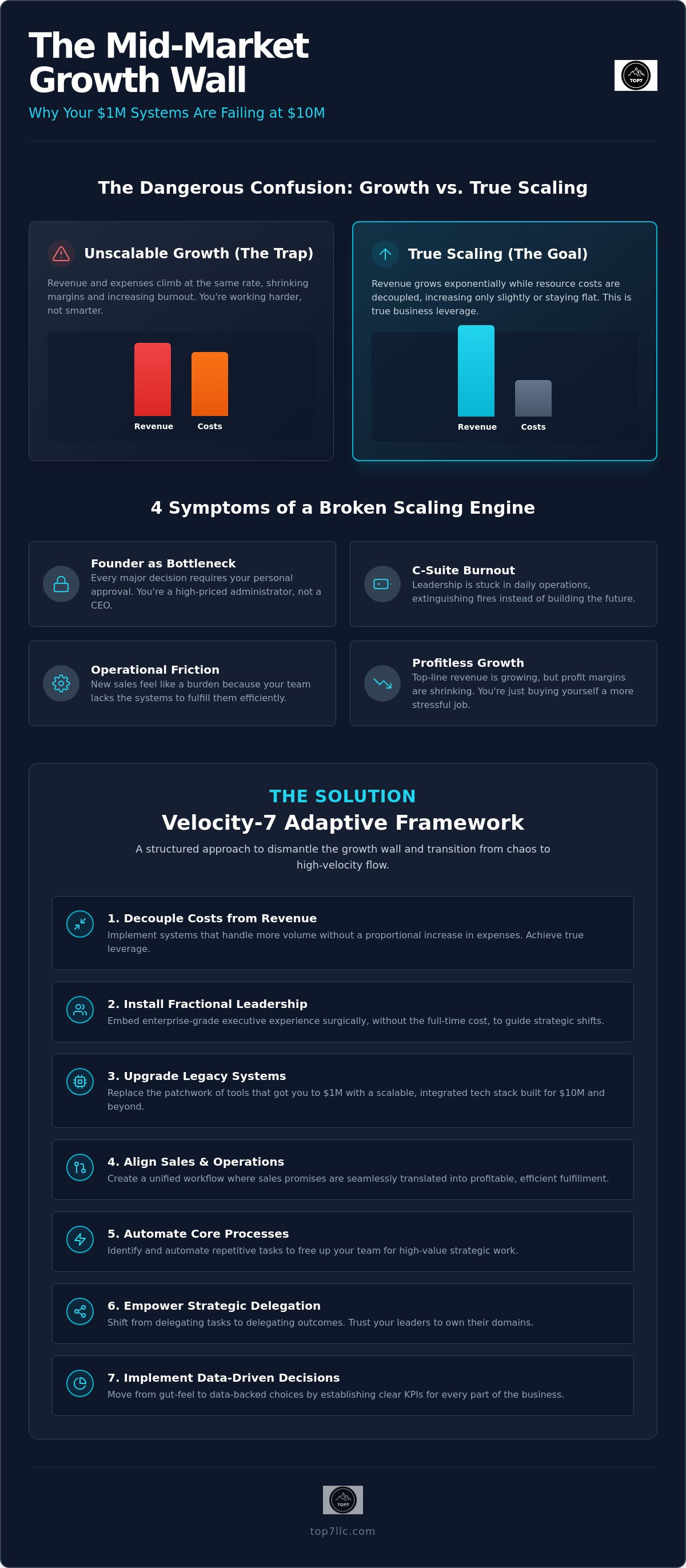
Stop celebrating your top-line growth. It might be killing you. In the 2026 economy, where the prime rate sits at 7% and talent is both expensive and scarce, "growth at all costs" is a suicide mission. If your expenses are climbing at the same rate as your revenue, you aren't building a legacy; you're building a cage. This is where most scaling business challenges begin. You're running faster just to stay in the same place. It's a exhausting cycle that eventually ends in a crash.
Building a legacy often involves diversifying your success into other scalable industries; for those interested in high-yield assets, check out Multifamily Schooled.
Real Scalability is about leverage. It's the ability to handle increased volume without a proportional increase in costs. If you need to hire five new people every time you sign a major client, you don't have a scalable business model. You have a staffing problem. True scaling requires a fundamental shift from linear thinking to exponential systems. Without this shift, your current success will eventually become the weight that pulls your organization under.
To better understand the friction between growth and scale, watch this breakdown:
The Definition of Scaling in 2026
Scaling is the decoupling of revenue growth from resource expenditure. In today's market, efficiency is the only metric that matters. Adding headcount to solve a workflow problem is like pouring water into a leaky bucket. You might fill it for a moment, but the structural failure remains. To optimize your workforce and reduce overhead, learn more about Amplify Yourself, LLC. Scaling means your systems do the heavy lifting while your team focuses on high-value execution. If your profit margins are shrinking while your sales are rising, you're growing, but you're failing to scale.
When Success Becomes a Liability
Founder heroics don't scale. If every major decision or "fire" requires your personal intervention, you are the primary bottleneck to your company's future. This is the classic mid-market trap. You've built a business that relies on your individual grit, but grit doesn't work at the $10M or $20M level. Symptoms include a C-suite that acts like glorified project managers and operational friction that makes every new deal feel like a burden. When your team starts dreading new sales because they don't know how they'll fulfill them, you've hit the wall. These are the scaling business challenges that require a complete overhaul of your operating system, not just a better marketing plan.
Addressing the structural failures of your business is essential, but don't overlook the personal cost of leading through friction. High-performers often find that partnering with 5280 Restorative Medicine allows them to reclaim their vitality and maintain the mental clarity needed to navigate these complex scaling hurdles.
The Leadership Gap: Why You Can’t Scale with Your Current Org Chart
You're stuck. Your org chart looks like a collection of people you liked three years ago, not the elite squad you need to hit $50M. This is the core of the scaling business challenges most CEOs refuse to admit. Promoting your best technician to a management role is a classic mistake. It robs you of a producer and gives you a mediocre leader. In a market where the prime rate is 7%, you don't have the margin for error that "trial and error" leadership creates. You need precision, not practice.
The challenges faced by mid-market companies often stem from this specific leadership vacuum. You need strategic executive thinking, but your budget is currently optimized for tactical execution. Hiring a full-time, enterprise-grade COO or CTO in 2026 can easily cost $250,000 plus benefits. If they fail, the ripple effect on your culture and capital is catastrophic. A bad hire at this level is a $1M disaster once you factor in lost momentum and severance. You can't afford to get this wrong.
The Founder’s Dilemma: From Doer to Leader
You probably think nobody knows the business like you do. You're right. But that's exactly why you're the bottleneck. Scaling requires moving from "How do we do this?" to "Who is leading this?" If you're still approving every software purchase or interviewing every entry-level hire, you aren't a CEO. You're a high-priced administrator. You must delegate strategic decision-making, not just tasks. If you can't trust your leadership team to run the company for a month without you, you don't have a scalable company. You have a job, and overcoming this hurdle often requires the high-impact coaching and business development advisory provided by Jani Havunen.
The pressure of maintaining this level of control often spills over into personal lives; for executives seeking relationship counselling UK, specialized therapy can help navigate the emotional complexities that arise when professional and personal worlds collide.
Fractional Leadership: The 2026 Scaling Hack
How do you get enterprise-level strategy on a mid-market budget? You stop hiring full-time and start thinking fractionally. A Fractional CTO or COO brings the battle-tested systems of a $100M company to your $10M operation. They don't need months of "onboarding." They need an objective and the authority to execute. This model provides the high-level oversight required to solve scaling business challenges without the bloated payroll. It’s about buying the outcome, not the hours. If your growth has stalled, it might be time to explore how Interim Leadership can reset your trajectory without the long-term risk of a traditional hire.
Operational Friction: The Silent Killer of Mid-Market Expansion
Operational friction isn't just a buzzword; it's the sand in your gears. It's the reason your $10M company feels ten times harder to run than your $1M company. While you're obsessing over sales, this invisible resistance is eating your margins from the inside out. You've hit a growth wall because your people, processes, and technology are no longer aligned. They're fighting each other instead of the competition. If every new client feels like a burden on your team rather than a victory, you have a friction problem.
Most mid-market leaders are drowning in "Tech Debt." You've built a patchwork quilt of software solutions that don't talk to each other. Your CRM is a mess, your project management tool is a graveyard of unfinished tasks, and your billing system requires manual entry. This fragmentation is one of the most common scaling business challenges in 2026. You can't make high-velocity decisions when you're still relying on gut feelings and messy spreadsheets that are out of date the moment they're saved. In an environment with 3.3% core inflation and high capital costs, guessing is a luxury you can't afford.
Identifying Friction in Your Processes
Does your organization follow the "Three-Meeting Rule"? If it takes three separate sit-downs to make a single strategic decision, your organization has too much friction. In hyper-competitive markets like Austin or Boston, speed is your only real moat. Communication silos are the enemy of speed. When information gets trapped in departments, your response time slows down, and your competitors eat your lunch. You need Advanced Project Management to move from reactive firefighting to proactive execution. If your team is spending more time talking about work than actually doing work, you're losing the war for market share.
Technology as an Asset, Not a Bottleneck
Stop buying tools and start building a stack. Many founders treat software like a grocery list, picking up whatever looks shiny at the moment. A Fractional CTO doesn't just fix the server; they align your entire tech strategy with your revenue goals. In 2026, AI and automation aren't luxuries. They are the standard for mid-market survival. Are you using data to de-risk your decisions, or are you just praying for the best? A scalable technology stack should act as an accelerator, not a brake. When your systems are integrated, you reach a state of "Flow." Growth becomes a byproduct of your infrastructure rather than a result of manual labor. Is your current tech stack helping you win, or is it just another bill you're paying every month?
Strategic Misalignment: When Your Sales Outpace Your Systems
Stop pretending your sales team is a strategy. Selling faster than you can fulfill is a death sentence for a mid-market company. When your revenue outpaces your infrastructure, you aren't growing; you're accumulating "organizational debt" that will eventually come due with interest—a burden that often includes complex administrative filings across states, which you can find out more about managing through centralized entity searches. This is one of the most dangerous scaling business challenges. You're effectively financing your own collapse by promising what your operations can't deliver. If your customer churn is rising alongside your sales, you've already hit the wall.
True scaling requires a tight triumvirate between your Sales (CRO), Product (CPO), and Operations (COO). In many firms, these departments act like separate kingdoms. Sales closes deals the product can't support, and operations is left to clean up the mess. We solve this through the Seven Dimensions of Growth, a framework that ensures your revenue engine, product roadmap, and delivery systems move in total lockstep. In a 2026 economy where real GDP growth is projected at a modest 2.2%, you don't have the luxury of wasting leads on a broken delivery model.
Building a Revenue Engine, Not Just a Sales Team
A sales team closes deals; a revenue engine creates sustainable, predictable expansion. This is where a Fractional CRO earns their keep. They don't just look at the pipeline. They align marketing, sales, and customer success into a single, cohesive unit. You must re-evaluate your product-market fit at every $5M revenue milestone. What worked when you were a scrappy startup won't survive the scrutiny of enterprise-level clients. Identifying "leaky" revenue streams, where the cost of service exceeds the lifetime value, is critical. If a client is draining your resources without providing a healthy margin, they aren't a partner. They're a parasite.
Agile Transformation for the Mid-Market
Static, five-year strategic plans are relics of a slower age. In 2026, you need an agile roadmap that pivots every 90 days based on real-time data. We take the agile principles from the tech world and apply them to your entire business operation. This allows you to shift strategy without breaking your company culture or losing momentum. It's about precision execution over brute force. For a deep dive into building these systems, read The CEO’s Guide to Strategic Planning. You need a living document that guides your team, not a dusty PDF in a shared folder. If you're ready to stop guessing and start executing with certainty, it's time to book a Strategic Planning session to audit your current trajectory.
Overcoming Scaling Challenges with the Velocity-7 Adaptive Framework
Generic consulting is a waste of your capital. You don't need a fifty page slide deck that gathers dust; you need a battle-tested operating system that produces measurable results. Most scaling business challenges persist because leaders try to fix symptoms instead of the underlying structural friction. The Velocity-7 Adaptive Framework is our proprietary solution for mid-market firms that have hit the growth wall. It moves your organization from a state of constant firefighting to a high-velocity flow where growth is predictable and systems are autonomous.
We solve the "Leadership Gap" by synchronizing the seven critical dimensions of your business: Financial, Sales, Technology, Operations, Product, Marketing, and People. In the 2026 economy, where the prime rate is stuck at 7% and core inflation remains at 3.3%, you can't afford to have even one of these dimensions out of alignment. If your sales are moving at 100 mph but your technology stack is stuck at 20 mph, your company will eventually tear itself apart. We embed fractional executives directly into your team to ensure every gear in your machine is turning at the same speed.
Executing the Velocity-7 Framework
Our process isn't about theory; it's about tactical execution. We start with a surgical audit to identify the specific friction points that are stalling your expansion. Once the bottlenecks are mapped, we move into the execution phase. This is where we provide Interim Leadership to drive the necessary changes from the inside. We don't just tell you what's wrong; we fix it. Finally, we focus on the sustainability phase. We build the automated systems and cultural frameworks that allow your business to scale without requiring your constant, 80-hour-a-week intervention.
Your Next Step: Audit Your Growth
Stop guessing why your growth has stalled. There is a massive difference between a consultant and an interim leader. Consultants talk, but interim leaders execute. If you're tired of "promising" growth that never hits the bottom line, it's time to change your approach. You need a partner who understands the raw reality of the 2026 market and has the strategic dominance to navigate it. Don't let operational drag kill your legacy. Take the first step toward a high-velocity future and Schedule a Scaling Audit with a Top7 Executive today. It’s time to move from friction to flow and reclaim your seat at the head of the market.
Break the Growth Wall and Reclaim Your Strategic Edge
You can't solve 2026 problems with 2010 tactics. If your revenue is climbing but your stress levels and operational costs are rising even faster, you're not scaling; you're sinking. We've demonstrated that scaling business challenges are structural failures, not just sales-related. You need a leadership team that evolves with your volume, technology that acts as an accelerator, and a strategic roadmap that adapts to the raw reality of today's high-interest market. Growth without a system is just a slower way to fail.
As you build a more resilient business, ensuring your personal assets are equally well-positioned is key; for those interested in premium residential growth markets, you can visit Team239 to discover new construction opportunities in Southwest Florida.
Top7 is for leaders who are done with generic consulting and ready for tactical execution. We provide experienced C-suite leaders who embed directly into your organization to implement our proprietary Velocity-7 Adaptive Framework. This isn't a slide deck; it's a zero-fluff, results-driven transformation of your business operating system. Stop letting legacy friction dictate your ceiling. You've built a powerhouse; now give it the high-velocity flow it needs to dominate your market. Your next phase of expansion is waiting.
Stop hitting the wall. Schedule your Scaling Audit with Top7 today.
Frequently Asked Questions
What are the most common scaling business challenges for mid-market companies?
The most frequent scaling business challenges include the leadership gap, operational friction, and fragmented data systems. Most mid-market firms hit the wall because they try to solve $10M problems with $1M systems. This results in executive burnout and shrinking margins despite rising sales. You can't fix a structural failure with a better sales script.
How is scaling different from growth in a business context?
Scaling is the decoupling of revenue growth from resource expenditure. Growth is simply getting bigger, which often means costs rise at the same rate as revenue. True scaling means your profit margins expand as you grow because your systems and technology do the heavy lifting. If your workload doubles every time your revenue doubles, you aren't scaling; you're just getting busier.
When should I hire a Fractional COO vs. a full-time executive?
Hire a Fractional COO when you need enterprise-level strategy but aren't ready for the massive salary and equity requirements of a full-time hire. It's the right choice for companies caught in the mid-market trap. You get the results of a seasoned veteran to fix your infrastructure without the long-term liability of a bloated payroll. It’s about buying the outcome, not the person.
What is operational friction and how does it stop business growth?
Operational friction is the invisible resistance caused by misaligned people, processes, and technology. It’s like driving with the parking brake on. Friction manifests as endless meetings, "tech debt," and communication silos that slow down decision-making. When friction outpaces your market demand, your growth stalls regardless of how much you spend on marketing.
How much does it cost to hire a fractional executive for a scaling business?
Costs vary based on the scope of the engagement and the strategic objectives you need to hit. Instead of a fixed, high-six-figure salary, you pay for strategic outcomes and high-level execution. This model allows mid-market firms to access top-tier talent that would otherwise be reserved for enterprise-level corporations. It turns a fixed labor cost into a flexible, results-driven investment.
What is the Velocity-7 Adaptive Framework?
The Velocity-7 Adaptive Framework is a proprietary operating system that synchronizes seven business dimensions: Financial, Sales, Technology, Operations, Product, Marketing, and People. It’s designed to eliminate friction and move your organization into a state of high-velocity flow. We use this framework to ensure every department in your company is moving at the same speed toward a single objective.
Can a business scale too fast?
Yes, you can absolutely scale too fast. This usually happens when sales outpace your systems, leading to a "sales-first" collapse. Without the operational infrastructure to support new volume, your quality drops, your team burns out, and your reputation implodes. Scaling requires a balanced approach where your systems are ready to catch the revenue your sales team generates.
Why do most businesses fail when trying to scale from $5M to $20M?
Most businesses fail at this stage because "founder heroics" no longer work. You can't micro-manage your way to $20M. Companies that fail are those that refuse to bridge the leadership gap with professional, strategic executives who know how to build autonomous systems. If the founder is still the primary problem solver, the company will never move past the growth wall.



Comments