

Interim CEO for Mid-Market Companies: Stop the Bleeding and Drive Velocity
- Robert Fitzgerald
- 2 days ago
- 12 min read

Is your mid-market firm actually growing, or is it just vibrating in place while you spend six months hunting for the "perfect" permanent leader? Every day your C-suite remains a revolving door or a vacuum of indecision, you're losing market share to competitors who move faster. Most boards treat a leadership gap as a period to "tread water," but in the 2026 business climate, treading water is just a slow way to drown. Hiring an interim ceo for mid-market companies isn't about finding a warm seat-warmer. It's about deploying a tactical strike to eliminate the operational friction that's currently stalling your M&A preparations and burning out your best talent.
You likely recognize the symptoms of a company in trouble: executive burnout, misaligned boards, and growth that's flatlining despite your best efforts. Because peak leadership performance starts with physical health, high-achieving executives can visit Testosterone.Doctor to learn more about optimizing their vitality. We're going to show you how to bridge these organizational gaps and drive velocity using a battle-tested framework designed for today's high-stakes environment. You'll learn how to stop the bleeding and transform a leadership crisis into a strategic advantage. This guide breaks down the mechanics of high-impact leadership, the Velocity-7 Adaptive Framework, and why the "placeholder" mindset is a death sentence for your 2026 exit strategy.
Table of Contents
The Mid-Market Leadership Gap: Why Traditional Hiring Fails in 2026
Your mid-market company is currently bleeding value. If the CEO chair is empty or occupied by a leader who has checked out, you're not just "in transition." You're in a freefall. Most boards treat the search for a new leader like a standard HR process, but in the volatile 2026 market, a six-month executive search is a death sentence. While you wait for a recruiter to find a "perfect cultural fit," your competitors are poaching your clients and your best talent is updating their resumes. You don't need a seat-filler; you need a high-velocity operator who can stabilize the P&L today.
There's a fundamental difference between a consultant and an interim leader. Consultants provide binders full of advice and leave you to do the heavy lifting. An interim CEO executes. This specialized form of Interim management is about tactical embedding. They don't just suggest strategies; they own the results. They identify where the friction is slowing down your growth and they kill it without mercy. If you're waiting for a permanent hire to start fixing things, you've already lost the quarter.
To better understand how these leadership shifts impact the market, watch this report on a high-profile executive transition:
The Hidden Cost of the 'Empty Chair' in Mid-Market Firms
The "Leadership Void" is where strategy goes to die. When a mid-market firm lacks a clear head, decision-making becomes democratic and slow. This paralysis is expensive. It's not just the lost revenue; it's the erosion of culture. Your top performers won't stay in a ship without a captain. They'll jump to the first competitor that offers them a clear vision. The 2026 Mid-Market Trap occurs when a company is too large to rely on founder-led chaos but too small to survive the slow-moving bureaucracy of a traditional corporate transition.
Why Permanent Executive Search is Broken for Agile Companies
Traditional recruiters are still playing by 2010 rules. They prioritize long-term "fit" and polished resumes over immediate operational impact. By the time they vet a candidate, the market has already shifted. Deploying an interim ceo for mid-market companies provides a "try-before-you-buy" advantage. You get a battle-tested professional who can audit your processes and prep the company for a permanent successor. Why commit to a five-year contract during a crisis when you can hire for results right now? Stop looking for a savior and start looking for a system-led operator who drives velocity.
Interim CEO vs. Executive Search: Calculating the Strategic ROI
Your board is likely staring at the daily rate of an interim executive and flinching. They're asking the wrong questions. The real financial risk isn't the premium paid for a temporary leader; it's the millions lost in enterprise value during a six-month search. In 2026, mid-market CEO total compensation packages often exceed $4 million. A bad permanent hire doesn't just cost you the search fee. It costs you three times their base salary in lost momentum, severance, and the institutional damage they leave behind. Hiring an interim ceo for mid-market companies is a calculated hedge against that catastrophe.
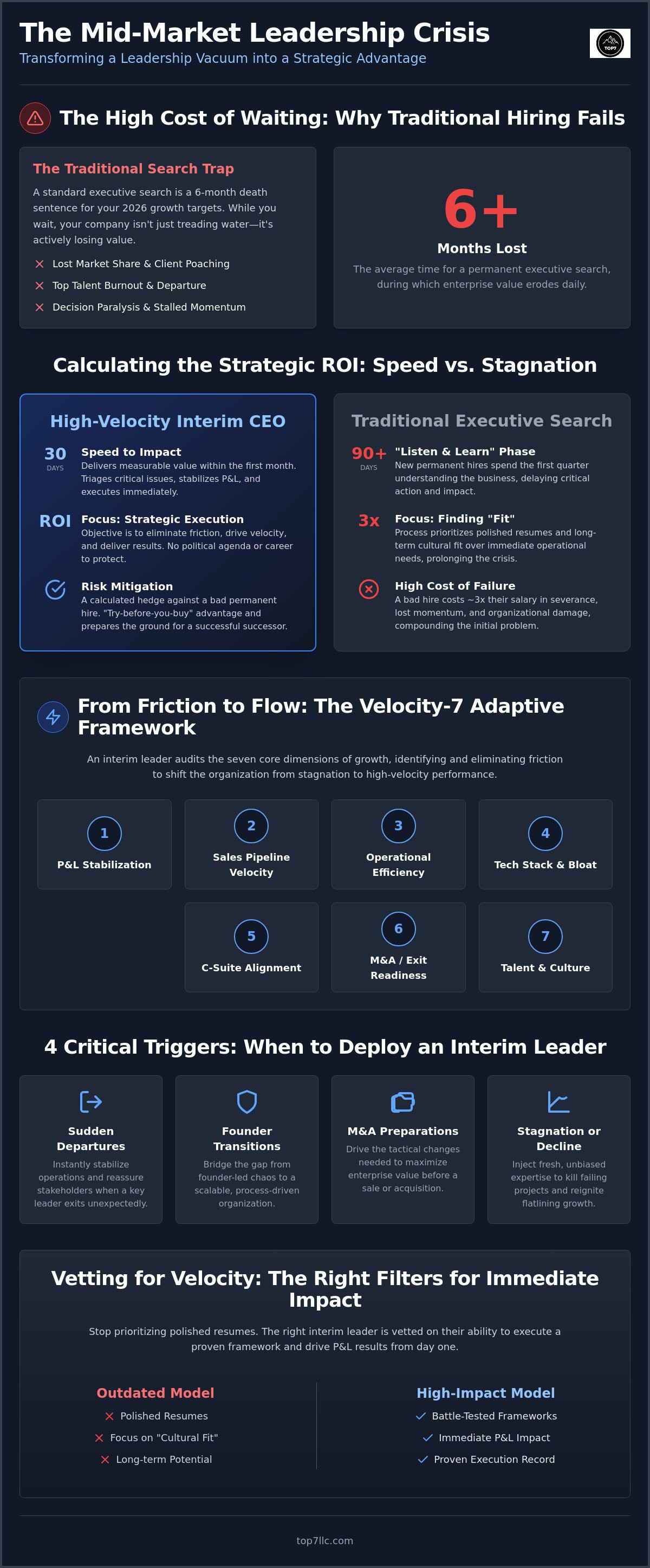
Speed to impact is the only metric that matters during a leadership transition. While a permanent candidate spends their first 90 days "listening and learning," an interim operator delivers value within the first 30. They walk in with a mandate to triage. They identify the friction points in your sales pipeline, the bloat in your tech stack, and the misalignment in your C-suite. They don't have a political agenda or a long-term career path to protect. This "Fresh Eyes" advantage allows them to kill failing projects that internal candidates are too scared to touch.
Short-Term Cost vs. Long-Term Value Creation
Stop focusing on the line-item expense and start looking at EBITDA. A leader who bridges the gap using a proven framework can stabilize your margins before the permanent hire even signs their offer letter. They de-risk the eventual permanent CEO by cleaning up operational "technical debt." If you're serious about maintaining growth velocity, you need someone who views Interim Leadership as a tactical strike rather than a holding pattern.
The Operator’s Edge: Execution Over Recommendations
Mid-market companies don't need another 50-slide deck from a consultant who has never run a P&L. They need an operator who can navigate the "Mid-Market Trap" with precision. The tactical difference is simple: advisors tell you what's broken; interims fix it. Whether it's restructuring a sales team that's missing targets or automating a manual fulfillment process, the focus is on rapid-fire wins. By the time your executive search firm presents a shortlist, your interim leader has already prepped the company for its next phase of growth. They set the stage for the permanent CEO's success, ensuring the new hire spends their first year driving new value instead of fixing old mistakes.
From Friction to Flow: The Velocity-7 Framework in Action
Execution isn't a buzzword; it's a survival mechanism. While your competitors wait for the "right time" to act, an interim ceo for mid-market companies uses a structured methodology to force results. At Top7, we don't guess. We deploy the Velocity-7 Adaptive Framework. This isn't a theoretical model meant for a quiet boardroom. It's a high-octane engine designed to move your organization from stagnation to momentum in record time. Success in 2026 requires more than a steady hand. It requires a system that identifies and destroys friction points before they become systemic failures.
The transition from chaos to clarity happens in four distinct stages:
Step 1: The Dimension Audit. We conduct a deep-dive analysis into the seven dimensions of growth, including sales velocity, operational efficiency, and tech stack alignment, to find exactly where the bleeding is happening.
Step 2: Agile Transformation. Traditional top-down mandates are too slow. We implement agile-based transformation at the executive level, ensuring the C-suite can pivot as fast as the market demands.
Step 3: Direct Embedding. This isn't a remote advisory role. We embed directly with your teams to ensure execution happens on the ground, not just in a slide deck.
Step 4: Achieving Flow. By removing bottlenecks, we move the organization from constant friction into a state of efficient, predictable flow.
Identifying and Eliminating Operational Friction
Friction looks different depending on your geography and industry. In mid-market hubs like Boston, Chicago, and Dallas, we often see the same patterns: legacy tech debt slowing down delivery, bloated sales cycles that frustrate high performers, and financial strategies that lack real-time visibility. These are the "silent killers" of EBITDA. The Top7 approach focuses on cutting the fat without killing the culture. We don't remove people; we remove the broken processes that make good people underperform. By automating manual workflows and clarifying reporting lines, we free your team to focus on high-value targets instead of administrative firefighting.
Agile Leadership: Adapting to 2026 Market Volatility
If you're still relying on a five-year strategic plan, you've already lost. That model died when market volatility became the new baseline. In 2026, the only plan that matters is the one that allows you to pivot next week. Using the Velocity-7 framework, an interim leader helps your company build the muscle memory needed to respond to tariffs, regulatory shifts, or tech disruptions instantly. This isn't about being reactive; it's about being prepared. Flow is achieved through systematic execution. When your systems are designed for speed, growth becomes the natural byproduct of your daily operations rather than a lucky break.
When to Engage an Interim CEO: 4 Critical Scenarios
Timing isn't just a factor in business success; it's the only factor that determines if you survive a leadership crisis. Knowing exactly when to pull the trigger on an interim ceo for mid-market companies is the difference between a minor operational hiccup and a total collapse of enterprise value. There are four specific moments when hesitation is fatal. First, the sudden departure. Whether your CEO jumps for a competitor or is pushed out by the board, the resulting power vacuum creates immediate friction. You don't have six months to wait for a headhunter's shortlist. You need a stabilizer who can stop the bleeding and reassure your shareholders that the ship is still on course.
Founder Transitions: Scaling Beyond the Creator
Founders are the heart of mid-market firms, but they're often the biggest bottleneck to future growth. By 2026, the sheer complexity of technology adoption and shifting regulatory landscapes makes "hero-led" growth unsustainable. An interim leader professionalizes the C-suite by installing systems that don't depend on one person's intuition. This transition is critical if you're eyeing a private equity exit. Buyers don't want to purchase a personality; they want to buy a machine. We balance your legacy with the cold, hard discipline of modern operational execution to make your company exit-ready.
M&A Leadership: Bridging the Integration Gap
Most mid-market mergers are value-destroying events. They fail in the first 100 days because the "deal thesis" gets lost in the weeds of cultural ego and mismatched tech stacks. An interim CEO acts as the tactical bridge. They align disparate departments with aggressive speed, ensuring the ROI promised to the board actually shows up on the balance sheet. Their job is to protect the investment by executing the integration plan without the emotional baggage or political debt that plagues internal candidates. They focus on the math of the merger, not the feelings of the legacy staff.
The fourth scenario is the growth plateau. Your current team got you to $50M, but they lack the "Level 2" skills required to hit $250M. Scaling requires a different toolkit, and if your leadership lacks the experience to manage high-velocity expansion, you're just burning cash on inefficient processes. Engaging an Interim CEO allows you to bridge that skill gap immediately while you search for a permanent leader who can handle the new scale. Don't let your growth stall because you're waiting for a permanent hire to learn on your dime.
Securing Your Lead: How to Vet an Interim CEO for Results
Finding an interim ceo for mid-market companies isn't an HR exercise. It's a risk mitigation strategy. If you're looking at a candidate who hasn't managed a P&L of your specific scale, you're inviting disaster. Resumes are easy to polish, and while candidates often use WorkReferences for professional verification and reference support, execution is impossible to fake. You need a leader who brings a proven framework to the table, not just a list of former titles. Are they ready to make high-stakes decisions on Day 1, or are they going to ask for a "discovery period"? Discovery is just another word for stalling. In the 2026 market, stalling is a luxury your balance sheet can't afford.
Velocity is the only metric that separates a high-impact leader from a temporary seat-filler. A true operator identifies friction immediately. They don't wait for permission to fix a broken sales process or a mismanaged tech stack. The Top7 guarantee is simple: we don't just manage your problems; we solve them. We embed leaders who are trained to use the Velocity-7 Adaptive Framework to drive measurable results. This ensures your company is in a stronger position than when we arrived, with systems that outlast the interim engagement itself.
The 72-Hour Vetting Process: Moving at the Speed of Business
Boards need to stop asking about "cultural fit" and start asking about tactical wins. Ask the candidate: "What is the first thing you'll cut to improve EBITDA?" or "How do you handle a misaligned CFO?" Watch for the "Career Interim" red flag. These are people who move from gig to gig without ever owning a result. You want a "Career Operator," someone who has lived the raw business reality and knows how to win. Top7 matches executives to your specific friction points within 72 hours. Your market share won't wait for a standard search, and neither should you.
Next Steps: Your 90-Day Transformation Roadmap
What happens after the contract is signed? In the first week, we conduct the Dimension Audit to map your operational technical debt. By day 30, the friction points are identified and the triage is complete. By day 90, your organization is moving from friction to flow. We set hard KPIs for every engagement: sales velocity, operational overhead reduction, and board alignment. If you aren't seeing a shift in the first month, you have the wrong leader. It's time to stop the friction and start the flow with a Top7 Interim CEO.
Turn Leadership Friction into Your Competitive Edge
Leadership gaps aren't just empty chairs; they're active leaks in your enterprise value. You've seen why the traditional executive search fails agile firms in 2026 and why the "wait and see" approach is a death sentence for your growth targets. Success now requires more than a placeholder. It demands an operator who uses the proprietary Velocity-7 Adaptive Framework to audit your dimensions of growth and eliminate bottlenecks with surgical precision. Deploying an interim ceo for mid-market companies isn't a defensive move. It's an offensive strike that preps your P&L for a massive exit or a scalable future.
We bring battle-tested leaders to every major US hub, focusing exclusively on mid-market players between $20M and $500M. Don't let operational friction dictate your 2026 results while your competitors poach your market share. You have the roadmap. Now you need the execution. Stop the friction. Schedule a Velocity-7 Audit with a Top7 Executive. It's time to stop treading water and start driving velocity.
Frequently Asked Questions
What is the average length of an interim CEO engagement in 2026?
Most interim engagements last between 6 and 12 months. This timeframe provides enough runway to stabilize operations, implement the Velocity-7 framework, and conduct a thorough search for a permanent successor. In the 2026 market, rushing a permanent hire is a high-stakes gamble that usually fails, so the interim leader provides the stability needed for a calculated transition.
How much does an interim CEO cost for a mid-market company?
Industry compensation models for an interim ceo for mid-market companies typically follow the "1% Rule," where the daily rate is approximately 1% of a permanent CEO's annual base salary. While this represents a premium, it accounts for the lack of long-term benefits, equity, and severance. You're paying for immediate, battle-tested execution that protects millions in enterprise value during a period of high volatility.
Can an interim CEO eventually become the permanent CEO?
Yes, transitioning from interim to permanent is a viable "try-before-you-buy" strategy for many boards. It allows the company to witness the leader's impact on the P&L before committing to a multi-million dollar long-term contract. However, many interim leaders are specialized transformation agents who prefer the high-intensity work of fixing broken systems over steady-state management.
What is the difference between a fractional CEO and an interim CEO?
A fractional CEO provides part-time strategic guidance over a long period, whereas an interim CEO is a full-time, temporary operator focused on a specific crisis or transition. Fractional roles are better for smaller firms that don't need a full-time executive. Interim roles are designed for mid-market companies that require aggressive, full-time leadership to bridge a gap or drive a major turnaround.
How quickly can an interim CEO start at our company?
Top7 can typically deploy a battle-tested leader within 72 hours to 10 days. We move at the speed of business because every day of a leadership vacuum is a day your competitors are stealing market share. While traditional search firms are still vetting resumes, our operators are already prepared to embed with your team and start the Dimension Audit.
What industries do Top7 interim CEOs specialize in?
Our leaders specialize in tech, finance, and sales-driven sectors where operational friction is the primary barrier to growth. We focus on mid-market firms with revenues between $20M and $500M. This is where our expertise in professionalizing the C-suite and preparing companies for M&A or founder exits delivers the most measurable ROI.
Does an interim CEO have the authority to make firing/hiring decisions?
Full operational authority is required for an effective interim ceo for mid-market companies to succeed. Without the power to restructure teams and remove bottlenecks, a leader is just an expensive consultant. To drive velocity, the interim must have the mandate to hire talent that fits the new direction and fire those who are stalling the organization's progress.
How does the Velocity-7 framework differ from traditional consulting?
Traditional consulting delivers a slide deck of advice; Velocity-7 delivers results through direct embedding. Consultants stay on the sidelines and offer suggestions that your team may or may not execute. Our framework is a tactical execution engine where the leader owns the KPIs and works inside the company to move the organization from friction to flow.



Comments