
Stop Leaking Profit: How to Improve Operational Efficiency in 2026

Updated: Jul 19
Why are you working harder, hiring faster, and paying for more SaaS subscriptions while your profit margins continue to shrink? It's a brutal reality in 2026: most growth-stage companies aren't scaling; they're just getting more expensive to run. If your revenue is climbing but your bank balance is stagnant, you aren't growing a business. You're feeding a parasite. You're likely exhausted from "firefighting" daily issues and wondering how to improve operational efficiency without adding even more weight to your overhead.
We agree that the "more is better" philosophy is dead. Adding headcount to a broken process doesn't fix the leak; it just makes the mess more expensive to clean up. You deserve a business that delivers predictable margins and consistent output without requiring your intervention in every minor decision. This article is your tactical map to stop the bleeding. We'll show you how to transition from operational friction to a state of high-velocity flow using the Velocity-7 framework. You'll learn why fractional leadership is the secret weapon for mid-market dominance and how to build a system that finally gives you clear visibility into team performance. It's time to stop surviving your growth and start commanding it.
Table of Contents
The High Cost of Operational Friction: Why Your Business is Stalling
Most executives mistake activity for progress. They see a bustling office or a Slack channel overflowing with messages and assume the engine is humming. It isn't. In the harsh reality of 2026, Operational efficiency isn't a buzzword; it's the cold, hard measure of your ability to convert raw effort into net profit without bleeding resources. If your team is working 60-hour weeks but your margins are flat, you have a friction problem. This friction acts as an invisible tax on your growth, culture, and sanity. It’s the difference between a business that scales effortlessly and one that collapses under its own weight.
Mid-market companies from Boston to Austin typically hit a "complexity wall" once they cross the $10M revenue mark. What worked at $2M is now a liability. At this stage, the founder's intuition is no longer enough to bridge the gaps between departments. You stop being a leader and start being a professional firefighter, jumping from one operational blaze to the next. Understanding how to improve operational efficiency starts with admitting that your current "firefighting" culture is a choice, not a necessity. You are either building a system of efficient flow, or you are paying for the friction every single day.
To better understand this concept, watch this helpful video:
The Three Silent Killers of Mid-Market Profit
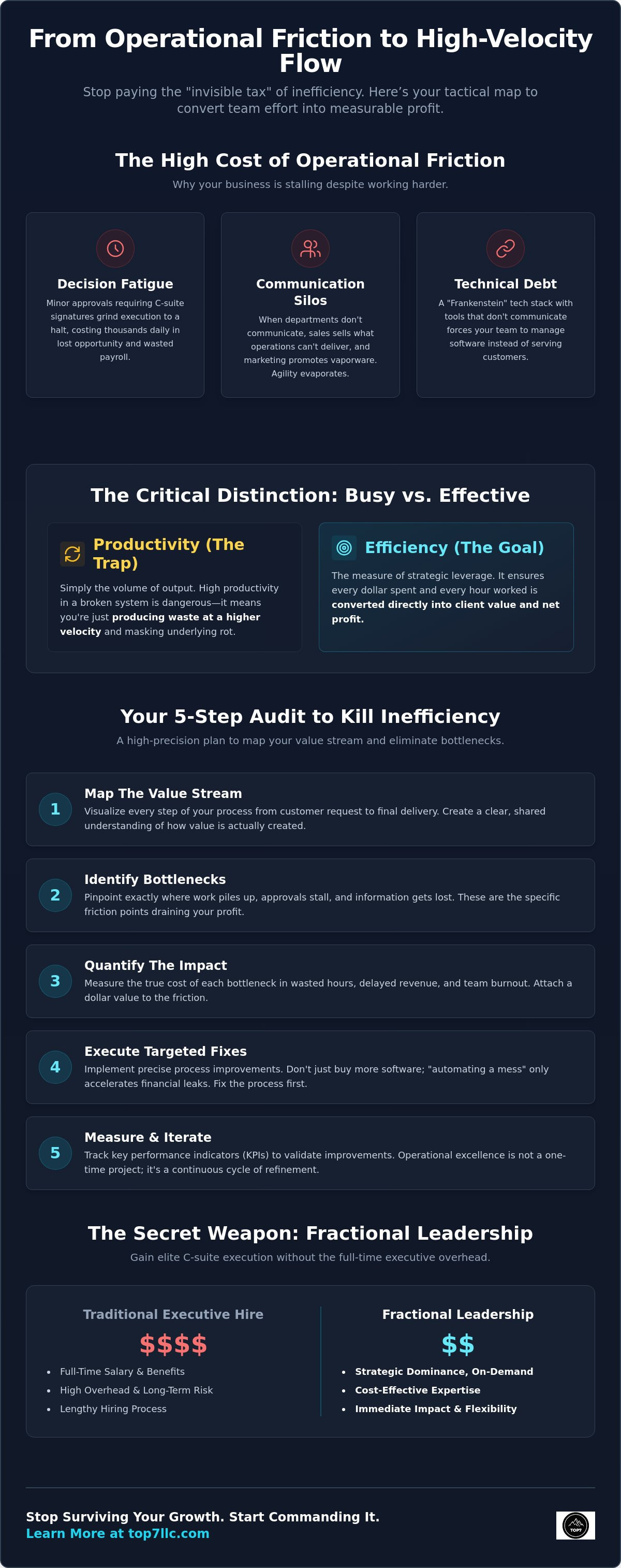
Decision Fatigue: When every minor approval requires a meeting or a C-suite signature, execution grinds to a halt. Slow approvals don't just delay projects; they cost you thousands in lost opportunity and wasted payroll daily.
Communication Silos: Information hoarding is the death knell of agility. When the sales team doesn't know what operations can deliver, or marketing is running campaigns for products that aren't ready, your efficiency evaporates.
Technical Debt: Relying on legacy systems or a "Frankenstein" tech stack creates a bottleneck that no amount of talent can overcome. If your tools don't talk to each other, your team spends more time managing software than serving customers.
Efficiency vs. Productivity: The Critical Distinction
Don't confuse being busy with being effective. Productivity is simply the volume of output, but if that output is flawed or unnecessary, you're just producing waste at a higher velocity. High productivity in a broken system is actually dangerous because it masks the underlying rot. Many leaders fail because they optimize the wrong processes, making a useless task happen faster instead of eliminating it entirely. If you want to know how to improve operational efficiency, you must stop looking at how much your team is "doing" and start looking at how much value is actually reaching the client. Operational efficiency is the ultimate measure of strategic leverage within your organization. It ensures that every dollar spent and every hour worked moves the needle toward your primary objective.
The Velocity-7 Approach: Moving from Friction to Flow
Generic lists of "17 ways to save money" are useless because they lack a core philosophy. You don't need another tip; you need a system that forces the optimization of business processes by default. This is where the Velocity-7 Adaptive Framework comes in. It isn't a suggestion box. It's a holistic business operating system designed to turn your organization into a high-performance machine that runs on data, not drama. If you want to know how to improve operational efficiency, you have to stop managing and start executing with tactical precision.
Most leaders think Agile is only for software developers in hoodies. They're wrong. In 2026, the most profitable mid-market firms apply agile principles to their entire operation to stay ahead of the competition. This means moving away from rigid, five-year plans that are obsolete before the ink dries. We focus on adaptive execution instead. We don't just hand you a manual and leave; we embed professionals directly into your team to ensure the framework takes root and delivers measurable ROI. The core of how to improve operational efficiency in 2026 lies in this shift from static planning to dynamic, real-time adjustments.
The Seven Dimensions of Operational Velocity
Strategic Alignment: If every employee doesn't know the #1 goal for the quarter, you've already lost the battle. Total clarity is the foundation of speed.
Financial Strategy: Stop using "rearview mirror" accounting. You need proactive capital management that treats your budget as a tool for aggressive growth; for specialized bookkeeping support, check out Skyplex Management.
Technology Leadership: Your tech stack should be a competitive advantage, not a collection of expensive bottlenecks. We turn your digital tools into a moat that protects your margins.
Agile Operations for Non-Tech Organizations
Traditional planning is too slow for the current market. We use 90-day sprints to identify and destroy operational bottlenecks that have plagued your company for years. These feedback loops are the only thing standing between you and "strategic drift," where your team works incredibly hard on the wrong things. Standardizing these workflows doesn't kill creativity. It provides the stable foundation that allows your best people to spend their time on innovation rather than fixing basic errors. If your current structure feels like a weight rather than a wing, it's time to look at the Velocity-7 Adaptive Framework as your path to a friction-free future.
Software Won't Save You: Why Strategic Operations Beat Tactical Tools
Stop looking for a magic app to fix your profit leaks. The market is flooded with founders who believe a new ERP or a high-end CRM will magically organize their internal chaos. It won't. If your internal processes are broken, throwing software at the problem only makes the mess happen faster. Software is a force multiplier, but the force must be strategic to be effective. You can't code your way out of poor leadership or vague objectives. True progress comes from fixing the engine before you bolt on a turbocharger.
The "Leadership Gap" is the real reason most digital transformations fail. You have tools, but you don't have the executive oversight to manage them properly. While you might be searching for strategies to improve operational efficiency through automation, you're likely ignoring the human and procedural friction that software cannot touch. In 2026, the winners aren't the companies with the most tools. They're the companies with the best strategy for how those tools are used. Strategy must always dictate tool selection, never the other way around.
The 'SaaS Trap' and How to Avoid It
Mid-market companies are notorious for falling into the SaaS trap. They accumulate dozens of disconnected tools and zero integration. This leads to "Shadow IT," where departments buy their own software without consulting the rest of the organization. The hidden cost is staggering. You're paying for duplicate features, unmanaged seat counts, and fragmented data. If your tools don't communicate, your team has to act as the manual bridge between them. That isn't how to improve operational efficiency; that's just expensive busywork.
The Role of the Fractional CTO in Tool Strategy
This is where a Fractional CTO becomes your most valuable asset. They don't care about flashy features or vendor sales pitches. They audit your existing tech stack for actual ROI and ruthlessly cut what isn't serving the bottom line. A Fractional CTO fixes tech bottlenecks by ensuring every piece of software aligns with your Velocity-7 roadmap. They provide the high-level technical leadership you need to turn your tech stack into a competitive advantage rather than a financial drain. Don't let your software dictate your strategy; hire the expertise to put strategy back in the driver's seat and finally learn how to improve operational efficiency at scale.
A 5-Step Audit to Identify and Kill Inefficiency
You cannot fix what you refuse to measure. Most executives are blind to the rot inside their own processes because they focus on the "what" instead of the "how." If you want to know how to improve operational efficiency, you must stop looking at your org chart and start looking at your value stream. An audit isn't a polite review; it's a search and destroy mission for waste. Follow these five steps to stop the bleeding and reclaim your margins.
Step 1: Map the Value Stream. Document every touchpoint from the first lead to the final invoice. If a step doesn't directly add value to the client or the bottom line, it's a target for elimination.
Step 2: Identify the Bottlenecks. Find the logjam. Whether it's a slow approval process or a single manager who hoards information, identify the specific point where work stops moving.
Step 3: Quantify the Leak. Attach a dollar sign to the delay. Calculate exactly how much money you lose every hour a project sits in a bottleneck. This turns an abstract problem into a financial emergency.
Step 4: Prune the Waste. Be ruthless. Eliminate low-value activities, redundant meetings, and "just in case" reporting. If it doesn't move the needle, kill it.
Step 5: Install the Framework. Apply the Velocity-7 Adaptive Framework to your new, lean process. This ensures the waste doesn't crawl back in once you stop looking.
Mapping the Value Stream for Service Firms
For service organizations, revenue leakage usually happens in the gaps between departments. Client onboarding is often the biggest offender. If your onboarding takes three weeks instead of three days, you're delaying your own payday. Scope creep is another profit killer that stems from weak leadership and vague project scoping. You must standardize the "hand-off" between sales and operations. If the execution team doesn't know exactly what was promised, they'll waste hours trying to figure it out on your dime. This is how to improve operational efficiency in a professional service context: tighten the hand-offs and protect the scope.
Tracking the Metrics That Actually Matter
Stop obsessing over vanity metrics like "team happiness" or total hours worked. Utilization rates are a lie if your profit per head is declining. You need velocity metrics that track the speed of value delivery and the cost of every touchpoint. A CEO doesn't need a 50-page report; they need a high-impact dashboard that shows exactly where the money is stalling and who is responsible for moving it. If your current reporting is more about storytelling than data-driven execution, it’s time for a change. Schedule a strategic planning session to build the metrics that actually drive your growth.
Fractional Leadership: The Secret Weapon for Mid-Market Efficiency
Consultants are professional talkers. They sell you a 50-page slide deck, charge a premium, and leave your team to figure out how to clean up the mess. Fractional leadership is the opposite. It is about execution. In 2026, mid-market companies are realizing they don't need a $300,000 executive sitting in a chair 40 hours a week. They need the strategic brain of a veteran leader for 10 hours a week to drive the Velocity-7 framework. When you consider that U.S. employer costs for benefits averaged 30.1 percent of total compensation in March 2026, the fractional model isn't just a smart move; it is a financial necessity for profit protection.
Top7 executives don't just "advise" from the sidelines. We embed ourselves directly into your team. We take ownership of the outcomes. If you are struggling with how to improve operational efficiency, you likely have a leadership gap, not a talent gap. Your team needs an architect to build the system, not more builders to stack bricks. Positioning a Fractional CTO, COO, or CEO at the helm of your operational transformation is the fastest path to a measurable ROI because you pay for results, not overhead.
Fractional CTO vs. Fractional COO: Which Do You Need?
The choice depends on where your profit is leaking. If your business is stalling because of technical debt, fragmented data, or software that doesn't scale, you need a Fractional CTO. If the friction is coming from human processes, broken workflows, or departmental silos, a Fractional COO is the answer. These roles don't exist in a vacuum; they collaborate to plug the financial holes that neither a pure tech nor a pure process approach can fix alone. You can explore our Fractional Leadership options to see which role aligns with your current bottlenecks.
From Crisis to Stability: The 90-Day Transformation
Transformation shouldn't take years. We operate in 90-day sprints because the market moves too fast for anything else. In the first 30 days of a Top7 engagement, we conduct a surgical audit of your value stream. We identify the "Quick Wins"—the low-hanging fruit that can be fixed immediately to fund the rest of the transformation. By day 60, we are installing the Velocity-7 framework into your core operations. By day 90, you have a lean, predictable machine that no longer relies on your constant intervention to function. This is how to improve operational efficiency with tactical precision. Stop guessing and start winning. Schedule your 15-minute Velocity Audit with Top7 and find out exactly where your profit is leaking.
Command Your Growth or Be Consumed by It
Revenue growth is a vanity metric if your operational friction is eating your profit alive. You've spent enough time firefighting daily issues that should have been automated or systematized months ago. In 2026, the winners aren't those who work the longest hours, but those who build the most resilient systems. We've laid out the blueprint for how to improve operational efficiency by shifting from tactical tool-chasing to strategic execution. By using the Velocity-7 Adaptive Framework and leveraging seasoned C-suite executives embedded in your team, you can finally break through the complexity wall that stalls most mid-market firms.
The path from friction to flow is a choice. You can continue to pay the invisible tax of inefficiency, or you can install the leadership and frameworks necessary for a scalable, predictable business. For creators and entrepreneurs looking to integrate AI and automation into their growth strategy, Entourage Insider offers a specialized playbook for scaling in 2026. Our fractional model ensures you get elite expertise focused specifically on mid-market growth obstacles without the burden of a full-time executive salary. Don't let another quarter of potential profit leak out of your organization because of a lack of visibility or broken hand-offs.
Stop the friction. Schedule your Velocity Audit with Top7 today.
Your business is capable of running with precision and high-velocity flow. It's time to stop surviving your success and start commanding your future.
Frequently Asked Questions
What is the difference between operational efficiency and productivity?
Productivity measures how much you produce; efficiency measures how much profit you keep from that production. You can be highly productive while wasting resources on the wrong tasks. If you want to know how to improve operational efficiency, you must focus on the ratio of input to output. Efficiency is about maximizing value and strategic leverage while ruthlessly eliminating the waste that productivity often hides.
How do I know if my company needs a Fractional COO or just better software?
If your processes are broken, new software will only help you fail faster. You need a Fractional COO when your team is firefighting daily or departments aren't communicating. Software is a tactical tool; leadership is a strategic necessity. A COO builds the system that software is meant to support. Don't buy a turbocharger for an engine that's already leaking oil.
What are the first signs of operational friction in a growing business?
The most obvious sign is stagnant profit margins despite rising revenue. You'll also notice executive burnout from constant firefighting and a "complexity wall" where hiring more people actually slows down execution. If your output is inconsistent across departments, you're paying an invisible tax on your growth. These are the red flags that your current operating system is no longer fit for purpose.
How long does it take to see results from an operational efficiency project?
You should see "Quick Wins" within the first 30 days of a focused engagement. While a full transformation using the Velocity-7 framework typically takes 90 days to stabilize, the financial leaks can often be plugged much sooner. The goal is to fund the long term transformation through immediate savings found in the initial audit phase. Speed is a requirement, not a luxury.
Can a mid-market company achieve enterprise-level efficiency without a full-time C-suite?
Absolutely, and usually more effectively than their larger competitors. The fractional model gives you access to elite strategic execution without the $300k plus salary and benefit burdens of a full-time hire. You get the same level of discipline and precision found in Fortune 500 boardrooms. It's a strategic shortcut that allows mid-market firms to punch far above their weight class.
What is the Velocity-7 Adaptive Framework?
Velocity-7 is a proprietary business operating system designed for rapid, agile execution. It moves your organization away from rigid five year plans and toward 90-day sprints focused on seven core dimensions of growth. This framework ensures every department is aligned with your number one goal. It's the primary tool we use when teaching founders how to improve operational efficiency in high-stakes environments.
How much does it cost to improve operational efficiency with a fractional leader?
The investment depends entirely on the complexity of your bottlenecks and the specific C-suite expertise required. While we don't quote fixed fees, the fractional model is designed to be a high-ROI alternative to full-time executive compensation. You are paying for a specific outcome and strategic dominance, not for someone to sit in a chair for 40 hours a week. It's about buying results.
Does Top7 provide services for businesses outside of Boston or the East Coast?
Yes, we drive results for mid-market companies across the globe. While we have a strong presence in hubs like Boston and Austin, our fractional executives embed themselves into your team regardless of your physical location. We use a combination of virtual leadership and strategic on-site visits to ensure the Velocity-7 framework is executed with precision. Geography is never a barrier to operational excellence.



Comments