

Scaling a Business with Fractional Leaders: Stop Hiring Resumes, Start Hiring Velocity
- Robert Fitzgerald
- May 15
- 12 min read

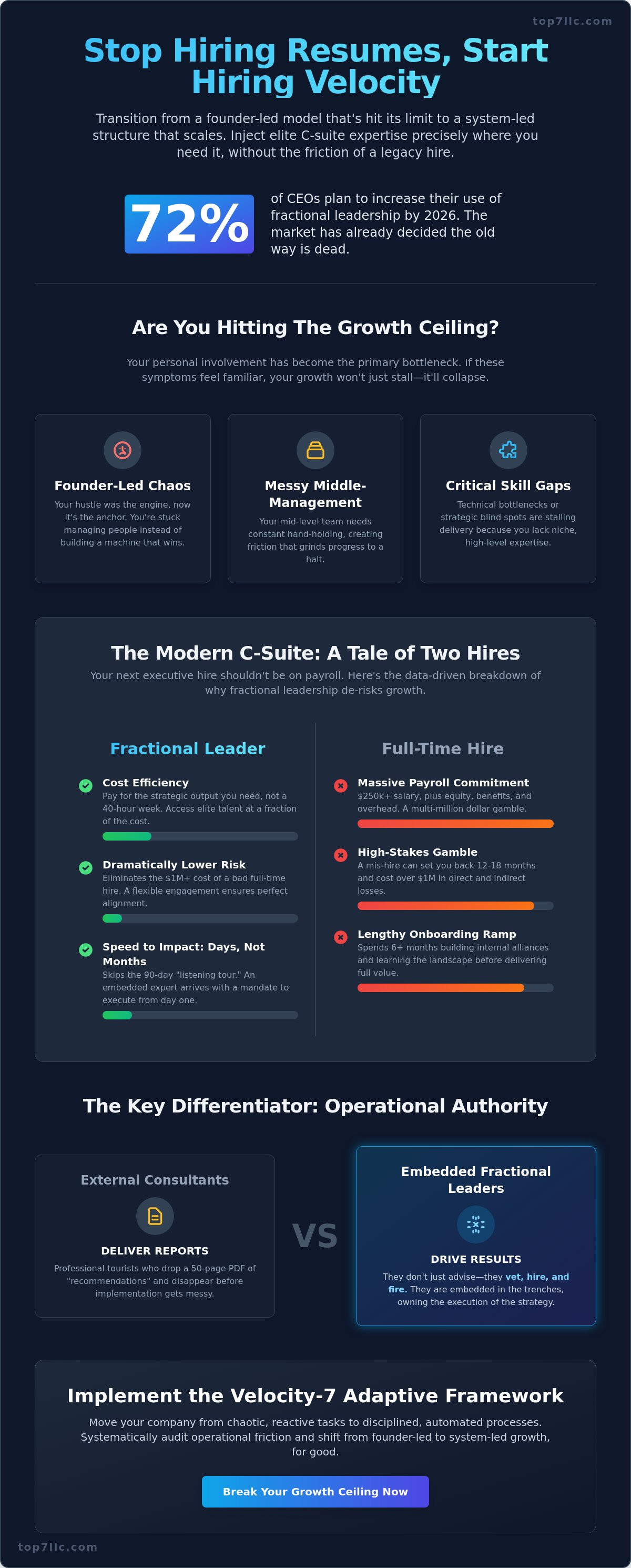
Stop hiring resumes and start hiring velocity. Most founders think they need a full-time executive to fix their mess, but a massive payroll commitment is often just expensive duct tape. Scaling a business with fractional leaders is the only way to inject high-level expertise into your operations without the friction of a legacy hiring process. If you're currently drowning in executive burnout or watching skill gaps stall your delivery, you're playing a losing game. With 72% of CEOs planning to increase their use of fractional help in 2026, the market has already decided that the old way is dead.
You know that your current pace is unsustainable and that your founder-led model has reached its limit. We're going to show you how to transition to a system-led structure that actually scales. You'll learn how to leverage embedded experts to eliminate operational drag and secure a measurable ROI on every dollar of executive spend. It's time to stop managing people and start building a machine that wins. This guide breaks down the framework for breaking your growth ceiling once and for all.
Key Takeaways
Stop paying for reports and start paying for results by understanding the critical distinction between external consultants and embedded fractional executives with operational authority.
Learn how scaling a business with fractional leaders eliminates the $1M+ risk of a bad full-time hire while slashing time-to-impact from months to days.
Implement the Velocity-7 Adaptive Framework to systematically audit operational friction and move your company from founder-led chaos to system-led growth.
Identify whether your growth is stalled by technical bottlenecks or messy middle-management drag and which specific C-suite role is required to break the ceiling.
Navigate regional talent shortages by leveraging elite leadership expertise that adapts to the specific economic demands of major US business hubs.
Table of Contents
What is Fractional Leadership in the Context of Scaling?
Stop pretending your personal hustle is a sustainable business strategy. Most founders hit a wall because they try to scale with mid-level managers who need constant hand-holding. You don't need more people to manage; you need leaders who can manage themselves and your results. Scaling a business with fractional leaders means embedding C-suite veterans, like a Fractional CTO, COO, or CFO, into your organization on a part-time basis. These aren't temporary workers. They're high-impact executives who take ownership of your outcomes without the $300k plus price tag of a full-time hire.
The economic reality is simple. You gain access to elite talent that has already scaled companies ten times your size, but you only pay for the strategic velocity you actually use. To understand the baseline of this model, What is a Fractional Leader? offers a foundational look at how this role differs from traditional part-time work. It's about buying the solution to your biggest bottleneck, not just filling a seat on the org chart.
To better understand how this strategic injection works in practice, watch this helpful video:
The Shift from Founder-Led to System-Led Growth
Every growing company eventually reaches a breaking point where the founder's intuition is no longer enough to drive the machine. This is the moment your personal involvement becomes the primary bottleneck for the entire organization. Fractional leaders step in to build the systems that allow you to stop playing hero and start being a CEO. They implement the Velocity-7 Adaptive Framework to move your business from chaotic, reactive tasks to disciplined, automated processes. The Growth Ceiling is the point where current systems fail under new demand. If you don't build a system-led structure now, your growth won't just stall; it'll collapse under its own weight.
Operational Authority: The Key Differentiator
Consultants are professional tourists. They arrive, drop a 50-page PDF of "recommendations" on your desk, and disappear before the implementation gets messy. Scaling a business with fractional leaders is different because these individuals carry real operational authority. They don't just suggest a new tech stack; they implement it. They don't just advise on hiring; they vet, hire, and fire. This transition from "thinking" to "doing" in the C-suite is what separates winners from those who just talk about growth. A fractional leader has the power to change your trajectory because they're embedded in the trenches with you, owning the execution of the strategy they help create.
Fractional vs. Full-Time: Why Your Next Hire Shouldn't Be on Payroll
Stop burning capital on permanent solutions for temporary problems. Hiring a full-time C-suite executive is a high-stakes gamble that most mid-market companies lose. It's not just the $250k salary. When you factor in equity, benefits, and the massive opportunity cost of a six-month onboarding period, you're looking at a multi-million dollar commitment. If that hire fails, the fallout can easily exceed $1M in direct and indirect losses. Scaling a business with fractional leaders allows you to bypass this financial minefield entirely while maintaining elite-level output.
Fractional executives prioritize speed to impact. They don't spend ninety days on a "listening tour" or building internal alliances. They arrive with a mandate to execute. Because they aren't entangled in your office politics, they provide the objective, brutal honesty required to fix broken processes. You get the strategic depth of a veteran without the permanent payroll burden. This flexibility lets you scale your leadership spend up or down based on your actual growth phase, ensuring your burn rate stays aligned with your measurable results.
The Hidden Risks of the $250k Executive
Companies in high-growth hubs like Austin or Boston often fall for the "Big Tech" resume trap. They hire someone from a Fortune 500 company who is used to unlimited budgets and armies of junior staff. These executives frequently suffocate in agile, resource-constrained environments. Beyond the salary, the "Equity Trap" is real. Don't dilute your cap table for a leader who hasn't proven they can handle your specific scale. Using Interim Leadership or fractional roles lets you "test drive" the position before making a permanent commitment.
When to Make the Switch to Full-Time
There is a point where a full-time role makes financial sense, but it's rarely at the start of a transformation. Wait for the steady state. This is when the chaos has been replaced by systems and the role becomes about maintenance rather than massive change. A high-performing fractional leader will actually help you write the job description for their full-time successor. They ensure the seat is ready for a permanent hire to succeed. Remember the 90-day rule: if the core problem is solved and the systems are running, do you really need a permanent $300k seat, or was it just a project-based need? Scaling a business with fractional leaders ensures you only pay for the value you consume during the most volatile stages of your growth.
The Velocity-7 Framework: Moving from Friction to Flow
Most businesses don't actually scale. They just get louder, messier, and more expensive until they implode under their own weight. Scaling a business with fractional leaders isn't about filling a gap on an org chart; it's about installing a high-performance engine into a chassis that's currently held together by duct tape. To do this, you need more than just "good people." You need a proven methodology. The Velocity-7 Adaptive Framework is our proprietary response to the chaos of growth, moving your organization from reactive firefighting to a state of disciplined flow.
This framework operates in four aggressive stages designed to produce measurable results in weeks, not years. First, we Audit the Friction. We stop the guessing games and use data to identify exactly where your current processes are leaking revenue. Second, we Embed the Expertise. We place a high-impact Fractional CTO, COO, or CFO directly into your biggest bottleneck to take immediate operational authority. Third, we Execute the Sprint. Using agile methodologies, we tackle complex problems in 30-day cycles, ensuring that progress is visible and constant. Finally, we Institutionalize Flow. We don't just fix a problem and leave; we turn those successes into repeatable, automated systems that run without intervention.
Identifying Operational Friction in Your Scaling Journey
You know you have a friction problem when deadlines become suggestions, client churn starts to climb, and the founder's phone never stops ringing with low-level tactical questions. If you're still the primary problem-solver for every department, you aren't a CEO; you're a glorified babysitter. Top7 executives use deep-dive audits to cut through the noise and find the "one lever" that unlocks 80% of your growth potential. Friction is the natural byproduct of growth, not a sign of failure. The failure only happens when you refuse to build the systems required to overcome it.
Agile Leadership: Beyond the Tech Department
Agile shouldn't be trapped in the software department. Your sales, finance, and operations teams need "sprints" just as much as your developers do. A Fractional COO excels here by applying agile transformation to the entire business, breaking down silos that slow down delivery. We help you create a culture of Efficient Flow, where data drives every C-suite decision instead of "gut feelings" or ego. This is how you stop hiring for resumes and start hiring for the velocity required to dominate your market. Success in scaling a business with fractional leaders depends on this shift from manual effort to systemized execution.
Strategic Impact: Which Fractional Leader Does Your Business Need?
Stop trying to find a unicorn that can do everything. You don't need a generalist; you need a specialist who can dismantle your specific scaling bottleneck with surgical precision. Scaling a business with fractional leaders works because it allows you to buy exactly the expertise you lack at this specific moment. Whether you're fighting technical debt, operational chaos, or a stagnant sales pipeline, there's a fractional executive designed to fix it. You've built the foundation, now you need the architects to build the skyscraper.
The Fractional CTO vs. The Outsourced Agency
Agencies want to sell you billable hours and more developers. A CTO wants to sell you a scalable product and technical dominance. When you use Fractional CTO services, you're hiring someone to own your technical roadmap and strategic planning. They don't just manage a Jira board; they ensure your technology stack can handle a 10x increase in users without crashing. They manage technical debt so it doesn't become a financial anchor. This is the difference between having a vendor and having a leader who is incentivized by your long-term success rather than their next invoice.
The Fractional COO: The Founder's Best Friend
Your vision is a liability if you don't have an engine to execute it. A COO is the founder's best friend because they bridge the gap between big ideas and actual delivery. They fix the messy middle where communication breaks down and projects go to die. If you're growing too fast for your current team to handle, Interim COO support provides the operational backbone you're missing. They optimize the delivery engine so you can step back from the daily grind and focus on the high-level strategy that only you can provide.
CFOs aren't just bookkeepers; they are capital strategists who master cash flow to fund your expansion. Similarly, a Fractional CRO builds a repeatable sales machine that doesn't rely on the founder's charisma to close deals. Scaling a business with fractional leaders ensures that every critical department is led by a veteran who has already won the battles you're currently fighting. This isn't about filling seats; it's about winning the market through strategic superiority.
Ready to stop guessing which role will unlock your next level of growth? Audit your leadership gap today and start hiring for velocity.
Implementing Fractional Leadership in Major US Business Hubs
Geography isn't an excuse for stagnation. Whether you're fighting for elite talent in the Boston tech corridor or trying to keep up with the explosive demand in Dallas, the executive shortage is a bottleneck you can't afford. You can't wait six months for a headhunter to find a "maybe" candidate while your competitors eat your market share. Scaling a business with fractional leaders solves the scarcity problem by giving you elite execution without the geographical or financial handcuffs. With the global fractional executive market exceeding $5.7 billion in 2026, the world's most aggressive companies have already stopped waiting for full-time hires and started buying velocity.
Regional Market Dynamics and Executive Expertise
Local context dictates your friction points. In the Northeast and New England, you're competing with legacy giants and financial powerhouses for every C-suite resume. Fractional leadership here allows you to pull seasoned talent from those very corridors without the rigid, outdated corporate baggage. In hyper-growth states like Florida and Texas, the challenge is different. Your revenue is likely outstripping your infrastructure. You need leaders who can build the "pipes" while the water is already rushing through them. Top7's model works because it combines national strategic superiority with local operational embedding. We don't just advise from a distance; we get into the trenches of your specific market to fix the friction where it happens.
Your 90-Day Transformation Blueprint
We don't believe in endless discovery phases. Our 90-day roadmap is designed for immediate, measurable impact. If you aren't seeing a shift in velocity within the first month, the system is broken. Here is how we deploy the Velocity-7 Adaptive Framework to take you from chaos to flow:
Month 1: The Audit and the Quick Win. We stop the bleed. Within thirty days, we identify the primary revenue leak and execute a "quick win" to establish operational credibility and clear immediate debris.
Month 2: Process Re-engineering. This is where the heavy lifting happens. We implement the Velocity-7 Framework to replace founder-led "gut feelings" with automated, data-driven systems.
Month 3: Flow Optimization. We fine-tune the engine. By the end of ninety days, your operations are system-led, allowing for a clean handoff to internal teams or a permanent hire who steps into a winning environment.
The market is moving too fast for you to stay stuck in the "messy middle." If your current leadership structure is the reason you've hit a growth ceiling, it's time to change the game. Stop managing resumes and start managing outcomes. You can schedule a call with a Top7 executive to find your friction points and begin your 90-day transformation today. Scaling a business with fractional leaders isn't just a trend; it's the tactical advantage you need to win.
Stop Playing Small and Start Building a Machine
You've seen the reality. The old model of bloated C-suite salaries and endless onboarding cycles is a relic of a slower business era. Scaling a business with fractional leaders isn't just about saving money; it's about buying the strategic velocity required to dominate your niche. You now understand that your growth ceiling is a systems problem, not a headcount problem. By applying the Velocity-7 Adaptive Framework, you can move from reactive chaos to a state of disciplined, automated flow.
Whether you're operating in the tech hubs of Boston or the hyper-growth corridors of Dallas and the West Coast, the competition isn't waiting for you to find the perfect full-time hire. You need seasoned executives with real-world P&L experience who can embed in your team and deliver results in weeks. Don't let operational friction be the reason your vision fails. It's time to choose between being a bottleneck and being a leader. Stop the friction. Scale with a Top7 Fractional Executive today. Your next level of growth is just one strategic decision away. Build the machine that wins.
Frequently Asked Questions
What is the difference between a fractional leader and a consultant?
Fractional leaders are embedded operators with real authority. Consultants are professional tourists who deliver advice and leave the implementation to you. When scaling a business with fractional leaders, you're hiring someone to own your P&L, manage your team, and make hiring or firing decisions. They don't just tell you what's broken; they're the ones who fix it.
How many hours a week does a fractional executive typically work?
Most engagements range from 5 to 20 hours per week depending on your specific bottlenecks. We don't sell blocks of time; we sell the removal of friction. You're paying for two decades of experience applied to your problem in a few focused hours. It's a high-velocity model that produces more impact than a full-time hire stuck in endless meetings.
Is a fractional leader a good fit for a mid-market company, or just startups?
Mid-market companies often see the fastest results because they already have the infrastructure that needs professionalizing. While startups use them to build from scratch, mid-market firms use them to break through growth ceilings. Scaling a business with fractional leaders allows a $20M organization to operate with the strategic sophistication of a $200M enterprise without the massive payroll burden.
Can a fractional CTO manage my existing development team or agency?
A Fractional CTO takes full ownership of your technical roadmap and all resources attached to it. They manage your internal developers and hold your external agencies accountable to your business goals. They stop vendors from overcharging you for unnecessary hours and ensure your technology stack is a scalable asset rather than a pile of technical debt.
How do I measure the ROI of a fractional leadership engagement?
ROI is measured through hard metrics like increased delivery speed, reduced churn, and the completion of strategic milestones. We focus on profit maximization and data-driven results. If your Fractional COO slashes operational drag or your CFO secures better capital terms, the engagement pays for itself within the first 90 days. We don't value soft metrics; we value winning.
What happens if we need to transition from a fractional to a full-time leader?
The transition is a sign of success, not a problem. A high-impact fractional leader builds the systems required for a full-time successor to thrive. They often help you write the job description and interview the permanent hire. This ensures the new executive steps into a functional machine instead of inheriting a mess they have to spend six months fixing.
How does the Velocity-7 Framework differ from standard business coaching?
Business coaching is about your feelings; the Velocity-7 Framework is about your company's output. It's a tactical execution engine designed to identify revenue leaks and fix them in aggressive 30-day sprints. We aren't here to give you pep talks. We're here to install the systems that allow your organization to scale without your constant intervention.
Do fractional leaders work on-site or remotely in cities like Boston or Chicago?
The model is hybrid by design. Our leaders use remote tools for daily execution but travel to major hubs like Boston or Chicago for high-stakes strategic planning. This gives you access to elite national talent without being limited by your local zip code. You get the best expertise in the country combined with on-site presence when the mission requires it.


Comments