
Revenue Stream Optimization: Stop Leaking Profit and Master Your Growth Engine

Is your company actually scaling, or are you just setting fire to your capital to keep a broken engine running? Most executives ignore the quiet hiss of profit escaping through the cracks until their margins are bone-dry. You've likely felt the sting of customer acquisition costs climbing while your sales and marketing teams operate in isolated bunkers. It's a common trap. You think you need more leads, but what you actually need is revenue stream optimization. Throwing more fuel into a leaking tank won't get you to the finish line; it just makes the explosion more expensive.
You know your current team is maxed out and lacks the specialized expertise to bridge the gap between strategy and execution. We're going to fix that. In this guide, you'll learn how to identify operational friction, plug every profit leak, and leverage fractional leadership to transform stagnant income into a high-velocity growth engine. We'll map out the path from chaotic bottlenecks to a predictable, scalable system that runs on data, not hope. It's time to stop guessing and start engineering your victory.
Table of Contents
What is Revenue Stream Optimization? (Beyond the Software Hype)
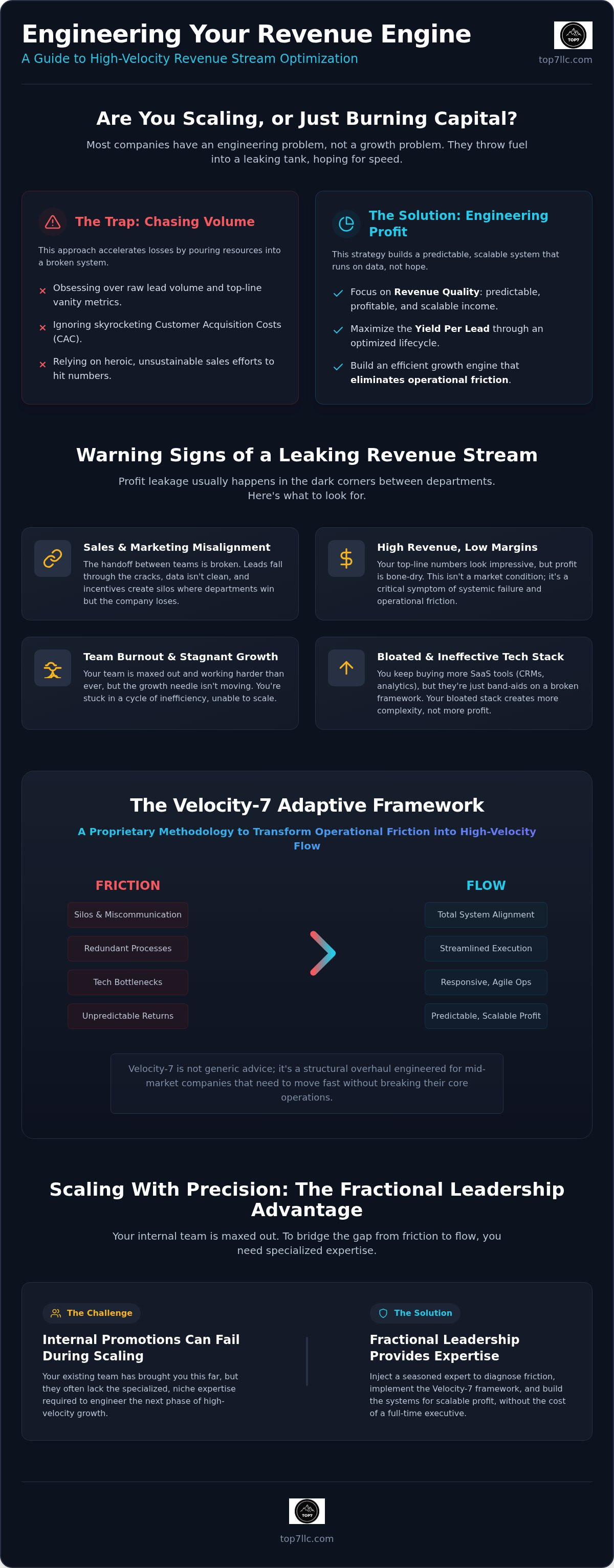
Most executives think they have a growth problem when they actually have an engineering problem. They dump capital into new leads while their existing engine burns through cash like a furnace. True revenue stream optimization is the strategic engineering of your business engine to maximize the yield per customer and lead. It's not about working harder; it's about making the system work for you. Before you can optimize, you need to understand What is a Revenue Stream? in the context of your specific market and operational capacity.
Stop obsessing over revenue volume. High top-line numbers are vanity metrics if your revenue quality is trash. Quality revenue is predictable, profitable, and scalable. If you're relying on heroic sales efforts to hit numbers every month, you don't have a growth engine; you have a ticking time bomb. Software won't save you here. Tools like CRMs or AI-driven analytics are merely band-aids on a broken operational framework. They collect data, but they don't execute strategy. The real killer of your margins is operational friction, the invisible resistance that slows down every transaction and eats your profit before it hits the bank.
To better understand this concept, watch this helpful video:
The Distinction Between Sales and Revenue Optimization
Selling more often hides deeper inefficiencies. If your customer acquisition costs are skyrocketing, simply closing more deals just accelerates your losses. You must balance aggressive acquisition with ruthless retention. A balanced strategy ensures that the value you extract over the long term justifies the initial spend. Revenue optimization is the removal of friction between a product and its market profit.
Signs Your Revenue Streams are Leaking
Revenue leakage usually happens in the dark corners between departments. Look at the handoff between marketing and sales. If leads are falling through the cracks or data isn't moving cleanly, you're losing money. Misaligned incentives across the C-suite create silos where everyone wins their specific KPI while the company loses the war. High revenue paired with low margins isn't a market condition. It's a symptom of systemic failure. When your team is maxed out but the needle isn't moving, your revenue stream optimization has failed, and your growth has stalled.
The Velocity-7 Framework: Aligning Systems for Maximum Flow
Alignment is a buzzword that lazy consultants use to justify high retainers. You don't need another meeting to "get on the same page." You need a structural overhaul. This is where the Velocity-7 Adaptive Framework transforms the way you think about revenue stream optimization. Unlike generic models built for enterprise behemoths with infinite resources, this framework was engineered specifically for mid-market companies that need to move fast without breaking their core operations. It isn't just advice; it's a proprietary methodology for total business transformation. When looking for a definition of revenue optimization, you'll often find surface-level strategies, but Velocity-7 goes deeper. It treats your business as a precision machine where every gear must mesh perfectly to achieve maximum yield.
Moving from Operational Friction to Flow
Friction is the silent killer of your margins. It's the redundant process that adds three days to a contract signing. It's the communication silo where marketing doesn't know which leads sales actually wants. It's the tech bottleneck caused by a CRM that nobody knows how to use. Flow, on the other hand, is the state where every dollar spent on acquisition yields predictable, scalable returns. We apply agile-based transformation to your revenue streams, treating profit generation with the same iterative discipline that top software teams use to ship code. Agile transformation isn't just for developers. In a high-velocity revenue engine, you must be able to pivot based on real-time data. If your marketing spend isn't converting because of a technical glitch in the handoff, you shouldn't wait for a quarterly review to fix it. Flow means your systems are responsive enough to self-correct.
The Seven Dimensions of Strategic Growth
Sustainable growth requires a synchronized assault on all seven dimensions of the growth engine. A holistic view is the only way to achieve sustainable revenue acceleration. You can't fix your sales team if your technology leadership is non-existent. You can't optimize your tech stack if your financial strategy doesn't support the investment. The framework aligns these critical areas:
Strategic Leadership: Setting the direction and pace of growth.
Revenue Operations: Engineering the sales and marketing handoff.
Market Positioning: Ensuring your message hits the right targets.
Technology Architecture: Building a stack that enables, rather than hinders, growth.
Operational Efficiency: Removing the waste from your internal processes.
Financial Modeling: Ensuring every growth move is profitable.
Product Velocity: Aligning product development with market demand.
We prioritize velocity because speed without direction is just a faster way to fail. True velocity is speed plus direction. It's about how quickly you can turn a market opportunity into realized profit. If your current leadership is maxed out, it might be time to see how our Velocity-7 Adaptive Framework can bridge the gap and move your organization from friction to flow.
Why Your Current Tech Stack Isn't Fixing Your Revenue Leaks
Stop buying more software. You're trying to solve a leadership vacuum with a monthly subscription. Most mid-market companies are drowning in tools but starving for actual results. Global software spending is projected to reach $1.43 trillion in 2026. Despite this massive investment, profit leaks are at an all-time high. In 2025, organizations had an average of 305 applications in their software portfolio. If you have 300 tools and still can't predict next month's revenue, the problem isn't the software. It's the lack of a cohesive revenue stream optimization strategy. Tools collect data. Only leadership executes strategy.
The CRM Paradox: Data Without Direction
We have a CRM, why aren't we growing? This is the most common question we hear from frustrated CEOs. The answer is simple: your CRM is likely a digital filing cabinet, not a growth engine. Disorganized data leads to chronic pipeline inefficiency. You're missing critical signals buried in the noise of irrelevant metrics. If your sales team spends more time navigating complex interfaces than talking to prospects, your tech stack has become a bottleneck. It's no longer an asset; it's an anchor. A tool without a process is just a faster way to make mistakes. You don't need more features. You need a system where every data point informs a profitable decision.
Fractional CTO: The Architect of the Revenue Engine
Technology strategy is not a help-desk ticket. It is a C-suite conversation. A Fractional CTO serves as the bridge between your tech debt and your revenue assets. They don't just manage servers; they align your technology architecture with your CRO's revenue goals. This alignment is critical for bridging the gap between product development and sales feedback loops. If your engineers are building features that your sales team can't sell, you're burning capital. A Fractional CTO ensures that every line of code and every software license serves the bottom line. They transform your tech stack from a cost center into a high-velocity revenue engine, ensuring that your technology enables growth rather than hindering it. It's about moving from a state of constant firefighting to a state of efficient, automated flow.
5 Steps to Audit and Optimize Your Existing Revenue Streams
Theory is cheap. Execution is expensive. To stop leaking profit, you need a tactical roadmap that moves beyond vague alignment talk. True revenue stream optimization requires a cold, hard look at your operational plumbing. Follow these five steps to rebuild your growth engine from the ground up.
Step 1: Map the Revenue Lifecycle. Document every touchpoint from the first marketing impression to the final contract renewal. If you can't see the whole path, you can't see the leaks.
Step 2: Identify the Bottlenecks. Where does the momentum die? Look for the highest friction points. Is it the handoff between sales and customer success? Fix the friction, or the volume won't matter.
Step 3: Analyze Unit Economics. Audit your Customer Acquisition Cost (CAC), Lifetime Value (LTV), and Payback Period. Calculate your LTV/CAC ratio as the first health check.
Step 4: Align the Leadership. Your CEO, CFO, and CRO must read from the same dashboard. If your executives are arguing about which data is correct, you've already lost.
Step 5: Execute via Velocity-7. Use our proprietary framework to apply agile principles to your revenue growth. Move fast, iterate often, and kill what isn't working.
Auditing Your Revenue Architecture
Most mid-market companies suffer from a leadership vacuum that they try to fill with more junior hires. Perform a leadership gap analysis to identify who is actually missing from your strategy sessions. If you don't have a dedicated CRO or a tech-focused CTO, your revenue architecture is likely crumbling under the weight of its own complexity. Identifying revenue leakage points in your current sales funnel is the only way to stop the bleeding. You aren't looking for minor tweaks; you're looking for systemic failures that drain your margins. Stop guessing and start measuring the flow of capital through your organization.
Iterative Optimization: The Agile Approach to Profit
Annual planning is a relic of a slower era. It's dead. Quarterly sprints for revenue are the only way to stay competitive in a market where SaaS inflation was recently measured at 16.4%. Use customer feedback loops to drive expansion through upsells and cross-sells. This isn't just about sales tactics. It requires Advanced Project Management to ensure these changes actually stick and produce measurable results. Every sprint should result in a leaner, faster, and more profitable version of your company. If you are ready to stop the leaks and master your engine, our Strategic Planning services can help you map the path from friction to flow.
Scaling with Precision: The Fractional Leadership Advantage
Stop promoting from within and expecting a miracle. Your top salesperson isn't a Chief Revenue Officer. Your bookkeeper isn't a CFO. Mid-market companies frequently fail because they lack the specialized scaling expertise required to hit the next level. They try to "figure it out" while their margins evaporate. Scaling with precision requires a battle-tested playbook, not a series of expensive experiments. Fractional leadership is the ultimate tool for revenue stream optimization because it injects elite expertise exactly where the friction is highest. It turns your leadership from a bottleneck into a catalyst.
Why pay for a full-time executive when you only need the results? A high-tier CRO or CFO in the US commands a massive salary, equity, and benefits package that can cripple a growing firm's cash flow. You don't need the overhead; you need the output. Top7’s model differs from traditional consulting because we don't just deliver a slide deck and leave. We embed seasoned professionals directly into your team to execute the strategy. We are the architects and the builders of your growth engine. This direct embedding ensures that every revenue stream optimization effort is grounded in your company's daily reality, not a theoretical vacuum.
Accessing C-Suite Expertise Without the Overhead
Fractional leaders provide strategic guidance and execution support that most mid-market teams simply can't generate internally. Whether you're navigating a market transition or a sudden crisis, having part-time executive expertise ensures your strategy remains sound. This model is far more sustainable than traditional management consulting. Consultants give you a map; fractional leaders drive the vehicle. You get the strategic dominance of a veteran executive without the long-term liability of a six-figure salary. It's about buying the outcome, not the person's 40-hour work week.
The Interim Management Bridge
When your current executive team is maxed out, they stop optimizing and start surviving. This is the birthplace of executive burnout. We use Interim Leadership to stabilize your operations while we build the optimization engine in the background. It's about moving your organization from a state of constant chaos to a state of efficient flow. We identify the leaks, plug the holes, and ensure the system is scalable before you pour more capital into it. Don't let your growth stall because of a leadership vacuum. Plug the holes in your revenue streams with Top7 and start winning again.
Turn Your Revenue Engine into a High-Velocity Asset
You've identified the leaks. You've felt the operational friction. Continuing to throw lead volume at a broken engine is just an expensive way to accelerate your failure. True revenue stream optimization isn't about chasing the latest SaaS hype; it's about engineering a precision system where every dollar spent yields a predictable, scalable return. We've shown you that software is merely a tool. The real power lies in the proprietary Velocity-7 Adaptive Framework and the elite strategic leadership that drives it forward.
Mid-market companies don't need more executive overhead. You need the strategic precision of Fractional CTO, CRO, and CFO leadership embedded directly in your operations to bridge the gap from friction to flow. We've delivered national results by aligning technology, finance, and sales into one cohesive growth engine. You have the roadmap and the steps to audit your architecture. Now you need the seasoned architects to execute the plan and protect your margins. Stop guessing and start winning.
Your high-velocity growth engine is waiting. Let's turn your stagnant income into a market-dominating force and move your organization toward its full potential.
Frequently Asked Questions
What is the difference between revenue management and revenue optimization?
Revenue management focuses on the tactical handling of existing income and pricing strategies. Revenue stream optimization is the strategic engineering of the entire business engine to maximize yield per lead. While management looks at the past and present, optimization builds the future by removing systemic friction. It ensures that every dollar spent on acquisition generates predictable and scalable returns. One is about maintaining the status quo; the other is about aggressive, profitable growth.
How does a Fractional CRO help with revenue stream optimization?
A Fractional CRO acts as the chief architect of your revenue engine. They don't just manage sales; they align marketing, sales, and customer success to eliminate the silos that cause profit leaks. By embedding directly into your team, they implement the high-level strategy needed for revenue stream optimization. They ensure your incentives are aligned with your actual margins, not just vanity metrics like lead volume or raw lead counts.
What are the most common signs of revenue leakage in a mid-market company?
Look for high customer acquisition costs that eat your margins or a maxed out executive team that can't move the needle. Revenue leakage often hides in the handoff between marketing and sales where leads simply disappear. Another sign is disorganized CRM data that creates noise instead of actionable signals. If your top-line revenue is growing but your profitability is stagnant, your system has massive systemic leaks that require an immediate audit.
Can the Velocity-7 framework be applied to service-based businesses?
Yes, the Velocity-7 Adaptive Framework is designed for any mid-market organization dealing with operational friction. In service-based businesses, friction often manifests as inefficient project delivery or poor client retention. Our framework applies agile-based transformation to these processes, moving the organization from chaotic management to efficient flow. Whether you sell software or specialized services, the goal remains the same: maximizing the yield of every operational hour and every marketing dollar.
How long does it take to see results from a revenue optimization audit?
You will see the holes in the bucket immediately during the audit phase. Identifying the bottlenecks and leakage points usually takes a few weeks. However, the execution of the full optimization engine happens through iterative quarterly sprints. While some quick wins in pricing or process alignment can show up on the next P&L, the transformation into a high-velocity growth engine is a disciplined, ongoing process that builds sustainable momentum over time.
Why is a Fractional CTO necessary for revenue growth?
A Fractional CTO transforms your tech stack from a cost center into a strategic revenue asset. Without technical leadership at the C-suite level, your company accumulates tech debt that creates operational friction. They ensure your technology architecture supports your revenue goals and your product feedback loops. They stop the SaaS-first mentality where you buy tools without a strategy, ensuring that every piece of software you own actually drives the bottom line.
How do you calculate the ROI of fractional leadership?
ROI is calculated by comparing the heavy overhead of a permanent, full-time executive against the targeted impact of fractional expertise. You aren't just saving on benefits and equity; you're gaining specialized scaling expertise that your current team lacks. The real return comes from the elimination of profit leaks and the acceleration of revenue velocity. If a fractional leader plugs a significant leak within months, the ROI is undeniable compared to a permanent hire.
What is the "Velocity-7" adaptive framework exactly?
The Velocity-7 Adaptive Framework is Top7's proprietary methodology for moving organizations from friction to flow. It focuses on seven critical dimensions of growth, including technology leadership, financial strategy, and sales guidance. By applying agile principles to the entire business engine, it allows mid-market companies to iterate on their growth strategy in real-time. It's a disciplined roadmap designed to replace executive burnout with a scalable, automated system for permanent market dominance.


Comments