
Fractional CFO for Startup Financial Strategy: Managing Cash Flow Between Funding Rounds

Most founders think they're running out of money because of a "tough market," but the truth is usually much uglier. You're likely bleeding out through operational friction you haven't even identified yet. It's a hard reality to swallow when you're staring at a dwindling bank balance and a board meeting that's only weeks away. You've felt that tightening in your chest as the runway shortens, realizing your current trajectory won't get you to the next milestone. Managing the gap between funding rounds isn't just about cutting costs; it's about surgical precision in execution.
You already know that traditional accounting won't save you. You need a wartime strategy, not just a spreadsheet. Integrating a fractional cfo for startup financial strategy into your leadership team transforms your burn rate from a terrifying liability into a tactical weapon for growth. We're moving beyond basic bookkeeping to aggressive capital management. This article breaks down how the Velocity-7 Adaptive Framework identifies hidden leaks and stabilizes your ship. You'll learn exactly how to extend your runway, eliminate operational friction, and build an investor-ready financial narrative that secures your next round. It's time to stop reacting to your bank balance and start dictating it.
Table of Contents
The Bridge to Nowhere: Why Startups Bleed Cash Between Rounds
Fractional CFO vs. Accountant: Who Actually Saves Your Startup?
Managing Cash Flow Between Funding Rounds: A 5-Step Strategic Guide
The Strategic Architect: How a CFO Drives Startup Financial Strategy
Velocity-7: Transforming Startup Friction into Financial Flow
The Bridge to Nowhere: Why Startups Bleed Cash Between Rounds
The period between funding rounds is a graveyard for startups that "almost" made it. You've secured your Seed or Series A, but now you're staring at a bank balance that only moves in one direction: down. Most founders fall into the trap of believing that standard accounting will save them. It won't. Your accountant is a historian. They tell you where your money went last month, but they have no idea where it needs to go tomorrow to ensure you survive until the next round. This is the fundamental failure of passive financial oversight.
Effective cash flow management isn't about counting pennies; it's about the strategic velocity of every dollar you deploy. When you hire a fractional cfo for startup financial strategy, you're not getting a bookkeeper. You're getting a wartime general who understands that "spending" is a liability, while "investing" is a calculated move toward a higher valuation. If your capital isn't actively shortening your path to the next milestone, it's just a leak. Most startups don't starve; they drown in their own inefficiencies while waiting for a rescue that never comes.
Operational Friction: The Invisible Runway Killer
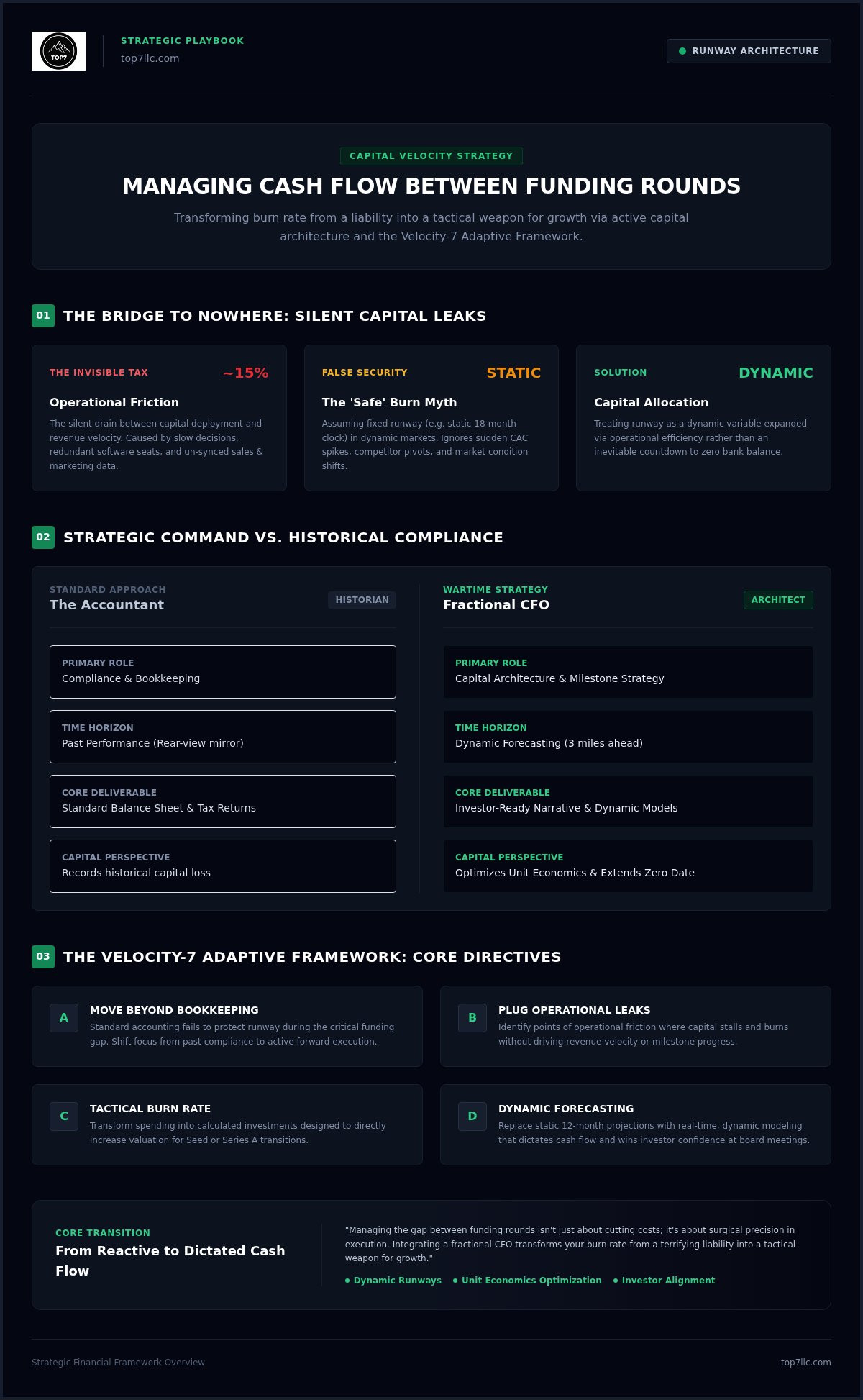
Operational friction is the gap between capital deployment and revenue velocity. It's the silent tax you pay for every slow decision, every redundant software seat, and every misaligned hire. In a high-burn environment, time is your most expensive resource. Inefficient processes manifest as financial losses that never show up on a standard P&L statement. You see the total burn, but you don't see the 15% of capital wasted because your sales and marketing data aren't synced. A strategic CFO identifies these stalls and clears the path, ensuring that your capital actually fuels growth instead of just keeping the lights on.
The Myth of the 'Safe' Burn Rate
A fixed burn rate is a hallucination. Founders love to say, "We have 18 months of runway," as if the market is a static environment. It's not. Markets shift, customer acquisition costs spike, and competitors pivot. Relying on a static projection is reactive survival, not proactive leadership. The "next round" mindset creates a psychological trap where you assume more money is always coming. It makes you soft. You need to move from reactive spending to proactive capital allocation. This means treating your runway as a dynamic variable that you can expand through operational efficiency, not just a countdown clock to zero.
Fractional CFO vs. Accountant: Who Actually Saves Your Startup?
Don't confuse bookkeeping with leadership. Most founders treat their financial department as a compliance center rather than a command center. Your accountant records the damage; they tell you how much you spent last month and ensure the tax authorities don't shut you down. While managing startup finances at a basic level is necessary, it won't help you survive a liquidity crisis or a predatory term sheet. If you're asking a tax professional to design your capital architecture, you're effectively asking a historian to predict the future. It's a recipe for bankruptcy.
The real value of a fractional cfo for startup financial strategy lies in forward-looking execution. While an accountant looks at the rear-view mirror, the CFO is focused on the road three miles ahead. They build the dynamic models that predict when your cash hits zero and, more importantly, how to move that date. One strategic pivot in your unit economics or a renegotiated vendor contract can easily save more capital than the entire fractional fee. This isn't an overhead cost; it's a high-yield investment in your company's survival.
Tactical Execution vs. Strategic Vision
A "Wartime CFO" is essential when you're operating in the funding gap. Investors don't care about your perfectly filed tax returns; they care about your path to profitability and your command over the numbers during board meetings. The output of an accountant is a balance sheet. The output of a strategic CFO is a roadmap that leads to your next milestone. They handle the high-stakes investor relations and board management that a founder often lacks the time or specialized knowledge to navigate effectively. They transform raw data into a narrative that wins confidence and capital.
Embedding Leadership into the Velocity-7 Framework
Top7 leaders don't sit on the sidelines. We embed our experts directly into your team to eliminate the friction that slows down growth. By utilizing the Velocity-7 Adaptive Framework, a fractional leader identifies where your organizational structure is leaking cash and fixes it in real-time. You get the wisdom of a C-suite veteran who has navigated dozens of funding rounds without the $300k plus payroll burden of a full-time hire. If you're ready to stop guessing and start executing, it's time to explore our fractional leadership models. We move beyond spreadsheets to drive total organizational transformation.
Managing Cash Flow Between Funding Rounds: A 5-Step Strategic Guide
Stop hoping for a market miracle. If you're managing your runway by staring at a static Excel sheet, you've already lost. A fractional cfo for startup financial strategy doesn't just watch the clock; they rebuild the clock to run slower when you need it most. To survive the gap between rounds, you need an aggressive tactical execution plan that moves beyond basic bookkeeping. You aren't just looking for "savings"; you're looking for strategic leverage.
Step 1 & 2: Auditing Friction and Dynamic Forecasting
Most startups bleed out because of unrecognized bottlenecks in their revenue cycle. Audit the friction by locating exactly where cash stalls in your machine. Is it a 45-day lag in invoicing? Is it a bloated sales tech stack that isn't actually converting? Once you find the leaks, you need a way to predict the future that isn't a fantasy. While foundational small business financial management is a start, high-growth startups require "Stress-Test" scenarios. Dynamic forecasting is the ability to pivot strategy based on real-time cash velocity. It's the difference between hitting a wall at full speed and adjusting your course before the impact occurs.
Step 3, 4 & 5: Optimization and Raising
Next, build a flexible burn model. Fixed costs are handcuffs in a volatile market. Shift toward variable cost optimization by aggressively negotiating vendor terms that favor your cash position, not theirs. Don't be afraid to demand net-60 terms; your liquidity is your leverage in any negotiation. Simultaneously, you must increase revenue velocity. Every day that passes between a lead generation and cash-in-hand is a day you're paying for the privilege of existing. Align your product development with immediate revenue goals rather than speculative long-term features that won't pay the bills this quarter.
Finally, use this financial clarity to craft your "Round-Ready" narrative. Investors don't just buy growth; they buy confidence in your execution and your ability to protect their capital. By deploying a fractional cfo for startup financial strategy, you arrive at the negotiating table with an airtight data set that leaves no room for doubt. You aren't begging for capital; you're offering a seat on a high-velocity vehicle that has already optimized its path to scale. This level of precision drives higher valuations because it proves you know how to manage every dollar you're given. It's about showing, not telling, that you are the master of your financial destiny.
The Strategic Architect: How a CFO Drives Startup Financial Strategy
A bank balance is a lagging indicator. If you're only checking your cash position to see if you can make payroll, you're not leading; you're reacting. The real value of a fractional cfo for startup financial strategy is the construction of a capital architecture that supports aggressive scaling without structural collapse. This architect acts as the CEO’s most critical strategic filter, ruthlessly pressure-testing every growth initiative against the reality of the balance sheet. They don't just manage cash; they manage the risk of your ambition. They turn "what if" into "here is how."
Strategic leadership means looking beyond the next thirty days. It involves building a capital strategy that anticipates the needs of your Series B while you're still executing your Series A. Without this level of foresight, you're just driving a fast car with no brakes. You need a partner who understands that every operational decision is a financial decision in disguise. If you're ready to stop playing defense and start architecting your growth, partner with a Top7 fractional leader today.
Mastering Unit Economics
Growth is often a mask for failure. Many founders celebrate rising revenue while their unit economics are quietly poisoning the business. You need to obsess over your LTV/CAC ratios because they tell the true story of your future. If your cost to acquire a customer is rising while their lifetime value stays flat, you're in a death spiral. This is "False Growth." It burns more money the faster you go. A strategic CFO ensures every dollar spent has a measurable, high-velocity path back to the bank. They demand that growth is sustainable, not just visible. They find the profit in the noise.
Risk Management and Market Agility
Markets don't care about your roadmap. Funding delays and sudden downturns are the norms, not the exceptions. A strategic architect builds hedges into your financial model long before the board starts panicking. This involves identifying the "Pivot Point": the exact moment when you must cut burn to preserve the core or accelerate to capture a market gap. It requires a culture of financial accountability across the entire C-suite. Every department head must understand the financial impact of their operational decisions. You can't afford silos when your runway is at stake. Execution requires total alignment; anything less is just expensive friction.
Velocity-7: Transforming Startup Friction into Financial Flow
Most startups are built on top of accidental processes. You've scaled fast, and now the internal friction is louder than your revenue growth. This is where most leaders fail: they try to fix financial symptoms with accounting bandaids. We don't do bandaids. We use the Velocity-7 Adaptive Framework to dismantle the obstacles preventing your organization from reaching a state of flow. If your capital isn't moving with precision, it's stagnating. And in a high-growth environment, stagnation is just a slow-motion crash.
A fractional cfo for startup financial strategy is the engine room of this transformation. We don't just hand you a report and leave. We embed directly into your leadership team, taking ownership of the financial architecture. We move you from the chaos of "emergency mode" to the predictability of "scale mode." By addressing the seven dimensions of growth, our CFOs ensure that your capital isn't just sitting in a bank account; it's actively working to increase your valuation. We are the last consulting firm you'll ever need because we build systems that last.
The Velocity-7 Advantage
Applying agile-based transformation to your finance department means your strategy is never static. We treat your financial model like a living organism. When market conditions shift, your strategy pivots in real-time. This framework allows us to identify exactly which of the seven dimensions is lagging, whether it's operational execution, capital allocation, or revenue velocity. We fix the bottleneck, clear the friction, and restore the flow. The result is a move from organizational chaos to predictable, measurable scale. You stop wondering if you'll make it to the next round and start knowing exactly how you'll win it.
Taking the Next Step
Engaging a Top7 Fractional CFO isn't a long-winded corporate onboarding process. We don't have time for that, and neither do you. Within the first 30 days of a Top7 engagement, we've already audited your friction points, stress-tested your runway, and established a dynamic forecasting model. You'll see an immediate shift in how decisions are made across the C-suite. No more guessing. No more runway anxiety. Just raw, data-driven execution. It's time to decide if you're a founder who survives or a founder who dominates. Stop the leaks and secure your runway with a Top7 Fractional CFO.
Command Your Runway and Master the Raise
Most founders wait until the bank balance is screaming before they look for help. By then, you aren't strategizing; you're panicking. You now understand how a fractional cfo for startup financial strategy moves you from a passive victim of market shifts to an active architect of your own growth. We've established that standard accounting is merely historical record-keeping, while true financial leadership is visionary. By identifying silent leaks and applying the Velocity-7 Adaptive Framework, you transform operational friction into financial flow.
Top7 provides more than just advice; we embed seasoned C-suite professionals with decades of experience directly into your team to solve complex growth obstacles. We don't have time for fluff, and neither do you. It's time to stop bleeding capital and start building a financial narrative that investors can't ignore. Your next round depends on the precision of the execution you start today. You have the tools to dominate your market; now you just need the leadership to wield them. Take control of your financial destiny and build the future your vision deserves.
Schedule your Velocity-7 Strategy Audit today.
Frequently Asked Questions
What is the difference between a Fractional CFO and a part-time accountant?
An accountant records the past to keep you compliant; a Fractional CFO architects the future to keep you alive. Accountants focus on tax filings and historical ledgers. A strategic CFO manages your capital architecture and investor relations. If you're asking an accountant for growth strategy, you're looking for answers in the wrong decade. You need a leader who understands how to leverage every dollar for valuation growth and sustainable scale.
How many hours a week does a Fractional CFO typically work for a startup?
There is no "typical" week because your needs change as your runway shifts. A Top7 leader embeds directly into your team, providing as much time as necessary to eliminate friction. This isn't about punching a clock; it's about achieving measurable outcomes. Whether it's five hours or fifteen, the focus remains on strategic execution and ensuring your financial machine is optimized for the next funding milestone and long term stability.
When is the right time for a startup to hire a Fractional CFO?
The right time is before you feel the panic of a shortening runway. Most startups wait too long and hire when they're already bleeding out. You should engage a fractional cfo for startup financial strategy as soon as you close your Seed or Series A round. This ensures your capital deployment is surgical from the start, preventing the operational friction that kills most early stage companies before they reach scale.
Can a Fractional CFO help me raise my Series B funding?
Absolutely. Raising Series B requires more than just a good product; it requires a sophisticated financial narrative. A strategic CFO builds the data driven case that proves your unit economics are sustainable. They handle the high stakes board management and investor scrutiny that founders often struggle with. By presenting an airtight capital strategy, they significantly increase your chances of securing a higher valuation from institutional investors during the next round.
How does the Velocity-7 framework improve cash flow management?
The Velocity-7 Adaptive Framework identifies the specific dimensions where your organization is stalling. It treats cash flow as an execution problem rather than a math problem. By auditing the friction between capital deployment and revenue velocity, the framework allows the CFO to clear bottlenecks in real time. This moves the organization from a state of chaotic survival into a predictable, efficient flow that maximizes every dollar of your available funding.
Is a Fractional CFO worth the cost for a pre-revenue startup?
It's often more critical then. Pre-revenue startups have the highest risk of building flawed capital structures that collapse under pressure. A CFO ensures your unit economics are designed for profitability before you start burning through your first major raise. Investing in high level leadership early prevents the "false growth" traps that lead to bankruptcy. It's not an overhead cost; it's the insurance policy for your company's survival and future growth.
What financial reports should I expect from a strategic CFO?
You should expect far more than a standard P&L or balance sheet. A strategic CFO provides dynamic forecasts, stress test scenarios, and deep dives into your LTV/CAC ratios. These reports focus on where your cash is going and how fast it's returning. You need actionable intelligence that informs board level decisions, not just historical data. If your reports don't tell you how to extend your runway, they're useless for growth.
How does a Fractional CFO manage operational friction?
Friction is managed by identifying where processes stall and drain capital. A fractional cfo for startup financial strategy looks at the gap between spending and revenue velocity. They audit your tech stack, your hiring plan, and your vendor contracts to find hidden leaks. By aligning these operational elements with your financial goals, they eliminate the "silent tax" of inefficiency. This ensures that your runway is used for growth, not just maintenance.


Comments