
Fractional COO for Logistics: Driving Flow

In logistics, your operations are either a friction point burning cash or a disciplined machine generating profit. When net margins hover at a razor-thin 3% to 4%, you can't afford unbilled detention fees, clunky legacy ERP workarounds, or constant dispatcher turnover. So, what does a fractional coo do for a logistics company caught in that operational crossfire? Rather than handing you an academic slide deck, an operational executive embeds directly into your business to eliminate friction and restore flow.
You already know that scaling revenue means nothing if last-mile inefficiencies and disconnected systems quietly bleed your bottom line dry. You need battle-tested leadership on the floor, but you don't need the bloated overhead of a permanent corporate hire. In this guide, discover how a fractional COO transforms logistics chaos into a high-margin, scalable operation using tactical execution and the Velocity-7 framework. We'll break down the exact operational roadmap to cut overhead, automate your tech stack, and build predictable flow across your entire network.
Table of Contents
The Logistics Bottleneck: Why Your Operations are Eroding Your Margins
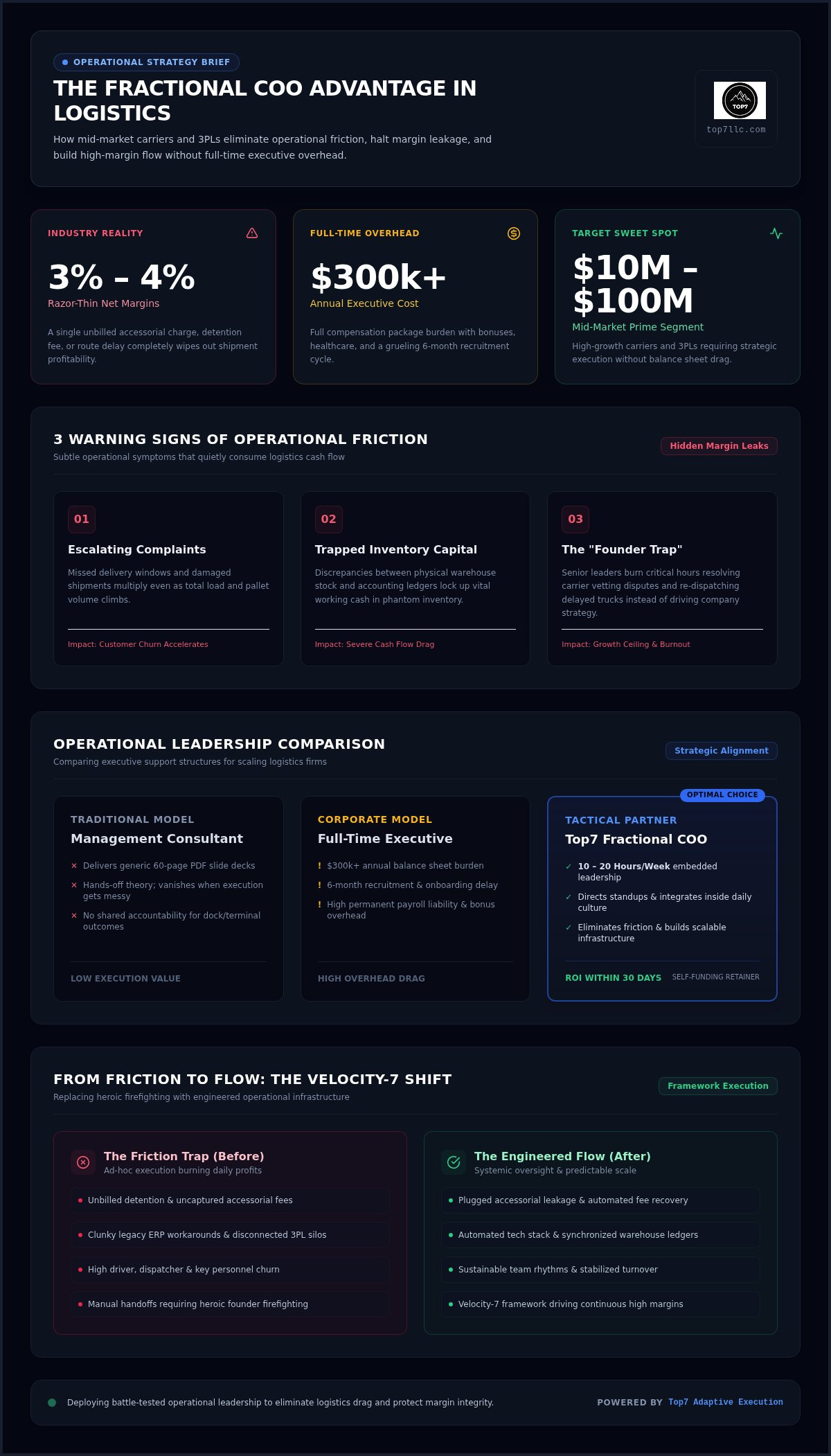
Revenue growth in logistics can be deceptive. You add new freight contracts, increase pallet volume, and watch your top line expand, yet your net profit barely budges. Why? Because operational friction quietly consumes your cash. Mid-market logistics providers constantly run into mismatched tech stacks, warehouse labor gaps, and disconnected 3PL communication silos. When domestic transportation margins hover near 3%, a single missed accessorial charge or route delay wipes out your profitability. Grinding harder on the dock won't solve structural dysfunction. You need engineered operational flow, not brute force.
Most mid-market operations hit a glass ceiling when founders try to manage logistics execution manually. Understanding Chief Operating Officer role dynamics reveals that high-growth logistics requires systemic oversight, not ad-hoc problem-solving. This reality often leads executives to ask: what does a fractional coo do for a logistics company when daily operations stall? Simply put, they break through this growth plateau by replacing heroic individual firefighting with scalable operational infrastructure.
Signs Your Logistics Firm is Suffering from Operational Friction
Operational friction rarely announces itself with a single catastrophe. Instead, it surfaces through persistent, subtle symptoms:
Escalating customer complaints: Missed delivery windows and damaged shipments multiply even as total volume climbs.
Trapped inventory capital: Discrepancies between your physical warehouse stock and accounting ledgers lock up cash in phantom inventory.
The founder trap: Senior leadership spends valuable hours resolving carrier vetting disputes or re-dispatching delayed trucks instead of driving company strategy.
The High Cost of Doing Nothing
Tolerating operational drag acts as an invisible tax on every load you move. Driver and dispatcher churn spikes, customer churn accelerates, and your key personnel burn out trying to manually bridge broken handoffs between your legacy systems. Waiting six months to source, interview, and onboard an expensive full-time executive is a massive tactical error. In the hyper-competitive shipping market, that delay gives competitors ample time to capture your market share while your margins evaporate.
Bridging this execution gap is precisely what does a fractional coo do for a logistics company seeking immediate stability. Instead of waiting months for executive recruitment cycles, an experienced operator steps directly into the chaos to establish accountability, protect your cash flow, and build operational flow from day one.
The Fractional COO Defined: Strategic Leadership Without the $300k Overhead
A Fractional COO is a battle-tested operations executive who embeds directly into your leadership team for 10 to 20 hours a week to architect, optimize, and run your operational systems. Forget traditional consultants who hand you a generic 60-page PDF and disappear when execution gets messy. A fractional operator owns performance outcomes alongside your dispatchers, warehouse leads, and terminal managers. Simply defined, a Fractional COO is a tactical asset deployed to eliminate friction and build sustainable operational flow across your supply chain.
Full-time logistics executives routinely demand annual compensation packages exceeding $300,000 once you factor in healthcare, performance bonuses, and recruitment overhead. Mid-market carriers and 3PLs don't need that balance sheet drag to run an elite operation. When managing the high-stakes complexity outlined in the U.S. Bureau of Labor Statistics overview of supply chain logistics, you need tier-one executive governance without the permanent liability. Clarifying what does a fractional coo do for a logistics company comes down to math: they deliver high-level operational leadership at a fraction of full-time executive overhead.
Fractional vs. Interim vs. Full-Time
Mid-market logistics providers generating between $10M and $100M represent the prime sweet spot for this model. While interim leadership manages acute turnaround crises or sudden executive departures, a fractional executive drives ongoing, sustainable scaling. Top7 operators don't sit on the sidelines; they integrate directly into your daily operational rhythms, directing standups and engineering workflows from inside your culture.
The ROI of Fractional Leadership
Within the first 30 days, an experienced operator often pays for their retainer by identifying hidden margin leaks, like unbilled detention fees, deadhead mileage, and carrier vetting penalties. Tactical strategic planning happens directly on the warehouse floor as daily execution improves. To eliminate your operational friction without executive payroll bloat, connect with Top7 fractional executive leadership to establish predictable flow across your network.
4 Critical Areas a Fractional COO Fixes in a Logistics Firm
Operational drift destroys margins quietly. When freight owners ask what does a fractional coo do for a logistics company, the answer centers on decisive intervention across four operational pillars:
Supply chain optimization: Shifting your logistics network from daily reactive fire-fighting to predictive load planning, dynamic route density, and airtight carrier vetting.
Tech stack synchronization: Auditing fractured legacy ERPs, transportation management systems (TMS), and modern warehouse management systems (WMS) to kill manual data entry.
Labor and floor culture: Eliminating dock floor burnout, dispatcher turnover, and communication gaps with structured operating rhythms.
Scalability architecture: Codifying institutional knowledge into tactical standard operating procedures (SOPs) that allow your business to 10x capacity without exploding overhead.
Eliminating Tech-Driven Friction
Manual re-entry between your TMS, warehouse software, and customer accounting platforms bleeds margin on every shipment. A Fractional COO audits your integrations to ensure 3PL feeds, EDI handshakes, and dispatch schedules speak to each other automatically. Collaborating with a Fractional CTO, an operations leader bridges the tactical gap between IT systems and dock execution. Grounded in the Velocity-7 Adaptive Framework, this alignment guarantees that every software tool actively accelerates load velocity rather than trapping your dispatchers in administrative quicksand.
Professionalizing the Workforce
Mid-market logistics providers constantly suffer from tribal knowledge locked inside the heads of two or three veteran dispatchers. If they quit, your operations stall. Answering what does a fractional coo do for a logistics company caught in this cycle means eliminating key-person risk entirely. They translate operational memory into repeatable playbooks and institute high-accountability scorecards. Instead of vanity metrics, your floor leaders manage by critical operational numbers: On-Time In-Full (OTIF) execution, accessorial cost recovery, and dock turnaround time.
From Friction to Flow: Implementing the Velocity-7 Framework
Frameworks without operational teeth are useless. In freight and warehousing, academic advice dies on the dispatch floor. That is why Top7 deploys the Velocity-7 Adaptive Framework, a proprietary methodology built specifically to transform supply chain friction into disciplined operational flow. Moving across seven core dimensions of business growth, this agile system forces alignment between executive strategy, freight tech, and warehouse execution.
When evaluating what does a fractional coo do for a logistics company, examine their operating system. A great operator doesn't rely on gut feelings; they execute a battle-tested 90-day sprint cycle. Days 1 to 30 focus on assessment. Days 31 to 60 drive process realignment. Days 61 to 90 lock in automated execution and continuous optimization.
The Velocity-7 Audit
During the initial 30 days, your fractional leader conducts a deep diagnostic across every handoff point in your fulfillment pipeline. They pinpoint where shipments stall, where unbilled accessorial fees slip through, and where labor hours vanish. The result is a dedicated Velocity Scorecard that ties your daily terminal metrics directly to gross profit margins, giving you crystal-clear visibility into operational bottlenecks.
Executing the Transformation
Agile methodologies aren't reserved for software teams. In logistics, agility means two-week operational sprints that resolve routing bottlenecks, update TMS rules, and fix receiving delays in real time. Top7 operators ensure every workflow tweak either accelerates delivery velocity or protects margin. Moving from operational friction to efficient flow happens in a single quarter, permanently stabilizing your logistics engine.
Executing this rapid transformation is precisely what does a fractional coo do for a logistics company facing aggressive market pressure. Stop letting operational drag drain your enterprise value. Deploy the Velocity-7 Adaptive Framework with Top7 to convert your logistics network into a high-margin competitive advantage.
Why Top7 is the Tactical Choice for High-Growth Logistics
Top7 doesn't parachute in an isolated consultant with an abstract slide deck. We embed seasoned, battle-tested executives backed by an operational framework engineered for mid-market scale. When freight founders ask what does a fractional coo do for a logistics company at this tier, the answer isn't polite advice. It's hands-on leadership that builds an unshakeable operational backbone. With nationwide reach, our operators import battle-tested logistics strategies from coast to coast directly into your distribution hubs.
Beyond the COO: The Power of Fractional C-Suite
Operational bottlenecks rarely stay confined to warehouse docks. When routing slippage balloons fuel expenses or carrier fraud threatens receivables, an isolated operations leader hits a wall. Top7 delivers an integrated fractional leadership bench. Your Fractional COO works directly with our Fractional CFO to recover leaked accessorial charges, while teaming with our Fractional CTO to automate carrier vetting. Backed by advanced project management and cohesive strategic planning, your operational infrastructure operates in lockstep. Ready to take command of your supply chain? Schedule a call with a Top7 Executive to assess your network.
Your Next 90 Days
Day one starts on the operational floor, completely free of corporate posturing. During week one, your embedded executive audits dispatch rhythms, analyzes TMS routing rules, and interviews floor supervisors to expose margin drag. The transition from founder-led firefighting to executive-led flow begins immediately. Disconnected handoffs are eliminated. Operational accountability becomes mandatory across every shift.
Ultimately, determining what does a fractional coo do for a logistics company comes down to one metric: turning operational chaos into predictable, scalable profit. Stop letting operational friction bleed your balance sheet dry. Deploy a fractional operator who actually executes.
Take Command of Your Logistics Execution
Running a mid-market freight or warehousing operation with broken systems and shrinking margins is an expensive waiting game. Understanding what does a fractional coo do for a logistics company reveals a simple truth: sustainable growth demands operational flow, not daily triage. When you replace ad-hoc firefighting with documented SOPs, synchronized TMS platforms, and rigorous scorecard management, your margins immediately recover.
Top7 equips your business with seasoned C-suite veterans across the country, delivering zero-overhead executive expertise directly to your floor. Powered by our proprietary Velocity-7 Adaptive Framework, we eliminate dispatch friction, halt accessorial leakage, and build an airtight supply chain that scales on demand. You don't have to let operational drag dictate your profitability or burn out your best talent. Take control of your network, protect your bottom line, and move from friction to flow by scheduling your tactical audit.
Frequently Asked Questions
How many hours a week does a fractional COO work for a logistics company?
A fractional COO typically works 10 to 20 hours per week, depending on operational complexity and sprint demands. This targeted allocation focuses entirely on high-impact bottlenecks rather than administrative bloat. The fractional operator runs weekly standups, audits dispatch protocols, and directs process re-engineering without lingering on trivial tasks. You get high-level operational leadership concentrated strictly on removing friction and maximizing throughput.
Is a fractional COO better than a logistics consultant?
Yes, because traditional consultants deliver presentations while fractional COOs take operational ownership. A consultant diagnoses issues, leaves a binder of recommendations, and exits. A fractional COO embeds directly within your terminal or warehouse operations, executing changes alongside your dispatchers and warehouse managers. They don't just tell you how to streamline your freight network; they build the systems and hold your team accountable to the numbers.
What is the average cost of a fractional COO in 2026?
Fractional leadership is structured around flexible monthly retainers rather than fixed executive payroll. While a permanent logistics operations executive carries heavy loaded annual costs through bonuses, healthcare, equity, and recruitment fees, a fractional operator delivers the same strategic horsepower at a fraction of that total expense. You pay for execution and tactical results without being locked into multi-year executive liabilities.
Can a fractional COO help with warehouse automation and ERP implementation?
Directing complex tech rollouts is a core reason freight owners ask what does a fractional coo do for a logistics company. They audit current legacy ERP or TMS workflows, select viable warehouse management systems, and manage user adoption on the dock floor. Working alongside technical leaders, they ensure software serves your dispatch speed and order accuracy instead of creating new operational bottlenecks.
How long does it take to see results from a fractional COO?
Tangible operational improvements typically surface within the first 30 days. The initial audit exposes hidden margin leaks, unbilled accessorial fees, and routing waste. By day 60, updated standard operating procedures and redesigned communication rhythms take hold. Within a full 90-day cycle, mid-market carriers and 3PLs establish predictable execution, lower labor friction, and visible recovery in net margins across daily shipments.
Does a fractional COO manage my existing logistics team?
Yes, an embedded fractional executive directly leads terminal managers, warehouse leads, and dispatchers. They conduct regular operational standups, establish performance scorecards, and hold personnel accountable to delivery metrics like On-Time In-Full (OTIF). Instead of bypassing your team, they mentor mid-level managers, eliminate tribal knowledge silos, and build an autonomous operational culture that runs smoothly even when leadership isn't in the room.
What is the Velocity-7 framework and how does it apply to shipping?
The Velocity-7 Adaptive Framework is Top7's proprietary operational methodology that accelerates business flow across seven core dimensions. In logistics, it aligns executive strategy directly with warehouse and dispatch execution. The framework breaks your transformation into 30/60/90-day agile sprints, auditing friction, automating handoffs, and installing real-time scorecards. It converts a sluggish shipping operation into a high-margin, scalable machine.
Why shouldn’t I just hire a full-time COO for my mid-market firm?
Full-time executive searches take six months or longer, burning valuable time while your margins erode. Beyond the executive salary, bonus pools, and benefits package, mid-market firms rarely need 40 hours of high-level strategy every week. Discovering what does a fractional coo do for a logistics company proves that agility wins. You secure veteran C-suite leadership immediately, pay strictly for execution, and scale leadership capacity as freight volume grows.


Comments