
Fractional CTOs for Manufacturing: 2026 Strategic Guide

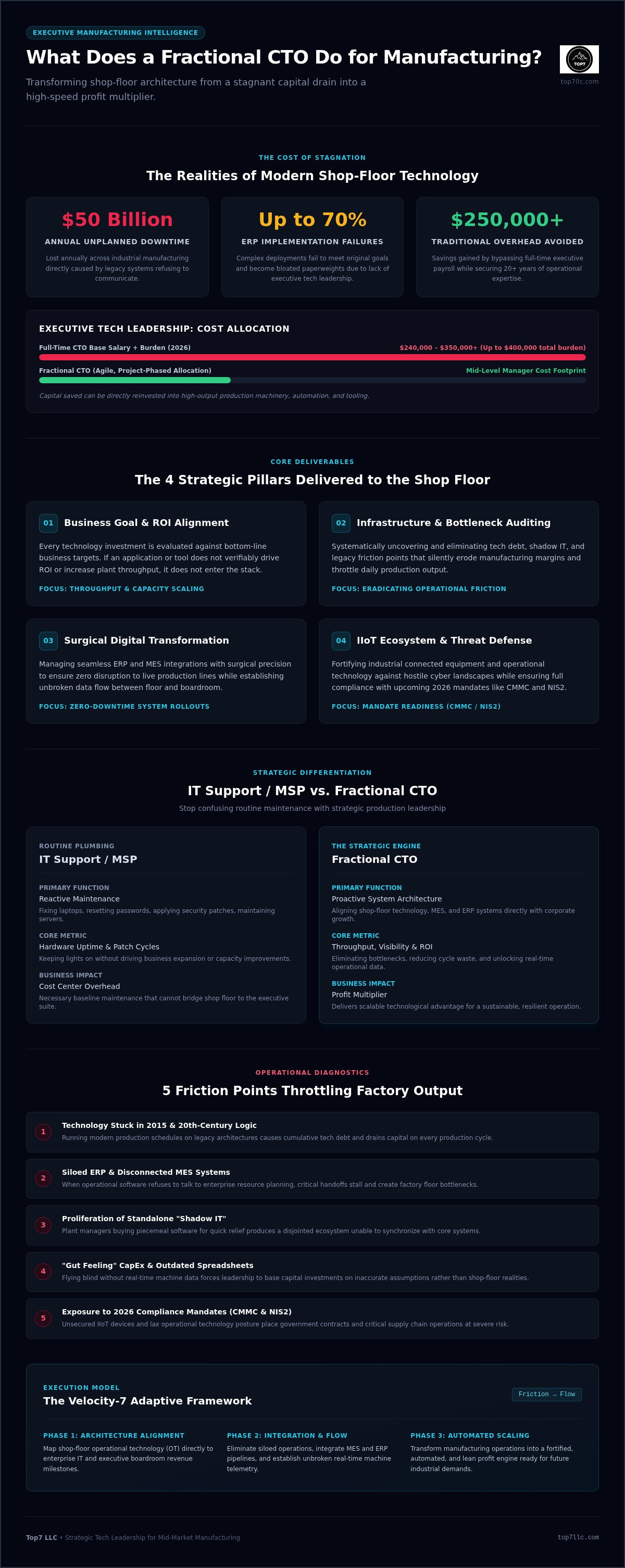
Is your shop floor hemorrhaging cash because your technology is stuck in 2015? Industrial manufacturing loses an estimated $50 billion annually to unplanned downtime. Most of that waste is the direct result of legacy systems that refuse to talk to each other. You don't need a $400,000 full-time executive to fix a broken ERP or a siloed MES. You need a strategist who understands the grit of production. If you are asking what does a fractional cto do for a manufacturing company, the answer is simple. They transform your technology from a stagnant bottleneck into a high-speed profit multiplier.
We know the frustration of watching tech and production clash while overhead costs skyrocket. This guide promises to show you how to bridge that gap, eliminating the $250,000 plus burden of a traditional hire while securing your plant against 2026 mandates like CMMC and NIS2. We will break down the Velocity-7 Adaptive Framework, the roadmap for seamless ERP and MES integration, and the tactical steps to automate your way to a leaner, more profitable operation. It's time to stop guessing and start executing.
Table of Contents
Beyond IT Support: Why Manufacturing Technology is Your Biggest Growth Bottleneck
The 4 Strategic Pillars: What a Fractional CTO Actually Delivers to the Shop Floor
Fractional CTO vs. Managed Service Provider (MSP): Stop Confusing Maintenance with Strategy
Identifying the "Friction Points": 5 Signs Your Factory Needs Part-Time Tech Leadership
Executing with Velocity: How Top7 Transforms Manufacturing Operations
Beyond IT Support: Why Manufacturing Technology is Your Biggest Growth Bottleneck
Manufacturers often treat technology as a necessary evil, a cost center managed by an "IT guy" who fixes laptops and resets passwords. This mindset is a terminal mistake that throttles your production capacity. A Fractional CTO is a strategic executive who provides high-level tech leadership on a part-time basis, moving your operation away from reactive maintenance toward proactive growth. If you are wondering what does a fractional cto do for a manufacturing company, they don't just keep the lights on; they drive the engine. While your IT team handles the "plumbing," a CTO architects the systems that actually scale production.
To better understand how this strategic role integrates into your business structure, watch this video:
The distinction between basic support and strategic leadership is often the difference between a profitable year and a stagnant one. Most mid-market plants are drowning in "maintenance" tasks while their competitors are automating. Consider the following differences:
IT Support: Focuses on uptime, security patches, and hardware lifecycle.
Fractional CTO: Focuses on throughput, data visibility, and system ROI.
The Cost of Tech Debt in Modern Manufacturing
Legacy systems create invisible operational friction that eats your margins daily. When your shop floor relies on 20th-century logic in a 21st-century market, you are losing money on every cycle. This friction often leads to "shadow IT," where plant managers buy standalone software to solve immediate pains, creating a disjointed mess that doesn't sync with your ERP. Tech debt is the cumulative cost of choosing easy fixes over strategic solutions. By failing to integrate operational technology (OT) with your enterprise systems, you're flying blind, making critical decisions based on outdated spreadsheets rather than real-time machine data.
Fractional Leadership: The Sustainable Path to Scale
A full-time CTO in 2026 commands a base salary between $240,000 and $350,000. For most mid-market manufacturers, that's a massive waste of capital that should be going into new machinery or automation. Fractional leadership gives you access to 20+ years of experience for the price of a mid-level manager. You get the flexibility to scale leadership hours up or down based on your specific project phases. When evaluating what does a fractional cto do for a manufacturing company, consider the agility they bring to your capital allocation strategy. This model allows you to focus capital on production equipment while ensuring your tech stack is built for flow, not friction.
The 4 Strategic Pillars: What a Fractional CTO Actually Delivers to the Shop Floor
Most manufacturers throw money at software and pray for a miracle. That isn't a strategy; it's a gamble. When you ask what does a fractional cto do for a manufacturing company, the answer is rooted in four non-negotiable pillars. First, they align every technology investment with your bottom-line business goals. If a tool doesn't drive ROI or increase throughput, it doesn't belong in your stack. Second, they audit your current infrastructure to identify bottlenecks that are choking your production capacity. Third, they manage complex digital transformations with a surgical focus, ensuring new systems don't disrupt active production lines. Finally, they secure your entire Industrial Internet of Things (IIoT) ecosystem against an increasingly hostile threat landscape.
ERP and MES Optimization
Industry data shows that up to 70% of ERP implementations fail to meet their original goals. They become bloated, expensive paperweights because they lack executive-level technical oversight. A Fractional CTO ensures your ERP and Manufacturing Execution System (MES) actually communicate. By creating a single source of truth between the warehouse and the shop floor, you eliminate the manual data entry and human error that lead to shipping delays and inventory nightmares. It's about building a system that supports flow rather than creating new friction points.
Data Strategy and Predictive Maintenance
Raw machine data is worthless if it stays trapped in a silo. A strategic leader turns that telemetry into actionable business intelligence. By implementing IoT sensors across critical equipment, you move from reactive "firefighting" to predictive maintenance. This shift allows you to identify equipment fatigue before a catastrophic failure occurs. Real-time data visibility prevents "emergency" production halts by giving your team the foresight to schedule repairs during planned downtime instead of mid-shift. If you want to move from chaos to precision, you need a strategic fractional leader who understands the marriage of data and iron.
Cybersecurity for the Factory Floor
Your intellectual property and proprietary processes are your most valuable assets. In 2026, air-gapped systems are a myth. Every connected machine is a potential entry point for ransomware. A Fractional CTO implements rigorous security protocols based on NIST operational technology security guidance to protect your shop floor. They don't just install a firewall; they architect a disaster recovery plan that ensures your machines keep spinning even if your network is under fire. Securing your OT environment isn't just an IT task; it's a fundamental requirement for business continuity.
Fractional CTO vs. Managed Service Provider (MSP): Stop Confusing Maintenance with Strategy
Your MSP is not your strategist. Period. Most manufacturers fall into a dangerous trap by expecting their "IT guy" to lead their digital transformation. Managed Service Providers are built for maintenance; they're the plumbers of your organization. They ensure the network is up, the firewalls are patched, and the laptops work. That's tactical, not strategic. If you're relying on an MSP to design your 2026 roadmap, you're essentially asking a mechanic to design a supercar. They can keep the engine running, but they have no idea how to win the race.
When leadership asks what does a fractional cto do for a manufacturing company, they're looking for an architect, not a repairman. A CTO fixes business models by aligning tech with throughput. Relying solely on an MSP leads to stagnant technology because their business model thrives on stability, not change. Innovation introduces risk and support tickets, which is exactly what an MSP wants to avoid. You need a leader who isn't afraid to disrupt the status quo to eliminate operational friction.
The Conflict of Interest in Vendor-Led Strategy
Software vendors and MSPs have a fundamental conflict of interest. They want to sell you the tools they know or the hardware they resell. An unbiased Fractional CTO doesn't profit from your hardware choices. Their only metric is your ROI. They prevent "vendor lock-in" by architecting systems that are modular and scalable. Instead of following a salesperson's pitch, they utilize NIST MEP advanced manufacturing technology and Industry 4.0 guidance to build a custom tech stack that serves your specific production goals. They negotiate better terms because they speak the language and know when a vendor is padding the bill.
Accountability and Execution
A Fractional CTO acts as the translator between technical jargon and business outcomes. Do you really know if your tech projects are on track, or are you just hearing excuses about "complexity"? A strategic leader sets KPIs for your tech team and vendors that actually align with your shop floor's needs. They manage the MSP to ensure they're meeting their SLAs while pushing for the modernization required to scale. What does a fractional cto do for a manufacturing company? They own the result. They ensure that every dollar spent on technology is a direct investment in your future market share, not just another line item in the maintenance budget.
Identifying the "Friction Points": 5 Signs Your Factory Needs Part-Time Tech Leadership
If your factory floor feels like a series of fires you're constantly putting out, your technology is failing you. Most manufacturers don't realize they're in trouble until production halts or a major contract is lost due to inefficiency. What does a fractional cto do for a manufacturing company? They act as the diagnostic surgeon for your operational health, identifying the hidden friction points that your internal team is too close to see. If you recognize any of these five signs, your current setup is a liability.
Data Silos: Your production data is trapped in manual spreadsheets or disconnected software, making real-time OEE tracking impossible.
Gut-Feeling CapEx: You're making multi-million dollar capital expenditure decisions based on intuition rather than hard, verifiable machine data.
Project Paralysis: Tech initiatives are consistently over budget and past deadlines, with no clear accountability for the failure.
Reactive IT: Your tech team only appears when something breaks; they have no plan for how technology will drive your growth next year.
Executive Distraction: The CEO or owner is spending more than five hours a week troubleshooting software glitches or arguing with vendors.
The "Founder Bottleneck" in Manufacturing
Owners of mid-market plants often fall into the trap of being the "de facto" CTO. This is a strategic error that caps your company's growth. You cannot focus on high-level market expansion while you're worrying about server uptime or ERP integration errors. The emotional cost of executive burnout is high, but the financial cost of your misallocated time is higher. Every hour a CEO spends troubleshooting a glitchy ERP is an hour stolen from high-level sales and strategic market expansion. It's time to stop being the fix-it guy and start being the leader your company needs.
Assessing Your Digital Maturity
Is your technology an asset that accelerates production or a liability that slows it down? Determining your digital maturity requires moving beyond "Interim" crisis management and into "Fractional" strategic growth. A strategic leader doesn't just patch holes; they build a scalable architecture. The first 90 days of a fractional engagement are critical because they set the tone for the entire transformation. This window is used to stabilize the environment, eliminate the most glaring software waste, and build a tactical roadmap that moves you from chaos to precision. Eliminate these bottlenecks by partnering with a strategic leader who moves your operation from friction to flow.
Executing with Velocity: How Top7 Transforms Manufacturing Operations
Most consultants leave you with a 50 page slide deck and a handshake. We leave you with a high performance engine. Top7 doesn't play the traditional consulting game. We provide strategic fractional leadership that embeds directly into your C-suite to drive measurable results. If you are still asking what does a fractional cto do for a manufacturing company, the answer is simple. They act as the architect of "Flow." We don't just talk about digital transformation; we execute it using our proprietary Velocity-7 Adaptive Framework.
Our approach is built for manufacturers who are tired of stagnation. We don't hide behind technical jargon or vague promises. Instead, we focus on the raw business reality of your shop floor. By aligning technology with operational execution, we eliminate the "zombie costs" and stagnant capital that hold mid-market companies back. We are here for the players who want to dominate their market, not just survive in it.
The Velocity-7 Difference
The Velocity-7 Adaptive Framework is our structured model for moving your organization from friction to flow. We identify and eliminate the seven dimensions of organizational friction that prevent your tech stack from performing. This isn't just about software; it's about the intersection of people, processes, and programmable logic. We apply Agile-based transformation principles directly to the manufacturing environment. This allows for rapid iteration and immediate gains in throughput, turning your operational chaos into an efficient, automated flow that scales without adding headcount.
Your 90-Day Roadmap to Tech Dominance
We work in high intensity sprints, not multi-year "discovery" phases. Our roadmap is designed for immediate impact and long-term strategic superiority. We focus on getting your systems stabilized before we start scaling.
Phase 1: The Friction Audit (Days 1-30). We conduct a 30-day stabilization sprint to identify immediate operational friction and software waste. We secure your perimeter and stop the bleeding.
Phase 2: Strategic Alignment (Days 31-60). We optimize your tech stack, ensuring your ERP, MES, and shop-floor sensors are speaking the same language.
Phase 3: High-Impact Execution (Days 61-90). We launch the growth projects that move the needle, from predictive maintenance to full-scale automation.
Dominating the 2026 Manufacturing Landscape
Manufacturing in 2026 leaves no room for strategic hesitation. If your technology remains a friction point, your competition is already accelerating past you. We've defined exactly what does a fractional cto do for a manufacturing company; they bridge the gap between legacy shop-floor machinery and high-level growth targets. You don't need the $250,000 plus overhead of a full-time executive to achieve this. You need execution-focused leadership that knows how to turn raw machine data into measurable profit.
Top7 doesn't just deliver advice; we deliver results through our proprietary Velocity-7 Adaptive Framework. We move your entire operation from friction to flow by embedding seasoned professionals directly into your leadership team. It's time to stop treating technology as a maintenance expense and start using it as a strategic weapon. You have the production capacity; now give it the technical architecture it deserves.
Stop managing tech headaches and start scaling production. Get a Top7 Fractional CTO.
Your future market share depends on the decisions you make today. Build a factory that doesn't just run, but dominates.
Frequently Asked Questions
What is the difference between a Fractional CTO and a full-time CTO?
A full-time CTO costs you between $240,000 and $350,000 in base salary alone, plus benefits and bonuses. A Fractional CTO provides the same level of strategic depth without the massive overhead. You get C-suite experience to solve specific growth obstacles without committing to a permanent six-figure liability. It's about buying the result, not the person's 40-hour work week. This model allows you to reinvest that saved capital directly into shop-floor automation.
How many hours a month does a Fractional CTO typically work for a manufacturing company?
Most manufacturing engagements range from 10 to 20 hours per week, depending on the complexity of your transformation. During an aggressive stabilization phase, hours may scale up to ensure the Velocity-7 Adaptive Framework is implemented correctly. The flexibility is the point. You scale leadership hours based on your current project load, ensuring you only pay for high-impact execution rather than paying an executive to sit at a desk during slow cycles.
Can a Fractional CTO help with ERP selection and implementation?
Yes, this is a critical part of what does a fractional cto do for a manufacturing company. They act as an unbiased architect who prevents vendor lock-in and manages the RFP process. Instead of letting a salesperson dictate your future, a CTO ensures your ERP and MES systems actually talk to each other. They own the implementation roadmap to ensure you don't become part of the 70% of ERP projects that fail.
Is a Fractional CTO worth the investment for a mid-market manufacturer?
If your technology is currently a bottleneck rather than a multiplier, the investment is mandatory. Industrial manufacturing loses $50 billion annually to unplanned downtime. A Fractional CTO pays for itself by eliminating that friction and optimizing your tech stack for maximum throughput. You're trading a monthly retainer for systemic flow and data-driven CapEx decisions that protect your long-term margins. It's a strategic move for leaders who value results over headcount.
Does a Fractional CTO manage my existing IT team or MSP?
Absolutely. Your IT team or MSP needs a strategic director, not just a manager. A Fractional CTO sets the KPIs and holds these teams accountable to business outcomes rather than just ticket resolution times. They translate your boardroom goals into technical requirements, ensuring your vendors actually deliver on their promises. They manage the technical plumbing so you can focus on high-level production growth and market dominance.
What happens if we need to transition to a full-time CTO later?
A Fractional CTO's goal is to move your organization from friction to flow. Once the tech stack is stabilized and the roadmap is clear, they help define the strategic requirements for a full-time successor. They ensure the transition is seamless by documenting all architectures and processes. You'll hire a permanent leader into a functional system rather than a chaotic mess, which significantly reduces the risk of executive turnover and failed initiatives.
How does a Fractional CTO improve shop floor productivity?
They eliminate the data silos that keep your plant manager guessing. By implementing real-time OEE tracking and predictive maintenance sensors, they reduce unplanned outages by 30% to 50% based on industry benchmarks. This visibility allows you to schedule repairs during planned downtime instead of mid-shift. They bridge the gap between enterprise ERP and shop-floor machinery, ensuring every machine cycle is captured and analyzed for immediate efficiency gains.
What industries within manufacturing do you specialize in?
Top7 works with mid-market manufacturers across the United States who are ready to modernize. Whether you are in defense supply chains requiring CMMC compliance or industrial automation, our focus remains on strategic leadership. We specialize in organizations where legacy systems are currently throttling production. If you have a shop floor and a boardroom that aren't communicating, our Velocity-7 Adaptive Framework is designed to fix that specific friction.


Comments