

Part-Time Executive Leadership: Why Your Mid-Market Company is Stagnating Without It
- Robert Fitzgerald
- May 12
- 12 min read

Your full-time executive hire is a legacy liability, not a strategic asset. While you're waiting an average of 7.5 months for a traditional hire to finally make an impact, your competitors are already outmaneuvering you. Why are you still burning capital on massive salaries and bloated benefits when part-time executive leadership can deliver measurable results in just 37 days? You're likely feeling the suffocating pressure of operational bottlenecks and growth plateaus in competitive markets like Boston or Austin. It's time to admit that your current overhead is dragging your ROI into the dirt.
We know you're tired of the high cost of bad hires and the burnout that comes from trying to lead every department yourself. You've been told that a "real" company needs a full-time C-suite to be serious, but that's an outdated dogma that keeps you slow and expensive. This article will show you how to stop wasting capital and start injecting high-velocity strategic leadership exactly where it moves the needle. We'll break down how companies using fractional talent see a 29% revenue increase and how our Velocity-7 Adaptive Framework builds a scalable leadership team that actually delivers profit instead of just promises.
Key Takeaways
Stop burning capital on full-time overhead and discover why elite strategy on a part-time basis is the ultimate competitive advantage for mid-market firms.
Uncover the true ROI of part-time executive leadership and how 10 hours of high-velocity expertise outperforms 40 hours of mid-level management.
Identify the specific strategic bottlenecks—from tech debt to operational leaks—that are currently stalling your market dominance in hubs like Boston and Chicago.
Learn how to deploy the Velocity-7 Adaptive Framework to integrate C-suite precision into your organization’s Slack and Zoom culture within days.
Get a 90-day roadmap to replace the "slow-hire" lag with immediate, measurable impact that moves the needle on your bottom line.
Table of Contents
The Executive Trap: Why Full-Time Payroll is Killing Your Growth
You’re bleeding cash and calling it an investment. Hiring a full-time C-suite executive in 2026 is often a high-stakes gamble that ignores the reality of your balance sheet. In competitive hubs like Boston or Chicago, mid-market companies reflexively sign $300,000 contracts for roles that only require ten hours of high-velocity strategy per week. This isn't growth; it's a legacy liability. By the time a traditional hire integrates, the market has already shifted. Understanding the modern structure of Defining Part-Time Executive Leadership is the first step toward reclaiming your margins and your speed.
To better understand how senior leaders must evolve to drive results, watch this breakdown on executive presence:
The $300,000 Mistake
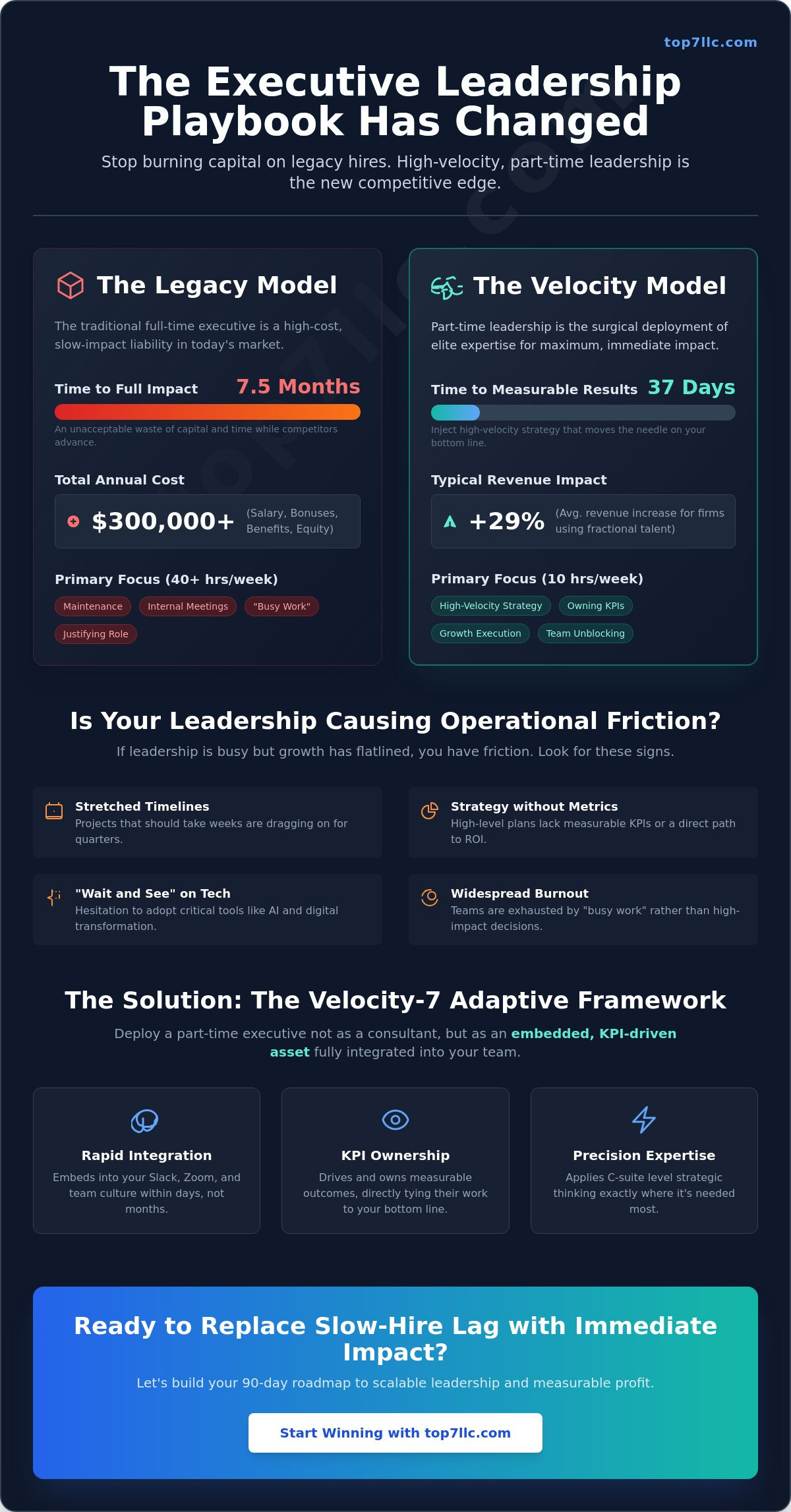
The total cost of ownership for a permanent executive is staggering. Beyond the base salary, you're looking at bonuses, comprehensive benefits, and often a significant equity stake. Then there's the "slow-hire" lag. Research shows it takes 7.5 months for a full-time hire to reach full productivity. In a world where part-time executive leadership can start moving the needle in under 40 days, that seven-month wait is an unacceptable waste of capital. A legacy hire is a permanent anchor in a volatile 2026 market that rewards speed over seniority. If the culture doesn't click, the exit package alone can derail your quarterly projections. Why take the risk when you can buy the expertise without the baggage?
Identifying Operational Friction
Is your executive team stuck in maintenance mode? Look at your operations. If your leadership is "busy" with meetings but your growth has flatlined, you have friction. This stagnation at the top creates massive bottlenecks for your entire New England or West Coast team. They're waiting for decisions that never come because your full-time leaders are over-complicating simple strategic shifts to justify their 40-hour week.
Adopt a marketing-commando perspective: if your leaders aren't actively winning territory and seizing market share, they are just expensive tourists in your office. Business isn't a social club; it's a conversion machine. Signs of friction include:
Project timelines that stretch from weeks into quarters.
A "wait and see" approach to AI and digital transformation.
High-level strategy that lacks measurable KPIs or direct ROI.
Executive burnout caused by "busy work" rather than high-impact decision making.
In 2026, agility beats tenure every single time. You don't need a leader who has been in the same seat for a decade; you need a precision instrument that can drop in, fix the engine, and scale the system.
Defining Part-Time Executive Leadership in 2026
Stop confusing "part-time" with "half-effort." In 2026, part-time executive leadership isn't about someone working fewer hours because they're semi-retired or lack ambition. It's about the surgical deployment of elite C-suite expertise on a fixed-retainer basis. You aren't hiring a helper; you're installing a high-performance engine into your existing structure. Unlike a consultant who drops a 50-page PDF on your desk and disappears before the bill arrives, a fractional leader is an embedded asset. They own the KPIs. They manage your teams. They drive your Slack channels and Zoom calls as if they were on the permanent payroll, but without the $300k drag on your cash flow.
The market is shifting with brutal speed. Understanding the Benefits of Fractional Executives is no longer optional for mid-market firms that want to stay lean and aggressive. If you're still thinking in terms of 40-hour work weeks for strategic roles, you're already losing territory. You don't need "presence" in a swivel chair; you need the strategic clarity that only comes from a leader who has seen this battlefield a hundred times before.
Fractional vs. Interim: Which Do You Need?
Don't make the mistake of hiring a bridge when you need an engine. Interim leadership is "The Bridge." You use it during a crisis or a sudden vacancy to keep the ship from sinking. It's a defensive play. Fractional leadership is "The Engine." You hire a Fractional COO or CTO to build systems, scale operations, and drive growth. It's an offensive play. As your Dallas or Austin startup matures, you'll likely pivot from interim "gap-filling" to fractional "growth-building." Knowing the difference determines whether you're just surviving or actually dominating your niche.
The Velocity-7 Difference
Most advisory services fail because they stop at the "what" and ignore the "how." We use the Velocity-7 Adaptive Framework to ensure our leaders hit the ground running on Day 1. This isn't a "get to know you" phase that lasts three months. It's an agile-based transformation that moves your company from friction to flow immediately. We move beyond generic advice to provide kőkemény execution support. Advice without execution is just expensive noise. If you're ready to stop listening to theories and start seeing measurable ROI, it's time to explore how a fractional framework scales your business.
A Fractional CTO or COO shouldn't be an outside observer. They should be the person fixing your tech stack bottlenecks or plugging profit leaks in real-time. That's the hallmark of a true partner in a conversion-driven business.
The ROI of High-Velocity Part-Time Leadership
ROI is a weapon, not a math problem. Most mid-market owners treat executive hiring as a cost center, but they ignore the staggering "Expertise Gap" cost. What does it cost you to fumble a capital raise because you didn't have a CFO? What’s the price of a botched tech migration without a CTO? You aren't just paying for part-time executive leadership; you're buying insurance against catastrophic strategic errors. An elite leader doesn't need 40 hours to move the needle. In fact, 10 hours of a battle-tested COO often yields more tactical progress than 40 hours from a mid-level manager who is still learning how to lead.
The data is clear. The ROI of High-Velocity Part-Time Leadership shows that companies leveraging fractional talent see a 29% average revenue increase, compared to just 19% for those stuck in traditional hiring cycles. You get Tier-1 talent from Florida or the Midwest without the $50,000 relocation package or the bloated payroll taxes. You're hiring a precision strike team, not a permanent occupation force. You get the local market knowledge you need without the permanent overhead that kills your margins.
Cost vs. Impact Analysis
Let’s talk numbers. A full-time C-level hire costs 50-70% more than a fractional counterpart when you factor in the total cost of ownership. While a permanent hire takes an average of 7.5 months to make a measurable impact, a fractional leader delivers results in just 37 days. One mid-market firm we partnered with slashed their C-suite spend by 60% while doubling their operational output. They stopped paying for "presence" and started paying for performance. It’s about speed to value. If your current leadership isn't paying for itself within the first quarter, you’ve made a bad hire.
Preserving Your Cap Table
Equity is your most valuable currency. Why are you handing out 5% of your company to a CTO just to get them in the door? You don't need to dilute your ownership to attract world-class talent. The "Rent-to-Own" leadership model allows you to leverage elite strategy while keeping your cap table clean for future investors or a clean exit. For East Coast firms looking for an exit in the next 24 months, this isn't just smart; it’s essential. You get the strategic planning required for a high-multiple valuation without the long-term equity drag. Don't give away the farm when you only need the harvest.
Which Fractional Leader Does Your Business Need Now?
Stop hiring for the title you think you "should" have and start hiring for the problem that's actually killing your growth. If you’re reading this, your current team is missing a gear. You don't need another body in a chair; you need a strategic strike. Whether it’s a tech stack that’s become a bottleneck or a sales process that’s leaking profit, part-time executive leadership allows you to deploy elite talent exactly where the fire is hottest. By 2027, Gartner predicts that over 30% of midsize enterprises will have at least one fractional executive on their roster. If you aren't one of them, you're fighting with one hand tied behind your back.
Each role serves a specific tactical purpose in your conversion machine:
Fractional CTO: When your technology is a liability instead of an asset. For a monthly rate between $6,000 and $15,000, you get a leader who aligns your code with your revenue goals.
Fractional COO: When scaling feels like chaos and your operations are bleeding margin. A COO at $4,000 to $12,000 per month turns that chaos into a repeatable system.
Fractional CFO: When you need a capital strategy for a raise or an exit, not just a bookkeeper. US retainers typically range from $4,000 to $10,000.
Fractional CRO/CMO: When your "conversion machine" is broken. At $5,000 to $15,000 per month, these leaders fix your market positioning and drive measurable growth.
The CTO/COO Power Dynamic
In high-velocity companies, these two roles work in tandem to eliminate friction. The CTO builds the engine; the COO drives the vehicle. They bridge the gap between "what we sell" and "how we deliver it." Don't fall for the objection that a part-time leader can't manage a full-time team. They don't need 40 hours to manage; they need 10 hours of high-impact decision-making. They focus on output and KPIs, not babysitting. They set the pace, and your full-time team follows the rhythm of the Velocity-7 Adaptive Framework. If you need this level of clarity, book a strategic planning session to identify your primary bottleneck.
Market-Specific Leadership Needs
Geography dictates your strategy. A mid-market firm in Boston or San Francisco faces tech-heavy talent wars that require a Fractional CTO who can navigate high-velocity innovation. Meanwhile, a Chicago-based logistics firm needs a Fractional COO who understands the complexity of Midwest supply chains. You have to adapt your leadership style to the regional business culture. Whether it’s the Midwest "Handshake" or the East Coast "Hustle," our executives integrate into your local reality while maintaining a global strategic perspective. We don't just provide advice; we provide the precision execution required to dominate your specific territory.
Implementing Velocity-7: Your 90-Day Leadership Roadmap
Execution is the only thing that separates a visionary from a dreamer. You don't need a 50-page strategy document that gathers digital dust in a shared drive. You need a mission plan. The Velocity-7 Adaptive Framework isn't a suggestion; it's a precision-engineered process designed to turn your stagnating mid-market firm into a conversion machine. While your competitors are still interviewing for a full-time role they won't fill for months, you can deploy part-time executive leadership to seize market share in less than six weeks.
Our roadmap follows four non-negotiable steps:
Step 1: The Audit. We dissect your organization across the Seven Dimensions of Growth. We find the profit leaks and operational friction points you've been too busy to notice.
Step 2: Embedding. Your fractional leader isn't a "consultant" watching from the sidelines. They integrate into your Slack, lead your Zoom scrums, and own your culture from day one.
Step 3: The Sprint. We set 30-60-90 day KPIs. Every metric is tied to profit and revenue velocity, not just "activity." If it doesn't move the needle, we don't do it.
Step 4: Transition. As you hit your revenue milestones, we scale the leadership intensity. You only pay for the horsepower you need at each specific stage of your growth.
The First 30 Days: Stopping the Bleeding
The goal of the first month is simple: immediate tactical wins. We don't wait for "onboarding" to finish. We conduct a brutal Leadership Gap Analysis to re-align your current team and stop the capital burn. Research shows that while a full-time hire takes 7.5 months to reach full productivity, a fractional leader makes a measurable impact in just 37 days. We focus on the bottlenecks that are choking your flow right now. It's time to stop guessing and start winning. You can audit your current leadership gaps with a Top7 expert to see exactly where your systems are failing.
Long-Term Flow: The Goal of Velocity-7
True scale happens when you stop managing people and start managing systems. The Velocity-7 framework ensures your business is exit-ready or scale-ready at every turn. In the high-stakes market of 2026, agility is your only protection against volatility. Relying on bloated, full-time C-suites is a slow-motion disaster for mid-market firms. Choosing part-time executive leadership isn't just a cost-saving measure; it's a strategic strike that guarantees you have elite talent without the legacy liability. The future belongs to the lean, the fast, and the focused. Don't get left behind.
Stop Managing the Past and Start Owning the Future
The business world in 2026 doesn't reward those who play it safe with bloated payrolls and slow-moving legacy structures. You've seen how the traditional executive hire drains your capital and stalls your growth for months. By choosing part-time executive leadership, you're choosing to deploy elite strategy as a precision instrument rather than a permanent overhead weight. We specialize in helping mid-market companies in the $5M to $50M range eliminate operational friction and install a conversion machine that actually works.
Our seasoned professionals don't just give advice; they embed directly in your team to execute the mission using our proprietary Velocity-7 Adaptive Framework. This isn't about "trying harder" to fix your tech or ops bottlenecks. It's about having the right commander in the field when the stakes are highest. You've sat on the sidelines long enough while competitors leveraged fractional talent to scale faster and leaner. It's time to reclaim your strategic advantage and build a leadership team that delivers measurable ROI instead of just excuses.
Stop guessing and start growing; Schedule your Velocity-7 Audit today
Your business is ready for the next level. We're here to make sure you have the firepower to get there.
Frequently Asked Questions
What is the difference between a part-time executive and a business consultant?
Consultants give advice; fractional executives provide execution. A consultant typically delivers a report and leaves the implementation to you. A part-time executive joins your Slack, manages your team, and owns the KPIs. It is the difference between a map-maker and a driver who actually gets the vehicle to the destination.
How much does a fractional CTO or CFO typically cost in 2026?
In the US, monthly retainers for a Fractional CFO range from $4,000 to $10,000. A Fractional CTO typically costs between $6,000 and $15,000 per month. These rates allow you to access Tier-1 talent without the $300,000 base salary, equity grants, or the 12% superannuation rates seen in other markets like Australia.
Can a part-time leader effectively manage my full-time employees?
Elite leaders don't need 40 hours to manage; they need high-impact systems. They focus on output and strategic clarity rather than clock-watching. By using the Velocity-7 Adaptive Framework, they set the pace and provide the roadmap for your full-time staff to follow. They manage through results, not through presence in a swivel chair.
What are the benefits of hiring a fractional executive in Boston or Chicago?
You gain elite market knowledge without paying the local "talent tax" or massive relocation fees. In tech-heavy hubs like Boston or logistics centers like Chicago, part-time executive leadership lets you compete for talent that usually only goes to Fortune 500 firms. You get the strategic advantage of a local expert without the full-time overhead.
How do I know if my company is ready for fractional leadership?
You're ready if your growth has plateaued or your operations feel like a bottleneck. If you're spending more time fixing internal fires than winning market territory, you have a leadership gap. Don't wait for a total system failure to install the high-velocity strategy your business needed six months ago.
What happens if we need more time from our fractional leader as we grow?
The fractional model is designed to be highly adaptive. You can ramp up the engagement hours as you approach a capital raise, a major product launch, or an exit. This flexibility prevents you from over-committing capital too early while ensuring you have the strategic horsepower required for every revenue milestone.
Does a fractional executive bring their own team or framework?
Top7 executives bring the battle-tested Velocity-7 Adaptive Framework to ensure impact from day one. We don't show up to "wing it" or spend months learning your business. We bring a precision system that integrates with your existing tools to drive measurable profit and operational flow immediately.
Is fractional leadership suitable for early-stage startups or only mid-market companies?
While startups use them for foundations, part-time executive leadership is the secret weapon for mid-market companies between $5M and $50M. These firms often outgrow their "do-it-all" founders but aren't ready for a million-dollar C-suite payroll. It's the most efficient way to break through growth ceilings without burning through your capital reserves.


Comments