
Operational Friction: The Invisible Tax Killing Your Mid-Market Growth

You're hiring more people, yet your output is flatlining. It's a brutal reality for mid-market leaders: you've built a machine that's now fighting against itself. This is operational friction, and it's not just a nuisance; it's a silent tax draining your EBITDA every single hour. You feel the weight of it every time you're forced back into the weeds to fix a tactical mess your team should have handled. You're right to be frustrated. You didn't scale this far just to become a high-priced babysitter for broken processes.
It's time to stop blaming your team and start auditing your architecture. This article identifies the systemic bottlenecks that turn growth into a grind and provides the tactical framework needed to move from drag to operational flow. You'll learn how to identify these hidden leaks and implement a system that scales without demanding more executive overhead. We'll preview how the Velocity-7 Adaptive Framework transforms chaotic execution into a precision-engineered growth engine that delivers measurable results. Stop settling for stalled revenue and start reclaiming your strategic edge.
Table of Contents
What is Operational Friction? Defining the Invisible Growth Killer
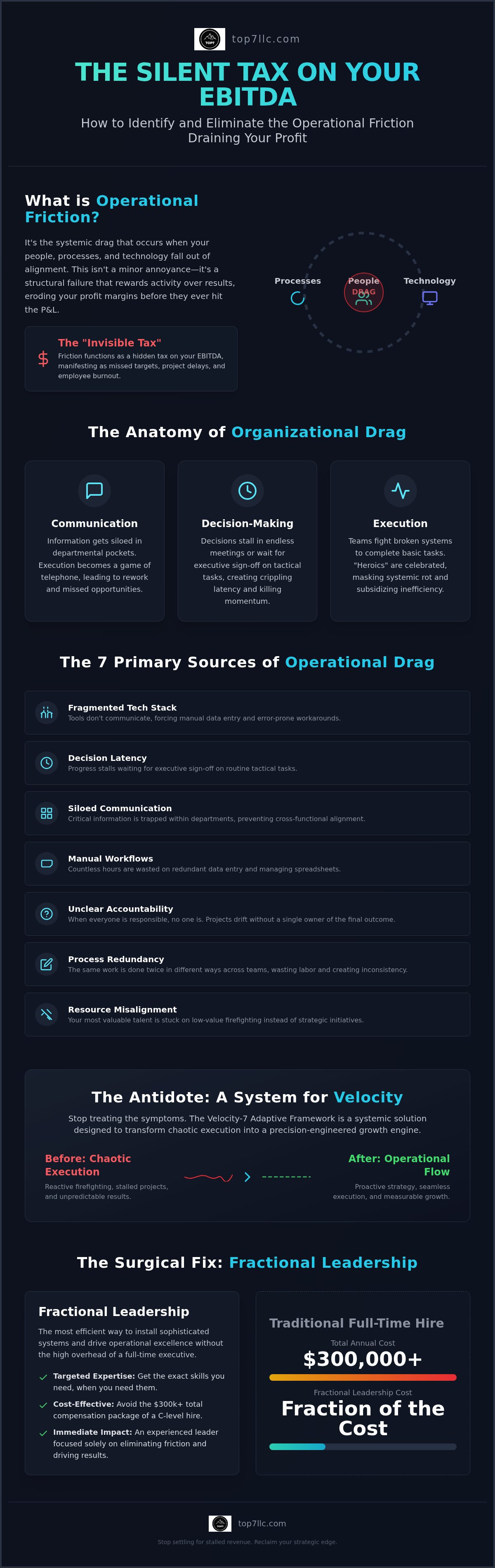
Operational friction isn't a minor annoyance; it's the sand in your high-performance engine. It's the systemic drag that occurs when your processes, people, and technology fall out of alignment. While you're focused on the next big contract, this friction is quietly eating your lunch. It functions as an "Invisible Tax" on your EBITDA. You won't see a line item for it on your P&L, but it's there in the form of eroded margins and missed targets. Understanding What is a Business Process? provides the foundation for seeing where these gaps occur. When these processes fail, your organization stops flowing and starts grinding.
To better understand how these hidden costs manifest in your daily operations, watch this helpful video:
For most mid-market leaders, operational friction is invisible because it feels like "just how we work." You've become accustomed to the noise. But in a truly optimized organization, work should feel like flow, not a fight. If your team is working harder than ever but the needle isn't moving, you aren't looking at a productivity problem. You're looking at a structural failure that rewards activity over actual results.
The Anatomy of Organizational Drag
Friction hides in three primary pillars: Communication, Decision-Making, and Execution. As your organization grows, these pillars naturally become more complex. Without intentional design, that complexity turns into drag. Information gets siloed, decisions stall in endless committee meetings, and execution becomes a game of telephone. This drag compounds over time. What was a minor delay at $10M in revenue becomes a catastrophic bottleneck at $50M. Operational friction is a leadership-driven systemic failure.
Friction vs. Hard Work: Know the Difference
Don't confuse grinding with productivity. High-growth companies often mistake "the hustle" for progress, but there's a massive difference between "good" growth pains and "bad" operational drag. Good pains come from scaling to meet demand. Bad drag comes from fighting broken systems to complete basic tasks. When your top talent has to spend 40 percent of their time navigating internal bureaucracy or fixing manual errors, they burn out. Your best people don't leave because the work is hard. They leave because the system makes it impossible for them to win. If your culture celebrates the "heroics" required to overcome bad processes, you're subsidizing inefficiency.
The 5 Primary Sources of Operational Drag
Stop blaming your team for missed targets. If you've hired competent people and they're still failing to deliver, the problem isn't the talent; it's the architecture. Operational friction is a systems failure that no amount of "hustle" can fix. In fact, relying on "Hero Culture" is a strategic mistake. When individual effort is the only thing keeping your projects on track, you're masking systemic rot. This makes the underlying issues harder to find and even more expensive to fix later. You aren't building a scalable business; you're running a high-stakes fire department.
Many leaders try to buy their way out of this with new software. It's a trap. Adding more SaaS to a broken process just creates faster-moving chaos. Understanding The Two Types of Friction is essential here. While some resistance can sharpen a strategy, the drag found in most mid-market companies is purely destructive. It's an invisible tax on every dollar you earn. At Top7, we've identified the specific sources that stall growth:
Fragmented Tech: Tools that don't communicate, forcing manual workarounds.
Decision Latency: Waiting for executive sign-off on tactical tasks.
Siloed Communication: Critical information trapped in departmental pockets.
Manual Workflows: Wasted labor on redundant data entry and spreadsheets.
Unclear Accountability: Nobody knows who truly "owns" the final outcome.
Process Redundancy: Doing the same work twice in different ways across teams.
Resource Misalignment: Putting your best people on low-value firefighting instead of strategy.
Misaligned Technology and Tool Fatigue
Fragmented tech stacks are a primary driver of operational friction. When your CRM, project management tools, and accounting software don't talk to each other, your staff becomes "human middleware." They waste hours on manual data entry and "Shadow IT" workarounds. This happens when teams build their own rogue systems because the official ones are too clunky to use. You don't need more tools; you need a cohesive strategy. A Fractional CTO provides the high-level audit necessary to eliminate redundant software and integrate your core systems into a single source of truth.
Decision Bottlenecks and Executive Overload
Are you caught in the "Founder Trap"? If every tactical decision requires your sign-off, you've become the ultimate bottleneck. This creates "Decision Latency," where your organization's responsiveness is limited by your personal bandwidth. Middle management becomes paralyzed, afraid to act without a green light. This lack of clear authority levels kills momentum. Execution shouldn't wait for your calendar to clear. It should happen through a framework of delegated authority and clear KPIs that allow your team to move fast without asking for permission at every turn.
Measuring the Real Cost of Friction on Your EBITDA
EBITDA is the pulse of your business, but operational friction is a slow-release poison. Most leaders look at their P&L and see "Labor" as a single, static block. They're wrong. You need to look deeper into the hidden financial leaks that never make it to a formal spreadsheet. When your team spends hours on rework or navigating broken handoffs, you're paying for productivity you never actually receive. This isn't just a management headache; it's a direct drain on your company's valuation.
Consider the opportunity cost. Every hour your team spends "firefighting" is an hour they aren't spending on strategic growth, innovation, or market expansion. You aren't just losing money; you're losing your competitive edge. This environment also drives away your most expensive assets: your A-players. High performers thrive on impact, not bureaucracy. If they have to fight your internal systems just to do their jobs, they'll take their expertise to a competitor who has their act together. The cost of replacing a seasoned mid-market executive often exceeds 200 percent of their annual salary when you factor in lost momentum.
The math is simple but brutal. In many mid-market firms, reducing operational friction by just 10 percent can result in a 30 percent or higher increase in net profit. This happens because your overhead and labor costs are largely fixed. When you remove the drag, that reclaimed capacity drops straight to the bottom line. You don't need to hire more people to grow; you need to stop wasting the people you already have.
The Capacity Drain: Paying for 100% and Getting 60%
Most organizations run a "hidden factory." This is the unofficial, unmeasured part of your business that produces nothing but overhead, rework, and redundant meetings. You can calculate this by auditing how many hours are spent on manual data reconciliation or fixing errors from previous steps in a workflow. It's often staggering to realize that labor costs are fixed, but labor output is variable based on friction. If your systems are broken, you're effectively paying a massive premium on every salary in the building for work that adds zero value.
Customer Friction: When Your Internal Mess Leaks Out
Your back-office chaos eventually hits the front line. Internal delays lead to missed deadlines, shipping errors, and defensive customer service. This isn't just an "experience" issue; it's a churn issue. Customers sense the friction in your organization through every delayed response and botched order. You cannot provide a frictionless customer experience with a high-friction back office. If you want to stop the bleeding on customer retention, you have to fix the engine before you try to polish the paint.
The Antidote: The Velocity-7 Adaptive Framework
Generic business advice won't save your EBITDA. You don't need another "motivational" offsite or a vague list of cultural values. You need a system designed to kill operational friction at the source. The Velocity-7 Adaptive Framework is that system. It's our proprietary methodology for transitioning mid-market firms from a state of constant drag to a state of high-velocity flow. We've taken the most effective principles of "Agile for Tech" and re-engineered them for the entire organization.
This isn't just for your developers. It's for your Sales, Finance, and Operations teams. The framework identifies seven specific dimensions of growth and aligns them so they work with each other, not against each other. The goal is a total cultural shift. You're moving away from reactive firefighting where the "loudest" problem gets the most attention. Instead, you're building a proactive, velocity-based culture that prizes precision and predictable output over chaotic effort.
Auditing Your Current Velocity
Transformation begins with a kilingly honest audit. You cannot fix what you haven't measured. Step one of the framework involves an organizational deep dive to find exactly where work slows, stops, or repeats. We map your current processes against the seven dimensions of velocity to find your "Red Zones." These are the high-friction areas where your ROI for a fix is greatest. If your decision-making process takes three weeks for a three-hour task, that's a Red Zone. We don't guess; we use data to expose the bottlenecks that are currently invisible to your internal team.
Implementing Adaptive Execution
Once the audit is complete, we embed adaptive execution into your non-tech departments. This means bringing Advanced Project Management into the C-suite and middle management. We replace vague "status updates" with high-impact, iterative sprints. But there's a hard rule: you must standardize the process before you touch a single piece of automation. Automating a broken process just makes the failure happen faster. We ensure your workflows are lean and functional first. Only then do we use technology to scale that efficiency. This disciplined approach ensures that growth doesn't come with a massive spike in executive overhead.
Ready to see how this system applies to your specific bottlenecks? Learn more about the Velocity-7 Adaptive Framework and how it can reclaim your lost margins.
Fractional Leadership: The Surgical Fix for Operational Drag
You're bleeding EBITDA and your instinct is to hire a full-time executive. Stop. That's a $300k gamble that takes six months to recruit and another six to onboard. You don't have a year to wait while your margins evaporate. Operational friction is a systems problem; it's not a seat-filling problem. Hiring a permanent C-suite member to fix a broken engine is like buying a new house because the sink is leaking. It's expensive, slow, and often misses the point. You need a surgical fix, not a lifelong commitment.
The "Fractional Advantage" allows you to inject elite C-suite expertise into your organization at a fraction of the cost. These aren't consultants who hand you a 50-page slide deck and leave. They're operators. A Fractional CTO or COO from Top7 embeds directly into your team to execute the Velocity-7 roadmap. They build the systems, remove the drag, and then hand off a high-performance machine to your permanent staff. You get the strategic heavy lifting without the long-term payroll burden or the "Leadership Gap" that paralyzes mid-market firms during transitions.
CTO vs. COO: Which Friction-Reducer Do You Need?
Identifying the source of your drag is the first step in choosing your weapon. If your friction is technical; think messy data silos, an aging tech stack, or software that doesn't talk; you need a Fractional CTO. They provide the high-level architecture that turns your technology from a cost center into a growth lever. If your drag is process-driven; think broken workflows, logistics nightmares, or middle-management paralysis; you need a Fractional COO. They focus on the "human middleware" and the logistics of execution. Sometimes, the drag is so pervasive you need both. When the drag is technical, don't make the mistake of hiring a dev shop to lead. Compare a Fractional CTO vs. Agency to understand why strategic leadership is the only way to solve systemic technical friction.
What to Expect in the First 90 Days
Top7 executives don't spend months "getting to know" the culture. They start with the audit. Within the first 30 days, we identify the "Red Zones" where friction is highest. By day 60, we're implementing the Velocity-7 dimensions to stabilize flow. We prioritize "Quick Wins" that often pay for our own retainer fees through immediate friction savings and reclaimed labor capacity. By day 90, your organization moves from reactive firefighting to a proactive, velocity-based culture. We don't just tell you what's wrong; we fix it and leave you with the framework to keep it fixed. It's time to stop subsidizing inefficiency.
Stop Subsidizing Inefficiency and Reclaim Your Velocity
Operational friction is a choice you make every day you allow broken systems to persist. You've seen how this invisible tax erodes your EBITDA and drives your most valuable A-players toward the exit. It's not a people problem; it's a design failure. Growth shouldn't feel like a constant grind against your own internal architecture. You can continue firefighting or install a precision-engineered engine built for scale.
Our Velocity-7 Adaptive Framework is the proprietary antidote to organizational drag. By embedding seasoned C-suite professionals directly into your team, we don't just advise; we execute. We've proven that mid-market firms can achieve radical transformation without the bloated overhead of permanent hires. It's time to stop paying for activity and start demanding results. You've built a great company; now it's time to let it run at full speed.
Eliminate Drag and Restore Flow with Top7 Fractional Leadership. Your next stage of growth is waiting on the other side of efficiency.
Frequently Asked Questions
What are the symptoms of operational friction in a growing company?
Look for stalled output despite an increased headcount and executive burnout from constant tactical firefighting. You'll notice redundant meetings and manual workarounds becoming the standard operating procedure. If your team is constantly busy but the revenue needle remains flat, you're likely suffering from operational friction. These symptoms indicate that your current organizational architecture is actively fighting against your growth goals rather than supporting them.
How is operational friction different from a bad corporate culture?
Operational friction is a systems failure, while culture is a behavior failure, though they often feed each other. You can have a team of motivated, talented A-players who are forced to underperform because your processes are broken. Culture often rots because people are frustrated by systemic drag. Fix the systems first, and you'll find that culture problems like low morale or high turnover often solve themselves once the path to winning is clear.
Can software tools alone solve operational friction?
No, software often acts as an accelerant for existing friction rather than a cure. Adding a new CRM or project management tool to a broken process just creates faster, more expensive chaos. You must standardize and optimize your workflows before introducing any new automation. Technology is a force multiplier, but if you multiply zero efficiency, you still get zero results. Systems design must always precede software implementation to ensure a real return on investment.
How much does operational friction actually cost a mid-market business?
The cost manifests as a direct drain on your EBITDA, often functioning as an invisible tax on your margins. While it doesn't appear as a line item on a P&L, it shows up in eroded profit, wasted labor costs, and expensive employee turnover. Reducing this drag by just 10 percent can often lead to a 30 percent or higher increase in net profit. You aren't just losing money on inefficiency; you're losing the massive opportunity cost of what your team could have built instead.
Why is a Fractional COO better than a full-time hire for fixing friction?
A Fractional COO provides elite, surgical intervention without the $300k payroll and long-term commitment of a permanent hire. Most mid-market firms in crisis need a builder to fix the engine, not just a driver to maintain it. A fractional leader from Top7 embeds directly into your team, implements high-level systems, and then hands off the optimized machine. It's the most cost-effective way to bridge the leadership gap and restore operational flow without adding permanent executive overhead.
What is the Velocity-7 Adaptive Framework?
The Velocity-7 Adaptive Framework is a proprietary methodology designed to transition organizations from drag to flow. It adapts high-velocity agile principles for non-tech departments like Sales, Finance, and Operations. The framework audits seven specific dimensions of growth to align people, processes, and technology into a single, cohesive unit. It moves your company away from reactive firefighting and toward a proactive culture that prizes predictable output and strategic scalability over chaotic effort.
How long does it take to see results from an operational audit?
You should expect a comprehensive roadmap within the first 30 days of an audit. At Top7, we prioritize quick wins that identify immediate savings to help offset our own retainer fees. By day 60, implementation of the framework begins to stabilize flow, and by day 90, the organization typically sees measurable improvements in labor capacity. We don't believe in long, academic studies; we focus on rapid, tactical execution that delivers measurable ROI.
Is operational friction inevitable as a company scales?
Friction is natural as complexity increases, but it is not inevitable if you design your organization for scale. Most companies grow by adding human middleware to patch holes in broken systems, which creates massive drag. You can avoid this trap by implementing adaptive frameworks early and maintaining a disciplined approach to process standardization. Scaling without adding massive executive overhead is possible, but it requires a relentless focus on eliminating systemic bottlenecks before they compound.


Comments