

Onboarding a Fractional COO: A Tactical Deployment Guide for 2026
- Robert Fitzgerald
- May 22
- 11 min read

Why are you paying five figures a month for a discovery phase that just documents your own chaos? Most leaders treat onboarding a fractional coo like a slow-burn internship, wasting the first 30 days on getting up to speed while operational bottlenecks continue to choke the business. By the end of 2026, 35% of U.S. companies will leverage fractional leadership. The winners won't be the ones who onboard gently; they'll be the ones who deploy with surgical precision.
You’re exhausted and your growth has plateaued because you're currently the single point of failure. You need a rapid transition from friction to flow, not a month of hand-holding. This guide shows you how to stop the bleeding and trigger immediate impact using the Velocity-7 Adaptive Framework. We're moving past the fear of wasting money on part-timers who don't get the business. Instead, you'll learn to install a self-sustaining operational rhythm that delivers clear ROI within your first four weeks. Here is how to turn a new hire into a tactical advantage from day one.
Key Takeaways
Stop treating leadership integration like a passive tour and learn why traditional "listening tours" are actually momentum killers for mid-market growth.
Prepare for Day Zero by building a high-transparency data room that ensures onboarding a fractional coo leads to execution within hours, not weeks.
Utilize the Velocity-7 Adaptive Framework to rapidly map the seven dimensions of growth and expose the hidden friction points stalling your scaling efforts.
Execute a disciplined 30-day sprint that transitions from initial diagnostic to tangible "quick wins" and measurable profit growth.
Understand the critical difference between a passive consultant and an embedded fractional executive who implements self-sustaining operational rhythms.
Table of Contents
Why Traditional Executive Onboarding Fails Mid-Market Companies
Most mid-market companies are hemorrhaging capital because they treat executive integration like a social club. They hire a Chief operating officer and then spend three months "introducing" them to the team. This is a death sentence in 2026. In high-velocity hubs like Boston or Dallas, a slow start isn't just an inconvenience; it's a market share giveaway. If your process for onboarding a fractional coo involves more coffee chats than KPI audits, you've already lost the quarter.
The "passive orientation" trap is a common failure point where leaders wait for the new executive to "soak up the culture." Culture doesn't fix a broken supply chain or a bloated payroll. You aren't paying for a spectator. You're paying for a tactical operator who can identify friction points in hours, not months. With the global fractional executive market growing at a 14% CAGR, the competition for efficiency is fierce. You don't have the luxury of a slow burn.
To better understand this concept, watch this helpful video:
The Fatal Flaw of the 90-Day Roadmap
Traditional HR wisdom suggests a 90-day ramp-up period. This is a relic of the past. Mid-market firms scaling at double digits can't afford a quarter of "learning." There's a massive difference between cultural integration and an operational diagnostic. While your new hire is busy learning everyone's favorite lunch spot, a leadership vacuum persists at the core of your operations. Slow onboarding doesn't just waste the retainer; it demoralizes the team that was promised relief from bottlenecks. You need a surgical strike, not a long-term orientation.
Onboarding as Tactical Deployment
Stop "onboarding" and start deploying. Successful onboarding a fractional coo requires defining mission-critical objectives for Day 1. This isn't about training them on how you've always done things. It's about empowering them to see what you've become blind to. We align every engagement with the Velocity-7 framework immediately to ensure the partnership is results-oriented from the first minute. You don't need a part-time employee; you need full-speed leadership that uses data to drive profit growth. Set the tone early: execution is the only metric that matters.
Day Zero: The Tactical Readiness Checklist for Your Fractional COO
Success starts before the first invoice is paid. If you wait until the start date to gather your data, you've already burned a week of high-value time. Effective onboarding a fractional coo requires a Day Zero mentality. This means having your ammunition ready before the operator arrives on the field. You aren't just hiring a consultant; you're deploying an executive who needs to see the raw, unfiltered reality of your business to be effective.
Radical transparency is your only option. Secrets are friction. If you hide your cash flow struggles or your toxic middle manager, you’re paying for a solution you aren't allowing to work. Open the books. Grant full access to your CRM and ERP. If they aren't in your Slack or Teams hubs by 9:00 AM on Monday, you’re failing the deployment. You need them in the room where decisions happen, not waiting in the lobby for a login.
Identify your Top 3 Bottlenecks now. Don't ask the COO to find them; tell them where the fire is so they can bring the extinguisher. Is your lead-to-close cycle too long? Is your churn rate spiking because of poor fulfillment? Give them a target. A tactical deployment is only as good as the intelligence provided at the start.
The Essential Documentation Vault
Your COO needs the last 12 months of P&Ls on Day Zero. They need to see the financial pulse of the business to understand where resources are being misallocated. Map your "unwritten" processes. Every business has tribal knowledge that lives only in a founder’s head. Document it or prepare to spend hours explaining it. A comprehensive technology leadership audit starts with a clean list of every software subscription you’re currently paying for. This allows the COO to identify redundant tools and immediate cost-saving opportunities.
Stakeholder Preparation and Buy-In
Your team is likely nervous. They see a new executive and think "layoffs" or "replacement." Fix that narrative before it starts. Brief your department heads: the Fractional COO is an accelerator, not a watchdog. They are there to clear the path so the team can move faster. When you utilize Fractional COO services, you're buying speed, but that speed requires a team that isn't pulling in the opposite direction.
Establish the reporting line immediately. The COO reports directly to the CEO. No exceptions. This ensures they have the authority to actually implement change. Schedule "Friction Download" sessions with every department head for the first 48 hours. These aren't for socializing. They are for identifying the specific operational hurdles preventing each team from hitting their KPIs. Move fast or get out of the way.
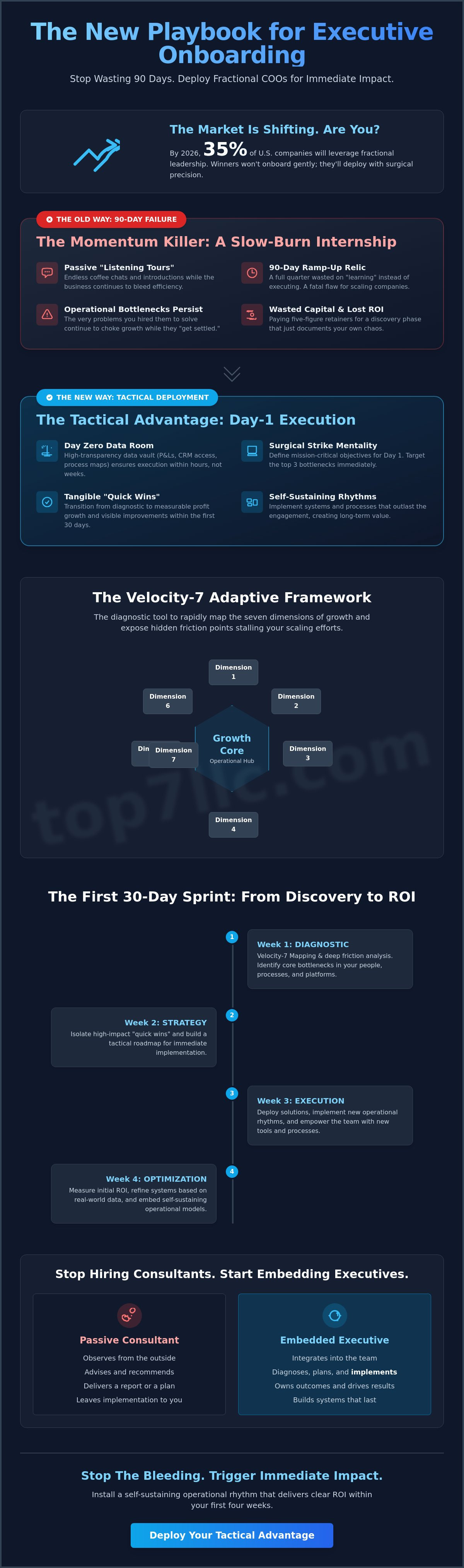
The Velocity-7 Diagnostic: Rapidly Mapping Operational Friction
Generic discovery phases are where growth goes to die. Most consultants spend thirty days asking "how do you feel about the culture?" while your margins continue to erode. When onboarding a fractional coo, you aren't paying for a therapist; you're paying for a diagnostic surgeon. The goal is to move from friction to flow in days. We achieve this by deploying the Velocity-7 Adaptive Framework, a proprietary system designed to strip away the noise and expose the systemic rot holding your business back.
During the first week, the focus shifts to identifying the "Seven Dimensions of Growth" bottlenecks. This isn't about observing symptoms like "low sales" or "unhappy clients." Those are results. The diagnostic looks for the root causes: misaligned tech stacks, fractured communication loops, or a lack of financial strategy. By treating the Fractional COO as an agile transformation lead, you turn the discovery phase into an active intervention. If you don't find a major systemic flaw within the first forty-eight hours, you aren't looking hard enough.
Applying the Velocity-7 Framework
The Velocity-7 Framework moves organizations from friction to flow by surgically identifying and eliminating systemic growth inhibitors across seven core business pillars. Instead of a vague overview, the diagnostic zooms in on financial strategy, sales guidance, and tech leadership. We don't just list problems. By the end of week one, every identified bottleneck is ranked by a strict "Impact vs. Effort" matrix. This ensures the first 30 days are spent on high-leverage actions that actually move the needle on profit, not just busy work that fills a spreadsheet.
The Operational Friction Audit
Friction is often invisible to those who live in it every day. It hides in your project management tools that nobody uses correctly and in sales processes that rely on founder-led heroics rather than repeatable systems. Technology is frequently a bottleneck rather than an asset because it was implemented without a cohesive strategy. By the end of week two, the audit culminates in a "State of the Union" report. This document is a kark reality check. It outlines exactly where the system is failing and provides the tactical roadmap for the execution sprint. No fluff. No jargon. Just the raw data you need to win.
The First 30 Days: Moving from Discovery to Execution Sprint
Generic discovery is a luxury your payroll can't afford. While most firms spend the first month "learning the ropes," our approach to onboarding a fractional coo demands that execution begins in the second week. Speed is a choice. You aren't hiring a researcher; you're hiring an operator who builds the plane while flying it. The first 30 days are a tactical sprint, not an orientation period. If you aren't seeing operational changes by Day 15, you've hired a consultant, not an executive.
Week 1: Assessment and Alignment. We apply the Velocity-7 framework to your current mess. Stakeholders are aligned, and the mission-critical objectives are locked in.
Week 2: The Friction Map. We identify exactly where your profit is leaking. By Friday, the "Quick Win" target is selected for immediate destruction.
Week 3: Tactical Implementation. Process re-engineering begins. We stop talking about the bottlenecks and start removing them using Advanced Project Management techniques.
Week 4: Operational Rhythm. We install the KPI dashboards and meeting cadences that ensure the business runs without CEO intervention.
Ready to stop the bleeding? See how our Fractional COO services deliver measurable profit growth within the first 30 days.
Executing the "Quick Win" Strategy
Credibility is earned through action, not slide decks. A high-impact operator must fix at least one visible, painful bottleneck within the first 14 days. This might be a broken billing cycle or an automated follow-up system that hasn't worked in months. When the team sees immediate relief, resistance vanishes. This rapid success transitions the role from an "interim leader" to an embedded strategic partner. You don't need a 90-day plan to prove value. You need a win on the board before the first month's retainer is fully spent.
Regional Market Considerations
Operations don't exist in a vacuum. A strategy that works in a remote-first environment might fail in high-growth hubs like Chicago or Austin where the talent war is constant. Onboarding a fractional coo requires someone who understands local dynamics. In Austin, you're competing with tech giants for operational talent; in Chicago, you're navigating complex logistics and supply chain nuances. We leverage local networks and regional data to ensure your operational diagnostic isn't just theoretically sound, but practically executable in your specific market. This regional intelligence allows for advanced project management support that actually accounts for local labor costs and regulatory hurdles.
Securing the ROI: Why Top7 Leadership Embeds Differently
Stop confusing advice with execution. Most consultants hand you a forty page PDF and a bill before vanishing. We do the opposite. When you're onboarding a fractional coo from Top7, you aren't hiring an observer. You're installing a high performance component engineered to work from the first hour. This is about profit maximization, not professional babysitting. We don't just suggest systems; we own the outcomes.
Let's look at the raw numbers. A full-time C-suite hire can cost between $270,000 and $320,000 annually once you factor in benefits, taxes, and equity. Most mid-market firms don't actually need sixty hours of executive-level oversight. They need fifteen to twenty-five hours of high-impact precision. By choosing a fractional model, you eliminate the massive overhead while gaining access to elite talent that usually only lives in the Fortune 500. You get the strategic superiority without the bloated payroll.
Our Velocity-7 Adaptive Framework is the engine. It ensures that measurable profit growth isn't a byproduct; it's the primary objective. We move your roadmap from reactive crisis management to a sustainable, self-governing flow. You aren't just buying time. You're buying a proven methodology for scaling without the typical friction that kills growth.
Measuring Success Beyond the Spreadsheet
ROI isn't just a number on a P&L. It's the "Velocity" metric. How fast can your organization change direction? How quickly can you ship a new product or fix a failing sales funnel? A successful onboarding a fractional coo results in a team that moves faster because the bottlenecks have been surgically removed. We also prepare your firm for the future. If you eventually need a full-time hire, you'll be handing them a well-oiled machine, not a pile of operational debt. We build the systems so the business stops depending on your personal stamina.
Ready to Eliminate Friction?
Every day you spend "thinking about it" is a day your competitors are optimizing their margins. Burnout isn't a badge of honor. It's a sign of a broken system. You need seasoned professionals who solve complex problems, not more meetings. Stop wasting your first thirty days on discovery tours. Deploy a leader who understands that growth is a kark battle for market share. Scale your business with a Top7 Fractional COO today.
Dominate Your Market with Operational Precision
You can continue to drown in operational bottlenecks or you can choose to lead. Successful onboarding a fractional coo isn't about hand-holding. It requires a Day Zero mentality and a total refusal to settle for traditional 90-day ramp-up periods. By deploying the Velocity-7 Adaptive Framework, you replace expensive discovery tours with a surgical strike against friction. You've seen the roadmap from readiness to execution sprint. Now it's time to stop the bleeding and start winning.
Our seasoned executives bring deep mid-market expertise and a proven track record in agile-based transformation to your organization. We don't just provide advice; we embed a self-sustaining operational rhythm that drives profit growth. The cost of waiting another quarter is significantly higher than the cost of taking action today. Secure your strategic advantage and move from friction to flow immediately.
Stop the operational friction. Schedule a Velocity-7 Assessment with Top7.
Your business deserves a leader who executes at your speed. Let's get to work and build the machine that drives your future success.
Frequently Asked Questions
How long does it take to onboard a Fractional COO?
Onboarding a fractional coo should take hours, not months. While traditional executive hires often waste ninety days on orientation tours, a tactical deployment targets execution within the first two weeks. You aren't paying for a learning curve; you're paying for an operator who arrives with a pre-built framework to identify friction points immediately. If you're still "getting up to speed" after fourteen days, your deployment has failed.
What access does a Fractional COO need to be effective?
They need radical transparency and full system access from Day Zero. This includes your last twelve months of P&L statements, current org charts, CRM, ERP, and communication hubs like Slack or Teams. If you hide the "ugly" parts of your business or restrict data, you're paying for a solution you aren't allowing to work. Secrets are the primary cause of operational friction.
How do I introduce a Fractional COO to my existing team?
Position them as a force multiplier, not a threat to existing roles. Explain that the Fractional COO is there to clear the operational hurdles that prevent the team from hitting their KPIs. You must establish a direct reporting line to the CEO immediately. This ensures they have the authority to implement change without being slowed down by middle-management politics.
What is the difference between a Fractional COO and an Interim COO?
A Fractional COO provides long-term strategic leadership on a part-time basis, whereas an Interim COO is typically a full-time, short-term placeholder. Fractional leaders focus on building self-sustaining systems and profit growth over years. Interim roles are usually gap-fillers designed to keep the seat warm during a search for a permanent full-time replacement.
How does the Velocity-7 framework speed up the onboarding process?
The Velocity-7 framework eliminates discovery waste by using a standardized diagnostic across seven core business pillars. Instead of starting from scratch, the operator uses this roadmap to find systemic root causes in week one. This turns onboarding a fractional coo into a surgical strike. It replaces generic "getting to know you" meetings with data-driven audits that lead to immediate action.
Can a Fractional COO manage a remote or hybrid team effectively?
Digital-first leadership is a requirement for modern operators, not an option. They manage remote teams by installing automated workflows, clear KPI dashboards, and disciplined meeting cadences. Geography is irrelevant when you have a system that enforces accountability and measures output rather than hours logged. They build the digital infrastructure that makes hybrid work actually profitable.
What are the red flags during a Fractional COO’s first 30 days?
Watch out for executives who prioritize "cultural vibes" over hard data in the first two weeks. If they haven't identified a major bottleneck or delivered a visible "quick win" by Day 15, you've hired a consultant, not a COO. Another red flag is a failure to demand full transparency. An operator who isn't digging into your financials isn't planning on fixing your business.
How do I measure the ROI of a Fractional COO engagement?
Measure success through the velocity of organizational change and the measurable reduction in CEO operational burden. If your cash flow is improving and you've reclaimed ten hours of your week from micromanagement, the engagement is paying for itself. ROI is found in profit growth, faster delivery cycles, and the creation of a business that no longer depends on the founder's personal stamina.


Comments