
Fractional Sales Management: Stop Searching 'Near Me' and Start Scaling Revenue

What if the best sales leader for your business isn’t nearby? If you’re searching “fractional sales management near me,” you may be prioritizing proximity when the real problem is revenue execution. A good product won’t build a predictable pipeline by itself. And when reps lack clear processes and accountability, hiring a full-time VP can add cost before it fixes the system.
You’re right to want experienced leadership without betting the company on a permanent executive hire. Fractional sales leadership can bring strategic direction and hands-on execution without geographic limits. The key is finding someone who’ll own the work, not hand you a deck and disappear.
Here, you’ll learn how to evaluate fractional sales leaders by their ability to build repeatable processes, coach teams, and connect activity to revenue. We’ll cover what to look for beyond “near me,” how to avoid the consultant trap, and how Top7’s Fractional CRO leadership and Velocity-7 Adaptive Framework can help move your sales operation from friction to flow. The goal is a more scalable revenue operation, clearer accountability, and less founder burnout.
Table of Contents
The Geographic Myth: Why 'Fractional Sales Management Near Me' is the Wrong Search
The Buyer’s Checklist: 5 Non-Negotiables for Your Fractional Sales Leader
Cost vs. Value: Comparing Fractional Sales Management to Full-Time Hires
Avoiding the 'Consultant Trap': How to Vet for Execution, Not Just Advice
Scaling with Velocity: The Top7 Approach to Fractional Revenue Leadership
The Geographic Myth: Why 'Fractional Sales Management Near Me' Is the Wrong Search
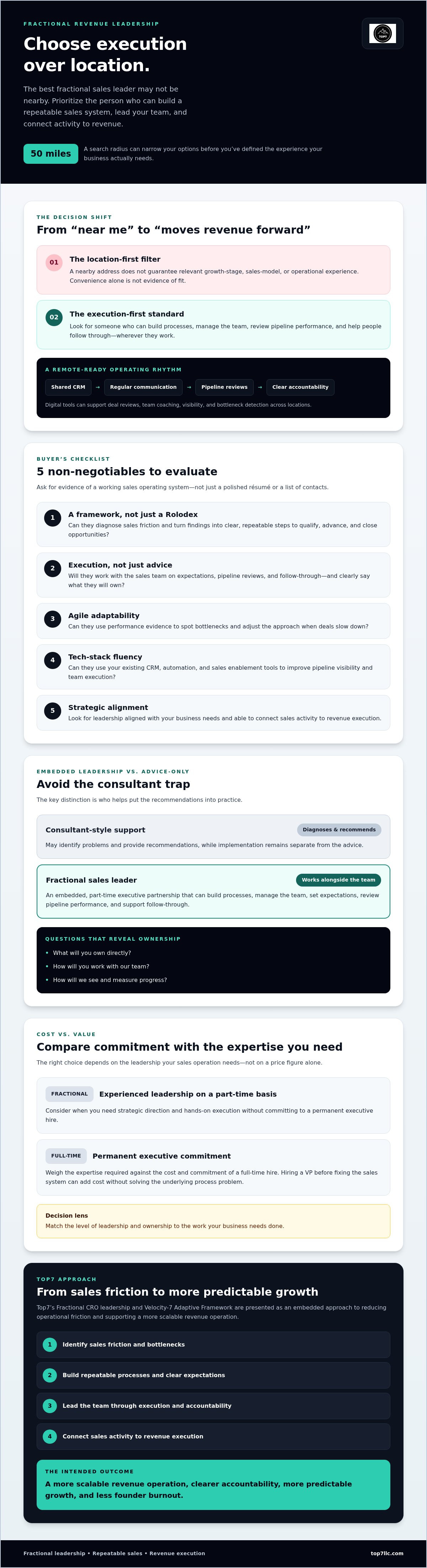
If you’re searching “fractional sales management near me,” ask what you’re really trying to solve: distance, or stalled revenue? A sales leader’s value isn’t measured by how quickly they can reach your office. It’s measured by whether they can build a repeatable sales system, lead the team, and improve revenue execution.
Modern sales work runs through shared CRMs, video calls, messaging, and digital pipeline reviews. Those tools can support deal reviews and team coaching without everyone sharing a physical office. To see how fractional sales leadership fits into broader temporary executive roles, explore Interim management.
For a closer look at the rise of this leadership model, watch this video:
What Is Fractional Sales Management?
Fractional sales management is an embedded executive partnership that brings experienced sales leadership into a business on a part-time basis. The leader can help build sales processes, manage the team, and strengthen revenue execution.
The distinction matters. A consultant may diagnose problems and recommend changes; a fractional leader works alongside your people to put those changes into practice. That can mean setting clear expectations, tightening sales processes, reviewing pipeline performance, and helping the team follow through. Before hiring, ask what the leader will own, how they’ll work with your team, and how you’ll measure progress.
The Downside of the “Near Me” Constraint
Searching within a 50-mile radius can shrink your candidate pool before you’ve defined the experience your business needs. In a specialized market, proximity doesn’t guarantee a leader has handled your growth stage, sales model, or operational challenges. A nearby candidate may be a strong fit, but don’t assume local availability equals scale-up expertise.
The risk is settling for a convenient hire instead of evaluating the strongest candidates available. Prioritize evidence of building sales processes and leading teams through growth, not simply a familiar local network.
A shared office can support culture, but it isn’t the only way to create accountability. With a well-maintained CRM, regular communication, and clear operating rhythms, a leader can monitor deals, coach reps, and surface bottlenecks across locations. The target is revenue velocity, not physical presence. Choose someone who can help your team move qualified opportunities forward, wherever they’re based.
The Buyer’s Checklist: 5 Non-Negotiables for Your Fractional Sales Leader
A polished résumé and a deep contact list won’t fix a sales system that depends on guesswork. As you evaluate fractional sales management near me, look beyond location and niche experience. The real test is whether a leader can turn their experience into a repeatable operating system your team can execute.
A framework, not just a Rolodex. Relationships can open doors, but a reliable process helps the whole team qualify, advance, and close opportunities. Ask how the leader diagnoses sales friction and turns findings into clear steps.
Execution, not just advice. Your leader should work with the sales team on expectations, pipeline reviews, and follow-through, not simply manage the CEO’s concerns. Ask what they will own and how you’ll see progress.
Agile adaptability. Sales tactics shouldn’t stay fixed when the data shows a bottleneck. Look for someone who can review current performance, identify what’s slowing deals, and adjust the approach based on evidence.
Tech-stack fluency. A CRM should help reveal what’s happening across the pipeline, not become a digital filing cabinet. Ask how the leader will use your existing CRM, automation, and sales enablement tools to improve visibility and team execution.
Strategic alignment. Sales doesn’t operate in a vacuum. A strong leader connects revenue priorities with the broader business, including delivery capacity and company goals, so growth doesn’t create new operational friction.
Vetting for Systematic Thinking
Ask candidates to walk you through their sales operating system. What do they inspect first? How do they find friction between lead qualification and closing? What changes when the evidence challenges their original plan? A structured approach, such as Top7’s Velocity-7 Adaptive Framework, gives you a concrete basis for discussing how strategy becomes execution. “We’ll figure it out as we go” isn’t a system; it’s a warning that the team may keep repeating the same costly mistakes.
Interview Questions That Reveal Real Leaders
Skip vague questions about personality fit. Ask for specific examples and listen for the steps, decisions, and outcomes behind each story:
“Describe the last sales process you broke down and rebuilt. What was failing, and what did you change?”
“How do you manage a remote or hybrid sales team for maximum output? What operating rhythms and metrics do you use?”
“What would your 90-day roadmap for revenue stabilization look like, and what would you need to learn before setting priorities?”
Compare the candidate’s responsibilities with those of a full-time role using the U.S. Bureau of Labor Statistics’ overview of sales managers, including its median annual wage for sales managers. For another reference point on a structured leadership approach, review Top7’s Velocity-7 Adaptive Framework.
Cost vs. Value: Comparing Fractional Sales Management to Full-Time Hires
The right comparison isn’t “fractional is cheaper.” It’s whether the leadership you need justifies a full-time commitment, and what stalled execution is costing in the meantime. A full-time executive brings ongoing capacity, but also ongoing compensation and hiring risk. A fractional leader offers focused access to senior expertise, provided the role has clear priorities and accountability. That distinction is central to understanding how fractional executives work.
The Hidden Costs of a Full-Time Executive
Salary is only one part of the total cost of ownership. Depending on the offer, bonuses, benefits, equity, onboarding, and separation terms can add financial and operational commitments. The CRO Report reported average total compensation of $350,465 for a U.S. VP of Sales in 2026. That figure is a benchmark for that role, not a quote for a fractional engagement or a universal cost for every company.
There’s also the cost of waiting. A new hire needs time to understand the product, team, pipeline, and decision-making habits. Don’t assume a fixed six-month ramp. Instead, ask what discovery and early execution will look like, and what outcomes are realistic at each stage. Total cost of ownership for a full-time hire includes compensation, benefits, incentives, onboarding, and potential exit costs; for a fractional engagement, assess the agreed fees, scope, and internal time required to execute.
Calculating Your Return on Leadership
Measure return on leadership by tracking revenue performance against the total resources devoted to sales management. Before work begins, agree on a baseline and indicators such as qualified pipeline, conversion between stages, forecast reliability, and time spent on stalled deals. Then review whether improvements are connected to the leader’s work, rather than assuming any revenue change proves impact.
Process optimization can create value by exposing missed follow-ups, inconsistent qualification, or unnecessary delays between sales stages. An outside leader may also question habits insiders have stopped noticing. Ask candidates how they’ll diagnose and address those issues; expertise alone doesn’t guarantee a return.
“100% of the brain for 20% of the time” is a catchy line, not a staffing plan. Define access, responsibilities, decision rights, and execution capacity instead. Ask for a first-month plan, but treat a 30-day start to results as a target to validate, not a promise. The right timeline depends on the business and the work required.
Use this decision rule: choose full-time when the role requires sustained daily leadership capacity and the business can support the full commitment. Consider fractional sales management near me, or beyond your immediate area, when the need is senior guidance and focused execution without a permanent executive seat. In either case, agree on scope, success measures, and review points upfront. That’s how you manage risk without confusing lower commitment with lower accountability.
Avoiding the 'Consultant Trap': How to Vet for Execution, Not Just Advice
A strategy deck can describe the problem. It can’t run your pipeline, coach a rep through a stalled deal, or make sure the forecast reflects reality. That’s the difference between advice and embedded leadership. As you evaluate fractional sales management near me, ask what the candidate will actually own once the engagement begins.
Clarify access and authority upfront. A fractional leader may need to work in your CRM and communication channels, such as Slack, to review deals, coordinate with the team, and act on emerging problems. But access alone isn’t accountability. Define reporting lines, decision rights, and how the leader will work with your managers and founder.
The Hallmarks of an Embedded Leader
Strong candidates can explain how they’ll turn strategy into an operating rhythm. Depending on the agreed scope and authority, that may include running weekly sales meetings, reviewing pipeline movement, coaching reps, and addressing performance concerns directly or with the appropriate manager. They should also take responsibility for the quality of the forecast, including explaining assumptions and flagging risks, rather than presenting a strategy and leaving execution to you.
Before signing, agree on measurable indicators and a review cadence. These might include pipeline coverage, stage conversion, forecast accuracy, or agreed lead-generation measures. Set targets that reflect your business and starting point. The goal is clear ownership, not a promise that one person controls every factor affecting revenue.
Red Flags in Sales Consulting
Watch for recommendations that arrive fully formed before the candidate has examined your sales motion. A template that works elsewhere may not fit your buyer, team, or delivery model. Strong leaders investigate first, then adapt.
Generic playbooks: They rely on canned processes without asking how your customers buy or where deals stall.
Surface-level diagnosis: They show little interest in operational friction, CRM data quality, or technology bottlenecks affecting execution.
Vague accountability: They resist agreeing on relevant KPIs, reporting expectations, or what they personally own.
Top7’s Velocity-7 Adaptive Framework is designed to move organizations from friction to flow through agile-based transformation. The practical distinction is important: a framework should guide action and adjustment, not become another presentation that sits untouched. Ask how a leader will apply the approach to your team and how you’ll assess progress together.
If your founder is still carrying every sales decision, clear embedded leadership can also reduce the operational burden. Explore Top7’s Fractional CRO and sales leadership to learn how its approach connects strategy with execution.
Scaling with Velocity: The Top7 Approach to Fractional Revenue Leadership
A sales team doesn’t need another strategy that lives in a slide deck. It needs a way to spot friction, act on it, and adjust as the business learns. Top7’s proprietary Velocity-7 Adaptive Framework supports that shift, combining fractional CRO and sales leadership with an agile-based approach to transformation.
The work is embedded, not limited to recommendations. Top7’s seasoned professionals work directly with clients to help move operations from friction to flow. That means examining how the sales engine functions in practice, aligning leadership and the team around priorities, then adapting the approach as execution reveals what’s working and what’s stuck. The aim is a more coherent revenue operation, not a promised result on a fixed timeline.
The Velocity-7 Framework in Sales
Top7’s Velocity-7 Adaptive Framework provides a structure for addressing operational friction and moving toward more efficient flow. Rather than assuming one tactic will solve every problem, leaders can use an adaptive approach to identify what is slowing progress and focus on the changes that fit the company’s situation.
Agile-based transformation means treating insights as a reason to test and refine, not as a cue to cling to an outdated plan. Review performance, identify friction, make a focused adjustment, and assess what changes. That creates a disciplined path from diagnosis to execution. No specific 90-day case-study result is provided here, so the roadmap below is a planning model, not a claim of guaranteed outcomes.
Your 90-Day Revenue Roadmap
A practical first-quarter roadmap can organize the work into three phases. Agree on the pace and deliverables with the leadership team based on the company’s starting point.
Phase 1: Audit and friction identification. Review the sales process, pipeline visibility, team responsibilities, and the operational handoffs that may slow deals. Agree on the most important constraints to address.
Phase 2: Framework implementation and team alignment. Set priorities, clarify ownership, and establish working rhythms that connect the sales plan to day-to-day execution.
Phase 3: Execution and optimization. Track agreed measures, address emerging bottlenecks, and refine the process based on what the team learns. Build on changes that support repeatable growth.
This model can suit mid-market companies that need experienced revenue leadership and coordinated execution without defaulting to a full-time executive hire. If you’re still weighing “fractional sales management near me,” focus on leadership fit and operating approach, not distance alone. Schedule a call with Top7 to discuss how its Fractional CRO leadership and Velocity-7 Adaptive Framework could address your sales friction.
Build Revenue Momentum Without the Geographic Guesswork
The right sales leader is defined by execution, not proximity. Look for a repeatable framework, clear accountability, and hands-on leadership that connects sales activity to broader business priorities. Then compare fractional and full-time options based on the capacity you need, the commitment your business can support, and the cost of leaving sales friction unresolved.
If you’re still searching “fractional sales management near me,” widen your search. Top7 helps organizations address growth obstacles, embeds with clients to turn strategy into action, and applies its proprietary Velocity-7 Adaptive Framework to move organizations from friction toward flow. Fractional CRO leadership can provide experienced executive direction without adding a full-time executive seat, helping founders focus their attention where it matters most.
Ready to address the revenue friction holding your team back?Explore Top7’s Fractional CRO leadership and Velocity-7 Adaptive Framework. With clear priorities and disciplined execution, you can build a stronger foundation for scalable growth.
Frequently Asked Questions
Is a fractional sales manager the same as a sales consultant?
No. A consultant typically analyzes a problem and recommends what to change, while a fractional sales manager can take an ongoing leadership role in carrying out those changes. Clarify the distinction before you engage anyone: ask whether they’ll manage sales routines, work with reps, review pipeline performance, and own specific responsibilities. The title alone doesn’t guarantee execution. Scope, decision rights, and accountability do.
How many hours a week does a fractional sales manager work?
It depends on the company’s needs, the leader’s responsibilities, and the engagement scope. Some arrangements focus on strategic oversight and regular reviews; others require more direct involvement with sales meetings, pipeline management, and team coaching. Agree on expected availability, meeting cadence, priorities, and deliverables before work begins. The goal isn’t to buy hours for their own sake. It’s to secure enough leadership capacity to address your business’s actual sales constraints.
Can a fractional leader manage my existing sales team effectively?
Yes, if the role includes clear authority and the team understands how the leader fits into its reporting structure. Define who sets priorities, coaches reps, reviews deals, and addresses performance concerns. A fractional leader can work with your existing managers and salespeople without replacing the team, but access alone won’t create accountability. Set shared operating rhythms and measures so employees know what’s expected and leadership can see whether execution is improving.
What is the typical ROI of hiring a fractional CRO or sales manager?
There’s no reliable universal ROI figure. Results depend on your starting point, sales cycle, team adoption, and the leader’s scope. Before the engagement, record a baseline for measures such as qualified pipeline, conversion by stage, forecast accuracy, and time deals spend stalled. Agree on which indicators the leader can influence and review them consistently. Treat revenue impact as something to measure, not a result any provider should promise in advance.
Do I need to hire someone local if my sales team is remote?
Not necessarily. If your team works remotely and your CRM, communication tools, and sales routines provide clear visibility, physical proximity may add little value. Search beyond “fractional sales management near me” and compare candidates on relevant leadership experience, ability to manage remotely, and hands-on execution. If in-person work matters for your culture or selling process, make that an explicit requirement rather than assuming every sales leader must be local.
How long does a typical fractional sales management engagement last?
There’s no single standard duration. An engagement may be shaped around a defined business need, ongoing leadership capacity, or a transition in the company’s sales operation. Set an initial review point and specify what progress you’ll assess, such as improved pipeline visibility or clearer team accountability. Also agree how either side can adjust the scope. A useful engagement lasts as long as the business need and agreed value justify it.
What happens if I need to transition to a full-time hire later?
Plan the transition as part of the leadership arrangement, not as an afterthought. Document sales processes, current priorities, pipeline definitions, forecast assumptions, team responsibilities, and unresolved risks so a future executive can take over with context. Agree in advance on how knowledge transfer and handoff will work. A fractional leader can support continuity, but don’t assume they will recruit or provide a permanent replacement unless that service is explicitly part of the agreement.
How does fractional leadership handle proprietary company data and security?
Set data protections before granting access. Confirm confidentiality terms, which systems and records the leader needs, how access will be approved, and how permissions will be removed when the engagement ends. Give the leader only the access required for the agreed work, and follow your company’s policies for CRM exports, customer information, and communication tools. Ask how sensitive information will be handled, documented, and returned or deleted under the contract.
Want to discuss your sales leadership needs?Contact Top7 to explore its Fractional CRO leadership and Velocity-7 Adaptive Framework.


Comments