
Finding an Interim COO During a Supply Chain Crisis: The Operator Playbook

When suppliers fail, backorders mount, and working capital stays trapped in stagnant inventory, conventional hiring cycles become an active liability. Finding an interim COO during a supply chain crisis isn't about hiring a polished advisor to build slide decks. It's about deploying a battle-tested tactical commander who seizes immediate control of vendor leverage, cash burn, and physical throughput within days, not months.
You already know your existing leadership team lacks the bandwidth and crisis reps to engineer emergency turnarounds while keeping daily fulfillment alive. Waiting twelve weeks for a traditional search firm to deliver resumes will cost you the business. This playbook gives you the exact strategy to rapidly evaluate, source, and deploy an interim operator to stabilize fractured supply lines before irreversible damage occurs. Ahead, you'll discover a ruthless vetting framework to filter out paper consultants, an immediate 72-hour operational triage blueprint, and the systematic plan to harden your supply network for permanent leadership.
Table of Contents
Why a Supply Chain Breakdown Demands an Emergency Interim COO
A fractured supply chain is never an abstract strategic puzzle; it is an acute liquidity drain. When distribution stalls or key components disappear, invoicing stops cold while payroll, debt service, and warehouse overhead continue unabated. In high-stakes manufacturing and distribution environments, finding an interim coo during a supply chain crisis becomes a direct race against balance-sheet insolvency.
Existing executive teams quickly develop operational fatigue. Swamped by daily firefighting, internal leaders suffer from tunnel vision, often defending legacy vendor relationships out of habit rather than necessity. Deploying an established interim management model injects ruthless prioritization into your executive bench. An interim operator brings total emotional detachment, restructuring vendor leverage and restoring plant throughput without saddlebags of permanent overhead or equity dilution.
To understand the structural forces behind systemic bottlenecks and why traditional planning fails during disruptions, watch this tactical breakdown:
The Warning Signs of Critical Operational Friction
Operational decay rarely happens overnight; it leaves unmistakable indicators before turning catastrophic:
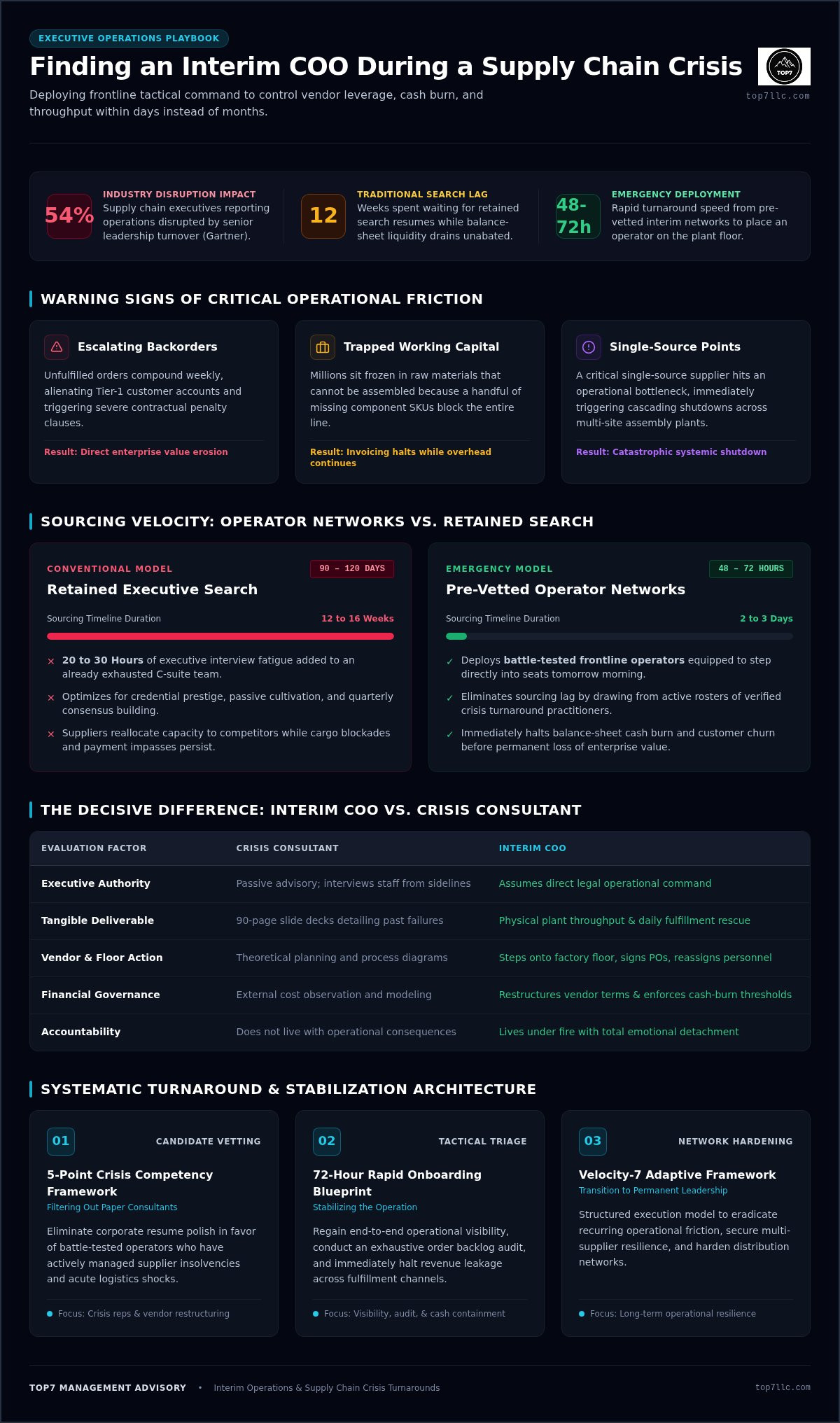
Escalating Backorders: Unfulfilled orders compound weekly, alienating Tier-1 customers and triggering severe contractual penalty clauses.
Trapped Working Capital: Millions sit frozen in raw materials you cannot assemble because a handful of missing SKUs block the entire line.
Single-Source Vulnerabilities: A critical supplier hits a bottleneck, instantly causing cascading shutdowns across your assembly plants.
Interim Executive vs. Crisis Consultant: The Decisive Difference
Management consultants study problems, interview staff, and deliver ninety-page slide presentations detailing what already went wrong. They do not live with the consequences. An interim COO assumes legal operational command. They step directly onto the factory floor, sign purchase orders, renegotiate restrictive vendor terms, reassign personnel, and enforce daily cash-burn thresholds.
True operational rescue requires executive authority, not passive observations. When immediate survival is on the line, finding an interim coo during a supply chain crisis gives your company a frontline operator who executes turnarounds under fire instead of writing advisory reports from the sidelines.
Sourcing an Interim COO: Operator Networks vs. Retained Search
When freight sits stranded and assembly lines stall, relying on traditional executive headhunters is organizational malpractice. Conventional search models optimize for credential prestige and passive candidate cultivation over quarterly cycles. When you're finding an interim coo during a supply chain crisis, speed is your primary survival metric. You don't need a recruiter vetting sixty-day shortlists; you need an operator on the floor tomorrow morning.
The Hidden Costs of Retained Recruiting Delays
Retained executive search firms take 90 to 120 days to complete a placement. During an active logistics breakdown, that delay directly erodes enterprise value. Customer churn accelerates, suppliers reallocate capacity to your competitors, and boards lose faith in executive leadership.
According to Gartner, senior leadership turnover disrupts operations for 54% of supply chain executives. Layering 20 to 30 hours of internal interview fatigue onto an already stressed C-suite only accelerates burnout. Traditional search firms build consensus around polished resumes; they do not solve physical cargo blockades or vendor payment impasses.
Deploying Pre-Vetted Interim Management Firms
Specialized interim operator networks eliminate sourcing lag entirely. Rather than starting from a blank database, these firms maintain active rosters of battle-tested practitioners who step into operational seats within 48 to 72 hours. These leaders arrive equipped with proven protocols, such as the NIST framework for supply chain resilience, to execute rapid risk assessments, triage production dependencies, and establish vendor leverage.
Deployment Speed: Critical operational command established within 48 to 72 hours of engagement intake.
Contract Agility: Structured as focused 3-to-6-month mandates with 30-day outs, eliminating balance-sheet overhang.
Immediate Authority: Frontline operators who control shop-floor throughput, re-route logistics lanes, and renegotiate contracts from day one.
Instead of gambling on unvetted candidates during a breakdown, deploying experienced interim leadership stops cash leakage immediately and installs resilient operational flow before irreparable brand damage occurs.
The 5-Point Crisis Competency Framework for Vetting Candidates
A pristine resume built inside steady-state Fortune 500 operations is useless during an emergency turnaround. Managing predictable volumes with abundant capital doesn't translate to salvaging stalled freight lines under cash constraints. Gartner reports that while operational roles continue expanding, only 22% of current supply chain leaders demonstrate the cross-functional crisis management capabilities needed to absorb systemic shocks. When finding an interim coo during a supply chain crisis, you need an evaluation scorecard that filters out paper consultants and identifies battle-tested operators.
Forensic Cash Control: The ability to conduct instant payables reconciliation and protect liquidity while maintaining baseline material inputs.
Dynamic Vendor Renegotiation: Proven reps restructuring unfavorable Tier-1 and Tier-2 supplier contracts and securing alternative secondary sources under pressure.
Rapid Logistics Rerouting: Practical execution in bypassing port logjams, clearing customs hurdles, and recalculating safety stock parameters in real time.
Decisive Shop-Floor Command: Establishing immediate trust with warehouse staff and shift managers to boost daily throughput velocity.
Transparent Stakeholder Alignment: Delivering unvarnished operational reporting to boards, lenders, and private equity sponsors to restore immediate confidence.
Hard Skills: Logistics Triage and Cash Conservation
Your candidate must treat logistics as an extension of the corporate balance sheet. Drawing on concepts central to the MIT Sloan Management Review's framework on managing supply disruptions, true crisis operators don't wait for supply chains to heal; they activate alternate distribution lanes and aggressively renegotiate carrier agreements. Cash-conscious logistics execution separates business survivors from court-supervised liquidations.
Soft Skills: Decisive Command Under Extreme Ambiguity
Operational panic breeds inaction across your facility. An elite interim leader steps into chaos, cuts through noise, and unifies fragmented teams behind immediate twenty-four-hour targets. They don't seek consensus when line velocity drops; they make the tough, unpopular cuts necessary to protect core margin. Successful operators communicate unvarnished ground truths to capital partners, replacing corporate spin with verified progress metrics.
When finding an interim coo during a supply chain crisis, ignore candidate pedigree from calm waters. Hire the operator who has already steered companies out of the storm.
The 72-Hour Rapid Onboarding Blueprint: Stabilizing the Operation
Theoretical hundred-day onboarding plans are useless when delayed shipments bleed working capital today. In an acute emergency, stabilization must occur within the first seventy-two hours. Finding an interim coo during a supply chain crisis is about inserting a commander who bypasses corporate orientation and seizes control of physical inventory, supplier commitments, and fulfillment channels immediately.
A seasoned operator executes an aggressive three-day sequence designed to halt systemic collapse:
Hours 0 to 24 (Visibility and Triage): Execute a forensic audit of raw materials, work-in-progress inventory, and open purchase orders. Cross-reference backorders against customer contracts to identify at-risk accounts facing delivery penalties. Freeze non-critical capital expenditures to ringfence cash for critical shipments.
Hours 24 to 48 (Bottleneck Containment): Stand up an operational war room with heads of procurement, plant operations, and logistics. Replace weekly status updates with twice-daily, fifteen-minute resolution sprints focused purely on clearing physical freight blockers.
Hours 48 to 72 (External Realignment): Re-engage Tier-1 suppliers directly to renegotiate delivery schedules and trade credit. Establish secondary logistics corridors to bypass saturated distribution hubs, and align sales leadership around realistic production run rates.
Immediate Friction Audits and War Room Setup
Day one centers on brutal operational reality. The interim leader audits cash-to-order velocity to pinpoint where materials are stalling and why. Setting up a centralized war room immediately breaks operational silos. Shift supervisors, warehouse managers, and freight dispatchers meet every twelve hours with one objective: clear production blockers and enforce operational discipline.
Vendor Leverage and Logistics Realignment
Stabilization requires direct, frontline intervention with critical suppliers. An interim COO doesn't wait for vendor emails. They get on the phone, leverage historical spend, negotiate revised payment covenants, and secure line priority for critical parts. Simultaneously, they activate alternative freight routes to reroute delayed cargo around port choke-points.
Resetting customer commitments protects long-term commercial relationships while line velocity recovers. Rather than letting operational friction compromise your market share, take immediate action. Deploy an interim COO who will seize vendor leverage, protect working capital, and restore operational flow to your supply chain.
Securing Interim Operations Leadership with Top7
Consulting consortiums charge premium retainers to deliver slide decks; traditional recruiters burn precious months searching for passive talent. Neither model solves the operational firestorm threatening your enterprise value right now. Top7 bypasses that bureaucratic overhead entirely. By deploying battle-tested interim leaders directly into your executive structure, Top7 restores operational throughput, takes command of supplier friction, and stops balance-sheet erosion immediately.
When finding an interim coo during a supply chain crisis, your goal isn't just surviving the acute bottleneck. You must systematically fortify the entire operation. Top7 operators embed on day one, seizing direct responsibility for vendor covenants, working capital discipline, and plant velocity without long-term equity dilution or permanent payroll obligations.
The Velocity-7 Approach to Operational Turnaround
Top7 operators leverage the proprietary Velocity-7 Adaptive Framework to transition organizations from chaotic reaction to agile, resilient execution. Instead of applying brittle corporate templates, this framework diagnoses critical choke points across your fulfillment pipeline and installs agile project management cadences to eliminate delivery drag.
Friction Diagnostics: Pinpointing systemic flow breakdowns across procurement, warehousing, and transportation lanes.
Agile Execution Cycles: Replacing sluggish quarterly planning with high-velocity operational sprints that continuously clear blockers.
Institutionalized Resilience: Hardening vendor networks and standardizing processes so the operational gains outlast the emergency.
Initiating an Interim COO Engagement
Emergency stabilization cannot wait for bureaucratic hiring committees. The process begins with an immediate discovery evaluation to map acute operational exposure, cash-to-order friction, and critical vendor vulnerabilities. Within days, Top7 embeds an experienced operator equipped with executive authority to stabilize your fulfillment engine and build the documentation required for a permanent successor.
Don't let operational failure dictate your market position. If you are focused on finding an interim coo during a supply chain crisis, take decisive tactical action now. Connect with Top7 to deploy battle-tested leadership and restore momentum to your operations today.
Take Tactical Command Before Operational Collapse
Operational bottlenecks do not resolve on their own; they compound until working capital freezes and customer trust breaks. Waiting on prolonged search cycles during active delivery failures is a risk your balance sheet can't afford. When finding an interim coo during a supply chain crisis, your business requires immediate, battle-tested intervention. You need embedded C-suite operators focused on hands-on tactical execution rather than theoretical slide decks.
By leveraging the proprietary Velocity-7 Adaptive Framework, Top7 transitions your fulfillment network from acute operational friction into resilient, agile flow. Flexible interim and fractional leadership engagements allow you to secure elite crisis triage and vendor renegotiation without the burden of permanent executive payroll overhead. Your operation can emerge from this disruption stronger, leaner, and more disciplined than before. Take decisive control of your inventory throughput, protect your enterprise value, and deploy proven operational leadership now with Top7.
Frequently Asked Questions
How fast can an interim COO start during an emergency?
Rapid deployment typically happens within 48 to 72 hours through specialized operator networks. Unlike traditional recruitment cycles that consume months drafting job descriptions and interviewing candidates, interim leadership engages immediately. An experienced operator steps directly into the facility, takes control of the operational dashboard, and begins triaging critical logistics failures on day one. Speed is everything when unfulfilled backorders threaten enterprise solvency.
How much does an interim COO cost compared to a permanent hire?
An interim COO eliminates substantial long-term overhead. Permanent C-suite hires require six-figure search firm placement fees, performance bonuses, extensive benefit packages, and equity grants that dilute cap tables. Interim engagements operate on clean, time-bound structures with mutual exit clauses. You pay strictly for high-impact execution during the active crisis, eliminating severance liabilities and ongoing payroll burdens once your operational flow stabilizes.
Will an interim COO have real authority to renegotiate supplier contracts?
Yes, an interim COO holds direct executive operational authority. When finding an interim coo during a supply chain crisis, you are not hiring an outside observer. You are installing an officer with designated signing power. They directly renegotiate terms with Tier-1 and Tier-2 vendors, alter payment schedules, reassign plant personnel, and approve expedited freight routing to protect core customer commitments and cash reserves.
What is the difference between an interim COO and a supply chain consultant?
Consultants produce diagnostic decks and recommend theoretical strategies without bearing operational accountability. Interim COOs step into the line of fire. They take full command of warehouse floors, procurement channels, and shipping docks. While a consultant advises your team on what to fix, an interim executive executes the fixes directly, making the tough calls on inventory reallocation and supplier enforcement.
How long does an interim COO typically stay in the business?
Most crisis mandates run between three to six months. The immediate focus is rapid triage, vendor realignment, and throughput recovery rather than indefinite tenure. Once inventory moves predictably, working capital unlocks, and supplier relationships stabilize, the interim operator formalizes resilient standard operating procedures. This disciplined cadence guarantees that operational gains persist long after the emergency mandate concludes.
Can an interim COO assist with onboarding the permanent executive replacement?
Absolutely. A critical deliverable of finding an interim coo during a supply chain crisis is creating a seamless leadership bridge. The interim operator stabilizes the chaos, codifies clean operational documentation, and identifies the exact skill profile needed in a full-time successor. When the permanent executive arrives, the interim leader manages a disciplined handover to ensure zero loss of momentum.
What metrics determine whether the interim engagement was successful?
Success is measured strictly through operational velocity and capital efficiency. Key performance benchmarks include a rapid reduction in customer backorders, compressed cash-to-order cycle times, restored on-time in-full fulfillment rates, and working capital unlocked from frozen inventory. Successful mandates also deliver diversified supplier agreements and disciplined shop-floor throughput, ensuring your entire fulfillment network remains resilient against future market shocks.


Comments