
Finding an Interim CFO During an Audit: 2026 Guide

Traditional executive search won't save an audit that is actively spiraling out of control. When auditors start warning of material weaknesses and your PBC request lists grind to a dead halt, finding an interim cfo during an audit isn't an HR exercise; it is rapid-response crisis triage. You already know your internal finance team is stretched thin, leaderless, and completely out of leverage against audit partners demanding technical substantiation right now. Waiting months for a recruiting firm candidate pool simply invites regulatory penalties and qualified opinions that destroy enterprise value.
This guide shows you how to immediately source, vet, and deploy an audit-ready interim CFO before external scrutiny erodes your balance sheet. We will walk through the exact steps to secure seasoned interim leadership within days, clear operational backlogs, defend complex accounting positions, and establish the ironclad governance needed to close the audit cleanly.
Table of Contents
Why an Active Audit Without a CFO Threatens Enterprise Value
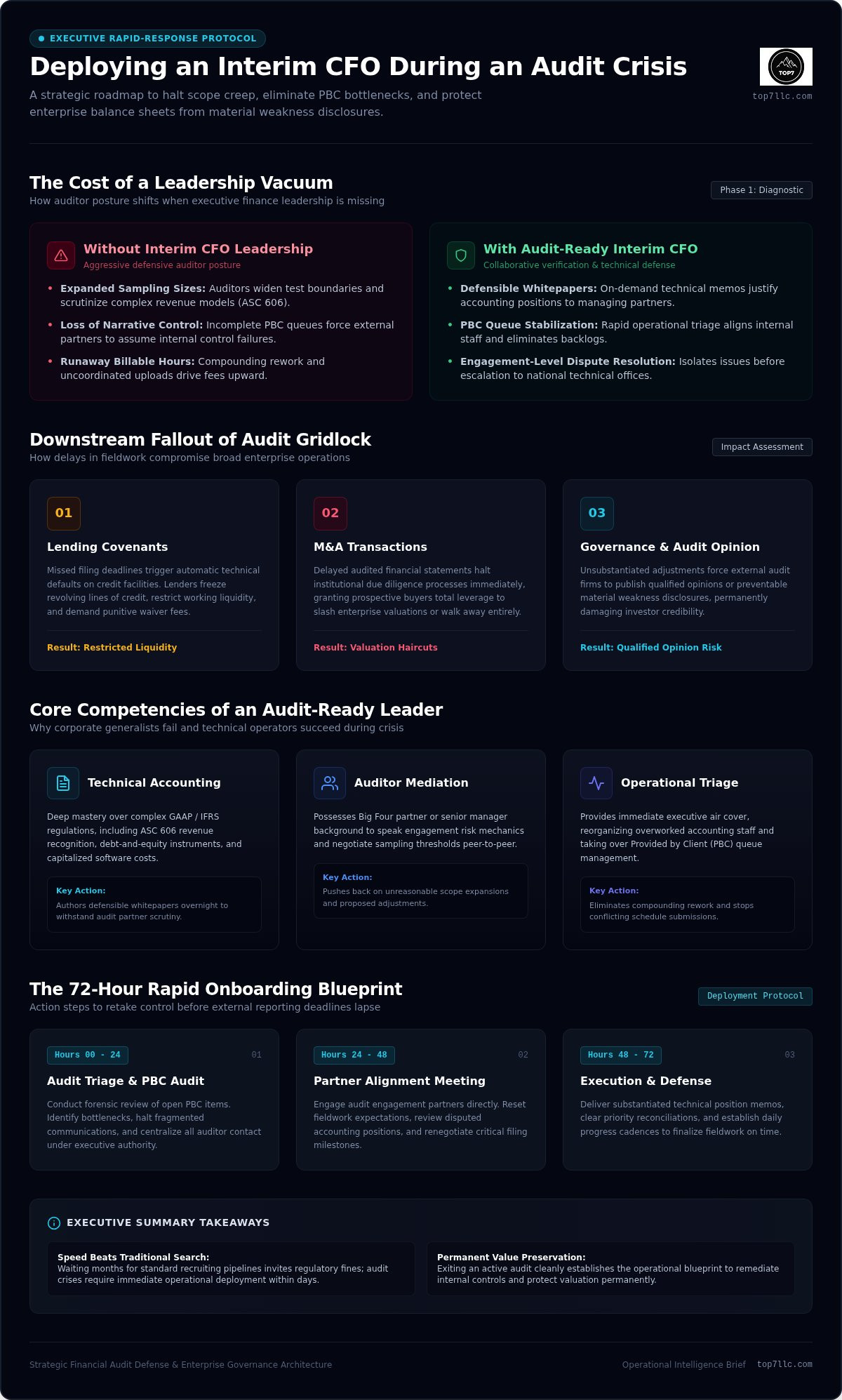
Audits do not stall because accounting teams are lazy. They stall because unguided teams lack executive air cover. When external audit partners detect a leadership vacuum at the top of finance, their operating posture shifts immediately from collaborative verification to aggressive defensive testing. They expand sampling sizes, scrutinize revenue recognition models, and challenge technical accounting positions that previously passed without friction.
Controllers and senior accounting managers cannot solve this problem. While skilled in daily reconciliations, they simply lack the executive standing and mandate to negotiate audit adjustments or push back on unreasonable scope creep. Without C-suite intervention, finding an interim cfo during an audit becomes your only realistic firewall against runaway billable hours and catastrophic audit report modifications.
The Breakdown of the PBC Request List and Fieldwork Friction
Fieldwork collapses when the Provided by Client (PBC) queue turns into an operational bottleneck. Junior accountants scramble to pull raw files without understanding the underlying technical narrative. Incomplete schedules and delayed reconciliations signal chaos to the audit team. Under the standard financial audit process, unanswered inquiries and missing workpapers force auditors to escalate risk assessments, driving billable hours upward while confidence evaporates.
Loss of narrative control: Disjointed, late submissions invite auditors to write their own conclusions about internal controls.
Compounding rework: Uncoordinated staff upload conflicting versions of schedules, multiplying clarification requests.
Fieldwork paralysis: Critical audit deadlines slip as external partners wait on baseline reconciliations.
Downstream Consequences for Lending Covenants and M&A Transactions
Audit gridlock rarely stays contained within finance. Missed filing deadlines trigger automatic technical defaults on credit facilities. Lenders don't debate technicalities; they freeze revolving lines of credit, restrict liquidity, and demand punitive waiver fees. In an active M&A process, delayed audited financials completely freeze institutional due diligence, giving buyers total leverage to slash valuations or walk away entirely.
This is precisely why finding an interim cfo during an audit represents direct enterprise value preservation, not administrative overhead. A battle-tested interim executive steps into fieldwork immediately, seizes control of the auditor dialogue, resolves technical impasses, and protects your balance sheet from devastating material weakness disclosures.
Key Criteria: What Makes an Interim CFO Audit-Ready?
Most organizations stumble by treating audit remediation like a typical executive hire. A traditional corporate CFO who focuses on capital allocation, long-term fundraising, or investor relations will freeze when confronted with unresolved technical accounting disputes. Audit survival demands an entirely different profile: an operator with forensic-level technical depth and senior executive authority.
When finding an interim cfo during an audit, you need a specialist who treats audit fieldwork like an operational turnaround. They must possess the credibility to push back against unreasonable audit partner requests while simultaneously rallying a depleted finance department.
Technical Accounting Mastery and GAAP or IFRS Compliance
Your interim leader must possess immediate technical fluency in contentious areas like ASC 606 revenue recognition, complex debt-and-equity instruments, and capitalized software costs. They cannot rely on outside consultants to draft technical position memos under pressure. Look for seasoned professionals, often with prior Big Four partner or senior manager experience, who can author defensible whitepapers overnight to satisfy rigorous audit standards.
Auditor Mediation and Managing Partner Negotiations
Audit partners don't back down when challenged by anxious controllers. They respect executives who speak their regulatory language and understand the mechanics of engagement risk. An audit-ready interim CFO knows how to negotiate reasonable sampling thresholds, challenge proposed adjustments, and isolate audit issues before they reach national technical office review. Resolving disputes at the engagement-team level prevents unnecessary scope inflation and keeps reporting dates intact.
Operational Triage and Immediate Team Direction
Technical skill means little if your internal team remains disorganized and exhausted. An effective interim executive implements rigorous project discipline within forty-eight hours of stepping into the role:
Daily audit burn-down tracking: Real-time management of all outstanding PBC requests, assigning single-threaded ownership to every line item.
Direct inquiry firewalls: Routing every external auditor question through a single executive filter to prevent contradictory responses.
Resource reallocation: Shifting routine operational tasks off key accounting staff so they can focus entirely on audit support.
Deploying battle-tested interim leadership gives your enterprise the immediate authority required to command the audit room, clear critical workpaper queues, and protect shareholder value.
Sourcing Models: Executive Search vs. Traditional Staffing vs. Interim Leadership
Sourcing under regulatory pressure exposes the flaws of conventional hiring channels. When audit deadlines tighten and fieldwork stalls, choosing the wrong talent channel accelerates disaster. Successfully finding an interim cfo during an audit requires ruthlessly evaluating three distinct models: retained search, contingent staffing, and dedicated interim leadership.
The Fatal Flaws of Traditional Executive Search During an Audit
Retained executive search operates on a 90 to 120-day timeline. In an audit crisis, your runway is measured in weeks, sometimes days. Top-tier permanent candidates routinely decline offers when they realize they're walking directly into an active, contentious audit. Paying massive upfront retainers while auditor billable hours compound weekly drains cash without solving the immediate bottleneck. You don't have time to deliberate cultural nuance; you need emergency leadership right now.
Contingent Staffing Agencies and the Problem of Unvetted Resumes
Staffing agencies function as resume clearinghouses, flooding executive inboxes with unvetted CVs. This shifts the grueling task of technical screening onto an already overwhelmed CEO. Individual contingent contractors lack strategic ownership. They bill for hours logged rather than milestones completed. Transactional recruiters simply cannot evaluate whether a candidate can defend complex revenue recognition positions before national technical accounting committees.
Strategic Interim Leadership and Adaptive Execution Frameworks
Dedicated interim leadership bypasses recruitment friction entirely by deploying battle-tested executives who plug directly into active fieldwork. Rather than acting as passive caretakers, interim leaders use agile execution frameworks to establish immediate control over audit milestones.
Instant integration: Executives assume direct accountability on day one without drawn-out hiring cycles.
Agile operational flow: Structured delivery systems replace ad-hoc firefighting, systematically burning down PBC backlogs.
Aligned business outcomes: The mandate centers strictly on securing an unmodified audit opinion and safeguarding valuation.
When finding an interim cfo during an audit, choosing an agile interim leadership model delivers the speed, technical firepower, and crisis triage capabilities that traditional staffing agencies cannot provide.
The 72-Hour Action Plan to Vet, Onboard, and Deploy
When an active audit stalls, deliberate hiring timelines vanish. You have seventy-two hours to install executive command before external auditors reschedule fieldwork or document scope limitations. Successfully finding an interim cfo during an audit requires a compressed deployment protocol focused entirely on operational triage.
Day 1: Technical Screening and Crisis Diagnostic
Ditch conventional behavioral interviews. Test for battlefield competence. Present the candidate with your actual audit friction points: an unresolved revenue cut-off issue, an unamortized debt discount dispute, or an unallocated variance. Challenge them to explain how they de-escalate that specific impasse with an audit partner. Confirm 100% immediate operational availability and establish total authority over all audit-related communications.
Day 2: Access, Governance, and External Auditor Handshake
Bureaucracy kills momentum. Provision general ledger, ERP, and audit firm portal access before noon. By early afternoon, schedule the executive alignment call with the lead audit engagement partner. The interim leader must reset the tone immediately: acknowledge past bottlenecks, present a revised deliverable timeline, and establish that all fieldwork inquiries now flow through them. This single conversation instantly halts auditor panic.
Day 3: Triage the PBC Queue and Establish Fieldwork Rhythm
Chaos ends when structured execution takes over. Your interim CFO must conduct a rigorous inventory of the Provided by Client queue to identify critical-path dependencies:
Isolate high-risk technical workpapers: Prioritize complex accounting positions that require technical documentation over standard operational schedules.
Implement single-threaded ownership: Assign each open request to a specific internal preparer with firm submission deadlines.
Enforce daily 15-minute standups: Track the PBC burn-down rate every morning, unblocking staff roadblocks before they escalate into delinquent audit requests.
When your active audit threatens lending covenants or transaction timelines, don't wait for a slow search cycle to play out. Take control of your audit room right now by choosing to deploy audit-ready interim leadership built for rapid crisis execution.
Transitioning from Audit Defense to Permanent Financial Control
Securing an unmodified audit opinion stops the bleeding, but surviving fieldwork is only phase one. If you treat the audit conclusion as a reason to return to business as usual, you guarantee the exact same panic twelve months from now. Finding an interim cfo during an audit resolves the acute emergency; retaining that strategic discipline permanently protects your valuation.
Remediating Control Deficiencies and Closing Management Letter Points
Auditors issue management letters to expose operational blind spots. Don't file these findings away. An experienced financial leader converts auditor deficiency points into an operational remediation plan within thirty days of report sign-off. This means establishing standardized close checklists, enforcing strict segregation of duties, and automating manual balance sheet reconciliations. Eliminating these operational friction points turns your finance function into a well-oiled machine long before next year's fieldwork commences.
Evaluating Long-Term Leadership: Fractional CFO vs. Permanent Hire
Once the audit crisis subsides, leadership must evaluate long-term financial governance. Many middle-market enterprises rush back into executive recruitment, assuming a permanent, full-time hire is mandatory. Often, that is an expensive miscalculation.
Cost alignment: A full-time C-suite executive carries heavy overhead that middle-market companies don't always require year-round.
Strategic agility: Retaining fractional leadership provides tier-one financial architecture and board-level strategy without full-time executive costs.
Year-round audit readiness: Ongoing oversight ensures books remain continuously reconcilable, ending the era of frantic year-end cleanups.
Accelerating Strategic Growth with Embedded Executive Expertise
Clean audits create enterprise momentum. Once defense transforms into stability, your finance organization should pivot directly toward capital efficiency, margin expansion, and cash flow acceleration. Achieving this transition requires structured operational discipline rather than uncoordinated tactical adjustments.
By leveraging the proprietary Velocity-7 Adaptive Framework, organizations transition out of chaotic firefighting into structured operational flow. Rather than settling for transactional staffing fixes, partnering with Top7 interim and fractional leadership establishes the institutional governance, technical rigor, and ongoing strategic clarity needed to ensure that finding an interim cfo during an audit becomes a turning point for sustainable enterprise growth, not a recurring nightmare.
Take Control of Your Audit Room and Secure Your Valuation
Stalled fieldwork and compounding auditor inquiries don't resolve themselves. When reporting deadlines loom and credit facilities hang in the balance, finding an interim cfo during an audit is the definitive move to reclaim leverage. You don't need a passive advisor; you need an operator who commands the room, clears technical roadblocks, and enforces operational discipline immediately.
Top7 delivers rapid national deployment of battle-tested C-suite leaders who integrate directly into your executive team without traditional search overhead. Powered by our proprietary Velocity-7 Adaptive Framework, our interim executives transition organizations from friction to flow, defending complex accounting positions and establishing permanent financial governance. Stop audit bleed today with Top7 interim executive leadership. With decisive intervention, you won't just survive this audit; you will build a resilient financial foundation that fuels sustainable enterprise growth.
Frequently Asked Questions
How quickly can an interim CFO step into an active audit crisis?
An experienced interim CFO can deploy within 24 to 72 hours. Traditional executive search takes months you don't have. When finding an interim cfo during an audit, specialized firms deploy battle-tested operators immediately nationwide to take over fieldwork communications, review open PBC requests, and halt auditor escalation before critical deadlines collapse.
Can an interim CFO sign off on audit representation letters?
Yes, an interim CFO can sign management representation letters if granted corporate officer status by the board of directors. While some organizations prefer joint signatures alongside the CEO, interim leaders routinely assume full executive accountability once they have vetted the underlying financial schedules. The key is ensuring your interim executive conducts sufficient balance sheet diligence before affixing their signature to formal audit representations.
What is the difference between an interim CFO and a fractional CFO?
The primary distinction lies in scope and operational intensity. An interim CFO steps into a full-time, hands-on operational role to steer an organization through an urgent crisis, leadership transition, or contentious audit. A fractional CFO provides ongoing, part-time strategic leadership and board advisory services over a sustained period. Both deliver tier-one financial guidance without executive recruitment overhead.
How much authority should an interim CFO have with our external auditors?
You must grant your interim CFO absolute executive authority over all auditor interactions from day one. If junior staff continue debating workpaper requests directly with audit managers, mixed messaging will trigger expanded sampling. Funneling all PBC deliveries, dispute resolutions, and technical accounting memos through a single interim leader eliminates communication leaks and re-establishes institutional control over the engagement.
What happens if our company receives a going concern or material weakness warning?
A going concern or material weakness warning immediately puts debt covenants, credit facilities, and equity valuations at severe risk. When auditors issue these preliminary findings, rapid intervention is essential. Finding an interim cfo during an audit ensures you have the technical firepower to challenge flawed auditor assumptions, model viable cash flow forecasts, or construct an immediate remediation plan that satisfies national technical committees before reports are finalized.
How do we prevent our existing finance team from quitting during an audit crisis?
Stop treating your existing accounting team like crisis shock absorbers. Controllers and senior accountants burn out when forced to field relentless auditor demands while managing everyday transactional operations. Installing an interim CFO creates an immediate operational shield. The interim leader manages the auditor relationship, reallocates internal workloads, and resolves technical friction points, restoring sanity and morale across the entire department.


Comments