
Calculating and Reducing Customer Acquisition Cost: The Executive Playbook

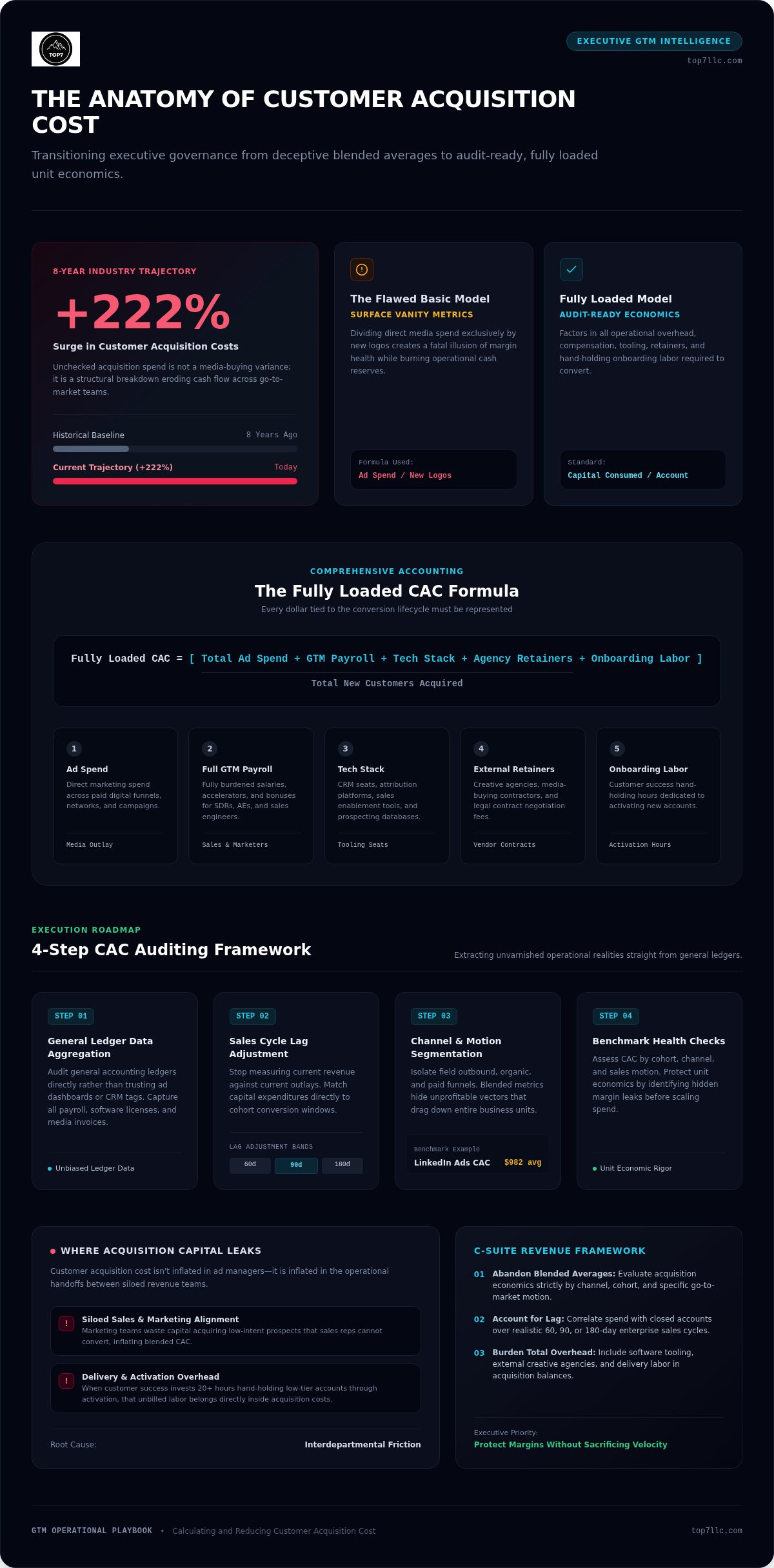
Unchecked acquisition spend isn't a media buying problem; it's a structural breakdown. Customer acquisition costs have surged by 222% over the past eight years, leaving leadership teams burning cash while debating vanity metrics. If you're relying on simplistic models that ignore operational overhead, software tooling, and sales salaries, you aren't seeing reality. Truly calculating and reducing customer acquisition cost requires looking past flattering blended figures and confronting the operational friction that quietly erodes your margins.
You already sense the disconnect between top-line pipeline growth and bottom-line cash flow. Blended averages routinely mask unprofitable channels, while siloed sales and marketing teams waste capital on low-intent prospects. This playbook changes that dynamic. You'll master the indisputable math behind fully loaded, audit-ready CAC, diagnose hidden margin leaks across your funnel, and execute proven operational plays to slash acquisition expenses without sacrificing revenue velocity. Here's how modern executives rebuild their go-to-market architecture for disciplined, scalable growth.
Table of Contents
The Anatomy of Customer Acquisition Cost: Simple vs. Fully Loaded CAC
Calculating and Auditing Your Real CAC: A Step-by-Step Framework
Root Causes of Inflated Acquisition Costs Across the Enterprise
High-Impact Strategies for Reducing Customer Acquisition Cost
Aligning Executive Leadership to Protect Margins and Accelerate Velocity
The Anatomy of Customer Acquisition Cost: Simple vs. Fully Loaded CAC
Most executive dashboards present a comforting fiction. When leadership teams discuss Customer Acquisition Cost, they routinely point to basic ad spend divided by new logos. That isn't economic reality. True customer acquisition cost represents the total capital deployed across your entire organization to win a single paying client. Masking this number with basic blended averages creates a fatal illusion of profitability while burning operational cash reserves.
Relying on surface-level metrics blinds executive teams to unprofitable segments, distorted unit economics, and cash drains hidden across departments. To see how failing to account for underlying friction quietly destroys margins, watch this breakdown of acquisition mechanics:
The Flaw of Basic CAC Formulas
Dividing digital marketing spend by total acquired customers makes board decks look impressive. It's also dangerous governance. This elementary view ignores base sales salaries, commission accelerators, onboarding specialist hours, and software seats. When customer success teams spend twenty hours hand-holding a low-tier account through activation, that operational overhead belongs directly in acquisition expenses. Excluding these inputs inflates your perceived gross margins and tricks you into scaling fundamentally unprofitable acquisition vectors.
The Fully Loaded CAC Formula Explained
Real market dominance requires ruthless accounting accuracy. When calculating and reducing customer acquisition cost, executives must use an audit-ready, fully loaded model that reflects true capital consumption:
Fully Loaded CAC = (Total Ad Spend + Full GTM Payroll + Tech Stack Overhead + External Agency Retainers + Onboarding Labor) / Total New Customers Acquired
Every dollar linked to the conversion cycle must be accounted for:
GTM Payroll: Fully burdened salaries, bonuses, and commissions for marketing, sales engineering, SDRs, AEs, and onboarding specialists.
Software Infrastructure: CRM seats, attribution software, sales enablement tooling, prospecting databases, and customer communication platforms.
Operational Services: External creative agencies, media-buying contractors, and legal contract negotiation costs.
Adopting this loaded formula exposes margin leaks immediately. It shifts your leadership team away from vanity metrics, setting a baseline for calculating and reducing customer acquisition cost with genuine operational precision.
Calculating and Auditing Your Real CAC: A Step-by-Step Framework
Clean financial accounting doesn't rely on marketing dashboards. If your leadership team still calculates unit economics using Facebook Ads Manager or HubSpot conversion tags, you're making strategic decisions on biased data. Auditing your true acquisition cost requires pulling unvarnished figures directly from your general ledger and mapping them against the operational realities of your sales pipeline.
Step 1 & 2: Data Aggregation and Sales Cycle Adjustments
Start by auditing direct accounting ledgers to capture every dollar spent on payroll, software licenses, vendor contracts, and ad networks. The critical failure point for most executives happens right here: ignoring sales cycle lag. If your enterprise deal takes 90 days to close, measuring this month's revenue against this month's marketing outlay yields meaningless data. Tie capital expenditures directly to the exact cohort of closed accounts they generated, adjusting for 60, 90, or 180-day sales cycles.
Step 3 & 4: Channel Segmentation and Benchmark Health Checks
Never look at a blended number when evaluating go-to-market performance. Segment your acquisition metrics ruthlessly across three core dimensions:
Acquisition Channel: Separate expensive outbound field sales from organic and paid digital funnels. LinkedIn Ads, for example, average an acquisition cost of $982 per customer, which demands vastly different deal sizes than self-serve channels.
Customer Tier: Track SMB, mid-market, and enterprise cohorts independently. Mid-market sales-led motions typically carry acquisition costs between $4,200 and $6,800, whereas enterprise deals often reach $14,000 to $22,000.
Capital Health: Evaluate the resulting figures against the 3:1 Lifetime Value to CAC (LTV:CAC) golden standard. A ratio under 2:1 signals that your customer acquisition is burning cash, while a payback period stretching beyond 12 months threatens liquidity.
When leadership teams master this step-by-step audit, they uncover the real economic drivers behind their pipelines. Unifying these metrics across siloed departments is complex, which is why forward-thinking organizations engage fractional CFO and operational advisory services to build rigorous, audit-ready financial frameworks.
Mastering this audit baseline gives you the unvarnished truth about your unit economics. It provides the financial clarity required for calculating and reducing customer acquisition cost with surgical precision across your entire enterprise.
Root Causes of Inflated Acquisition Costs Across the Enterprise
Blaming ad network pricing for runaway acquisition expenses is lazy leadership. Global digital ad spend continues to climb, projected to reach $740 billion in 2026, while average Google Ads cost per click sits at $5.42. External inflation exists, but it isn't what breaks your balance sheet. The real culprit is internal friction. When departments operate as disconnected islands, your business bleeds cash at every stage of the go-to-market motion.
Strategic and Operational Disconnects
Cost inflation starts when marketing and sales chase opposing incentives. Marketing teams celebrate hitting raw lead quotas, pouring budget into paid campaigns where business services leads average $93.69 each on Google Ads. Meanwhile, sales reps reject those inquiries as tire-kickers. Lacking a strictly enforced ideal customer profile, SDRs waste valuable hours chasing low-intent accounts that will never convert. Compound this with tech stack bloat, where overlapping revenue intelligence tools, redundant automation platforms, and unused CRM seats quietly drain capital every month.
Funnel Friction and Pipeline Leakage
Even qualified buyers get lost in broken execution systems. Operational delays turn expensive interest into complete waste:
Decayed Lead Velocity: Modern B2B buyers navigate 8 to 12 touchpoints before signing. If an inbound inquiry sits in an unassigned queue for hours, your acquisition investment evaporates before the initial discovery call occurs.
Bloated Sales Cycles: Unnecessary validation steps, convoluted approval tiers, and manual administrative handoffs drag out deal cycles. Every extra week in pipeline limbo burns sales payroll and elevates loaded acquisition costs.
Post-Sale Implementation Failures: Acquisition doesn't end at signature. When rocky handoffs between sales and onboarding cause accounts to churn before reaching payback velocity, your upfront spend is permanently destroyed.
Diagnosing these enterprise bottlenecks is essential for calculating and reducing customer acquisition cost. Trimming ad budgets won't fix structural decay; eliminating operational friction will.
High-Impact Strategies for Reducing Customer Acquisition Cost
Slashing customer acquisition expenses requires surgical operational discipline, not arbitrary budget cuts. Simply pausing ad campaigns slows pipeline velocity and starves your sales engine. Real margin expansion happens when you reallocate resources toward high-intent conversion vectors and strip out administrative drag across the revenue cycle.
GTM Channel Rationalization and Conversion Rate Optimization
Audit your acquisition channels ruthlessly and kill underperforming programs immediately. Inbound marketing leads cost 61% less than outbound leads on average, while organic channels deliver a median acquisition cost of $205 compared to $341 for paid search in B2B SaaS. Pivot your acquisition mix toward assets that attract high-intent buyers rather than broad awareness clicks:
Cut Low-Yield Campaigns: Reallocate ad spend from broad display networks directly into precision search and high-intent capture.
Tighten Conversion Gates: Use interactive qualification forms to weed out unqualified prospects before they take up valuable sales capacity.
Target Solution-Aware Buyers: Create case studies and technical comparison guides that resolve friction early, driving organic conversion rates higher.
Shortening Sales Cycles and Driving Expansion Revenue
Sales velocity determines your capital burn. Every day a deal sits idle in your pipeline, it consumes overhead and drives up fully loaded acquisition expenses. Standardize qualification criteria so your reps stop chasing accounts with low closing probability. Equipping your sales team with targeted battle cards and upfront objection-handling collateral helps eliminate weeks of unnecessary proposal revisions.
Retention provides the strongest economic lever of all. Retaining an existing client is 5 to 25 times cheaper than winning a new one, and a 5% improvement in retention can lift profits by 25% to 95%. Expanding current accounts through cross-selling and systematic customer referrals lowers your blended acquisition outlay naturally, creating durable cash flow without additional ad spend.
Executing these systemic changes requires tight cross-functional coordination across sales, marketing, and operations. If your pipeline is stalling under operational drag, deploy the proven methodology of the Velocity-7 Adaptive Framework to remove organizational bottlenecks and restore capital efficiency.
Sustainable growth happens at the intersection of conversion efficiency, rapid sales cycles, and aggressive account retention. That unified operational engine is the key to calculating and reducing customer acquisition cost while accelerating revenue velocity.
Aligning Executive Leadership to Protect Margins and Accelerate Velocity
Isolated tactics don't fix broken unit economics. You can audit ad platforms, cut underperforming keywords, and streamline qualification forms, but point solutions collapse without unified leadership. When calculating and reducing customer acquisition cost, the ultimate leverage point isn't software; it's executive alignment. If your CFO manages cash in isolation while the CMO buys reach and the CRO scrambles for quota, margin decay is inevitable.
Bridging the Go-To-Market Leadership Void
High-growth companies frequently outpace their internal leadership capabilities. Full-time executive hires carry massive overhead, with public tech CMO median base compensation reaching $325,000 before bonuses and equity. That commitment adds substantial burn to your operating expenses before delivering a single strategic win.
Fractional leadership solves this structural bottleneck. An embedded Fractional CMO or Fractional CRO steps in with immediate operational authority, tying pipeline generation directly to closed-won revenue without lengthy recruiting timelines. These seasoned operators establish unified scorecards where customer success, marketing, and sales share responsibility for payback periods and gross margins, shutting down finger-pointing permanently.
Executing Sustainable Transformation
Sustained margin defense requires a rigorous operational operating system. Deploying the Velocity-7 Adaptive Framework provides the structural blueprint needed to break cross-functional logjams and turn operational friction into efficient flow:
Harmonized Executive Priorities: Unite financial controls with aggressive revenue targets so every commercial team targets identical unit-economic thresholds.
Synchronized Execution Plays: Align marketing positioning, sales deal stages, and delivery handoffs to eliminate pipeline lag and wasted capacity.
Operational Scorecards: Replace siloed department dashboards with holistic metrics that track fully loaded acquisition metrics and cash payback velocity.
When leadership acts with unified clarity, acquisition stops being a speculative bet and becomes a predictable growth machine. It transforms calculating and reducing customer acquisition cost from a defensive accounting exercise into an enduring competitive moat. If your enterprise is ready to overhaul unit economics and accelerate scalable pipeline performance, Schedule an executive consultation with Top7.
Take Command of Scalable Growth and Reclaim Your Margins
Runaway acquisition burn isn't resolved by tweaking ad copy or trimming software subscriptions. Winning enterprises treat calculating and reducing customer acquisition cost as a core operational discipline. When you confront fully loaded unit economics, prune deadweight pipeline channels, and eliminate friction between commercial teams, you insulate your business against market inflation.
Sustainable growth demands executive precision. Instead of absorbing permanent C-suite overhead, forward-looking organizations deploy seasoned practitioners who embed directly across finance, revenue, and operations. Utilizing the proven Velocity-7 Adaptive Framework, these flexible fractional leaders systematically resolve operational friction, aligning go-to-market teams to secure rapid capital payback and defend gross margins.
Stop letting hidden pipeline drag dictate your balance sheet. With disciplined operational architecture and unified executive leadership, you can protect your cash flow and scale with absolute confidence. Take control of your unit economics today: Schedule a strategic consultation with Top7.
Frequently Asked Questions
What is the difference between simple CAC and fully loaded CAC?
Simple CAC measures only direct media spend divided by newly acquired logos, presenting an artificially low cost. Fully loaded CAC incorporates all direct and indirect expenses required to win a customer. That includes sales salaries, performance bonuses, onboarding specialist payroll, sales enablement tools, CRM licenses, and agency retainers. Relying on simple CAC deceives executive teams into scaling unprofitable customer segments, while fully loaded figures reveal true balance-sheet impact.
How do you calculate customer acquisition cost when sales cycles span several months?
You calculate multi-month acquisition metrics by introducing a time-lag adjustment that matches upfront spend with the specific cohort it converted. If your sales cycle takes 90 days, you divide your total fully loaded expenses from quarter one by the customers closed in quarter two. This lag model prevents executive teams from falsely crediting current marketing spend for closing deals that entered the funnel three to six months earlier.
What is considered a healthy CAC payback period for growing companies?
A healthy CAC payback period typically falls between 8 and 12 months for mid-market and enterprise businesses. Payback periods under 12 months ensure that cash reserves remain liquid enough to reinvest aggressively in pipeline generation. When capital recovery stretches beyond 14 to 18 months, your company takes on serious working capital risks, requiring immediate intervention across pricing, contract terms, or sales qualification efficiency.
Can you reduce CAC without decreasing total revenue or new pipeline volume?
Yes, you can slash acquisition expenses while expanding revenue by focusing on conversion velocity and qualification precision. Calculating and reducing customer acquisition cost doesn't require shrinking top-of-funnel activity. Instead, businesses tighten qualification gates, eliminate deadweight sales administrative tasks, and reallocate capital away from low-intent paid clicks into high-converting inbound channels. Shortening sales cycles directly lowers loaded operational labor, driving down acquisition expenses while accelerating total deal flow.
What role does customer retention play in managing acquisition costs?
Customer retention acts as a structural defense against escalating market costs. Because retaining an existing account is dramatically cheaper than signing a new one, high net retention dilutes your corporate acquisition burden. Expanding contracts through cross-sells, upsells, and systematic client referrals generates high-margin revenue without incremental media spend. That expansion stabilizes unit economics, providing the financial runway required for calculating and reducing customer acquisition cost across net-new segments.
How does a fractional executive help optimize customer acquisition metrics?
A fractional executive brings battle-tested C-suite leadership directly into your revenue operations without the financial baggage of full-time hiring. Embedded Fractional CMOs, CROs, or CFOs audit financial ledgers, align conflicting team incentives, and install rigorous scorecards. Utilizing proven systems like the Velocity-7 Adaptive Framework, they cut operational friction between marketing and sales, helping companies re-engineer their unit economics and reach capital payback faster.
What are the most common hidden costs omitted from standard CAC formulas?
The most destructive omissions are internal labor hours, software bloat, and post-sale onboarding overhead. Standard formulas consistently forget sales engineer salaries, prospect data subscriptions, legal drafting fees, and customer onboarding team payroll. When customer success reps spend weeks getting a new account functional, that labor belongs in acquisition accounting. Omitting these operational investments creates an illusion of high gross margins that collapses under scrutiny.


Comments