
Fractional Leadership vs. Consulting: Why Advice Alone is Failing Your Business

Why are you still paying for slide decks that don't move the needle? Most consultants are professional tourists; they visit your problems, leave a map you can't read, and bill you for the privilege. This is the fundamental flaw in the fractional leadership vs consulting debate; advice is cheap, but execution is everything. You're likely feeling the weight of operational friction slowing your growth. You know you need C-suite expertise, but you can't justify a $300,000 salary for a full-time hire who spends months just learning your culture.
You're right to be skeptical of "experts" who offer reports instead of results. You need more than a strategy; you need a partner who embeds into your business to fix the gears while they're turning. This article promises to show you how embedded leadership bridges the gap between a plan and a profit. We'll examine why 43% of companies replace fractional hires within six months and how the Velocity-7 Adaptive Framework ensures you aren't one of them. It's time to stop paying for "what if" and start investing in "what works."
Table of Contents
Stop Paying for PowerPoint: The Failure of Traditional Consulting
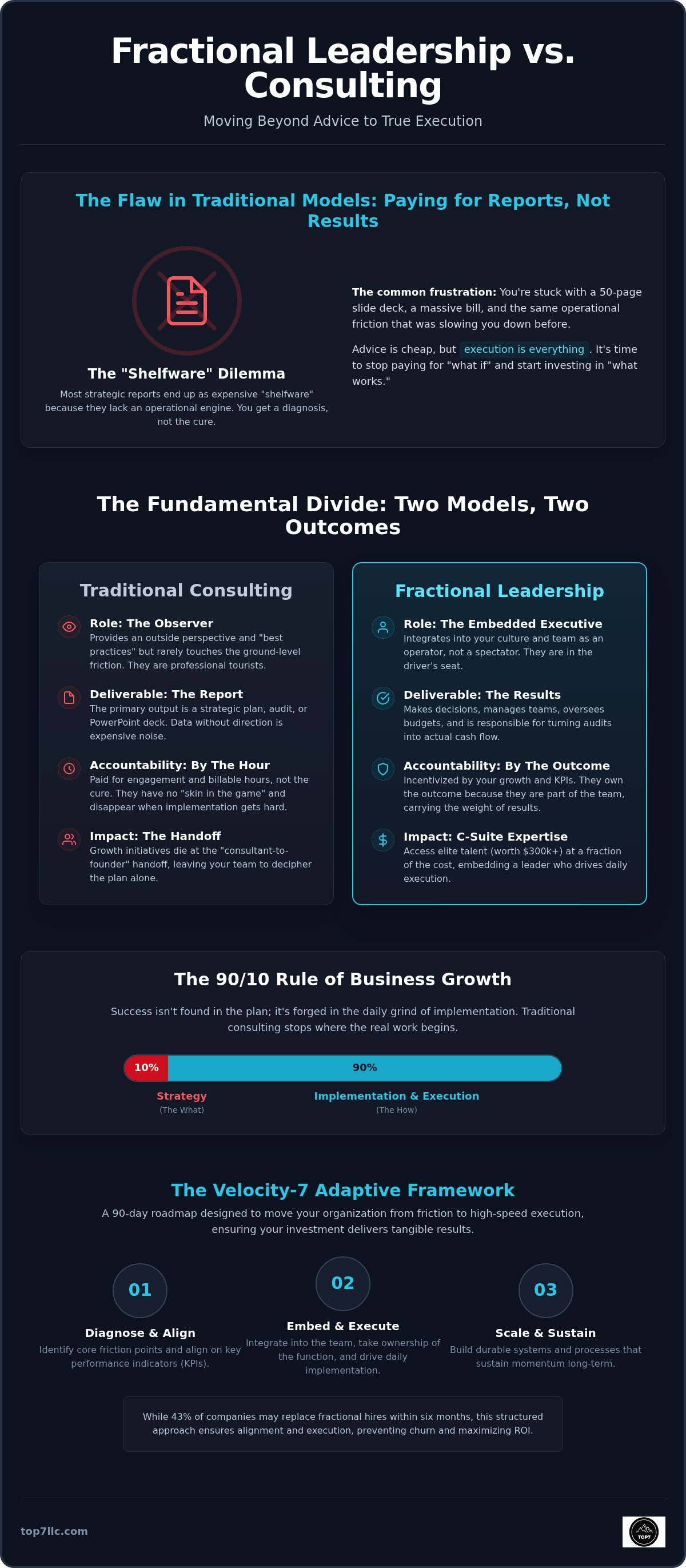
Traditional consulting is built on a dangerous myth: that insight equals impact. It doesn't. Most strategic reports end up as "shelfware" because they lack the operational engine to drive them. Consultants are paid for the diagnosis, not the cure. This is the core problem when weighing fractional leadership vs consulting. You're essentially hiring a mechanic who tells you your engine is smoking but refuses to pick up a wrench. You pay for the advice, but you own the failure when that advice doesn't translate to the bottom line.
To better understand the practical differences between these two models, watch this helpful breakdown:
The 'Observer' Effect in Business Consulting
Outside perspectives are often marketed as a "fresh set of eyes." In reality, they're often eyes that don't see the ground-level friction stalling your growth. Consultants offer "best practices" that ignore your culture and your team's specific bottlenecks. They provide a map but never touch the steering wheel. They disappear the moment implementation gets difficult, leaving you with a massive bill and a list of chores your team doesn't have time to finish. Unlike a Fractional executive, a consultant has no skin in the game. They don't own the outcome; they own the engagement. When the strategy fails, they blame the execution. When it succeeds, they take the credit. It's a low-risk model for them and a high-risk gamble for you.
Why Reports Don't Drive Revenue
When comparing fractional leadership vs consulting, the biggest differentiator is who carries the weight of the results. Data without direction is just expensive noise. You don't need more strategic audits. You need someone to manage the daily execution that turns audits into cash flow. The "Consultant-to-Founder" handoff is where most growth initiatives die a quiet death. You're left trying to decipher a 50-page deck while your team continues to trip over the same operational friction that existed before the consultant arrived. Traditional consulting models ignore the reality that strategy is only 10% of the battle. The other 90% is the grit of implementation. Hiring a consultant when you actually need a leader is a tactical error that costs more than just the consulting fee. It costs you time, market share, and the morale of a team that's tired of "new ideas" that never actually change the way work gets done.
What is Fractional Leadership? Beyond Part-Time Consulting
Fractional leadership isn't just "part-time consulting" with a fancier title. It's a fundamental shift in how mid-market companies access elite talent. While a consultant observes from the sidelines, a fractional leader is an embedded executive who owns a specific C-suite function. They don't just offer suggestions; they make decisions. They manage your team, oversee your budget, and carry the weight of your KPIs. When you look at fractional leadership vs consulting, the difference is ownership. A fractional leader is incentivized by your growth, not by how many billable hours they can squeeze out of a discovery phase.
This model allows you to tap into seasoned professionals who have already built and scaled companies. You get the expertise of a $300,000 plus executive at a fraction of the full-time overhead. Whether you need a Fractional CTO to fix a broken product roadmap or a Fractional COO to streamline operations, you're hiring an operator, not a spectator. This is about moving from friction to flow by putting a veteran in the driver's seat.
The Embedded Executive Model
Being "embedded" means being in the trenches. A fractional leader doesn't just send emails from a remote island; they integrate into your culture. They have direct authority to change processes, hire talent, and kill projects that aren't serving the bottom line. This isn't about making suggestions that your team might ignore. It's about influencing team behavior through active leadership. They identify the "hidden friction" that an outside consultant would miss because they're living in your operational reality every day.
The Fractional CTO: A Case Study in Execution
For tech-stalled companies, a Fractional CTO is a game-changer. Most founders struggle to bridge the gap between business goals and technical debt. They end up with tech that acts as a bottleneck rather than an asset. An embedded CTO takes command of both internal teams and external vendors. They stop the "developer sprawl" and focus resources on what actually drives revenue. By applying the Velocity-7 Adaptive Framework, they transform technology from a cost center into a competitive weapon. This is where the fractional leadership vs consulting debate ends. You don't need a report on your technical debt; you need someone to pay it down and scale the system.
Fractional Leadership vs. Consulting: The Comparison
The choice between fractional leadership vs consulting isn't a matter of semantics. It's a choice between buying a map and hiring a driver. Traditional consultants operate as external auditors. They arrive, interview your team, and produce a high-level strategy that often ignores the daily reality of your operations. Once the report is delivered, they move on to the next client. Fractional leaders do the opposite. They embed themselves within your organization, taking over a specific function like a Fractional COO or CFO. They don't just point at problems; they own the solution from start to finish.
Accountability is the primary differentiator. If a consultant's advice fails, they blame your team's execution. If a fractional leader's strategy fails, it's their own failure. They carry the weight of your KPIs and manage your resources as if they were full-time hires. This shift from vendor to partner changes the entire dynamic of the engagement. You stop managing a service provider and start collaborating with an executive peer who has real skin in the game.
Ownership of Outcomes
Consultants are obsessed with the "What." They'll tell you what is wrong with your sales funnel or why your tech stack is outdated. Fractional leaders are obsessed with the "How." They focus on the gritty details of implementation that turn a roadmap into a destination. This embedded approach allows them to spot operational icebergs long before you hit them. Because they're in your Slack channels and attending your leadership meetings, they see the friction that a monthly consulting check-in would miss. They don't just hand you a plan; they build the systems required to make that plan work.
Cost-Benefit Analysis of Execution
Many founders get sticker shock from elite consulting fees only to realize the "soft costs" are even higher. You spend dozens of hours onboarding consultants, explaining your business, and then managing their output. With fractional leadership vs consulting, the ROI is measured in velocity, not page counts. A $50,000 strategic report is a paperweight if your team is too over-leveraged to act on it. A six-month fractional engagement provides access to C-suite expertise that builds permanent internal capacity. You aren't just paying for a temporary fix. You're investing in sustainable growth and systems that outlast the leader's tenure. This is how you move from a cycle of "more advice" to a culture of measurable results.
Identifying Operational Friction: When to Pivot Your Model
Friction isn't just a minor annoyance; it's a silent profit killer. Most mid-market companies don't fail because they have a bad strategy. They fail because they lack the operational horsepower to execute the one they have. If your growth has stalled, the last thing you need is another consultant with a 50-page spreadsheet. In the fractional leadership vs consulting debate, the pivot point usually arrives when "more advice" starts feeling like a burden rather than a solution. You've reached the limit of your current team's bandwidth, and no amount of external observation will fix a broken engine.
You need to recognize when your leadership team is over-leveraged. When your C-suite is spending 80% of their time on tactical fire-fighting instead of strategic growth, you have a leadership gap. Choosing an operator over an advisor is the only way to move from operational friction to an efficient, measurable flow.
Symptoms of a Leadership Gap
How do you know if you're hitting the wall? Look at your project board. Stalled initiatives and missed deadlines are the first signs that your leadership is over-leveraged. You might be suffering from the "founder bottleneck," where every decision requires your personal sign-off because there's no one else with the authority to lead. This leads to executive burnout and, eventually, high turnover in your most critical departments. People don't leave because the work is hard; they leave because a lack of direction makes their daily effort feel meaningless.
The Velocity-7 Diagnosis
We use the Velocity-7 Adaptive Framework to strip away the noise and find the real bottlenecks. This isn't a generic audit. It's a surgical assessment of the seven dimensions that dictate your growth. Velocity is the speed of strategic execution. To increase it, you have to identify which C-suite function is currently acting as a brake on the system. Is it a tech stack that can't scale? Is it a sales process that lacks veteran leadership? Or is it an operational flow that's drowning in manual tasks?
Once the friction is identified, you don't need a report; you need an operator. Choosing fractional leadership vs consulting at this stage means opting for someone who will actually remove the obstacles. If you're tired of seeing the same problems on every quarterly review, it's time to stop diagnosing and start executing. You can implement the Velocity-7 Adaptive Framework today to move from operational friction to a high-speed, efficient flow.
The Velocity-7 Approach: How Top7 Drives Execution
Most business owners are exhausted by the cycle of hiring consultants who leave them with more work than they started with. Top7 breaks this cycle by replacing theoretical advice with the Velocity-7 Adaptive Framework. We don't just hand you a list of things to fix; we provide the executive leadership to actually fix them. This is the final answer to the fractional leadership vs consulting dilemma. You aren't paying for a perspective. You're paying for a partner who takes command of your operations to drive measurable ROI. Our executives focus on operational flow because status reports don't pay the bills.
Getting started doesn't require the months of onboarding or the massive overhead associated with traditional C-suite hires. We've stripped away the friction. We've removed the fluff. You get direct access to seasoned operators who know how to navigate the complexities of mid-market growth without the baggage of a $300,000 plus annual salary.
From Friction to Flow: The 90-Day Transformation
We operate on a tight, 90-day roadmap designed to move your company from a state of friction to a state of flow. In Phase 1, we conduct a rapid diagnostic to identify exactly where your growth is stalling. We don't spend weeks on discovery; we find the bottlenecks in days. Phase 2 involves embedding the fractional leader directly into your core team. They take on direct authority, managing your departments and streamlining your processes from the inside. This isn't a temporary advisory role. It is a full integration where the leader aligns your team's daily actions with the high-level strategy. By Phase 3, we're executing the Velocity-7 roadmap. This isn't about trying new ideas. It's about implementing proven systems that result in measurable growth and strategic superiority.
Why National Leaders Choose Top7
National leaders choose Top7 because they're tired of the noise. They need access to a bench of seasoned Fractional CTOs, COOs, and CFOs who can step in and lead immediately. Our no-nonsense approach means we cut through the professional jargon and focus on the raw business reality. We don't care about looking busy; we care about your profit maximization. We provide a disciplined, operative mindset that treats marketing and operations as a tough struggle for market share, where every decision is backed by data and every action is designed to win. If you're ready to stop the bleeding and start winning, it's time to change your leadership model.
Stop Buying Advice and Start Owning the Engine
You've seen the reality. Traditional consulting is a legacy model that prioritizes observation over operation. When you compare fractional leadership vs consulting, the winner is always the model that embeds accountability directly into your C-suite. You don't need another report gathering dust on a digital shelf. You need a veteran who can diagnose friction and execute the fix in real-time. Advice is a commodity; execution is a competitive advantage.
By leveraging our proprietary Velocity-7 Adaptive Framework, you gain access to seasoned C-suite professionals who focus on measurable mid-market growth results. It's the difference between hearing about a destination and actually arriving there. Stop letting operational bottlenecks dictate your ceiling. The market doesn't wait for strategic discovery phases to end; it rewards those who move with precision and speed. You have the vision. We have the operators to make it a reality. Ready to eliminate operational friction? Get a Top7 Fractional Executive.
Frequently Asked Questions
What is the difference between a consultant and a fractional executive?
The core difference in the fractional leadership vs consulting debate is the level of authority and accountability. A consultant operates as an external advisor who provides recommendations and reports. A fractional executive is an embedded member of your leadership team who owns a specific function. They don't just suggest changes; they have the power to manage budgets, lead staff, and execute the strategy they develop.
How many hours a week does a fractional leader typically work?
Fractional leadership is built on impact rather than a standard forty hour work week. Most engagements involve one to three days of dedicated focus per week depending on the complexity of your growth obstacles. We prioritize strategic velocity over billable hours. You're paying for the veteran expertise required to solve problems quickly, not for a warm body to occupy an office chair for eight hours a day.
Is fractional leadership cheaper than hiring a full-time executive?
Yes, it is significantly more efficient for your bottom line. A full-time C-suite executive in 2026 carries an all-in cost between $270,000 and $320,000 when you include benefits and taxes. Fractional leaders provide the same level of seasoned expertise through a monthly retainer. This allows mid-market companies to access elite leadership without the massive overhead, providing a much higher and more immediate ROI on leadership spend.
Can a fractional CTO manage my existing software development agency?
Absolutely. A Fractional CTO acts as your internal technical authority to hold external vendors accountable. Many founders struggle with project bloat because they can't vet the technical claims of their agencies. Your fractional leader manages these relationships, ensures the code meets your business goals, and prevents the accumulation of technical debt. They turn your technology from a confusing cost center into a scalable asset for the business.
How long does a typical fractional leadership engagement last?
Most engagements last between six and eighteen months. This isn't a quick fix; it is a sustained leadership commitment to move your company through a specific growth or transformation phase. The goal is to stabilize operations and build a scalable system. Some companies keep a fractional leader long-term to maintain lean operations, while others use the engagement to prepare the organization for a permanent, full-time executive hire.
What happens if our company outgrows the fractional model?
Outgrowing the model is a primary goal of the engagement. Your fractional leader builds the systems and processes that allow the business to scale. When your revenue and operational complexity justify a full-time hire, your fractional executive will lead the search for their permanent replacement. They vet candidates and handle the handoff, ensuring that the Velocity-7 framework and operational flow they established remain intact during the transition.
How does Top7's Velocity-7 framework differ from standard consulting?
Standard consulting often results in "shelfware" reports that are never implemented. The Velocity-7 Adaptive Framework is a disciplined, operative methodology focused on execution. We don't just identify friction; we embed a leader to remove it. Our framework moves you from audit to action within a 90-day roadmap. It is a kőkemény approach to business transformation where every step is measured by the speed of strategic execution and profit maximization.
Will a fractional leader have the authority to fire or hire staff?
Yes, a fractional leader is a real executive with the authority to manage your talent stack. They aren't passive observers. If your current team lacks the skills to achieve your growth targets, the fractional leader will manage the necessary hiring or firing. They take the founder out of the tactical bottleneck, making the difficult personnel decisions required to optimize your departments and restore efficient operational flow.


Comments