
Fractional Executive vs. Management Consultant: Stop Paying for Maps and Start Buying Results
- Robert Fitzgerald
- May 24
- 11 min read

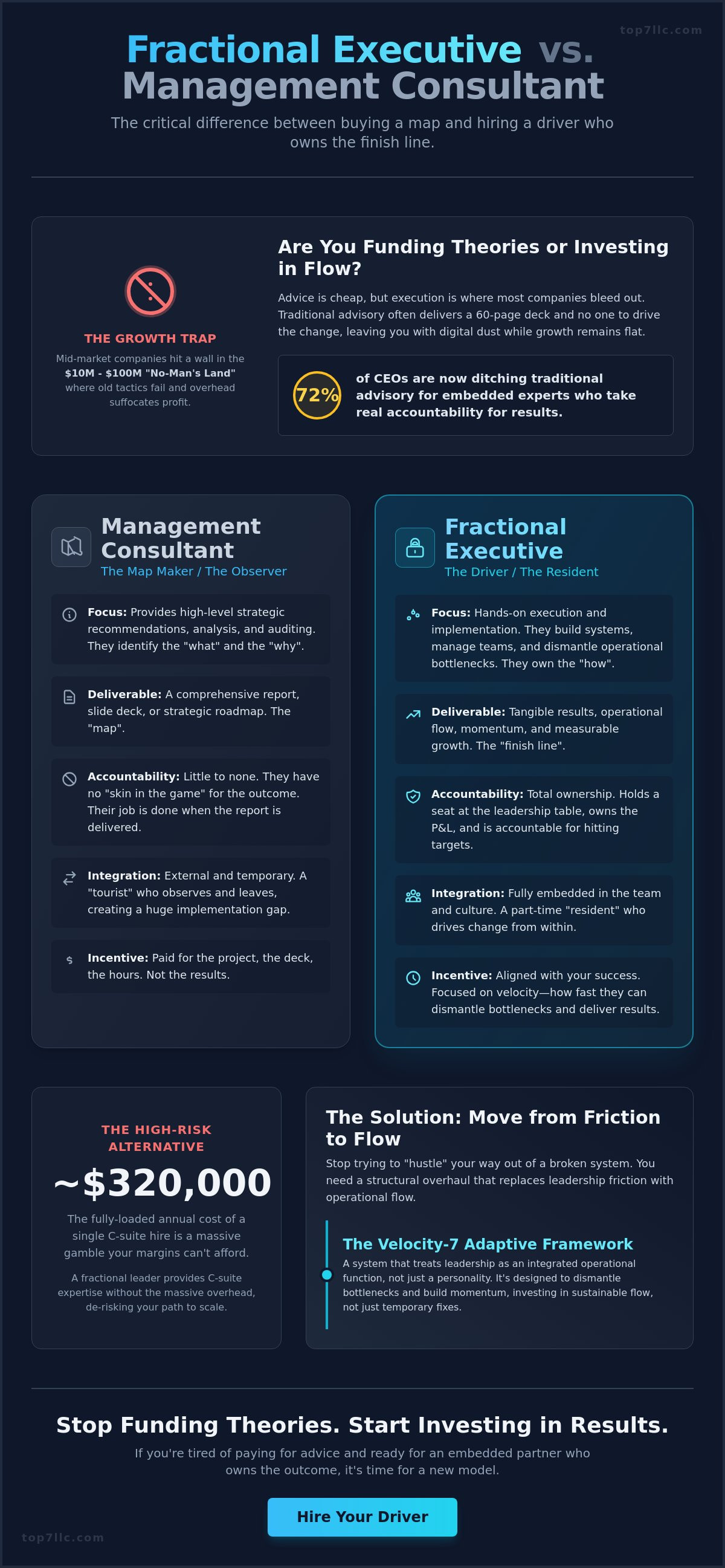
How much have you paid for strategic roadmaps that are currently gathering digital dust while your growth remains flat? It's a common trap for mid-market leaders who are burnt out from wearing too many hats. You think a consultant will solve the friction, but you usually end up with a 60-page deck and no one to actually drive the change. When comparing a fractional executive vs management consultant, the difference isn't just a title. It's the difference between buying a map and hiring a driver who owns the finish line.
You've likely realized that advice is cheap, but execution is where most companies bleed out. With the fully-loaded cost of a full-time C-suite hire now reaching up to $320,000, your margins can't afford a recruitment gamble. This article promises a clear framework for scaling without that massive overhead. We'll explore the Velocity-7 Adaptive Framework and why 72% of CEOs are ditching traditional advisory for embedded experts who take real accountability for results. It's time to stop funding theories and start investing in operational flow.
Key Takeaways
Stop trying to hustle through the $10M to $100M "No-Man's Land" and learn why your current leadership model is built to fail as you scale.
Discover the critical distinction between a fractional executive vs management consultant and why advice without accountability is a sunk cost for mid-market firms.
Replace the "hourly rate" trap with a focus on Velocity, measuring how fast an embedded leader can actually dismantle your operational bottlenecks.
Master a 5-step framework to identify if you have a strategy problem or an execution gap before you sign another high-overhead contract.
See how the Velocity-7 Adaptive Framework moves your organization from friction to flow by treating leadership as a system rather than a personality.
Table of Contents
The Mid-Market Growth Trap: Why Your Leadership Model is Failing in 2026
Most mid-market companies hit a invisible wall between $10 million and $100 million in revenue. It's the "No-Man's Land" where your old tactics stop working and your overhead starts suffocating your profit. You're stuck in a loop of hiring and hoping, but the needle isn't moving. When you weigh the choice of a fractional executive vs management consultant, you're really deciding between a partner who builds the engine or an advisor who just critiques the blueprint. If you're still trying to hustle your way through $50 million in revenue, you aren't a CEO; you're just a high-paid firefighter.
To better understand how these roles differ in the real world, watch this breakdown:
The fatal flaw for scaling firms is thinking a full-time C-suite hire is the only path to stability. Current data shows a fully-loaded executive in the US costs between $270,000 and $320,000 annually. That's a massive, high-risk bet on a single person who might not have the specific "scale-up" DNA you need for this exact phase. Stagnation isn't just a lack of growth. It's a monthly burn rate that produces zero momentum while your market share evaporates.
The Symptoms of Operational Friction
In hyper-competitive hubs like Austin or Boston, speed is your only real moat. If your decision-making is stalled by a "Founder's Ceiling," your competitors are already eating your lunch. You'll see the signs in mounting tech debt and sales silos that refuse to communicate. These aren't just departmental issues; they're leadership failures. You can't "hustle" your way out of a broken system. You need a structural overhaul that replaces friction with flow.
Why Traditional Consulting Fails the Mid-Market
Traditional firms sell you "observation." They spend six weeks learning your business just to tell you what you already know in a prettier format. To understand what management consulting is at its core, look at the incentives. They're paid for the deck, not the delivery. They have no skin in the game and no accountability for the outcome. You don't need another 60-page strategy document. You need an operator who implements a fractional executive vs management consultant model that prioritizes execution over theory. Stop paying for maps; it's time to start buying results.
Fractional Executive vs. Management Consultant: Advice vs. Accountability
When your company hits a wall, the standard reflex is to hire a consultant. You pay for their prestige and their perspective. But here is the brutal truth: a consultant is a tourist. They visit your office, take photos of your problems, and leave you a souvenir in the form of a slide deck. The fundamental difference in the fractional executive vs management consultant debate boils down to who stays in the room when the pressure mounts. One gives you a list of things to fix; the other picks up the tools and starts fixing them alongside your team.
Ownership is the metric that matters. A management consultant rarely has skin in the game. They don't own your P&L, they don't manage your headcount, and they certainly don't lose sleep over your EBITDA. In contrast, a fractional leader is a resident. They are embedded in your culture, holding a seat at your leadership table with the same accountability as a full-time hire. If you are tired of paying for observations, it might be time to look at fractional leadership services that prioritize execution over theory.
The Management Consultant: The Observer
Traditional consultants excel at the "what" and the "why." They are external auditors who provide high-level strategic recommendations based on market data and historical benchmarks. Their engagement is usually project-based with a clear expiration date. While their audits can be sharp, they often create a massive implementation gap. Once the final report is delivered and the invoice is paid, your internal team is left to figure out the "how" on their own. This often leads to "consultant fatigue," where staff feel judged but not supported.
The Fractional Executive: The Operator
A fractional executive doesn't just suggest a better sales process or a more efficient supply chain; they build it. They bring long-term organizational health into focus by mentoring your existing managers and making daily tactical decisions. Recent industry data shows that 85% of these leaders have worked independently for over a year, meaning they aren't "between jobs." They are professional operators who specialize in high-velocity transformation. They don't just hand over a roadmap. They drive the car, navigate the traffic, and ensure you actually reach the destination. Their success is measured by your growth, not by the number of billable hours they can extract from your budget.
Calculating the Real ROI: Beyond the Hourly Rate
Rookie CEOs obsess over hourly rates. This is a fatal distraction that keeps your business stagnant. When you are stuck in the fractional executive vs management consultant debate, looking at the price per hour is like comparing a surgeon to a first-aid instructor by the minute. One stops the bleeding and repairs the heart; the other just tells you how to apply a bandage. In the mid-market, you don't have the luxury of paying for time. You must pay for velocity.
The true metric of success is the speed at which you can dismantle a bottleneck. A management consultant might charge $300 to $500 per hour for senior expertise, but that meter runs while they "analyze" your problems. You are subsidizing their learning curve. Fractional executives typically operate on monthly retainers, often ranging between $8,000 and $22,000 depending on the role. This model aligns their cost with your long-term success rather than their own billable hours. It's a strategic investment in momentum, not a line-item expense for advice.
The Cost of Inaction
Doing nothing is the most expensive decision you can make. If your operational friction is causing a 10% revenue leak on a $20 million run rate, you are losing $2 million a year. A $15,000 monthly retainer for a Fractional COO isn't an expense; it is a high-yield recovery strategy. Beyond the immediate cash flow, fractional leadership preserves your most valuable asset: equity. Founders often give away 5% to 10% of their company to attract a full-time C-suite hire who might burn out in 18 months. Fractional leaders provide the same caliber of leadership without diluting your ownership.
Value-Based Outcomes
Stop buying hours and start buying milestones. The goal is to move from "hours billed" to "systems built." When you bring in a Fractional CTO or CFO, you are hiring a multiplier. They don't just do the work; they build the framework that allows your entire team to work faster. This is where the Velocity-7 Adaptive Framework becomes your competitive advantage. It replaces the "observation" phase of consulting with an agile-based transformation that focuses on immediate operational flow. By fixing the foundational ops, companies often see a radical shift in their ability to scale, turning a stagnant department into a high-performance engine in months, not years.
How to Decide: A 5-Step Framework for Strategic Hiring
Stop making hiring decisions based on gut feelings or expensive lunches. You need a cold, calculated framework to determine the right path for your company’s survival. Choosing between a fractional executive vs management consultant isn't a toss-up; it's a diagnostic choice based on your current operational maturity. If you're bleeding market share, you don't need a second opinion. You need a surgeon.
Step 1: Identify the Friction. Is your growth stalled because you don't know what to do, or because you can't get it done? Strategy problems belong to consultants. Execution problems belong to operators. If you have a 60-page deck but zero progress, your problem is execution.
Step 2: Assess the Timeline. Is this a 3-month sprint or a 12-month transformation? Consultants are built for the short term. If you need a deep-rooted cultural and operational shift, you need a Fractional COO or CFO who will stay until the job is finished.
Step 3: Evaluate the Team. Do you have mid-level managers who need a mentor, or a complete void at the top? Fractional leaders build people; consultants build reports. If your current staff is drowning, they need a leader, not an auditor.
Step 4: Analyze Local Market Dynamics. Geography still matters for execution. Leveraging talent networks in Chicago, Dallas, or Florida requires more than just a Zoom link. A Fractional CRO or CMO in these hubs brings a local Rolodex and market intelligence that a remote-only consultant simply cannot match. They understand the local competitive pulse.
Step 5: Determine the Level of Integration. Does this person need to "own" the department? If they aren't authorized to make spending decisions or sign off on budgets, they aren't an executive. You are paying for a spectator. Real growth requires a leader with the authority to pull the trigger.
When to Hire a Management Consultant
Consultants are the right choice for "One and Done" projects. Use them when you need a highly specialized audit, such as a complex tax restructuring or a specific legal compliance review. They are also useful for third-party validation when you need to present an unbiased, "outside" perspective to a skeptical board of directors. Their value lies in their distance, not their involvement.
When a Fractional Executive is Non-Negotiable
If you are scaling from 20 to 100 employees, your old operations will break. This is a non-negotiable scenario for fractional leadership. With 25% of U.S. businesses already utilizing fractional talent, the market has moved past traditional advisory. You need a "Growth Partner" who fills a critical C-suite gap, such as a Fractional CTO, to stabilize your tech stack while you scale. Apply for a strategic planning session to see which leadership role your current revenue stage requires.
Velocity-7: Why Top7 Redefines Fractional Leadership
Most discussions comparing a fractional executive vs management consultant end in a stalemate because both sides miss the point. You don't need a compromise. You need a system that translates high-level strategy into ground-level execution without the friction of traditional advisory. This is where the Velocity-7 Adaptive Framework changes the game. While consultants are busy polishing their next presentation, our leaders are already embedded in your operations, clearing the tech debt and sales silos that keep you from the $100M mark.
We've built our reputation in high-velocity hubs like Boston and Austin by refusing to play the role of the passive observer. We know that mid-market companies don't have years to wait for a "transformation" to take hold. Our approach is rooted in agile-based transformation. This means we prioritize immediate operational flow over theoretical perfection. We don't just provide a map; we build the infrastructure that makes the map irrelevant. The Top7 promise is simple: we don't just advise; we execute.
The Velocity-7 Difference
The Velocity-7 Adaptive Framework isn't just about sales or finance. It's a holistic look at the seven dimensions of growth that actually drive EBITDA. Whether we are deploying a Fractional CTO to overhaul a failing tech stack or a Fractional CFO to stabilize your financial strategy, the goal remains the same: measurable results. This framework was designed specifically for the US mid-market, where the stakes are high and the margin for error is razor-thin. We solve complex problems by becoming a part of the solution, not a line item on your expense report.
Ready to Stop Stalling?
Executive burnout happens when you try to be the CEO, COO, and CMO all at once. It’s a recipe for stagnation. You don't need a full-time executive who will take six months to onboard and another six to understand the culture. You need an operator who can plug your growth holes today. The transition from chaotic "hustle" to sustainable growth requires a leadership model built for speed and accountability. Stop paying for theories and start buying the velocity your company deserves.
Stop Funding Theories and Start Owning the Market
The $10M to $100M revenue gap is a graveyard for companies that prioritize advice over action. You've spent enough capital on slide decks that don't move the needle. By now, the winner of the fractional executive vs management consultant debate should be clear. You don't need a consultant to tell you your operations are leaking cash; you need a seasoned leader embedded in your team to plug the holes.
Our Velocity-7 Adaptive Framework was built specifically for US mid-market firms that are tired of the status quo. We don't offer generic audits or high-level observations. We provide battle-tested professionals who take direct ownership of your outcomes. It's time to stop paying for maps and start investing in the execution that actually drives EBITDA.
Stop the friction and start the flow. Book your Velocity-7 audit today.
Your growth is waiting on the other side of this decision. Let's get to work.
Frequently Asked Questions
What is the difference between a fractional executive and an interim manager?
An interim manager is a tactical placeholder, while a fractional executive is a long-term strategic partner. Interim roles usually last 3 to 9 months to bridge a gap during recruitment. Fractional leaders stay for years, focusing on scaling and sustainable growth. They don't just fill a seat; they build the department and own the long-term outcomes.
How many hours a week does a fractional executive typically work?
Most fractional leaders commit between 5 and 20 hours per week to a single client. This isn't about clock-watching; it's about high-impact output. You're paying for their decade of experience condensed into a few hours of precision execution. They focus on the activities that drive 80% of your results, ensuring every minute translates into measurable EBITDA growth.
Can a management consultant eventually become a fractional executive?
A management consultant can transition, but they must trade their slide decks for operational toolkits. The skill sets overlap, but the accountability is different. To succeed, they must stop being "tourists" and start owning the P&L. If they can't manage a team or make hard tactical decisions, they'll remain a consultant regardless of their new title.
Is fractional leadership only for tech startups?
Fractional leadership has moved far beyond the tech bubble into manufacturing, healthcare, and professional services. Any mid-market company facing operational friction needs this model. Whether you're comparing a fractional executive vs management consultant in a factory setting or a law firm, the need for embedded leadership remains the same. It's about scaling systems, not just writing code.
How do I measure the success of a fractional CTO or CFO?
Measure success through hard data and specific milestones, not just "feeling better" about your leadership. For a Fractional CFO, look at debt restructuring or improved cash flow margins. For a Fractional CTO, track the reduction of tech debt or the speed of product shipping cycles. If your operational velocity isn't increasing within the first 90 days, the engagement isn't working.
What happens to the fractional leader once we hire a full-time C-suite executive?
The fractional leader's final job is to make themselves obsolete by hiring and onboarding their full-time successor. They ensure a seamless handoff of the systems and frameworks they built. This prevents the new hire from spending six months figuring out where the files are. You get a fully functional department handed over to a permanent leader who can hit the ground running.
Does Top7 provide fractional services outside of the United States?
We focus exclusively on the US mid-market to ensure we understand the specific regulatory and economic pressures our clients face. We don't dilute our expertise by trying to be everything to everyone globally. By staying focused on American hubs like Dallas, Chicago, and Florida, we maintain the local networks and market intelligence required to drive real results for our partners.
How does the Velocity-7 framework apply to my specific industry?
The Velocity-7 Adaptive Framework is industry-agnostic because it targets universal operational bottlenecks. Whether you're in fintech or heavy manufacturing, the fractional executive vs management consultant choice remains relevant because every business needs flow. We adapt the seven dimensions of the framework to fit your specific market dynamics, replacing friction with a system designed for high-speed scaling.


Comments