

Fractional Executive Cost 2026: The Brutal Truth About C-Suite ROI
- Robert Fitzgerald
- May 8
- 12 min read

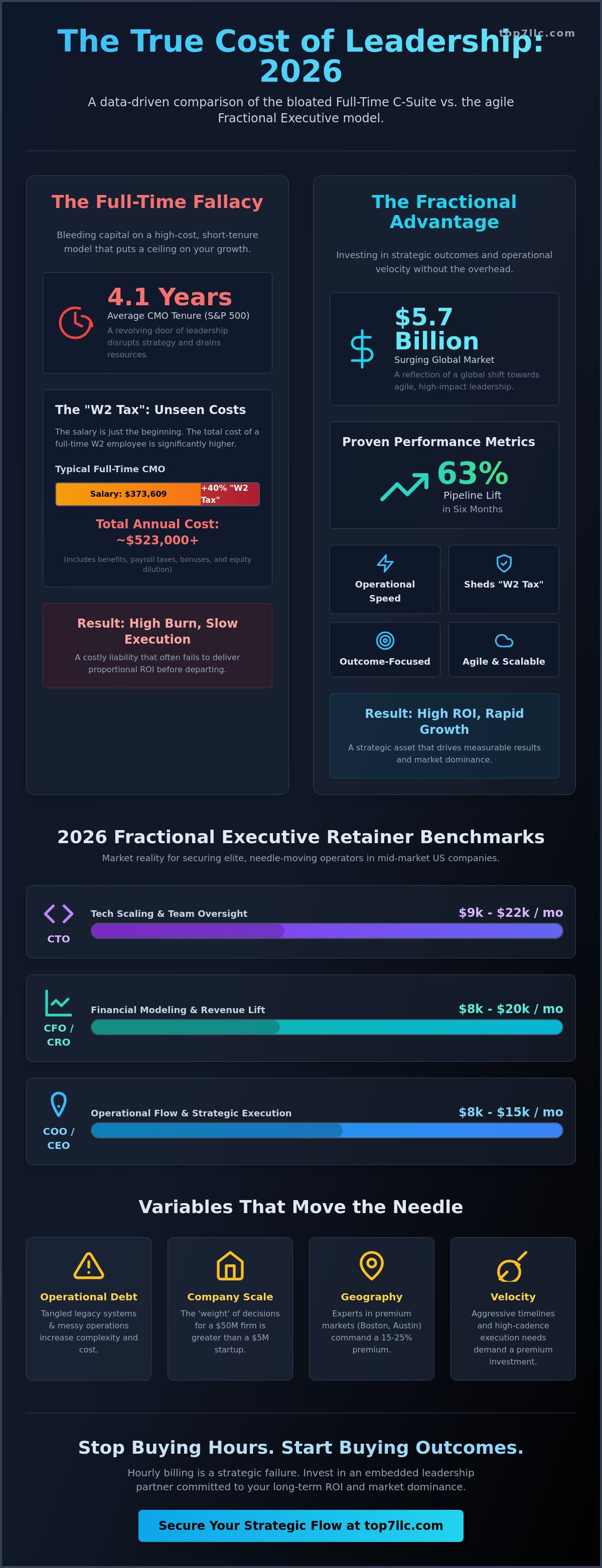
Hiring a full-time CMO for $373,609 a year isn't a strategic investment. It's a ransom payment for an executive who, according to 2025 S&P 500 data, will likely leave your company in just 4.1 years. You're bleeding capital on benefits and payroll taxes while your growth hits a hard ceiling. The real cost of a fractional executive 2026 isn't just a monthly retainer; it's the price of buying back your operational speed and shedding the "W2 Tax" that's killing your margins. While the global market for these elite operators has surged to $5.7 billion, most founders are still overpaying for seniority instead of buying outcomes.
You already know the traditional C-suite model is too slow and too expensive for the current market. This article delivers the brutal truth about 2026 rates, from the $8,000 monthly retainers for growth-stage CFOs to specialized CTOs commanding up to $22,000. I'll show you how to swap bloated salaries for agile leadership that has been proven to deliver a 63% pipeline lift in six months. We're going to dismantle the myths of full-time hiring and map out exactly how much you'll pay to secure the strategic flow your business deserves.
Key Takeaways
Get the hard numbers on 2026 monthly retainers for CMO, CFO, and CTO roles to stop overpaying for seniority.
Calculate the true cost of a fractional executive 2026 by factoring in the 40% "W2 Tax" and the high price of equity dilution.
Identify the specific operational variables, from tech stack complexity to team size, that actually drive leadership pricing.
Discover how the Velocity-7 Adaptive Framework transforms leadership from a overhead cost into a measurable execution engine.
Learn why hiring for strategic outcomes beats the "freelancer marketplace" model every time you need to scale.
Table of Contents
What Does a Fractional Executive Actually Cost in 2026?
Stop hunting for discounts in the C-suite. By May 2026, the pricing floor for elite leadership has shifted significantly due to a 14 percent annual market expansion. You aren't just paying for time. You're paying for the 15 to 25 years of scar tissue that allows an operator to fix your revenue leaks in weeks rather than months. If you’re still trying to benchmark against 2022 prices, you’re already losing the war for talent. The cost of a fractional executive 2026 reflects a world where 120,000 professionals have flooded the market, but only the top 5 percent can actually drive a 29 percent revenue growth surge.
Before you sign a contract, you must understand What Does a Fractional Executive Actually Cost in 2026? in the context of your specific growth stage. Cheap "fractional" talent is the most expensive mistake you'll ever make. A low-cost hire who lacks the stomach for hard decisions will burn through your runway while your competitors seize the market. High-performance leadership requires an investment that matches the scale of the problem you need solved. We aren't talking about freelancers; we're talking about precision-strike operators who enter your business to win.
To better understand this concept, watch this helpful video:
2026 Role-by-Role Pricing Benchmarks
The 2026 landscape for mid-market US companies has stabilized around specific monthly retainer brackets. These aren't suggestions. They are the market reality for securing operators who actually move the needle. While a cost of a fractional executive 2026 can vary based on complexity, these are the current benchmarks for growth-stage companies:
Fractional CTO: $9,000 to $22,000 per month for tech-heavy scaling and team oversight.
Fractional COO/CEO: $8,000 to $15,000 per month for driving operational flow and strategic execution.
Fractional CFO/CRO: $8,000 to $20,000 per month for aggressive financial modeling and revenue pipeline lifts.
The Retainer vs. Hourly Debate
Paying an executive by the hour is a fundamental strategic failure. It forces a leader to think like a contractor rather than an owner. Hourly billing incentivizes "clocked-in" execution instead of the "always-on" strategic thinking required to navigate a crisis. It’s a trap that leads to misaligned goals and stalled growth. Top7 structures engagements around retainers because we focus on outcomes, not activity logs. We don't sell hours. We sell the strategic flow and market dominance that only comes from a fully embedded leadership partner who is committed to your long-term ROI.
Variables That Move the Needle: Why Prices Vary
Pricing isn't a guessing game. It's a calculated reflection of the battlefield you're asking an operator to enter. If your tech stack is a tangled mess of legacy code or your operations are held together by spreadsheets and prayers, the cost of a fractional executive 2026 will reflect that risk. You aren't just paying for leadership; you're paying for the cleanup crew. High-caliber executives don't accept flat rates for varying levels of chaos. They price based on the "Operational Debt" they have to retire before they can even start driving growth.
Geography still plays a role, even in our remote-first reality. An expert based in Boston or Austin often commands a 15% to 25% premium over a Dallas-based operator due to local market benchmarks and cost-of-living overhead. However, the most aggressive driver of price is "Velocity." If you need a 63% pipeline lift within a tight six-month window, you need a high-cadence engagement. Speed is a premium commodity. It requires more cognitive load, faster execution cycles, and a level of intensity that casual consultants simply can't provide.
Company Size and Operational Debt
Scaling a $50M firm with 200 employees is a different beast than guiding a $5M startup through its first major pivot. The "weight" of the decisions increases with every headcount and every million in revenue. Operational friction acts as a hidden tax on your progress. If your previous leadership left you with significant structural debt, your fractional partner has to work twice as hard to clear the path. Assess your mess honestly before you ask for a quote. You can't expect a discount when you're handing over a house on fire.
Scope of Execution vs. Strategy
There's a massive gulf between pure advisory and embedded execution. Many "fractional" marketplaces sell you a glorified consultant who shows up for a one-hour Zoom call and leaves you with a to-do list. That’s not how we operate. The embedded model means the executive is in the trenches with your team, managing direct reports and owning the KPIs. This high-touch approach is more expensive than basic advisory, but it’s the only way to ensure the Velocity-7 Framework actually takes root in your organization.
Are you looking for a spectator or a participant? Pure strategy is cheap because talk is cheap. Execution is where the real cost of a fractional executive 2026 is justified. When an operator takes ownership of your CPO or CRO functions, they are building the systems that will outlast their tenure. Stop buying opinions and start investing in the infrastructure of your future growth. If you want a leader who actually leads, you pay for the results, not the advice.
Fractional vs. Full-Time: Calculating the "W2 Tax"
Hiring a full-time executive in 2026 isn't just an expense; it's a structural liability. Most founders look at the base salary and think they've calculated the damage. They're wrong. When you factor in the 30 to 40 percent "W2 Tax" which includes health insurance, 401k matching, payroll taxes, and executive perks, the actual price tag explodes. The true cost of a fractional executive 2026 is often 50 to 70 percent lower because you only pay for high-octane execution, not administrative bloat. You are buying an outcome, not a permanent seat at the table.
Then there is the equity trap. Handing over 1 to 2 percent of your company to a full-timer who, statistically, will leave in 4.1 years is financial suicide. You're diluting your cap table for a temporary solution. Beyond that, the $100,000 risk of a bad hire is real. Between recruitment fees, signing bonuses, and the inevitable severance package, a failed C-suite hire can cripple a mid-market firm. A fractional leader offers total agility. You can terminate the engagement in 30 days without the year-long legal battles or "golden parachute" payouts that haunt traditional W2 contracts.
The $400k Full-Time CTO Reality Check
Let's look at the raw numbers. A full-time CTO with a $250,000 base salary actually costs you over $400,000 once you add a $50,000 bonus and $40,000 in benefits. You're paying for a six-month ramp-up period where they're "learning the culture" while your tech stack rots. While a full-time hire spends their first 90 days in meetings, a fractional leader delivers more operational impact in their first 14 days than a traditional executive achieves in a full quarter. You don't have time to pay for someone else's learning curve.
Opportunity Cost: What is Stalled Growth Costing You?
Waiting six months to find the "perfect" full-time hire is a choice to stay stagnant. If your revenue is $10M and you're growing at 10 percent instead of the 29 percent average achieved by companies using fractional leadership, that delay is costing you millions in lost market share. Speed is a financial asset. The Velocity-7 Adaptive Framework treats time as a non-renewable resource that must be optimized, not spent on endless recruitment cycles. Every day you spend without a leader is a day your competitors are gaining ground. The cost of a fractional executive 2026 is negligible when compared to the price of standing still while the market moves on without you.
Beyond the Retainer: Measuring ROI via Velocity-7
Stop obsessing over the monthly invoice. If you’re only looking at the dollar amount on the retainer, you’re missing the point of high-performance leadership. The real cost of a fractional executive 2026 is actually a measurement of how much "friction" you’re willing to tolerate before you demand "flow." Friction is the hidden tax you pay every time a project stalls, a sales cycle drags, or your tech team builds something nobody wants. Flow is what happens when an elite operator plugs those leaks and turns your overhead into a conversion engine.
Take a Fractional CTO for instance. In a mid-market firm, a seasoned tech leader can often identify and halt $200,000 in wasted R&D spending within the first 90 days. That isn't just a cost saving. It's a massive injection of capital back into your growth initiatives. When you stop burning cash on vanity features and start building for market dominance, the retainer pays for itself five times over before the first quarter ends. You aren't buying a person; you're buying the removal of expensive mistakes.
The Seven Dimensions of Value
Most competitors give you a basic formula for impact. We use the Velocity-7 Adaptive Framework. This isn't a suggestion; it's a diagnostic tool that analyzes seven critical dimensions: Strategy, Finance, Sales, Tech, Ops, Product, and Project Management. By deploying a cross-functional fractional team, you don't just fix one department. You create a unified front. We recently took a $20M business that was drowning in operational chaos and, through this framework, cleared the path for a highly profitable exit within 18 months by aligning these seven pillars.
The 10x ROI Goal
We don’t take engagements where we can’t see a clear path to a 10x return. If we can't find the "Low-Hanging Friction" that pays for our retainer in Month 1, we aren't the right fit. In the 2026 market, Return on Leadership is defined as the net profit increase generated by removing strategic bottlenecks divided by the total cost of a fractional executive 2026. If that number isn't double digits, you're just buying another employee.
If you’re ready to move from friction to flow, you need to explore the Velocity-7 Framework and see how elite leadership scales profit, not just headcount. Stop paying for presence and start paying for performance. Our framework is designed to identify exactly where your business is bleeding money so we can stop the hemorrhage immediately. Results are the only metric that matters.
Stop Buying Hours, Start Buying Outcomes: The Top7 Advantage
If you treat leadership like a commodity, you deserve the stagnation that follows. Most founders spend months debating the cost of a fractional executive 2026 while their operational friction burns through $50,000 in monthly overhead. Top7 isn't a marketplace where you browse resumes like a menu. We are a strategic execution firm. We don't just provide a person. We provide a battle-tested system designed to win. You're either building a conversion engine or you're managing a funeral for your growth. There is no middle ground in this market.
Our difference is in the scar tissue. Most "fractional" services are just directories. They take a fee to match you with a resume and then disappear. We operate as a high-precision tactical unit. Our professionals have actually sat in the seat. They've navigated the same 2026 market pressures you're facing right now. You aren't just hiring one person. You're gaining direct access to a multi-disciplinary brain trust that communicates internally to ensure your tech, finance, and operations are perfectly aligned. We don't offer opinions. We offer precision execution.
The Top7 Difference
The embedded model is our secret weapon. Traditional consulting is hands-off. They give you a report and a bill. We give you results. We step into your organization, manage your direct reports, and optimize your vendor relationships. We use proprietary tools for agile-based transformation that most mid-market firms don't even know exist. This level of intensity is why companies utilizing our framework often see a 29 percent revenue growth surge. We aren't here to be liked. We're here to dominate your market and ensure your cost of a fractional executive 2026 translates into a massive competitive advantage.
Your 90-Day Transformation Roadmap
The process is clinical. We start with a deep audit of your current mess and then deploy the Velocity-7 Framework to identify exactly where your capital is being wasted. By Day 30, the strategy is locked. By Day 90, you aren't just seeing activity; you're feeling the flow. We earn our place every single month. There are no long-term lock-ins because we believe that if we aren't delivering a 10x ROI, we shouldn't be in your building. Stop buying hours from people who don't have skin in the game. Start buying the outcomes that will define your next decade of growth.
Execute with Precision or Get Left Behind
The days of bloated C-suite salaries and 4.1-year tenures are over. You've seen the data. Paying for a full-time executive in May 2026 is a choice to accept 40% in hidden "W2 Taxes" and massive equity dilution. You don't have time for a six-month ramp-up period while your competitors seize the field. The real cost of a fractional executive 2026 is an investment in raw speed and strategic dominance. By leveraging our zero-recruitment-fee model and the Velocity-7 Adaptive Framework, you bypass the hiring mess and start driving a 63% pipeline lift from Day 1. Whether you're scaling in Boston, Dallas, or across the West Coast, our brain trust is ready to embed and execute. Stop managing overhead and start commanding your market. It's time to trade your operational friction for strategic flow. You have a choice: stay buried in the administrative mess or join the elite firms buying outcomes instead of hours. Your path to market dominance starts with a single decision.
Calculate Your Potential ROI with a Top7 Executive
Frequently Asked Questions
Is a fractional executive cheaper than a full-time hire?
Yes, a fractional operator typically costs 50% to 70% less than a full-time executive once you strip away the 40% overhead of benefits, payroll taxes, and recruitment fees. You aren't paying for downtime or administrative bloat. The cost of a fractional executive 2026 is a surgical expenditure focused entirely on high-impact results rather than a permanent drain on your cap table through equity or long-term severance liabilities.
How many hours a week does a fractional executive work?
Most engagements cover 10 to 20 hours per week, often structured as two or three dedicated days. However, we don't sell hours; we sell strategic flow. A Top7 executive remains "always-on" for critical decisions, providing the same level of leadership as a full-timer while focusing exclusively on the 20% of activities that drive 80% of your growth. We prioritize execution over clock-watching.
Can a fractional executive manage my existing full-time team?
Absolutely, and they should. A true fractional leader isn't a consultant; they are an embedded operator who takes full ownership of your direct reports and vendor relationships. They implement accountability systems and drive the team toward measurable KPIs. If your leader isn't managing the team, they are just an advisor. Top7 executives lead from the front to ensure your existing talent performs at its peak.
What is the typical length of a fractional engagement in 2026?
Engagements typically span 6 to 18 months depending on the complexity of the transformation. Some partners stay for years as the company scales, while others exit once they've cleared the operational debt and hired a permanent successor. The cost of a fractional executive 2026 is predictable because we work month-to-month. We earn our place on your roster every 30 days through performance, not long-term contracts.
Do fractional executives receive equity or bonuses?
Retainers are the standard, but performance-based bonuses are common when specific revenue milestones are hit. Unlike full-time hires who demand 1% to 2% equity, fractional leaders rarely require dilution of your cap table. This saves you millions in future valuation. We focus on hard cash ROI, ensuring the engagement pays for itself through the 29% average revenue growth we typically see in optimized firms.
How do I know if my company is ready for a fractional CTO or COO?
You’re ready when your growth hits a ceiling because you're stuck in the weeds of daily operations. If you're a founder doing the work of three people, or if your tech team is missing 30% of their deadlines, you need an operator. Usually, this happens when revenue crosses the $5M mark. You need a leader to build the systems that allow you to step back and focus on the vision.
What happens if we need more time than the retainer covers?
Retainers are designed to be flexible. If a major pivot or a funding round requires a temporary surge in leadership, we scale the engagement up immediately. Because we use an agile-based model, we don't let a contract stop the momentum. We adjust the scope to match the speed of your business, ensuring that leadership capacity never becomes the bottleneck that stalls your 2026 growth targets.
How does Top7 ensure a fractional leader understands our unique culture?
We don't guess; we audit. Every engagement begins with a deep dive into your operational DNA using the Velocity-7 Framework. We identify the cultural friction points and strategic gaps within the first 14 days. Our leaders are seasoned veterans who have navigated dozens of corporate environments. They don't just "understand" your culture; they optimize it to support high-speed execution and a clear roadmap to market dominance.


Comments