

Fractional CTO Rates in Boston: Stop Overpaying for Tech Leadership in 2026
- Robert Fitzgerald
- Apr 15
- 12 min read

Paying a $350,000 base salary for a full-time CTO in a vibrant tech hub like Philadelphia isn't a badge of honor; it is a tactical error that drains your runway before you even reach a Series A. You already feel the burn of Philadelphia's competitive executive market driving executive demands to the breaking point while your product roadmap stalls. It is a brutal reality that 68% of Philadelphia startups struggle to find leaders who actually bridge the gap between complex Biotech engineering and aggressive business scaling. You are stuck in a talent war you cannot win with traditional hiring methods.
You don't need a permanent fixture in a corner office to dominate your niche. This guide reveals the hard data behind fractional cto rates boston companies are actually paying in 2026, providing Philadelphia businesses with crucial context to secure Tier 1 strategic leadership without the $300,000 salary trap. Top7 is providing a precision framework to evaluate technical performance and a roadmap to accelerate your time-to-market by 45%. Stop burning cash on overhead and start deploying the strategic firepower your growth demands.
Key Takeaways
Stop bleeding capital on bloated executive salaries and learn how to bypass the $300k Boston salary trap while maintaining Tier-1 leadership.
Get the raw data on fractional cto rates boston for 2026 to benchmark your tech spend against the city's highest-performing mid-market firms.
Shift your focus from hourly billing to the "Impact-to-Investment" ratio, where a single strategic pivot can fund your entire leadership budget for the year.
Stop wasting months on an exhaustive search for a full-time hire; learn to deploy high-velocity leadership that prioritizes business flow over a simple list of features.
Table of Contents The Boston Salary Trap: Why Full-Time CTOs are Killing Mid-Market Growth Fractional CTO Rates in Boston (2026): A Comprehensive Breakdown Beyond the Hourly Rate: Evaluating CTO Value vs. Cost Calculating ROI: The Financial Logic of Fractional Leadership Securing High-Velocity Leadership for Your Boston Business
The Boston Salary Trap: Why Full-Time CTOs are Killing Mid-Market Growth
You are bleeding capital. In the Seaport and Cambridge tech hubs, the race for talent has turned executive hiring into a financial suicide mission for mid-market companies. Hiring a full-time Chief Technology Officer in 2026 isn't just a big move, it's often a fatal overhead error. You need elite strategy, not a permanent $450,000 liability on your balance sheet. By adopting the Fractional executive leadership model, you bypass the bloat while securing the same level of architectural oversight found at Fortune 500 firms.
To better understand how this model shifts the power back to the business owner, watch this breakdown of the role:
The $300,000+ Reality of the Boston Tech Corridor
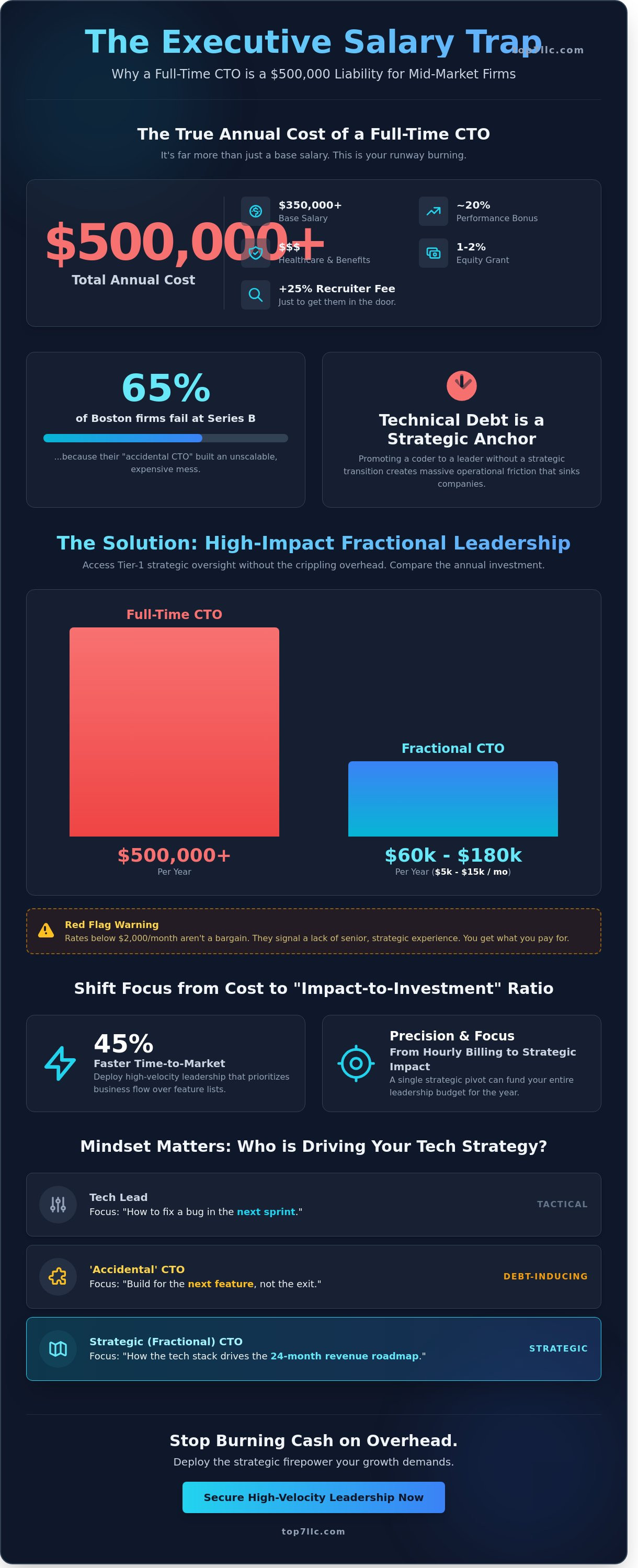
The numbers don't lie, but they do hurt. In 2026, base salaries for CTOs in the Route 128 belt start at $285,000 and quickly climb past $350,000 for anyone with a proven track record. When you factor in a 20% performance bonus, comprehensive New England healthcare premiums, and the standard 1% to 2% equity grant, your "hire" is costing you half a million dollars before they even write a single line of strategy. Don't forget the 25% executive search fee you paid to a recruiter just to get them in the door. The CTO Salary Gap in the New England market represents a $175,000 disconnect between the budget of a growing mid-market firm and the total compensation package required to lure top-tier talent away from established giants. This is why fractional cto rates boston are becoming the standard for companies that value agility over ego.
Why Technical Debt is an Operational Friction Problem
Stop pretending your best senior developer is a C-suite executive. This "Founder’s Dilemma" kills more Boston startups than lack of funding ever will. Builders love to build, but they rarely know how to scale a business. When you promote a "coder" to "leader" without a strategic transition, you get a codebase that works today but creates massive operational friction tomorrow. They build for the feature, not for the exit or the Series B expansion.
Tech Leads focus on how to fix a bug in the next sprint.
CTOs focus on how the technology stack drives the 24-month revenue roadmap.
Research shows that 65% of Boston-based tech firms fail at the Series B transition because their "accidental CTO" built an unscalable, expensive mess. This technical debt isn't just bad code; it's a strategic anchor. If you want to dominate the market, you need someone who understands fractional cto rates boston and can deliver a "marketing-kommandós" level of precision to your infrastructure without the full-time baggage.
Fractional CTO Rates in Boston (2026): A Comprehensive Breakdown
Stop hunting for a bargain if you want to win. In the Boston tech scene, you get exactly what you pay for. If you're searching for the lowest
fractional cto rates boston
, you're likely inviting a mid-level manager to play general with your company's future. High-level strategy isn't a commodity; it's a precision instrument. By 2026, the baseline for elite fractional leadership in the Hub has stabilized. You should expect monthly retainers to fall between $5,000 and $15,000. This isn't a random tax. It's the price of entry for a leader who has scaled companies, survived audits, and built "battle-tested" engineering cultures. If someone quotes you $2,000 a month for "strategic guidance," they aren't a CTO. They're a consultant with too much free time. Cheap rates are a glaring red flag for a lack of seniority. You don't want a "yes-man" who follows instructions; you want a veteran who tells you why your current roadmap is a suicide mission. Certain factors drive these rates into the premium tier. In 2026, AI specialization and Biotech expertise command the highest markups. A leader who understands the regulatory hurdles of Kendall Square or the computational demands of LLM integration isn't just an expense. They're a risk mitigation strategy. The latest State of the Technology Economy in Massachusetts highlights why the demand for local leadership remains at an all-time high despite the rise of global remote work. Local expertise translates to a 20% faster execution speed because they've already navigated the local talent wars.
Pricing Models: Retainers, Projects, and Equity
Most Boston firms operate on a monthly retainer. This ensures your CTO is "on-call" for critical board meetings or sudden scaling crises. Project-based fees work for specific missions like a 4-week technical audit or a 3-month digital transformation blueprint. These often range from $10,000 to $40,000 depending on complexity. Hybrid models are also gaining ground. You might offer a lower cash retainer in exchange for 0.5% to 1.5% advisory equity. This aligns their hunger with your exit strategy.
Local Benchmarks: Boston vs. Remote Fractional CTOs
A local Boston presence commands a 15-25% premium over remote-only options. Why? Because a leader with a local New England network can fill key engineering roles in weeks, not months. They know which local vendors are reliable and which ones are just burning your cash. Remote-only agencies often hide costs in "management fees" or provide junior talent masked by a senior's LinkedIn profile. If you're tired of guessing your tech's ROI, it's time to
.
Beyond the Hourly Rate: Evaluating CTO Value vs. Cost
Stop counting hours. It’s an amateur move. If you’re comparing fractional cto rates boston based on a clock, you’ve already lost the game. You don’t pay a C-suite leader to sit in a chair for forty hours a week. You pay them to prevent a $500,000 architectural blunder that would take your dev team six months to fix. The only metric that matters is the Impact-to-Investment ratio. One strategic pivot, like shifting to a scalable cloud infrastructure eighteen months before a Series B, pays for the entire year's engagement in a single afternoon. It's about the value of the decisions made, not the time spent making them.
Most founders hire for today’s fires. A elite fractional leader builds for the exit. In a 2025 analysis of tech startups, companies with high-level fractional guidance saw 15% higher valuations during due diligence because their codebases weren't liabilities. Don't let the "part-time" label fool you. Can a leader be truly embedded in your culture without a desk? Absolutely. They don’t need to attend your happy hours to dominate your technical roadmap. They need to be in the trenches when a deployment fails or when the board demands a 2027 growth forecast. Real leadership is measured by results, not physical presence.
Strategy vs. Execution: What Are You Paying For?
Stop viewing technology as a cost center. Your CTO is a revenue driver. They don’t just oversee code; they manage your external dev shops and agencies to stop the financial bleeding. We’ve seen Boston-based firms slash 22% off their monthly burn simply by having a fractional leader audit underperforming vendors. They bridge the gap between sales and engineering, ensuring your team isn't promising vaporware to investors. You're paying for a gatekeeper who ensures every dollar spent on tech actually moves the needle on your bottom line.
The Top7 Velocity-7 Framework for Tech Leadership
Friction is the enemy of profit. Most tech stacks are bogged down by legacy decisions and "good enough" solutions that kill momentum. Our approach moves your organization from operational friction to an efficient, high-speed flow. Top7 professionals don't just consult from the sidelines; they embed directly with your team to drive immediate, measurable results. You can learn more about our Velocity-7 Adaptive Framework to see how we turn stagnant tech into a conversion machine. This isn't about maintaining the status quo. It’s about market dominance. When you evaluate fractional cto rates boston, remember that you aren't buying a service. You’re buying a strategic advantage that your competitors are too slow to realize they need.
Calculating ROI: The Financial Logic of Fractional Leadership
Stop burning cash on executive vanity. Hiring a full-time CTO in a competitive market like Massachusetts is a $300,000 gamble that most scaling companies lose. When you analyze fractional cto rates boston businesses currently pay, the math reveals a brutal truth: you're likely overpaying for 40 hours of "presence" when you only need 10 hours of high-impact brilliance. Transitioning to a fractional model delivers an immediate 60-70% reduction in executive overhead. You eliminate the $250,000 base salary, the 20% performance bonus, and the massive equity grants that dilute your ownership.
The real killer isn't the salary; it's the opportunity cost. A standard executive search for a technical leader takes 180 days. During those six months, your product roadmap stalls, your lead developers drift, and your competitors seize the market. A fractional CTO integrates into your workflow within 72 hours. This speed allows for agile-based transformations that can accelerate product delivery by 40% in the first two quarters. You also gain a massive risk mitigation advantage. There are no severance liabilities or "golden parachutes" here. If the market shifts or you need to pivot, you scale the engagement down instantly. It's tactical flexibility for a volatile economy.
The 90-Day Transformation Roadmap
Expect a "search and destroy" mission in the first 30 days. Your fractional leader identifies technical debt, security vulnerabilities, and team bottlenecks. Success isn't measured by "good vibes" but by hard KPIs: Sprint Velocity, Mean Time to Recovery (MTTR), and Deployment Frequency. A comprehensive tech audit in the first quarter typically identifies redundant SaaS subscriptions and infrastructure waste that covers 100% of the fractional CTO's initial fee. This isn't just an expense; it's a self-funding strategic move.
Avoiding the "Agency Trap"
Development agencies are sales organizations disguised as technical partners. Their goal is to maximize billable hours, not to build your long-term asset. A fractional CTO acts as your internal advocate and "bullshit filter" against expensive dev shops. They ensure your technical leadership isn't just a sales front for a generic agency. By providing unbiased technology selection and rigorous vendor management, they prevent you from being locked into proprietary ecosystems that are impossible to leave. They build your team, not the agency's profit margin.
Don't let your technology stack become a liability. Audit your technical strategy with Top7 LLC and start operating like a market leader today.
Securing High-Velocity Leadership for Your Boston Business
Hiring a technical leader in a high-stakes hub like Boston isn't about filling a seat. It's about securing a competitive edge. Most founders get distracted by impressive resumes from MIT or Harvard but fail to ask the questions that actually impact the bottom line. If you want to win, you need more than a resume. You need a tactician who understands that fractional cto rates boston are an investment in speed, not just an overhead cost. Ask your candidates these three questions immediately:
"Show me a roadmap you built that increased EBITDA by 15% within 12 months."
"How do you handle technical debt without stalling new feature delivery for more than two weeks?"
"What is your specific 90-day plan to eliminate the bottlenecks currently stalling our release cycles?"
Top7 operates differently. We don't care about "Features" for the sake of features. Features are a commodity. We focus on "Flow." If your engineering team is busy but the product isn't moving, you have a flow problem. We eliminate the friction that causes 40% of development hours to be wasted on rework. We turn your tech stack into a conversion machine that dominates the market while your competitors are still arguing over sprint points.
Is Top7 Right for Your Organization?
We work with mid-market firms ready for aggressive growth. If you're satisfied with 5% year-over-year gains, we aren't for you. We don't just consult from a distance. We execute alongside your team. We identify the 20% of technical changes that will drive 80% of your revenue growth. Our Boston team starts every partnership with a strategic audit to find exactly where your profit is leaking.
Immediate Action Steps for Boston CEOs
Stop guessing why your technical delivery is lagging. Start measuring it. Your first step is to assess your current technical bottlenecks today. Are your deployments failing? Is your churn rate climbing because of bugs? Once you identify the pain, you need a solution that scales. We provide custom rate proposals based on your specific growth goals, ensuring the fractional cto rates boston you pay correlate directly to the value we deliver.
Stop the tech bleed. Move from a leadership gap to a strategic advantage. It's time to build a technical engine that outpaces the competition.
Primary CTA:Schedule your Tech Strategy Session with Top7
Stop Funding Overhead and Start Fueling Market Dominance
The Boston tech market doesn't reward hesitation or bloated payrolls. By 2026, data from Salary.com suggests the median CTO compensation in the Greater Boston area will climb past $315,000. That's a massive drain on mid-market capital that should be fueling your product development instead. You've seen the breakdown of fractional cto rates boston businesses face, and the logic is undeniable. Top7 LLC provides an embedded leadership model that cuts the fat and focuses entirely on execution. We use our proprietary Velocity-7 Adaptive Framework to drive efficiency that traditional full-time hires simply can't match. We aren't just advisors; we're your boots on the ground, solving technical debt and scaling infrastructure from within your own team. You get deep Boston market expertise without the soul-crushing payroll commitments. Take control of your margins and your roadmap right now. The market moves fast, and your leadership needs to move faster. Let's build something that lasts.
Get C-Suite Results without the Payroll - Talk to a Top7 Executive
Frequently Asked Questions
What is the average monthly retainer for a fractional CTO in Boston?
In Boston, the average monthly retainer for a fractional CTO ranges from $5,000 to $15,000 depending on the project scope. You're paying for strategic dominance, not for someone to occupy a chair for 40 hours. Most tech startups in the 617 area code use these retainers to access elite talent without the $300,000 annual salary burden. Fractional cto rates boston reflect the high demand in this tier-one tech hub.
How many hours a week does a fractional CTO typically work?
A fractional CTO typically works between 5 and 15 hours per week for your company. This isn't about clocking in; it's about surgical strikes on your technical debt and architecture. They focus on the 20% of decisions that drive 80% of your results. If you need someone for 40 hours, you don't need a CTO; you need a senior developer. Efficiency beats presence every single time.
Is a fractional CTO better than a full-time VP of Engineering?
A fractional CTO is superior when your primary bottleneck is strategy rather than daily personnel management. VPs focus on team velocity and HR issues. A CTO builds your competitive advantage and technical moat. Don't hire a full-time manager to do a strategist's job. It's a waste of capital that should go toward your growth engine. You need a leader, not a babysitter.
Can a fractional CTO help with Series A or Series B fundraising?
Fractional CTOs are essential for Series A and Series B fundraising because they lead the technical due diligence process. They prepare your documentation and defend your architecture to skeptical investors. Data from 2023 shows that startups with experienced fractional leaders secure funding 20% faster than those without. They ensure your tech stack isn't a liability during the high-stakes pitch. They turn your code into an asset.
How does a fractional CTO manage my existing development team?
Your fractional CTO manages your development team by implementing high-performance KPIs and rigorous code standards. They don't micro-manage daily tickets. Instead, they align the team's output with your business's profit goals. They turn a chaotic group of coders into a precision-engineered delivery machine. If your team isn't hitting milestones, the CTO identifies the friction and removes it immediately. Results are the only metric that matters.
What industries in Boston benefit most from fractional tech leadership?
Biotech, Fintech, and SaaS sectors in Boston benefit most from fractional tech leadership due to their high regulatory and scaling demands. With Boston seeing over $13 billion in venture capital investment in 2023, the competition is lethal. These industries require deep expertise in security and compliance that a standard developer simply doesn't possess. You need a veteran who knows the local ecosystem and the stakes of your market.
What happens if my company outgrows a fractional CTO?
When your company outgrows a fractional CTO, they manage their own replacement by hiring a permanent, full-time successor. This transition usually happens once you hit 50 employees or $20 million in annual revenue. The fractional leader ensures no knowledge is lost during the handoff. They leave you with a stable, scalable system that's ready for the next phase of market domination. It's an exit strategy for your technical debt.
How do Top7 fractional CTO rates compare to traditional consulting firms?
Top7 fractional CTO rates are structured around measurable ROI rather than the billable-hour bloat seen at traditional consulting firms. Traditional firms often add 30% to their fees to cover their own internal overhead and junior staff training. We don't do that. You get direct access to battle-hardened experts who focus on profit maximization. Compare our fractional cto rates boston to the big-box agencies and you'll see the efficiency gap clearly.


Comments