
Fractional CEO for Mid-Market Companies: Scaling Without the Executive Bloat

A $400,000 salary won't fix a broken strategy; it just makes the failure more expensive. Most mid-market leaders believe the only way to shatter a revenue plateau is to chain themselves to a full-time, heavy-hitting executive. They're wrong. Adding permanent weight to your payroll usually results in more bureaucracy and less actual movement. If your growth has stalled and your leadership team is pulling in different directions, you don't have a talent problem; you have an executive bloat problem.
You know that operational friction is quietly killing your margins while your competitors sharpen their edge. It's time to stop gambling on high-stakes recruitment and start demanding measurable execution. This guide explains how a fractional ceo for mid-market companies delivers elite strategic leadership at a fraction of the traditional cost. We'll show you how to use the Velocity-7 Adaptive Framework to eliminate bottlenecks. We also explore how supporting roles like a Fractional CTO or COO can further streamline your path to market dominance by turning strategic intent into surgical execution.
Table of Contents
The Mid-Market Growth Trap: Why Your C-Suite is Leaking Profit
Mid-market companies often find themselves in a dangerous operational purgatory. You've scaled past the initial hustle, yet you haven't reached the scale where a $1M+ C-suite makes financial sense. This is the Mid-Market Growth Trap. It's the point where the founder's intuition is no longer enough to drive the machine, but the cost of "elite" full-time leadership would cannibalize your remaining margins. You're stuck between a ceiling you can't break and a floor that's getting more expensive to maintain.
The real culprit isn't a lack of effort; it's operational friction. Friction is the silent killer of mid-market profitability. It's the invisible drag created by inefficient processes, misaligned teams, and strategic "debt" that accumulates when you prioritize survival over systems. Traditional business strategy fails here because it focuses on the "what" instead of the "how." At this stage, your goal must shift from managing people to architecting systems. This transition is why a fractional ceo for mid-market companies has become a tactical necessity for those targeting $50M+ revenue milestones.
Implementing a Fractional CEO Architecture allows you to inject high-level strategic execution directly into your workflow without the weight of permanent executive bloat. It's about surgical intervention rather than administrative overhead.
Symptoms of a Stalled Mid-Market Organization
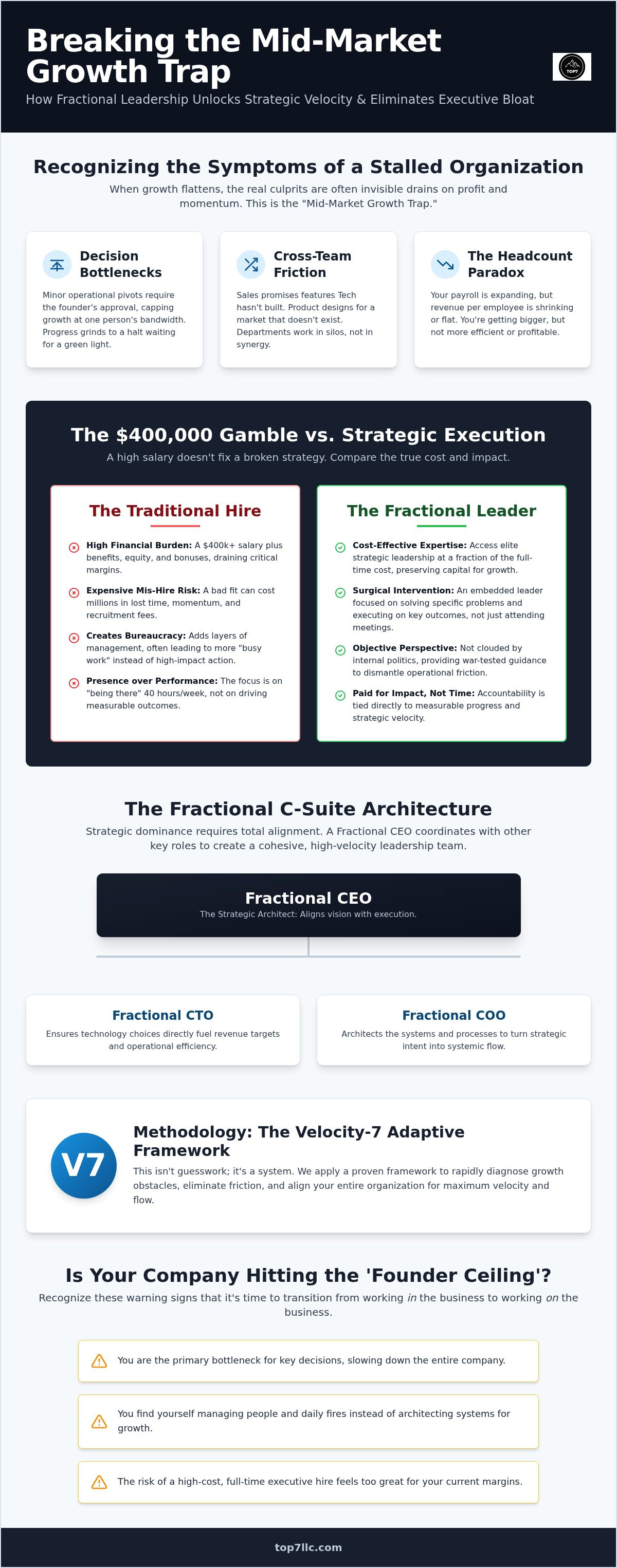
Decision-making bottlenecks: If every minor operational pivot requires the founder's green light, your growth is capped by a single person's bandwidth.
Cross-departmental friction: Sales is selling features that Tech hasn't built, and Product is designing solutions that the market doesn't want.
The Headcount Paradox: Your payroll is expanding, but your revenue per employee is shrinking or plateauting. You're getting bigger, but not better.
The Myth of the 'Full-Time' Requirement
The industrial-age belief that a CEO must be present for 40 hours a week to provide value is a lie. Presence doesn't equal strategic velocity. In fact, full-time hires in lean mid-market teams often lead to executive burnout or the creation of unnecessary "busy work" just to justify a massive salary. Strategic value happens in high-impact bursts of clarity and execution. A fractional leader brings an objective, war-tested perspective that isn't clouded by internal politics or the fear of losing a permanent paycheck. They aren't there to "be" a CEO; they're there to drive the company toward a specific, measurable outcome.
The Fractional CEO Architecture: Strategic Guidance Meets Agile Execution
Most mid-market leaders mistake a fractional CEO for a glorified consultant. That’s a mistake that costs time and capital. A consultant sells you a map; a fractional CEO takes the wheel. This role isn't about giving advice from the sidelines. It's about becoming an embedded strategist who bridges the massive disconnect between your financial goals and your technical execution.
In a typical mid-market firm, the CFO cares about margins while the tech team cares about code. A fractional ceo for mid-market companies acts as the architect who aligns these disparate forces. They integrate with your existing team to dismantle the silos that create operational friction. By focusing on strategic execution, they ensure that every dollar spent on technology or operations directly fuels your revenue targets.
Embedded Leadership vs. Traditional Consulting
The difference is accountability. Consultants are paid for their time; fractional CEOs are paid for their impact. When you bring in Top7 leadership, you aren't hiring a temp. You're hiring an executive who solves problems from the inside out. This form of Interim Leadership provides the stability your team needs during high-stakes transitions or rapid transformation. They don't just point at the fire. They build the fire-suppression system.
The Multi-Disciplinary C-Suite Advantage
Strategic dominance doesn't happen in a vacuum. A Fractional CEO is most effective when they coordinate with a Fractional CTO and a Fractional COO. This creates a cohesive "Fractional C-Suite" that delivers total alignment across the organization. This architecture focuses on three core pillars:
Strategic Velocity: Rapid decision-making without the weight of a full-time executive payroll.
Systemic Flow: Moving the organization from friction-heavy manual processes to automated, efficient execution.
Scalable Architecture: Building the systems today that will support your $100M revenue goals tomorrow.
This isn't just about saving money on salaries. It’s about gaining access to a caliber of talent that would otherwise be out of reach for a company your size. When your leadership team operates with this level of synergy, you stop fighting fires and start scaling the business. You move from a state of constant reaction to a state of disciplined, profitable growth.
Fractional CEO vs. Full-Time Hire: The True ROI for 2026
Hiring a full-time CEO is often an ego play, not a profit play. Mid-market founders frequently fall for the "savior" narrative; they believe a $300,000 salary will buy them a permanent solution to their scaling problems. In reality, you're buying a massive, inflexible liability. The Total Cost of Ownership (TCO) for a full-time executive in 2026 isn't just the base salary. When you factor in payroll taxes, 401k matching, premium health insurance, performance bonuses, and a 20% equity carve-out, that "expensive" hire just became a million-dollar gamble. If they fail, the severance and recruitment fees alone could cripple your quarterly margins.
A fractional ceo for mid-market companies flips this script. Instead of waiting six months for a headhunter to find a candidate who might fit your culture, you gain elite strategic execution in under 30 days. Speed to value is the only metric that matters when your revenue is plateauing. While a traditional hire spends their first 90 days "learning the ropes," a fractional leader is already dismantling bottlenecks and architecting systems for growth. This flexibility allows you to scale your leadership intensity up or down based on the actual needs of the business, not a rigid employment contract.
The Financial Breakdown: Salary vs. Retainer
The math is cold and undeniable. A top-tier full-time CEO commands a total compensation package that often exceeds $400,000 in the mid-market sector. A fractional retainer typically costs 50% to 75% less while delivering the same level of seniority. Ask yourself: what could your company achieve by reinvesting that $250,000 of saved overhead into your product or sales engine? You aren't losing 40 hours of "presence"; you're gaining 100% of the strategic results without the administrative bloat. Project-based fees are predictable; open-ended executive salaries are a drain on your agility.
Risk Mitigation in Executive Leadership
Industry data suggests a staggering failure rate for new full-time CEOs within their first 18 months. For a mid-market firm, a "bad hire" at the C-suite level is a catastrophic event that destroys team morale and wastes years of progress. Fractional leadership serves as a high-stakes "try-before-you-buy" strategy. It allows you to vet the individual's impact on your bottom line before committing to a permanent role. You maintain operational stability and strategic momentum without the long-term contractual liability that makes traditional hiring so dangerous in a volatile market. If the fit isn't right, you pivot in 30 days, not 12 months.
Eliminating Friction: The Velocity-7 Adaptive Framework in Action
Most mid-market companies are flying blind. You have dashboards full of data, yet your growth remains stagnant. This happens because your strategy lacks a repeatable, battle-tested execution engine. The Velocity-7 Adaptive Framework is our proprietary answer to this stagnation. It’s designed to transition your organization from "operational friction"—where every task feels like a struggle—to "efficient flow," where growth becomes a predictable outcome of your systems.
A fractional ceo for mid-market companies doesn't just attend board meetings. They use the Velocity-7 framework to audit seven critical dimensions of your business. This includes everything from cross-departmental alignment to the scalability of your technical infrastructure. By identifying where you are leaking revenue, we replace guesswork with surgical execution. Advanced project management is the secret weapon here; it’s the difference between a vision that stays on a whiteboard and a strategy that hits the bottom line.
Phase 1: The Organizational Audit and Friction Diagnosis
The first step is a brutal assessment of reality. We identify growth obstacles that are often invisible to your internal team because they've become part of the "corporate furniture." By benchmarking your current performance against the Velocity-7 framework, we pinpoint the exact friction points stalling your momentum. Within the first month, we establish a 90-day roadmap focused on high-impact operational wins. This isn't about long-term theory; it’s about immediate, measurable progress.
Phase 2: Agile Transformation and Strategic Execution
Agile isn't just for software developers anymore. We apply these principles to your Sales, Finance, and Operations departments to ensure total strategic synchronization. A major part of this phase is breaking down the silos that prevent your C-suite from functioning as a unit. Your fractional ceo for mid-market companies ensures that the CTO’s technical roadmap and the CFO’s financial targets are speaking the same language. We establish a relentless cadence of accountability where outcomes are measured in weeks, not years.
If you're tired of stalled revenue and want to see how the Velocity-7 Adaptive Framework can fix your operational leaks, it’s time to stop waiting for a miracle and start building a system.
Is Your Mid-Market Company Ready for a Fractional CEO?
Admit it. You're exhausted. You've spent years building this machine; now it’s starting to grind your gears. The "Founder Ceiling" is a real, measurable limit on your scale. If every decision still flows through your desk, you aren't an owner anymore; you're a high-priced bottleneck. Hiring a fractional ceo for mid-market companies is the only way to break this cycle without surrendering control or bankrupting your payroll with a bloated full-time executive contract.
Doing nothing has a price. Every month you delay is a month of leaking revenue and missed market opportunities. You need to transition from working in the business to working on the business. This requires a systems architect who can look at your operations with cold, clinical objectivity. It's about moving from a state of constant reaction to a state of disciplined, strategic execution.
The 5 Red Flags of Executive Stagnation
The Headcount Paradox: Your payroll is expanding, but your revenue per employee is shrinking. You're getting bigger, but not more profitable.
Strategic Paralysis: Initiatives that sound great in board meetings never actually make it to the execution phase.
Permanent Firefighting: You spend 90% of your day solving immediate crises instead of architecting future growth.
Departmental Silos: Your Sales, Tech, and Finance teams are operating as three separate companies with three different sets of goals.
Founder Burnout: You've lost the ability to think strategically because you're too busy managing the minutiae of daily operations.
Taking the First Step Toward Velocity
Preparation is simple. Stop looking for a manager and start looking for a catalyst. When you engage with Top7, the first 30 days are focused on radical transparency. We perform a deep-tissue audit of your leadership structure and operational flow using the Velocity-7 Adaptive Framework. We don't care about your intentions; we care about your results. We align your board and your leadership team around a single, aggressive roadmap that prioritizes flow over friction.
You've outgrown your current structure. That's a sign of success, but failing to adapt is a choice for failure. Top7 provides the seasoned leadership required to move your organization from stalled growth to market dominance. Stop letting operational friction kill your margins. It's time to demand more from your C-suite.
Audit your growth potential with a Top7 Fractional CEO
Shatter the Growth Ceiling and Reclaim Your Margins
Traditional leadership models are failing mid-market companies because they prioritize presence over performance. You've seen the reality; full-time executive bloat drains your capital and kills your strategic velocity. By utilizing a fractional ceo for mid-market companies, you bypass the high failure rate of traditional hires and gain immediate access to elite execution. We've shown you how the proprietary Velocity-7 Adaptive Framework moves your organization from operational friction to a state of efficient flow.
Top7 delivers national expertise in mid-market growth transformation with zero overhead. We don't offer generic advice; we deliver high-impact C-suite execution that scales with your needs. Are you ready to stop fighting fires and start architecting a $100M revenue engine? The difference between stagnation and dominance is the system you choose to run. Stop letting operational drag dictate your future.
Stop the friction. Schedule your Velocity-7 Strategy Call with Top7.
It’s time to stop settling for a leaking C-suite and start demanding the growth your company deserves.
Frequently Asked Questions
What is the difference between a Fractional CEO and a business consultant?
A business consultant provides a report and leaves; a fractional CEO stays to execute the plan. They take full accountability for the results and lead your team from within. While consultants offer advice, a fractional ceo for mid-market companies acts as an embedded strategist who bridges the gap between your high-level financial strategy and technical leadership. They don't just point at problems; they build the systems that solve them.
How many hours a week does a Fractional CEO typically work for a mid-market company?
Most fractional engagements for mid-market companies involve a commitment of 10 to 15 hours per week. However, focusing on hours is a vanity metric that misses the point of strategic velocity. You aren't paying for presence; you're paying for surgical execution and the elimination of operational friction. A Top7 executive delivers more impact in ten focused hours than a bloated full-time hire achieves in a standard forty-hour week.
Can a Fractional CEO handle a crisis or major company transition?
Yes, handling high-stakes crises and executive transitions is a core function of our Interim Leadership service. Whether you've lost a key founder or are facing a rapid market shift, a fractional leader provides immediate operational stability. They step into the vacuum to maintain momentum and implement the Velocity-7 Adaptive Framework. This ensures that your organization continues to scale while you navigate a complex transformation or search for a permanent solution.
How does a Fractional CEO integrate with our existing executive team?
A fractional CEO integrates as a strategic architect who aligns your existing leadership team. They don't replace your current talent; they optimize it. By coordinating with your Fractional CTO and CFO, they ensure that every department is speaking the same language and pulling toward the same revenue targets. This multi-disciplinary approach breaks down silos and replaces departmental friction with a unified cadence of accountability and measurable outcomes.
What is the typical duration of a fractional leadership engagement?
Engagement durations vary based on your specific growth obstacles, but most mid-market partnerships last between six and eighteen months. Some companies utilize fractional leadership as a bridge during rapid transformation, while others maintain a long-term retainer to keep their overhead lean. Because the model is flexible, you can scale the intensity of the engagement up or down as your project needs evolve without the liability of a permanent contract.
Is a Fractional CEO appropriate for a company with $50M+ in revenue?
Absolutely. Companies with $50M+ in revenue are often the primary targets for a fractional ceo for mid-market companies because they face the most complex operational friction. At this scale, the "Founder Ceiling" becomes a critical bottleneck. You need sophisticated systems and agile-based transformation to reach the next milestone. We provide the elite strategic guidance required for large-scale operations without the million-dollar price tag of a traditional full-time C-suite hire.
How do we measure the success and ROI of a fractional leader?
Success is measured through cold, hard data and the reduction of operational friction. We track specific KPIs such as revenue growth per employee, strategic velocity, and the successful completion of 90-day roadmaps. The ROI is often realized within the first year through the elimination of expensive hiring mistakes and the optimization of your existing systems. We focus on moving your organization from friction to flow, which is reflected in your bottom-line profitability.
Does a Fractional CEO participate in board meetings and long-term planning?
Yes, they are fully embedded executives who lead board meetings and spearhead long-term strategic planning. A fractional leader isn't an outsider; they are a core member of your leadership team. They provide the objective, high-stakes perspective needed to architect the systems that will support your future growth. By holding accountability for strategic execution, they ensure that the vision discussed in the boardroom actually becomes a reality on the ground.


Comments