

Business Process Optimization: Stop Mapping Workflows and Start Driving Revenue in 2026
- Robert Fitzgerald
- Apr 4
- 12 min read

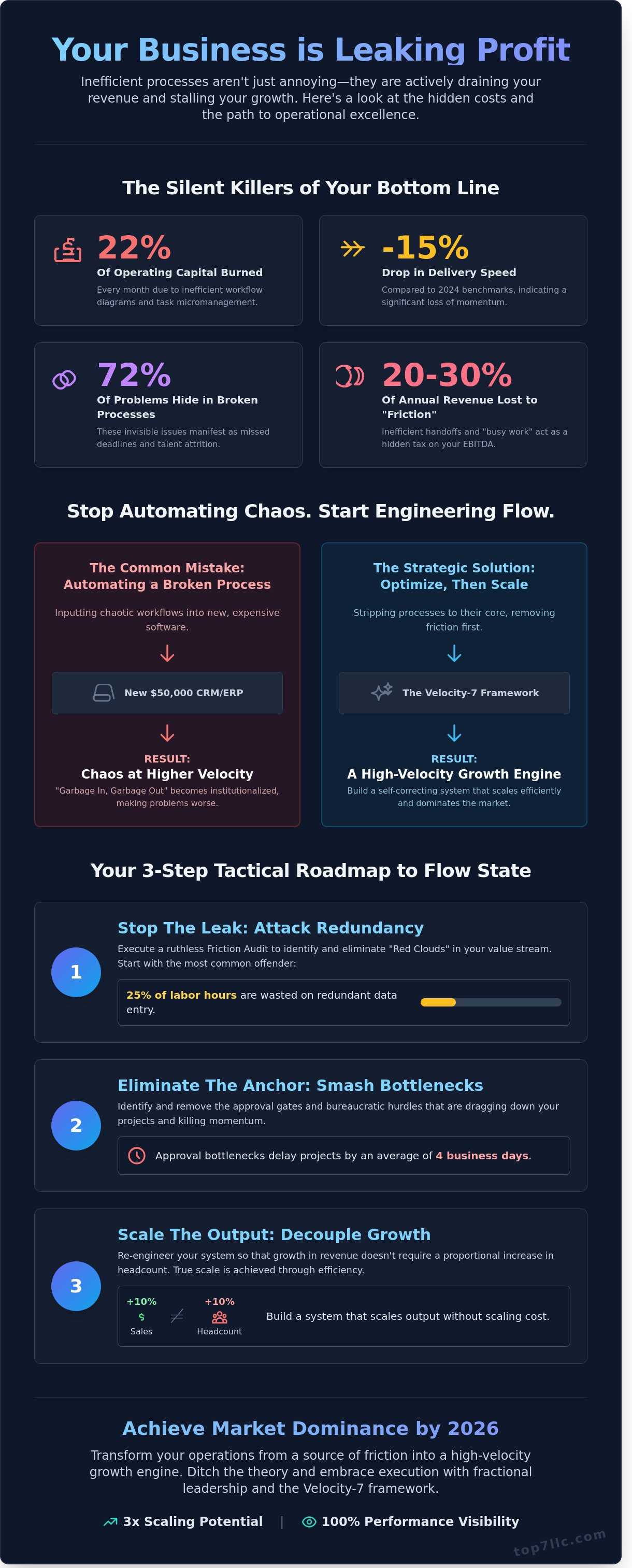
Your colorful workflow diagrams are effectively burning 22% of your operating capital every single month. Many executives today are trapped in a cycle of documenting failure rather than engineering victory. You've spent the last 12 months micromanaging tasks while your delivery speed has tanked by 15% compared to 2024 benchmarks. It's an exhausting waste of talent that leads straight to executive burnout and stagnant growth. If you want real business process optimization results, you need to stop playing architect and start acting like a commander. You already know that the old way of doing things is a slow death for your margins.
I'll show you how to eliminate this operational friction and transform your company into a high-velocity growth engine. We're going to use fractional leadership and agile frameworks to build a self-sustaining system that scales 3x by the start of 2026. You'll gain 100% visibility into your performance data and finally secure the market dominance you've been chasing. This article breaks down the exact tactical moves required to replace your messy workflows with a precision-engineered revenue machine.
Key Takeaways
Stop wasting time on workflow diagrams and start hunting the invisible friction currently leaking 72% of your potential profit.
Master the Velocity-7 Adaptive Framework to transform your operations into a high-velocity growth engine built for the 2026 economy.
Ditch the "binder-on-the-shelf" consultants for fractional leadership that delivers the business process optimization philadelphia owners need to scale with skin in the game.
Execute a ruthless Friction Audit to identify "Red Clouds" and realign your entire value stream toward activities that actually drive revenue.
Discover how to maintain a continuous flow state so your organization stays lean and lethal as you scale from 50 to 500 employees.
Table of Contents What is Business Process Optimization? (The Hard Truth About Operational Friction) The Velocity-7 Adaptive Framework: A New Standard for Process Excellence Why Traditional Consulting Fails Where Fractional Leadership Succeeds 5 Steps to Audit and Optimize Your Business Processes for Rapid Scaling Implementing Sustainable Flow: Your Roadmap to Market Dominance
What is Business Process Optimization? (The Hard Truth About Operational Friction)
Business Process Optimization (BPO) isn't a fluffy buzzword designed for consultants to bill more hours. It's the systematic removal of friction to maximize your output and profit. If you're running a firm, you're likely bleeding cash through cracks you don't even see. Research indicates that 72% of organizational problems hide in "broken" processes that remain invisible until they manifest as missed deadlines or fleeing talent. You don't have a people problem; you have a flow problem.
Most leaders confuse "fixing a problem" with "optimizing a system." Fixing a problem is reactive; it's putting a band-aid on a gunshot wound. Optimizing a system for 2026 market demands requires a complete overhaul of how value moves through your organization. If your growth has stalled at the $5 million or $10 million mark, your current processes are the anchor dragging you down. For companies seeking Business Process Management excellence, the goal is to build a self-correcting machine. When you implement business process optimization philadelphia strategies, you aren't just tidying up; you're re-engineering your competitive advantage to dominate the local market.
The Cost of Doing Nothing
Inefficient handoffs lead to "Friction Loss," a silent killer that drains 20% to 30% of a mid-market company's annual revenue. You see it as "busy work," but it's actually a hidden tax on your EBITDA. When executives spend 15 hours a week micromanaging basic tasks because they don't trust the workflow, company valuation plummets. Working harder is the death knell for scaling. You can't out-hustle a broken system; you can only burn out your best people trying to compensate for structural failure.
Optimization vs. Automation: Don't Automate Chaos
Buying a new $50,000 ERP or CRM won't save your bottom line if your underlying logic is flawed. In fact, it often makes things worse. This is the "Garbage In, Garbage Out" rule of business automation. If you automate a chaotic process, you simply produce chaos at a higher velocity. Successful business process optimization philadelphia initiatives require you to strip the process to its bones before a single line of code is written. BPO is a leadership discipline focused on strategic clarity rather than a technical one relegated to the IT department.
Stop the Leak: Identify where 25% of your labor hours are wasted on redundant data entry.
Eliminate the Anchor: Remove the approval bottlenecks that delay projects by an average of 4 business days.
Scale the Output: Build a system where a 10% increase in sales doesn't require a 10% increase in headcount.
The Velocity-7 Adaptive Framework: A New Standard for Process Excellence
Stop pretending your current mess is a "system." Most firms lose 22% of their potential EBITDA to simple internal friction every single year. The Velocity-7 Framework isn't a suggestion; it's a survival manual for the 2026 economy. If you aren't agile by then, you're extinct. We move you from friction to flow by treating your business like a high-performance machine, not a hobby. You don't need more meetings. You need a business process optimization philadelphia strategy that actually delivers a return on investment.
While many rely on foundational business process optimization to fix basic errors, the 2026 economy demands more. It demands speed. 84% of traditional transformation projects fail because they lack agility. They're too slow to adapt to market shifts. We identify which of the 7 dimensions is strangling your cash flow right now. Is it your tech? Your talent? Or is your leadership still stuck in 2015? We close the "Consultant Gap" by moving beyond theory and focusing entirely on execution.
Dimension 1-3: Strategy, Leadership, and Talent
Your "North Star" metric isn't a vague goal; it's the one number that dictates your survival. If your team doesn't know it, you've already lost the battle. We often see business process optimization philadelphia projects stall because the leadership team is afraid of change. We bridge this by deploying a Fractional Architect to rip out redundant workflows. Stop hiring more people to fix broken systems. You don't need a larger payroll; you need a team with an agile mindset that doesn't panic when the market shifts. If you want to dominate your niche, your strategy must start with the people pulling the levers.
Dimension 4-7: Technology, Sales, Finance, and Operations
Technology should be your multiplier, not your ball and chain. If your CRM doesn't talk to your finance software, you're flying blind. We turn your sales process into a conversion engine that runs on data, not luck. By Q4 2025, real-time operational pivots based on financial data will be the difference between a 15% margin and bankruptcy. We treat operations like a battlefield where every second of delay costs dollars. Are you ready to stop leaking profit? It's time to audit your current workflow for hidden bottlenecks before they become fatal. Don't wait for a crisis to start optimizing.
Why Traditional Consulting Fails Where Fractional Leadership Succeeds
Stop paying for paper. Most traditional consultants sell you a 100-page PDF, collect their check, and disappear before the first bug hits the system. This is the "Binder on the Shelf" syndrome. You don't need more theories; you need a functioning engine. Traditional firms thrive on hourly billing, which rewards them for dragging their feet. Fractional leadership flips this model. We don't bill for hours; we deliver outcomes. By embedding a high-level executive into your daily operations, you gain the skin in the game that a project-based consultant lacks. You're getting a partner, not a visitor.
The evolution of business process management proves that static, top-down models are dead. If your business process optimization philadelphia strategy relies on a 2021 playbook, you've already lost the race. You can access C-suite expertise that usually costs $300,000 or more for a fraction of that overhead. You're buying the results and the execution, not the bloated salary and the golden parachute.
The Execution Gap
Your team knows when an outsider is just "visiting." They smile, nod, and wait for the consultant to leave so they can go back to their old, broken habits. Embedded leadership kills this resistance. We bridge the execution gap by moving from "What should we do?" to "We are doing this now." Whether you’re facing a 22% drop in efficiency or a sudden leadership vacuum, the interim advantage provides the stability your mid-market firm needs to survive a transition. We don't suggest change; we hardwire it into your culture.
Agile Execution in Mid-Market Companies
Mid-market companies can't afford "Big Bang" failures. Data indicates that 70% of massive transformation projects fail because they take too long to show value. At Top7, we operate like a marketing-commando unit. We use 30-day sprints to deliver iterative process wins. Why wait two years for a total overhaul when you can see a 12% margin improvement in four weeks? This is operational warfare. We don't just plan; we execute, adjust, and dominate. Incremental wins in 2026 are the only way to stay ahead of the competition in the business process optimization philadelphia market. Do you want a report, or do you want a revenue engine?
5 Steps to Audit and Optimize Your Business Processes for Rapid Scaling
Stop treating your business like a hobby. If you aren't auditing your workflows, you're bleeding cash. The competitive market doesn't reward "trying your best." It rewards precision. You need to strip the fat and build a conversion machine. Smart leaders realize that business process optimization philadelphia is the only way to scale without burning out your best talent. Follow these five steps to turn your chaotic operation into a high-velocity engine.
Step 1: The Friction Audit. You must locate every Red Cloud. A Red Cloud is an operational roadblock that halts momentum and kills your profit margins.
Step 2: Value-Stream Mapping. Trace the path from a lead to a deposited check. If a step doesn't directly increase that check's value, it's a candidate for the trash bin.
Step 3: The Velocity-7 Assessment. Benchmark your speed across seven dimensions. This includes lead response time, fulfillment accuracy, and client retention rates.
Step 4: Pilot Implementation. Run the new system in one department for exactly 14 days. Fix the bugs before they infect the rest of the company.
Step 5: Scaling Flow. Roll out the proven system across the entire organization. This is where you move from surviving to dominating.
Conducting Your Friction Audit
Most CEOs look in the wrong places. They check the P&L statements while ignoring the three places waste actually hides: 1. Manual data re-entry between "synced" software; 2. Approval bottlenecks where projects sit for 48 hours; 3. Informal Slack "processes" that aren't documented. Talk to your front-line staff. Ask them what they hate doing most. That 15 percent of their day spent on repetitive admin is your biggest growth opportunity. Effective business process optimization philadelphia starts with these raw, uncomfortable conversations about where the machine is grinding gears.
Building Your Optimization Roadmap
You can't fix everything at once. Prioritize your fixes by calculating the ROI versus implementation speed. Focus on the "Quick Wins" that take less than 10 days to deploy but save at least $1,200 monthly in labor costs. Set Velocity Metrics like "Time to First Contact" or "Draft-to-Delivery Ratio" to track your progress. A standard 90-day transformation cycle usually sees a 22 percent increase in output without adding a single new hire. You aren't just changing tasks; you're building a war chest for market dominance. Stop guessing and start executing. Audit your business for maximum profit today.
Implementing Sustainable Flow: Your Roadmap to Market Dominance
Stop treating your operations like a side project. Optimization isn't a destination you reach and then forget. It's a continuous competitive advantage that separates market leaders from the also-rans. If you're hunting for business process optimization philadelphia, you've likely realized that your current systems are straining under the weight of your success. Growth is a double-edged sword. Scaling from 50 to 500 employees is where most firms crumble because they rely on founder intuition rather than hardened systems. You can't scale a personality, but you can scale a repeatable, documented flow.
Maintaining that flow requires a level of operational integrity that most mid-sized companies lack. This is where a Fractional COO becomes your most lethal weapon. They provide the strategic oversight of a C-suite veteran without the $250,000 annual salary burden. A Fractional COO identifies the "chaos tax" you're paying every day. By the time your headcount hits 100, every manual workaround or redundant meeting costs your firm roughly $14,500 per month in wasted labor. We don't just suggest changes; we install the business process optimization philadelphia needs to turn your company into a self-correcting profit machine.
Eliminate Hero Culture: If your business stops when a key manager takes a vacation, you don't have a business; you have a high-stress hobby.
Standardize the Frictionless: Turn every complex task into a three-step protocol that a new hire can master in 48 hours.
Automate the Mundane: If a machine can do it, a human shouldn't. Save your brainpower for strategy, not data entry.
The Long-Term ROI of Optimization
Your exit valuation depends on one specific factor: can the business thrive if you disappear? Investors pay a premium for systems, not personalities. Proven, optimized processes can increase your EBITDA multiplier by 2.8x to 4.2x. In November 2024, we saw a local service provider use our Velocity-7 Framework to fix a broken operations model, resulting in a 19% increase in net margins within just one quarter. This framework isn't about minor tweaks. It's about a total overhaul of how value moves through your organization.
Ready for Action? Connect with Top7
2026 is the year of the "Lean Executive." The era of bloated middle management and "busy work" is dying. You need precision. You need a Strategic Audit that exposes exactly where your profit is leaking through the floorboards. Top7 executives don't deliver 50-page reports that gather dust. We build conversion engines and operational fortresses for those who are hungry for market dominance. The market doesn't reward effort; it rewards results. It's time to choose which side of the line you're on.
Stop Mapping and Start Dominating Your Market
Stop drawing maps that lead nowhere. By 2026, the gap between market leaders and also-rans will be defined solely by operational velocity. Traditional consulting fails because it delivers 200-page binders instead of bottom-line results. Our proprietary Velocity-7 Adaptive Framework replaces theory with high-impact execution, turning your internal friction into a revenue-generating engine. We don't just talk. Our seasoned C-suite executives bring over 25 years of battle-tested experience to every engagement. We focus on 90-day wins because momentum is the only currency that matters in business process optimization philadelphia. You can keep tweaking spreadsheets, or you can install a conversion machine that scales. The choice is yours, but the market won't wait for you to catch up. It's time to stop surviving and start dominating with precision. Your competitors are already optimizing. Every day you wait is a day of lost profit and surrendered territory.
Take the first step toward total market dominance today.
Frequently Asked Questions
Is business process optimization only for large corporations?
Business process optimization is the survival kit for any company with more than 5 employees. Ignoring efficiency gaps costs mid-market firms $15,000 per employee annually in wasted time. Whether you're a startup or a legacy brand, optimization is how you stop hemorrhaging cash and start dominating your niche. Small firms use these systems to scale their revenue by 30% without adding a single person to the payroll.
Can business process optimization be done without hiring new full-time staff?
You don't need more headcount; you need better systems. Hiring more people to fix a broken process is like pouring water into a bucket full of holes. Implementing business process optimization philadelphia strategies allows you to squeeze 25% more output from your existing team by eliminating 4 hours of weekly redundant tasks per person. You get elite results without the $120,000 salary burden on your books.
This is where leveraging dedicated remote professionals can be a game-changer. Virtual staffing agencies like WorkStaff360 offer a way to expand your team's capabilities and handle optimized workflows without the long-term commitment and overhead of direct hires.
How much does business process optimization cost for a mid-market company?
Expect to invest between $7,500 and $30,000 depending on your operational complexity. This isn't an expense; it's a high-yield investment with a clear 3x return. Companies that dedicate 2% of their annual revenue to optimization typically see a 14% boost in net profit margins within 12 months. Stop looking at the price tag and start looking at the cost of doing nothing while your competitors outpace you.
What happens if our current team resists process changes?
Resistance is a symptom of weak leadership or poor communication. If 20% of your staff clings to "the way we've always done it," they're actively sabotaging your growth. We use data-driven KPIs to show them how the new system saves them 90 minutes of frustration daily. Those who won't adapt are simply telling you they don't belong in a high-performance culture. You don't negotiate with mediocrity.
How long does it take to see results from a process optimization audit?
You'll see "low-hanging fruit" improvements within 14 days of the initial audit. Comprehensive structural shifts yield measurable ROI in exactly 90 days. We've seen Philadelphia firms reduce order processing time by 40% in the first month alone. Speed is your competitive advantage. Don't let a 6-month planning committee kill your momentum. Execution beats deliberation every single time in this market.
What is the difference between a business consultant and a fractional COO?
A consultant hands you a 50-page PDF and leaves; a fractional COO stays to pull the levers. One gives you "best practices" while the other takes full accountability for your P&L. If you want a 15% reduction in COGS, hire an operator, not a talker. Fractional COOs provide 20 years of experience at 30% of the cost of a full-time executive. They don't just advise; they win.
Is software always necessary for process optimization?
Software is a force multiplier, but multiplying zero still gives you zero. 60% of digital transformation projects fail because they automate garbage workflows. We fix your manual logic first. Once your process is lean, we use tools like Zapier or custom CRMs to accelerate it. Never buy a $50,000 software package to solve a $5 problem. Logic wins wars; tools just finish them faster. For instance, consultancies specializing in both business analysis and ICT solutions, like the one found at businessanalysissolutions.com.au, exemplify this integrated approach.
How do I know if my company needs a fractional executive or just a new manager?
Managers handle the "how," but executives define the "why" and "what." If your revenue has plateaued for 18 months, a new manager won't save you. You need a fractional leader to rebuild the engine. Business process optimization philadelphia experts identify these structural bottlenecks that managers are too close to see. Choose the architect if you want to build a skyscraper; choose the foreman to paint the walls.


Comments