

Average Retainer for Fractional CTO in 2026: The Price of Market Dominance
- Robert Fitzgerald
- May 11
- 12 min read

Your technical debt isn't just a developer headache; it's a strategic anchor dragging down your sales. You know your engineering team lacks clear direction, yet you're hesitant to pull the trigger on executive help. You've likely searched for the average retainer for fractional cto services and felt a sting of skepticism. Why pay a premium for someone who isn't there forty hours a week? It's a valid question for any leader who prioritizes profit over vanity metrics.
We're here to stop the guessing game. This article delivers the definitive 2026 breakdown of fractional CTO costs and the ROI they generate for mid-market growth. You'll get a clear budget for the year ahead and a framework to justify the spend to your board. We'll show you exactly how a monthly investment, typically ranging from $8,000 to $15,000, can save you over $200,000 compared to a full-time hire while finally making your tech stack scale. It's time to trade your technical friction for a high-velocity conversion machine.
Key Takeaways
Stop paying for a glorified developer; learn why a true 2026 retainer buys you a seat at the leadership table for high-level technical strategy.
Get the exact market benchmarks for every stage, from $3,000 for early architecture to $15,000 for mid-market scaling.
Discover why the average retainer for fractional cto services pays for itself by eliminating six-figure technical debt and accelerating team velocity.
Master the agreement structure that focuses on Scope of Influence to ensure your tech leader is actually driving business results.
Understand how the Velocity-7 Adaptive Framework transforms your engineering department from a friction-filled bottleneck into a profit-generating machine.
Table of Contents
The Fractional CTO Retainer: What You’re Actually Paying For in 2026
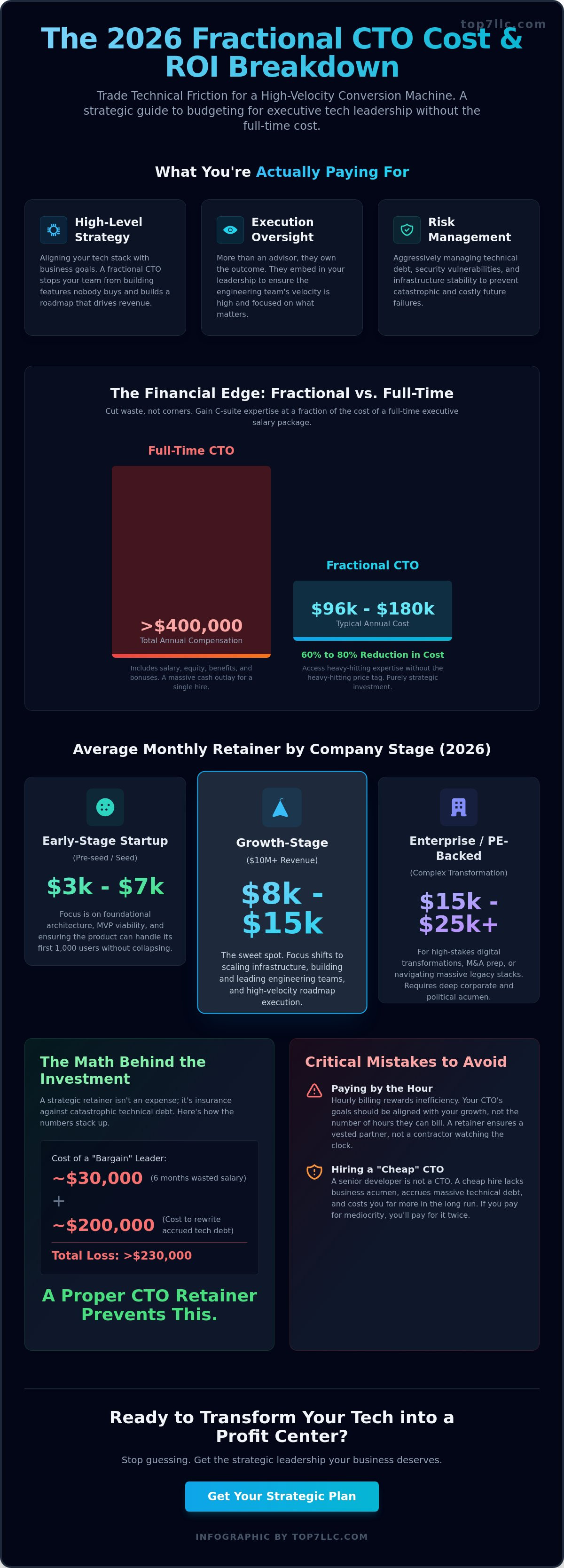
The average retainer for fractional cto services isn't just another line item on your P&L; it's the cost of operational sanity. In 2026, this fixed monthly fee typically lands between $5,000 and $15,000. Don't mistake this for a subscription to a technical helpdesk. You aren't paying for someone to fix your printer or debug a legacy script. You're buying a seat at the executive table. This fractional executive model ensures you have a heavy hitter who understands how code translates into cash flow.
To see how this investment translates into real world savings, watch this breakdown:
The retainer covers three non-negotiable pillars: high-level strategy, execution oversight, and aggressive risk management. Unlike a consultant who drops a 50-page PDF and disappears, a fractional CTO embeds into your leadership team. They don't just advise; they own the outcome. They stop your engineering team from building "cool" features that nobody buys and refocus them on the roadmap that actually moves the needle. It's about moving from technical friction to a high-velocity conversion machine.
Why "Cheap" CTOs are the Most Expensive Mistake
Many mid-market CEOs fall for the trap of hiring a senior developer and calling them a CTO. It's a disaster waiting to happen. A $5,000/month "bargain" leader usually lacks the business acumen to navigate board meetings or scale infrastructure. They accrue massive technical debt by choosing the easiest path rather than the most strategic one. By the time you realize they're out of their depth, you've wasted six months and $30,000. That $15,000/month retainer looks like a steal when it prevents a $200,000 rewrite of your entire tech stack. If you pay for mediocrity, you'll pay for it twice.
Retainer vs. Hourly: Why You Should Never Pay by the Clock
Stop paying by the clock. Hourly billing is a relic of the past that rewards inefficiency. If your CTO makes more money the longer a problem persists, your goals are fundamentally misaligned. A retainer aligns the CTO’s goals with the CEO’s growth targets by focusing on results rather than billable minutes. It creates an "always on" psychological commitment. When a high-stakes decision needs to be made at 4 PM on a Friday, you don't want a consultant checking their stopwatch. You want a partner who is invested in your market dominance. You want a commander, not a contractor.
Average Retainer Ranges by Market and Company Stage
Market dominance isn't cheap, but it shouldn't bankrupt you either. When you look at the average retainer for fractional cto services in 2026, you're seeing the price of surgical precision. A full-time executive at this level demands a total compensation package exceeding $400,000 when you factor in equity, benefits, and bonuses. By choosing the fractional path, you're looking at a 60% to 80% reduction in cash outlay without sacrificing the heavy-hitting expertise your board expects. You aren't cutting corners. You're cutting waste.
The specific price you'll pay depends entirely on your current battlefront. Different stages of business require different levels of strategic firepower:
Early-stage Startup (Pre-seed/Seed): Expect to pay $3,000 to $7,000 per month. At this level, your CTO isn't managing a massive team. They're focused on foundational architecture and ensuring your MVP doesn't collapse under its first 1,000 users.
Growth-stage Mid-Market ($10M+ Revenue): This is the sweet spot for most businesses, with retainers ranging from $8,000 to $15,000 per month. Here, the focus shifts to scaling infrastructure, team leadership, and high-velocity roadmap execution.
Enterprise or PE-Backed: For complex digital transformations or preparing for an exit, retainers climb to $15,000 to $25,000+ per month. This buys you a veteran who can navigate corporate politics and massive legacy stacks.
If you're unsure which tier fits your current trajectory, a quick review of your strategic planning needs will usually reveal the gap in your leadership.
Regional Pricing Trends: From Austin to Boston
Geography still plays a role, even in a remote-first world. In East Coast hubs like Boston and NYC, top-tier retainers often sit at the higher end of the spectrum due to the sheer density of complex FinTech and HealthTech requirements. Texas is seeing a massive surge in demand. Dallas and Austin are no longer "budget" alternatives; they're competitive battlegrounds where fractional leaders command premium rates for their ability to scale rapidly. Meanwhile, Silicon Valley retainers remain the highest in the country, often 20% to 30% above the national average, driven by venture-backed expectations of 24/7 availability and "unicorn-level" pedigree.
The "Seniority Premium": Experience Tiers in 2026
You aren't just paying for time; you're paying for the scars. Tier 1 leaders have 20 or more years of experience and have likely scaled companies to an IPO. They're the "War Veterans" who know exactly where the mines are buried. Tier 2 specialists, with 10 to 15 years of experience, are often Growth Specialists who excel at modernizing legacy stacks and building high-performance teams from scratch. It's a buyer's market for expertise. Data shows that 72% of fractional leaders have 15 or more years of experience, which means you're often getting a professional who is significantly overqualified for the price of a mid-level manager.
Retainer ROI: The Math Behind the Investment
Stop thinking about what this costs. Start thinking about what you're losing. Most CEOs compare the average retainer for fractional cto services to a full-time salary and call it a win. That's amateur math. True ROI isn't about saving $200,000 on a salary; it's about the millions in revenue you leave on the table because your engineering team is spinning its wheels. If your tech stack is a bottleneck rather than a catalyst, you aren't saving money. You're bleeding it.
A veteran CTO pays for their own retainer through surgical vendor negotiation and technical debt reduction. It's common for a mid-market firm to claw back $100,000 or more in wasted developer hours within the first six months. They audit your bloated cloud bills and kill SaaS contracts that provide zero value. Beyond the balance sheet, they protect your most valuable asset: talent. Replacing a key engineer costs between $50,000 and $100,000 in recruitment and onboarding. A leader who builds a high-performance culture stops that churn before it starts.
The Cost of Inaction (COI)
What does a three-month delay on your product launch actually cost? For a growth-stage company, that's often a $1,000,000 missed opportunity. This is your "Operational Friction" tax. Your sales team can't close deals because the tech stack is too slow or the features are buggy. When you look at it through this lens, a $10,000 monthly retainer is the cheapest insurance policy you'll ever buy. You aren't just paying for a person. You're paying to eliminate the friction that's currently strangling your revenue.
Strategic Roadmap Execution
Execution is where most "part-time" help fails. Our Velocity-7 Adaptive Framework ensures that your vague business ideas become deployable sprints within days, not months. We don't just talk about strategy; we measure it. We track deployment frequency, lead time for changes, and Mean Time to Recovery (MTTR). If these numbers aren't improving, your CTO isn't doing their job. This framework shortens transformation cycles. It ensures your tech stack finally scales at the speed of your ambition. We turn your technology from a cost center into a high-speed conversion machine.
How to Structure Your Fractional CTO Agreement for Success
Stop drafting a standard job description for your tech leader. You aren't hiring a senior developer to clear a backlog; you're hiring a commander to win a market. When you commit to the average retainer for fractional cto services, the contract must reflect a "Scope of Influence" rather than a "Scope of Work." If your agreement focuses on how many hours they spend in Jira, you've already lost. Success is measured by how effectively they align your tech stack with your revenue goals. They need to be in your weekly executive leadership meetings. Without that seat at the table, they're just a highly paid consultant guessing at your strategy.
Availability is the next critical pillar. Don't settle for vague promises of "part-time" help. Specify the engagement model clearly. Is it one dedicated day per week for deep work, or are they "on-call" for critical architecture decisions? Most mid-market firms thrive on a hybrid approach where the CTO is available for high-stakes pivots but doesn't micromanage daily standups. Demand a 90-day roadmap as the first non-negotiable deliverable. If they can't show you exactly where your tech debt will be in three months, they don't deserve the retainer. Real leaders don't hide behind technical jargon; they provide a clear path to deployment.
Hybrid Models: Cash + Equity
If you're a high-growth firm looking to preserve capital, consider a hybrid model. Offering 0.25% to 1% equity can significantly lower the monthly cash retainer while providing the "skin in the game" necessary for a long-term exit strategy. This aligns the CTO’s financial interests directly with your company’s valuation. It turns a service provider into a partner. Watch out for red flags, though. If an unproven leader asks for heavy equity upfront without a vesting schedule, show them the door. Equity is earned through execution, not just presence.
The First 30 Days: The Audit Phase
The first month of a retainer is a tactical sprint. Expect your CTO to be more intensive during this period as they perform a deep-dive technical audit. You should receive a "State of the Tech" report by day 30 that identifies every bottleneck strangling your growth. This isn't just a list of bugs. It's a strategic assessment of your team, your vendors, and your scalability. Use this phase to identify "Quick Wins" that justify the average retainer for fractional cto within the first quarter. If you're ready to stop guessing and start scaling, it's time to secure your Fractional CTO leadership today.
Beyond the Retainer: The Top7 Velocity-7 Difference
Knowing the average retainer for fractional cto services is only the first step toward market dominance. While competitors focus on saving you a few thousand dollars on a salary, we focus on generating millions in revenue. At Top7, we don't just "consult." We don't hand you a list of suggestions and leave your team to struggle with the implementation. We embed ourselves into your leadership. We transform your technology from a source of friction into a precision weapon. This is the "Marketing-Commando" approach: tech is not a cost center; it is a tool for winning the war for market share.
Our professionals don't guess. We use the Velocity-7 Adaptive Framework to move your engineering department from chaos to flow. This proprietary system is designed to eliminate the bottlenecks that stop your sales team from closing deals. We don't care about "busy" developers. We care about deployable code that drives profit. We solve complex problems across the US by applying battle-tested strategies that turn vague roadmaps into high-velocity execution machines. If your current leadership can't explain how their tech choices will increase your conversion rate, you have the wrong leadership.
Solving the Leadership Gap
Mid-market companies from Chicago to Florida and across the West Coast are hitting the same wall: the leadership gap. You have talented developers, but they lack a commander who understands the business reality of 2026. Top7 provides interim leaders who bring more than just a resume. We bring a framework for victory. We stabilize your infrastructure, rebuild your engineering culture, and align your tech stack with your board's expectations. When the time is right to transition to a full-time hire, we've already done the heavy lifting. We ensure your next CTO inherits a system built for growth, not a mess of legacy debt.
Ready to Stop the Leaks?
Your technical debt is a leak in your profit margin. Every day you wait to fix your leadership gap is another day your competitors gain ground. The final word on the average retainer for fractional cto is simple: it’s not about what you spend; it’s about the ROI you gain. A $12,000 monthly investment is a bargain when it prevents a $1M missed opportunity. We are here to perform a strategic audit of your current tech leadership and show you exactly where you're bleeding cash. Stop the guessing. Start the scaling. Schedule a call with a Top7 executive to fix your tech bottlenecks today.
Take Command of Your Technology
You now have the definitive 2026 breakdown of the average retainer for fractional cto services. You understand that a monthly investment of $8,000 to $15,000 isn't just an expense; it's the price of eliminating the technical friction currently strangling your growth. It's time to stop treating technology as a cost center and start using it as a weapon for market dominance. A true leader doesn't just offer advice. They provide a seat at the table and a clear path to execution.
Top7 provides seasoned executives with over 20 years of experience who embed directly into your C-suite. We don't just talk about strategy. We deploy our proprietary Velocity-7 Adaptive Framework to transform your engineering team into a high-velocity profit machine. The competition isn't waiting for you to fix your technical debt. They're waiting for you to fail. Don't give them that satisfaction.
Eliminate Tech Friction—Book Your Velocity-7 Strategy Session Now
Your tech stack should be your greatest advantage, not your biggest bottleneck. Take command of your future and lead your industry today.
Frequently Asked Questions
Is a $5,000 monthly retainer too low for a Fractional CTO?
A $5,000 retainer is usually a trap for growth-stage firms. While this price point works for pre-seed advisory, it rarely buys the strategic commander needed for mid-market dominance. You're likely hiring a glorified developer rather than a veteran who can navigate boardrooms. If you pay for a bargain, you'll pay again to fix the mistakes of a leader who lacks executive scars.
How many hours a week does a Fractional CTO typically work for their retainer?
Stop tracking hours and start tracking outcomes. Most fractional leaders dedicate 5 to 15 hours per week to high-impact work like architecture reviews and executive strategy. You aren't paying for their presence at a desk; you're paying for 20 years of experience applied to your specific bottlenecks. One hour of the right decision is worth forty hours of the wrong code.
Do Fractional CTOs take responsibility for the engineering team’s output?
They own the results or they aren't leaders. A true fractional CTO takes full responsibility for the engineering team’s velocity and roadmap execution. They don't just point out problems; they ensure the department hits its KPIs. If your technical leader hides behind a consultant's disclaimer when a deadline is missed, they've already failed you.
What is the typical duration of a Fractional CTO retainer contract?
Expect a commitment of 6 to 12 months. This duration allows the leader to move beyond the initial audit phase and deliver measurable scaling results. It's the ideal window to stabilize a legacy stack or prepare the organization for a full-time executive hire. Short-term fixes rarely solve deep-rooted technical debt.
Can a Fractional CTO help with fundraising or M&A due diligence?
Technical due diligence is where these leaders shine. They prepare your codebase for investor scrutiny and represent your tech stack in high-stakes boardrooms. Having a veteran CTO handle these conversations adds massive credibility during a Series B round or a private equity acquisition. They turn your technology into an asset that increases company valuation.
What happens if we need more time than the retainer specifies?
Most agreements include surge capacity for critical pivots. If a major launch or a merger requires more bandwidth, the retainer scales to meet the demand. You get the executive firepower you need without the overhead of a permanent, high-salary employee. Flexibility is the core advantage of the fractional model.
How do I know if my Fractional CTO is actually doing anything?
Look at the data. If your lead time for changes is dropping and your system uptime is climbing, the investment is working. The average retainer for fractional cto services is justified by clear KPIs like deployment frequency and technical debt reduction. If you don't see these numbers moving in your weekly reports, fire them immediately.
Is it better to hire a Fractional CTO or a tech agency?
Hire the CTO if you want to win; hire an agency if you just want to build. Agencies follow orders, even bad ones. A CTO challenges your assumptions and stops you from wasting capital on technical dead ends. They align your code with your cash flow and ensure your tech stack is a precision weapon for market dominance.


Comments