
When to Hire a Fractional CPO: A Growth-Stage Decision Guide

What if your product team doesn’t need more people or a busier roadmap, but someone empowered to make the hard calls? If priorities keep shifting, features ship without a clear customer or commercial purpose, and the founder remains the default decision-maker, the real question is when to hire a fractional cpo. More activity won’t fix a leadership gap.
It’s reasonable to hesitate before adding a senior executive. A full-time CPO may be more commitment than your company needs, while occasional advice may not be enough to change how product decisions get made. First determine whether product leadership, rather than delivery capacity or another operational constraint, is actually slowing growth.
This guide will help you spot the signals that justify fractional product leadership, compare a fractional CPO with consulting, interim, and full-time options, and choose support that fits your stage. You’ll also learn how to frame the engagement around decision ownership, strategic alignment, and business outcomes, not meetings or activity for their own sake. The right hire isn’t the one who adds the most process. It’s the one who helps your business make better product decisions and execute against them.
Table of Contents
When to hire a fractional CPO: signs product decisions are holding back growth
What a fractional CPO changes when product strategy lacks an owner
Fractional CPO vs. full-time hire, consultant, or internal product lead
How to assess readiness and scope a fractional CPO engagement
Choose the right moment to bring in Top7’s fractional CPO support
When to hire a fractional CPO: signs product decisions are holding back growth
A busy product team can still be stuck. Designers refine screens, engineers ship features, and sales keeps requesting changes, yet nobody can say which customer problem matters most or who has the authority to decide. That’s not necessarily a shortage of product work. It may be a shortage of product decision-making.
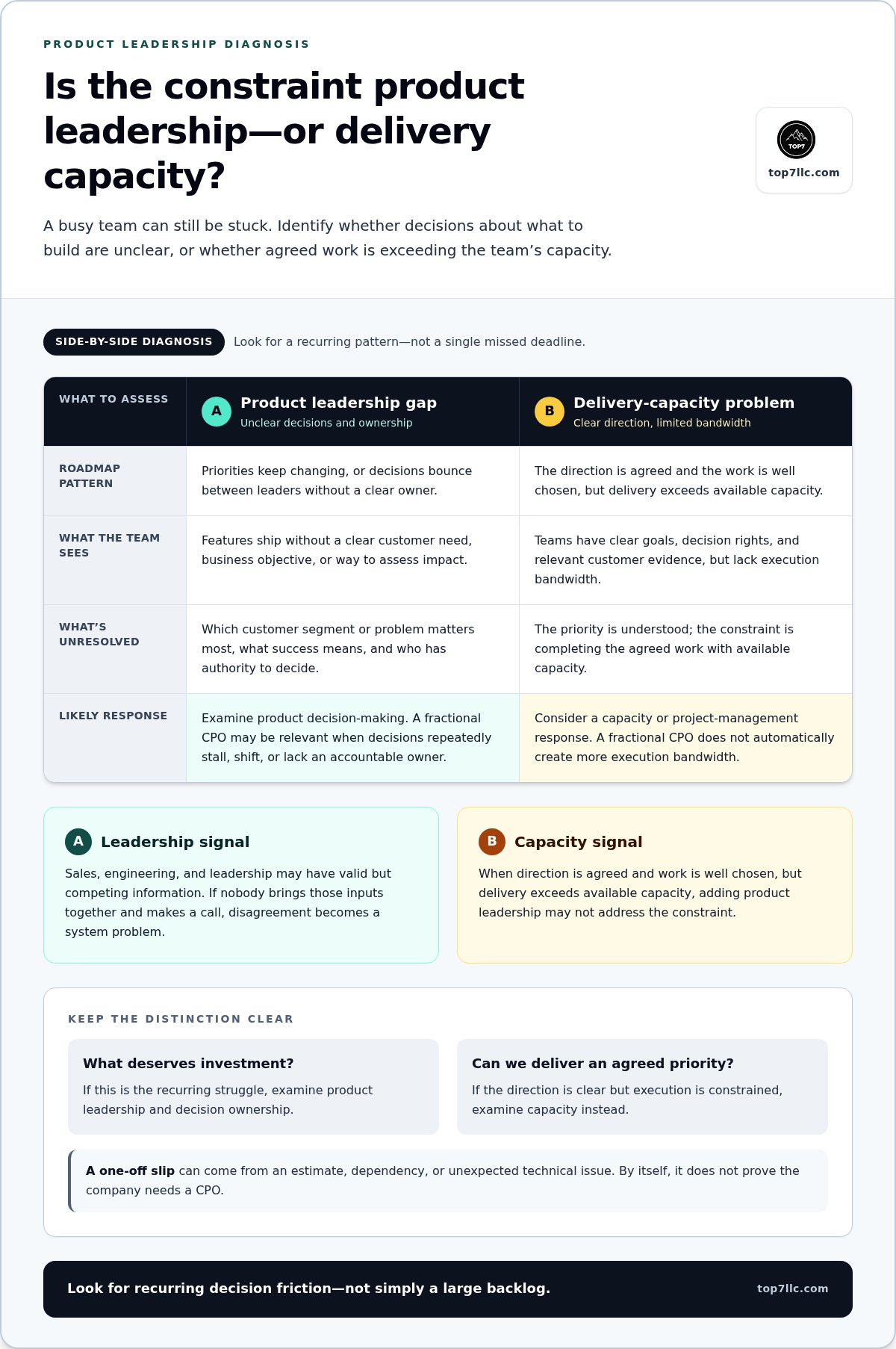
The question of when to hire a fractional cpo starts with a recurring pattern, not one missed deadline. Look for priorities that keep changing, decisions that bounce between leaders, and features that launch without a clear customer or commercial purpose. These symptoms point to a need to examine how product direction is set and owned.
For a broader overview of the discipline, explore product management and its role in shaping product strategy and lifecycle decisions. The video below also discusses when fractional CPO support may be relevant.
Which product leadership signals should trigger a closer look?
Start with the roadmap. Are teams working hard while high-stakes questions remain unresolved, such as which customer segment to prioritize or what success should look like? If priorities conflict, people may keep switching work to satisfy the loudest request. The cost is more than delay: effort gets spread across initiatives without a shared basis for choosing.
Repeated roadmap reversals can signal missing decision ownership, not an incompetent team. Product, engineering, sales, and leadership may each be acting on valid but competing information. Sales hears urgent customer requests; engineering sees technical constraints; leadership weighs business goals. If no one brings those inputs together and makes a call, disagreement becomes a system problem. Track who proposes priorities, who approves them, and whether the rationale changes when new evidence emerges.
A fractional CPO becomes relevant when product decisions repeatedly stall, shift, or lack an accountable owner, not simply when the backlog is large.
When is the problem execution rather than product leadership?
A one-off slip can come from an estimate, dependency, or unexpected technical issue. By itself, it doesn’t prove the company needs a CPO. Look for a different pattern: the team delivers reliably, but repeatedly chooses work that lacks a defined customer need, business objective, or way to assess impact. That points to a decision problem, not just a delivery problem.
Before concluding that leadership is the constraint, check whether teams already have clear goals, decision rights, and relevant customer evidence. If the direction is agreed and the work is well chosen, but delivery exceeds available capacity, adding a fractional CPO won’t automatically create more execution bandwidth. The gap may call for a capacity or project-management response instead.
Separate the questions: Are you struggling to decide what deserves investment, or struggling to deliver an agreed priority? The answer helps you avoid hiring for the wrong problem and focus senior product support where it can matter.
What a fractional CPO changes when product strategy lacks an owner
A fractional CPO is a senior product leader who works part-time with a focused strategic mandate. The role is to establish who the product serves, which problems deserve attention, and how product choices support the organization’s goals. It gives product direction an accountable owner without assuming the company needs a full-time executive.
The value isn’t measured by how many roadmap documents or feature briefs the CPO personally produces. Those are tools, not the job. The leader clarifies the decisions teams need to make, aligns the people responsible for making them, and sets a basis for evaluating whether the chosen work is creating customer and business value.
A CPO owns the logic behind what gets built, not the output of every feature. That distinction keeps strategic leadership separate from the delivery work handled by product, design, and engineering teams.
Which product decisions belong in the CPO’s mandate?
The mandate should connect customer problems to organizational objectives. For example, if the business aims to improve retention, the product leader helps determine which customer needs or product experiences merit investment, what evidence supports that choice, and what signals would indicate progress. These decisions inform priorities; they don’t guarantee product-market fit or a particular business result.
Decision rights matter, too. Executives may set business direction, while the CPO translates it into product priorities and clarifies where delivery teams can decide independently. Without that boundary, every trade-off can escalate, or teams can make conflicting calls.
How should a fractional CPO work with existing teams?
Product strategy cuts across functions. A CPO works with founders and leadership on business goals, with engineering on feasibility and sequencing, and with sales and marketing on customer needs and market signals. Product contributors bring research and delivery context. The leader’s job is to reconcile those perspectives into shared priorities, not dismiss them or replace the teams doing the work.
Execution stays with accountable teams. A useful leader makes the reasoning behind priorities visible, establishes how trade-offs get resolved, and helps teams apply those practices to future decisions. The goal is stronger internal judgment, not a permanent queue of questions that only the executive can answer.
Before engaging a fractional CPO, define the decisions the role should own and the outcomes the business needs to evaluate. Top7 provides fractional CPO leadership for businesses that need senior ownership of product direction and alignment between strategy and execution.
Fractional CPO vs. full-time hire, consultant, or internal product lead
The right model depends on the work the business needs done, not on which title sounds most senior. Compare the options by four factors: how long the need will last, who can make decisions, how much continuity the role requires, and whether the company has internal capacity to execute. A fractional CPO isn’t automatically better than a full-time executive. It’s a fit when the business needs senior product ownership but not necessarily a permanent, full-time role.
Use this comparison to identify the kind of support that matches the constraint:
Project leadership is another option when the strategy is clear but a temporary delivery effort needs coordination. That’s different from appointing someone to decide which product investments matter.
When does a fractional CPO fit better than a full-time CPO?
A fractional role can fit when a business needs executive-level ownership for a defined or still-evolving product challenge, but the mandate doesn’t yet require a permanent full-time presence. A full-time CPO may make more sense when product decisions demand sustained daily attention, span a broad portfolio, and require deep, continuous involvement in the organization. Judge the need by scope and decision load, not a universal company-size threshold.
When is consulting or internal ownership the better choice?
Choose consulting when the need is a bounded analysis or recommendation and leaders will retain accountability for acting on it. Keep ownership internal when a capable product lead is already in place and needs authority, alignment, or executive support rather than a replacement. If the strategy is settled and the issue is coordinating a temporary delivery push, project leadership may be the more proportionate response.
To answer when to hire a fractional cpo, first decide whether the business needs advice, execution coordination, or an ongoing owner for product choices. Match the role to that need. Don’t use an executive title to disguise a different problem.
How to assess readiness and scope a fractional CPO engagement
A fractional CPO engagement needs a defined problem, real decision authority, and a way to judge progress. “Improve product” is not a mandate. “Reduce repeated priority changes caused by unresolved ownership” gives the leader and team a problem they can investigate and address. Before work begins, capture the current roadmap, decision bottlenecks, key stakeholders, and available customer or product evidence. This creates a useful baseline, not a promise of a particular result.
Use this readiness sequence to turn a concern into a workable scope:
Name the constraint. Describe what is happening in observable terms. For example, identify decisions that routinely wait for executive approval or initiatives that lack a stated customer problem.
Identify the decisions. List the choices that keep stalling or changing, such as which customer need to prioritize, what work to defer, or how to assess a product bet.
Assign authority. Specify which decisions the CPO can make, which require executive agreement, and where product and delivery teams have autonomy. Accountability without authority is a dead end.
Define outcomes. Choose indicators tied to the constraint. If priorities keep shifting, track how often they change and whether teams can explain the rationale. If customer value is unclear, identify what evidence will inform future choices.
What should be clear before the engagement begins?
Write down the business problem, the people affected, and the decisions the role is expected to own. Name the founder or executive sponsor and the teams that need to work together. Agree on indicators that reflect the stated problem, using the company’s current evidence as a starting point rather than importing arbitrary benchmarks. Set review points in advance, with timing based on the scope and the organization’s decision cycle.
Deciding when to hire a fractional cpo becomes easier when leaders can explain both the mandate and its boundaries. If no one can say what decisions need an owner, clarify the problem first.
How can leaders tell whether the engagement is working?
Check whether people doing the work understand current priorities, know who makes key calls, and can explain why those calls were made. At agreed review points, compare progress with the original indicators and revise the scope if the underlying constraint has changed. Don’t confuse an early improvement in decision clarity with a longer-term commercial result; revenue, retention, or other business effects may take longer to assess.
Keep the review focused: what changed, what evidence supports that conclusion, and what decision comes next? Top7’s fractional leadership support can help businesses define senior ownership around product direction and execution alignment.
Choose the right moment to bring in Top7’s fractional CPO support
Consider fractional CPO support when strategic product decisions repeatedly lack an owner, not just when the roadmap feels crowded. If important choices keep circling between leadership and teams, or product direction isn’t tied to clear business priorities, the constraint may be senior product ownership. The right next move is to match that need to a defined mandate, not to add executive involvement for its own sake.
Top7 provides fractional CPO leadership for businesses that need senior ownership of product direction and stronger alignment between strategy and execution. Shape the role around the decisions your organization needs to make and the business constraint it needs to address. It isn’t a promise of a particular product result, and it doesn’t replace the teams responsible for delivery.
What makes a leadership engagement outcome-focused?
Start with three points: the constraint, the authority, and the intended change. For example, identify which product decisions lack an accountable owner, define where that leader can make or resolve decisions, and choose indicators that show whether ownership and alignment are improving. Keep measures connected to the actual issue. A clearer decision process is an operating signal; commercial results are separate outcomes that depend on more than one role.
Some constraints extend beyond product strategy. If execution is slowed by operational friction, agile-based transformation through Top7’s Velocity-7 Adaptive Framework may be relevant. Strategic planning can help connect product direction to business priorities, while advanced project management can support coordination when the challenge is execution. These capabilities complement product leadership; they shouldn’t be treated as interchangeable with the CPO mandate.
What is the next step after deciding a fractional CPO may fit?
Prepare a concise decision brief before the leadership conversation. Include:
The product decisions currently blocking progress, with examples of how they affect work.
The stakeholders who shape, approve, or carry out those decisions.
The authority the CPO would need, including decisions that remain with company leadership.
The available customer, product, and business evidence, plus the indicators you’ll use to review progress.
This preparation turns “we need product help” into a focused discussion about mandate, stakeholders, and success measures. It also gives both sides a basis for deciding whether fractional CPO leadership addresses the real constraint, or whether planning or project coordination is the more relevant need. Be specific. The clearer the decision problem, the sharper the scope can be.
If you’ve identified recurring strategic decisions without clear ownership, take the next step: Explore Top7’s fractional CPO and executive leadership support.
Turn product uncertainty into a clear leadership decision
The next step isn’t to add another layer of process. It’s to decide who will own the product choices that shape your company’s future. Ask your leadership team: which decision keeps getting deferred, what does that delay put at risk, and who has the authority to resolve it? Those answers will show whether you need executive product ownership or a different kind of support.
Knowing when to hire a fractional cpo means recognizing when product direction needs an accountable leader, then giving that leader a mandate tied to real business priorities. Top7 offers fractional CPO leadership alongside strategic planning, advanced project management, and the Velocity-7 Adaptive Framework, connecting leadership needs with broader planning and execution support where relevant.
Bring your unresolved product decisions and intended outcomes into the next leadership conversation. A clear mandate creates a stronger starting point for action and helps your team move with purpose. Explore Top7’s fractional CPO and executive leadership support, and take the next step toward more confident product decisions.
Frequently Asked Questions
When should a company hire a fractional CPO?
Assess the need when product decisions repeatedly stall, priorities compete without a clear rationale, or teams struggle to connect product choices to business goals. One delayed launch may reflect a dependency or estimate, not a leadership gap. Before deciding when to hire a fractional cpo, write down the recurring constraint, the decisions affected, and who must have authority to resolve them. That diagnosis helps prevent hiring for a symptom rather than the underlying problem.
Can a startup benefit from a fractional CPO?
Yes, a startup can benefit if consequential product choices need experienced leadership but don’t yet justify a full-time executive role. Company age alone isn’t the test. Consider whether the founder or leadership team can sponsor the work, whether the product leader can access customer and product evidence, and whether their input can genuinely shape priorities. If teams can’t act on decisions or leadership won’t align, the role may lack the conditions to be effective.
How is a fractional CPO different from a product consultant?
A fractional CPO generally takes ongoing leadership accountability for product direction and decisions, while a consultant is often engaged to analyze a defined issue or recommend a course of action. The boundaries can vary, so don’t rely on the title alone. Agree on whether the person can make decisions, how they’ll work with internal teams, and what outcomes the engagement should support. Strategic advice can be valuable in either model, but accountability should be explicit.
Should we hire a fractional or full-time CPO?
Choose based on how durable and complex the leadership need is, how much continuity the role requires, and whether internal teams can carry out the work. Fractional support may suit a focused or evolving mandate. A full-time CPO may fit when product leadership is a sustained, deeply embedded responsibility across the organization. Compare the actual scope, authority, and expected involvement. A fixed revenue or headcount threshold can’t make the decision for you.
What should a fractional CPO accomplish in the first 90 days?
There’s no universal 90-day result to expect. Early work should follow the agreed mandate and may include learning the product and organization, understanding how decisions currently get made, reviewing available evidence, and aligning relevant stakeholders on priorities. Set review points and measures before work begins so progress can be assessed against the real constraint. Clarify which early operating changes are within the leader’s influence and which longer-term outcomes depend on wider business conditions.
Can a fractional CPO help if a product is not reaching product-market fit?
A fractional CPO can help organize product choices around customer evidence, strategic aims, and what the company needs to learn next. That can sharpen the questions behind product changes, but leadership can’t guarantee product-market fit. First distinguish a direction problem, such as uncertainty about which need to serve, from a delivery-capacity issue or market conditions. Those constraints may need separate attention, even if they affect the same product and team.



Comments