
Fractional Executives: Roles, Work, and When to Hire

What if the leadership gap isn’t solved by another report, but by putting an experienced executive in the seat and getting the work moving? When decisions stall, it matters whether you need leadership, advice, or temporary coverage. So, what does a fractional executive do? They take on defined executive responsibilities, make decisions with your team, and drive execution, rather than simply handing over recommendations.
The model fits when you need senior judgment and action but aren’t ready for a full-time executive. A fractional leader provides ongoing, part-time leadership; interim leadership covers a temporary gap; and project leadership focuses on a defined outcome. The right choice depends on what’s stuck, who needs to make the calls, and what must be delivered.
This article explains the responsibilities a fractional executive can own, how to identify the right leadership seat, and when Fractional, Interim, or Project leadership makes sense. You’ll also see how structured work can move from diagnosis through execution to handoff. At Top7, there are three ways to engage: Fractional, Interim, or Project. Each engagement has one point of contact, and the Velocity-7 Framework guides the work from Basecamp to Ascent to Summit. The aim is to fill the leadership gap, move the business forward, and prepare the handoff.
Table of Contents
What Does a Fractional Executive Do Inside a Company?
A fractional executive is a senior leader who works inside a company on an ongoing, part-time basis, taking responsibility for a defined executive role and helping drive decisions and execution.
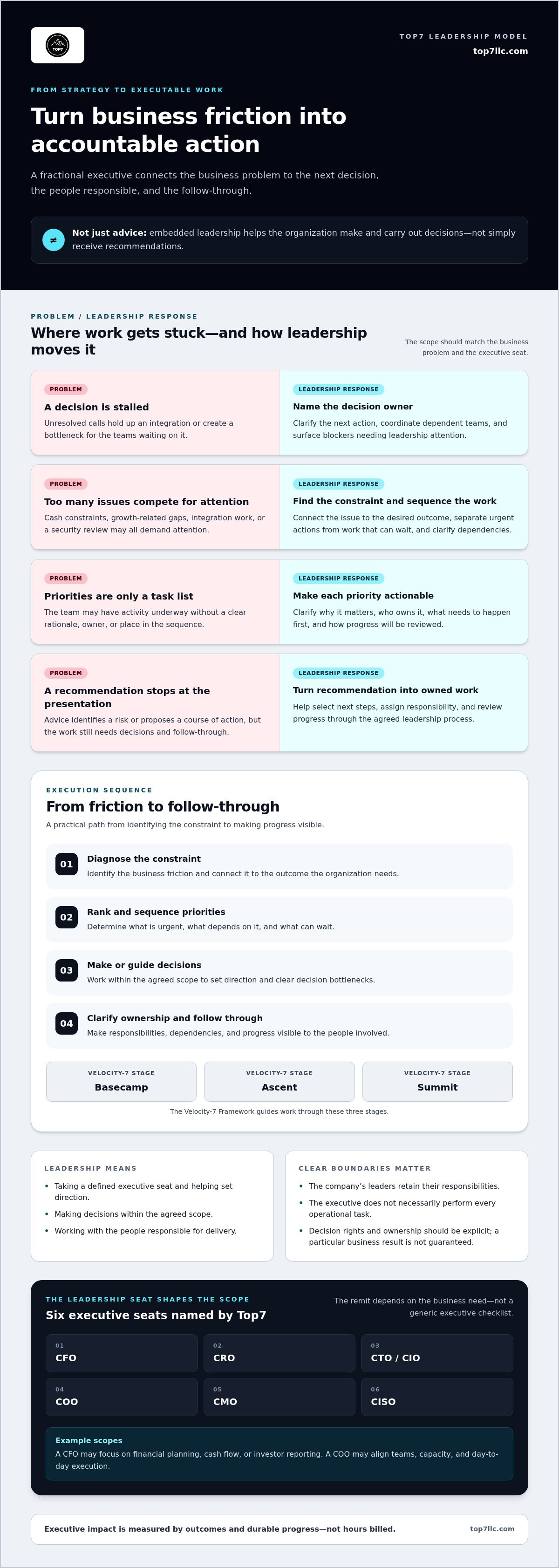
So, what does a fractional executive do beyond offering an experienced opinion? They step into a leadership seat, help set direction, make decisions within the agreed scope, and work with the people responsible for delivery. Their remit depends on the executive seat and the business need. A CFO may focus on financial planning, cash flow, or investor reporting; a COO may align teams, capacity, and day-to-day execution. The role isn’t simply to identify a problem. It’s to help the organization decide what happens next, who owns it, and how progress will be tracked.
This overview of What is a Fractional Executive? offers additional context on the model and how it differs from consulting.
For a closer look at how fractional work functions in practice, watch:
What responsibilities can a fractional executive own?
The scope should match the leadership seat and the business problem, not a generic executive checklist. Depending on the role, a fractional leader may:
Set priorities and clarify which decisions need executive attention.
Align teams around responsibilities, dependencies, and the outcome they’re working toward.
Assign owners to agreed actions and establish how progress will be reviewed.
These are examples, not a promise that every engagement includes every responsibility. Before work begins, clarify what the executive owns, which decisions they can make, and how progress will be assessed.
How is executive leadership different from advice?
Advice can identify a risk or recommend a course of action. Executive leadership goes further by working within the organization’s decision-making and operating structure. The leader helps turn a recommendation into a priority, clarifies who needs to act, and follows the work through the agreed process. That creates accountability for the work, not a guarantee of a particular business result.
For example, an advisor might recommend improving a company’s forecasting process. An executive in the leadership seat can help select the next steps, assign responsibility to the relevant team, and review progress in leadership discussions. The distinction is practical: recommendations inform a decision; embedded leadership helps the organization make and carry out that decision.
That doesn’t mean the executive takes over every function or makes every call. The company’s leaders still set the context and retain their responsibilities. A strong engagement makes decision rights and ownership explicit, so the executive’s judgment leads to action rather than ending in a presentation.
How Fractional Executives Turn Strategy Into Executable Work
Strategy creates value when it changes what the organization does next. A fractional executive connects the steps: diagnose the constraint, rank the work, make or guide decisions within the agreed scope, and follow through with the people responsible for delivery. This turns a broad goal into work the team can act on.
The executive doesn’t need to perform every operational task. They bring senior judgment, set direction, clear decision bottlenecks, and coordinate ownership while working alongside the team. Executive impact is measured by outcomes and durable progress, not hours billed.
From business friction to ranked priorities
Start with the friction the business needs to resolve. Is cash constraining choices? Is growth exposing operational gaps? Is an integration competing for leadership attention, or is a security review creating a decision bottleneck? The executive connects the problem to the desired business outcome, then helps separate urgent actions from work that can wait.
A useful priority is more than a task on a list. It has a clear rationale, an owner, and a place in the sequence. When several issues compete for attention, the executive helps leadership determine which one is the constraint, what depends on it, and what should happen next. This makes it easier to distinguish activity from progress.
How leadership creates accountability across a team
Once priorities are clear, accountability means making ownership visible. The executive helps clarify who is responsible for each action, what needs to happen first, and how progress will be shared with decision-makers. This isn’t about imposing one team structure on every company. It’s about connecting the functions involved so handoffs and dependencies don’t stall the work.
For example, if an integration is delayed by unresolved decisions, the leader can identify the decision owner, establish the next action, and coordinate the teams whose work depends on it. The executive isn’t necessarily performing each task. They’re keeping responsibility and sequence clear, then surfacing blockers that need leadership attention.
At Top7, the Velocity-7 Framework gives this work a defined progression: Basecamp, Ascent, and Summit. Basecamp focuses on assessment and stabilization, Ascent on planning and execution, and Summit on systematizing the work and preparing the handoff. The stages are Days 0-30 for Basecamp, Days 30-60 for Ascent, and Days 60-90 for Summit. Each engagement also has one point of contact to connect leadership priorities with execution and the handoff.
A useful handoff leaves more than a list of completed tasks. Where relevant, it documents decisions, ownership, and processes the team needs to carry the work forward. This clarifies the next move when the executive’s role changes or concludes. Learn more about Top7’s Velocity-7 Framework.
Fractional vs. Interim vs. Project Leadership: What Changes?
These three engagement models differ in the problem they’re designed to solve, the commitment involved, and what marks the work as complete. Choose based on the leadership capacity you need, not on which label sounds most attractive. Ongoing leadership, temporary seat coverage, and a defined project require different arrangements.
The distinctions are practical. Fractional leadership provides ongoing executive ownership for a continuing need. Interim leadership covers an open seat for a defined period. Project leadership focuses on a bounded piece of work with its scope and endpoint established up front.
When does each engagement model fit the need?
Use the business problem as your decision filter. If leadership capacity is persistently stretched and decisions need an ongoing executive owner, Fractional may fit. If an unexpected departure leaves a seat open and the organization needs full-time coverage for a defined term, Interim may fit. If the work has a clear boundary, deliverable, and end date, Project keeps the focus on completing that scope.
Ask what must be true at the end. Is the business looking for sustained leadership, continuity in an open seat, or completion of a specified outcome? The answer helps define the engagement before work begins and makes accountability clearer.
How does fractional leadership compare with full-time hiring?
A traditional full-time executive role involves a full-time commitment to the organization. Fractional leadership provides senior judgment on an ongoing, part-time basis, with responsibilities shaped around the company’s needs. The difference is the commitment and scope the leader owns, not the importance of the decisions.
This distinction matters when the leadership gap is real but doesn’t call for a full-time executive seat. A company may need experienced direction on a continuing priority while its existing team handles day-to-day work. A fractional executive can provide leadership capacity around that need without treating every gap as a reason to add a permanent role.
So, what does a fractional executive do in this model? They provide ongoing, part-time leadership inside the organization, with work shaped around the agreed need. Fractional, Interim, and Project each define a different commitment pattern. Make the choice by naming the gap, the scope of ownership, and the point at which the work should end.
When Should a Company Bring in a Fractional Executive?
Bring in senior leadership when a capacity gap is slowing decisions, weakening execution, or leaving an important outcome without an accountable executive owner. Don’t start with the title. Start with the problem. Adding an executive seat won’t fix unclear priorities if nobody has identified what’s blocking progress.
Work through these four questions to assess the need:
What is blocked? Name the decision, business function, or outcome that has stalled.
How urgent is it? Decide whether the gap is an ongoing constraint, a sudden vacancy, or a bounded piece of work.
Which seat owns the problem? Match the required judgment and decision-making responsibility to the executive function.
What shape should the engagement take? Define the expected outcome, authority, and people the executive needs to work alongside.
This sequence turns a vague concern, such as “we need more leadership,” into a business problem you can act on. It also helps prevent a mismatch between the work and the executive seat.
Which leadership gap is blocking progress?
Match the seat to the decision the company needs to make or the function that needs leadership. Cash constraints, financial planning, or investor reporting point toward CFO responsibilities. Technology direction, system priorities, or a technology integration may call for CTO/CIO leadership. Revenue execution that lacks clear ownership aligns with CRO responsibilities.
Other business problems point to different seats. Scaling challenges across day-to-day delivery may require COO leadership; a gap in marketing direction may call for a CMO; and a security review that needs executive ownership may require CISO leadership. These are starting points, not rigid rules. The right seat depends on the problem and the leadership responsibility needed to move it forward.
What should leaders clarify before choosing a model?
Be precise about the shape of the gap. Does the company need ongoing leadership capacity, full-time coverage for a temporarily open seat, or focused leadership around a bounded deliverable? Then define the outcome, which decisions the executive can own, and which internal people need to be involved. Clear boundaries help the leader contribute without duplicating existing roles or leaving decision rights ambiguous.
For example, a scaling challenge may involve both operational decisions and revenue priorities. Clarify which issue is holding up progress, where executive ownership should sit, and how the relevant teams will coordinate. The answer should reflect the organization’s needs, not a desire to add another title to the org chart.
When a leadership-capacity gap is holding back a defined business priority, review Top7’s executive leadership options to understand how the leadership seat and engagement model can align with the work ahead.
How Top7’s Fractional Executives Move From Assessment to Handoff
Senior leadership creates lasting value when the work is clear, owned, and carried forward. Top7’s six seats are CFO, CRO, CTO/CIO, COO, CMO, and CISO. Every engagement has one point of contact and uses the Velocity-7 Framework to guide assessment, execution, and handoff. This structure connects leadership work from the initial diagnosis through the next steps.
The framework has three stages: Basecamp, Ascent, and Summit. Each stage has a practical focus, helping leaders see what’s being assessed, what’s moving into execution, and what the organization needs to sustain afterward.
Basecamp, Ascent, and Summit: the three stages
Basecamp, Days 0-30: Assess & Stabilize. The work starts by assessing the business situation, surfacing blockers, and establishing priorities. The stage delivers an honest diagnostic and a ranked list of blockers, giving leaders a grounded basis for decisions.
Ascent, Days 30-60: Plan & Execute. Priorities become a sequenced plan, with early wins and an accountable leader helping keep the work moving. The focus is on connecting decisions with the people and actions needed to carry them out.
Summit, Days 60-90: Systematize & Hand Off. Documented playbooks help the team continue the work, alongside a clear view of ongoing responsibilities. The stage also clarifies whether additional leadership capacity is needed and supports a clear hire decision.
The sequence matters. Assessment without execution leaves blockers in place. Execution without a handoff can leave the organization dependent on knowledge held by one person. By building next actions, ownership, and documentation into the progression, Velocity-7 helps the team carry work forward beyond the engagement.
What the handoff and next step are designed to clarify
A useful handoff makes the work understandable to the people who will continue it. Documented playbooks can capture relevant processes, decisions, and responsibilities, supporting continuity as leadership needs change. For a COO engagement, a named deliverable may be the 100-Day Operational Plan. This plan is specific to that COO work, not a standard deliverable for every seat.
The healthcare services case study illustrates a project outcome involving ransomware response and an Attorney-General-ready report: 8 Weeks FROM ENGAGEMENT START TO AN AG‑READY FINAL REPORT. It shows how a defined need can move through focused leadership work toward a concrete deliverable. It does not mean every engagement follows the same timeline or produces the same result.
If you’re ready to clarify the leadership gap and the right next step, Book a 15-minute conversation, no pitch deck.
Turn the Leadership Gap Into a Clear Next Move
The useful question isn’t whether your company needs another executive title. It’s where decisions are stuck, what responsibility is missing, and what must move forward. Knowing what does a fractional executive do helps focus the decision: which leadership gap needs attention, and what kind of engagement fits the work?
Leadership should create momentum the organization can sustain. One point of contact and Velocity-7’s staged work and deliverables help keep ownership visible from assessment through handoff. The healthcare services case study records 8 Weeks FROM ENGAGEMENT START TO AN AG‑READY FINAL REPORT. That is a concrete example, not a promise that every engagement has the same scope or result.
If an unresolved leadership gap is slowing an important business priority, take the next step with a focused conversation. Book a 15-minute conversation, no pitch deck, and clarify what needs to change, who should own it, and how to move the work forward.
Frequently Asked Questions
What does a fractional executive do?
A fractional executive provides ongoing, part-time senior leadership, with responsibilities shaped by the role and business need. The work may include setting priorities, making decisions, aligning teams, or leading execution. The key distinction is that the executive works in the client organization’s leadership role rather than only delivering recommendations. For example, they may help turn a priority into clear decisions and owned next steps.
Is a fractional executive the same as a consultant?
Not necessarily. A consultant may advise on a defined problem, while a fractional executive provides leadership within a company’s executive seat. The difference comes down to the work and accountability, not the label alone. For example, advice might identify a gap in sales reporting; an embedded executive may help set the reporting priority, align the responsible people, and lead follow-through within the agreed scope. Top7 pairs senior leadership with execution support.
How many hours a week does a fractional executive work?
There isn’t one weekly schedule that applies to every fractional engagement. The commitment depends on the leadership need, agreed responsibilities, and intended outcome. Top7’s Fractional model is ongoing, part-time leadership embedded in the client team for as long as needed. Rather than using hours to measure progress, define the decisions, priorities, or deliverables the executive owns. This keeps expectations focused on business needs instead of an assumed schedule.
How is a fractional executive different from an interim executive?
A fractional executive provides ongoing, part-time leadership for a continuing need. Interim leadership provides full-time coverage for a defined term when a leadership seat opens unexpectedly. The difference is the engagement pattern and situation, not necessarily the executive’s title. A company that needs continuing senior finance leadership may use a fractional model, while an unexpected vacancy requiring full-time coverage points to interim leadership.
How quickly can a fractional executive start?
Top7 states that a senior operator can be placed in the seat within weeks, rather than waiting through a six-month full-time hire. This is Top7’s stated differentiator, not a guaranteed start date for every engagement. Timing depends on the specific leadership need and agreed scope. To make the start productive, clarify the immediate decisions, access to relevant people, and first priorities the executive will take on.
What happens after a fractional executive engagement ends?
The handoff is intended to make the next operating step clear. In Velocity-7’s Summit stage, stated outputs include documented playbooks, a self-sustaining team, and a clear hire decision. These are framework deliverables, not guaranteed outcomes for every company. For example, a playbook can help the team understand how to continue a process without relying on the departing executive’s undocumented knowledge.
Can a company use project-based leadership without an ongoing executive engagement?
Yes. Top7 offers Project as one of its three ways to engage, with work scoped and time-boxed around a clear deliverable and end date. It can suit a defined need, such as completing a strategic planning deliverable, without requiring an ongoing fractional leadership engagement. The project scope establishes what the work is meant to produce; it doesn’t automatically convert into fractional or interim leadership afterward.



Comments