
Product-Market Fit Strategy: A Practical Guide to Finding and Sustaining Fit

What if your product isn’t one feature away from growth, but your team is measuring the wrong signals? A practical product-market fit strategy treats fit as a testable operating loop, not a launch milestone. That distinction matters when customer interest comes and goes, the roadmap keeps expanding, and growth metrics don’t show whether people truly value what you’ve built.
Those signals are easy to misread. A burst of sign-ups can look like demand. A feature request can sound like a buying signal. Neither proves that customers have an important problem your product solves well enough to keep using it.
This guide will help you identify a specific customer and problem, test assumptions with qualitative and quantitative evidence, and turn what you learn into focused product and go-to-market decisions. You’ll see how to read customer conversations alongside activation, retention, and time-to-value, then decide whether to refine, reposition, or scale. The goal is a repeatable way to find evidence, make the next call, and keep testing as the market changes.
Table of Contents
What Product-Market Fit Means, and What It Does Not Prove
Product-market fit exists when a product reliably meets an important need for a specific market. The key words are specific and reliably. A launch can attract attention without proving customers will keep using or buying the product. Early interest is a clue, not a verdict.
Teams can mistake activity for evidence. Press coverage, sign-ups, and enthusiastic conversations may show curiosity. Stronger evidence appears when intended customers use the solution repeatedly, return to its value, or choose it over their current workaround. Product-market fit is about the match between a product and a market, not applause at launch.
To see why customer conversations matter before building, watch this lecture:
How Is Product-Market Fit Different From Problem-Solution Fit?
Problem-solution fit asks whether a target customer has a meaningful problem and whether your proposed solution could address it. Product-market fit requires stronger evidence: the solution works well enough for a real market to adopt and continue valuing it. Interviews can reveal pain; customer behavior helps test whether the product resolves it.
Hypothetical example: Office managers say reconciling team expenses is frustrating and express interest in a proposed tool. That supports the problem hypothesis. If a defined group then adopts the tool, uses it for recurring expense cycles, and keeps choosing it, the evidence for product-market fit is stronger.
Product-market fit is not product popularity; it’s evidence that a specific market repeatedly values the solution. A spike in attention can fade. Look for behavior that persists beyond the first impression.
Why Is Product-Market Fit a Strategy Question?
A product-market fit strategy connects three assumptions: who the customer is, what outcome the product delivers, and whether the business model can serve that need. Features are only one part of the equation. A feature can be well built and still miss the customer, solve a low-priority problem, or fail to support a workable offer.
When those assumptions remain fuzzy, teams often reward visible activity: shipping more features, adding campaigns, or chasing every request. More output doesn’t establish whether the right customers value the product. Define what evidence would change your decision before investing further. That keeps product, marketing, sales, and financial choices anchored to the same customer need.
Fit is not a guarantee of profit, fundraising, or future growth. Markets shift, competitors respond, and customer needs evolve. Treat fit as a condition to test and sustain, not a trophy to claim after launch. The strategic advantage comes from learning what the evidence supports, then choosing the next move with discipline.
Build a Product-Market Fit Strategy Around Testable Customer Hypotheses
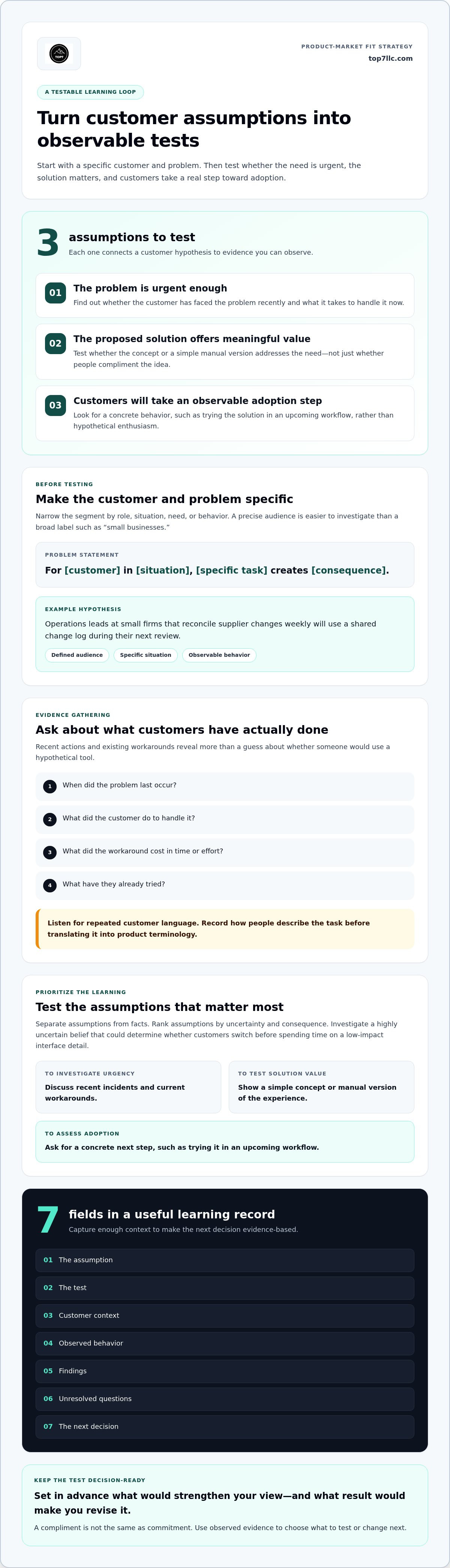
A useful product-market fit strategy starts with a customer you can describe precisely, not a market so broad it could mean anyone. Narrow the segment by role, situation, need, or behavior. “Small businesses” is a label, not a testable audience. “Operations leads at small firms who manually reconcile supplier changes every week” gives you a clearer group to investigate.
Start with the customer’s words. Ask about the last time the problem occurred, what they did to handle it, what the workaround cost in time or effort, and what they tried before. Avoid asking, “Would you use a tool that solved this?” That invites polite guesses. Recent actions and existing workarounds reveal more than hypothetical enthusiasm.
Define the Customer and Problem Before Expanding the Feature Set
Look for repeated language across conversations. If customers consistently describe a task as slow, error-prone, or difficult to hand off, record their wording before translating it into product terminology. Then form a focused problem statement: “For [customer] in [situation], [specific task] creates [consequence].” Keep the segment narrow enough that you can tell whether new evidence supports or challenges it.
Turn the Value Hypothesis Into a Learning Plan
Write down what must be true: the problem is urgent enough to address, the proposed solution offers meaningful value, and customers will take an observable step to adopt it. Separate assumptions from facts. Rank assumptions by uncertainty and consequence. A highly uncertain belief that determines whether customers will switch deserves attention before a low-impact detail about interface preferences.
A testable hypothesis links a defined customer to a specific action you can observe. For example: “Operations leads at small firms that reconcile supplier changes weekly will use a shared change log during their next review.” The hypothesis names the audience, situation, and behavior. It can be challenged. “Customers want a better workflow” can’t.
Pair each assumption with a low-risk test. To investigate urgency, interview customers about recent incidents and workarounds. To test solution value, show a simple concept or manual version of the experience. To assess adoption, ask for a concrete next step, such as trying it in an upcoming workflow. Set in advance what evidence would strengthen your view and what result would make you revise it. A compliment isn’t the same as commitment.
Keep a short learning record: the assumption, test, customer context, observed behavior, findings, unresolved questions, and next decision. This stops teams from treating the latest anecdote as a reason to change strategy. It also gives product, marketing, revenue, and technology leaders a shared basis for choosing what to investigate or build.
When the evidence points to a leadership or coordination gap, senior leadership for execution can help connect customer learning to accountable decisions. Keep the test at the center and let the evidence set the direction.
Measure Product-Market Fit With Multiple Signals, Not One Magic Number
No single metric can tell you whether customers truly value a product. A product-market fit strategy combines behavior data with customer feedback, then checks whether the evidence holds across customer segments and over time. A sign-up spike may show that a campaign reached people. It doesn’t show that they found lasting value.
Repeated customer behavior is stronger evidence than stated interest alone. What customers do after the first visit often reveals more than what they say they might do in a survey.
Which Quantitative Signals Help Reveal Fit?
Each metric answers a different question. Read them together, not as a scoreboard where one number settles the debate.
Retention: Do customers keep returning after initial adoption? Track whether they continue using the product at intervals that make sense for its purpose.
Repeat use or purchase: Do customers choose the product again for a recurring task or need? This helps show whether value extends beyond a first trial.
Conversion: Do people take a meaningful next step, such as starting a paid plan or completing onboarding? Conversion can reveal willingness to act, but it won’t explain whether customers stay.
Organic referrals: Do customers recommend the product without a direct incentive? Referrals can signal perceived value, but they don’t prove broad or durable fit on their own.
Growth needs context. A rise in sign-ups or revenue may reflect increased marketing spend, a promotion, or a temporary shift in demand. Compare results by acquisition source, customer segment, and time period. If conversion improves while retention weakens, find out which customers are arriving and where they lose value. Don’t let a blended average hide the pattern.
How Should Teams Interpret Customer Feedback?
Ask customers what they would miss if the product disappeared, which parts they actually use, and what problem it solves in their work. The Sean Ellis test asks active users how they’d feel if they could no longer use a product. If at least 40% say they’d be “very disappointed,” that’s a useful fit signal. It’s a heuristic, not a universal pass-or-fail threshold, and survey responses still need behavioral evidence.
Pair survey answers with interviews and observed usage. A customer may praise a product but rarely use it. Ask for a recent example: what were they trying to do, what did they use, and what happened next? That moves feedback from polite approval to specific evidence.
If feedback is positive but retention or repeat use is low, investigate the gap. Are customers praising an idea they haven’t adopted? Is onboarding delaying the first useful outcome? Does the product solve a real problem that occurs too rarely to drive regular use? Compare answers with behavior for the same segment and period, then test the most plausible explanation. The goal isn’t to collect flattering quotes. It’s to find out which customers get enough value to return, and why.
Use a Repeatable Product-Market Fit Process to Decide What Changes Next
A product-market fit strategy needs a decision loop, not a string of disconnected experiments. Run each test to answer one question, then let the evidence determine the next move. Keep the cycle simple enough to repeat:
Define a segment. Choose a specific customer group and situation. Avoid changing the audience halfway through a test.
State an assumption. Name what you believe about the customer, problem, value, or behavior, and what observable result would support it.
Run a test. Select the smallest practical test that can challenge the assumption without building or scaling prematurely.
Review the evidence. Compare observed behavior with your threshold, and note differences across relevant customer groups.
Choose an action. Continue, adjust one major assumption, narrow the segment, or stop the test and record why.
That final step is where discipline often breaks down. Teams collect findings, then keep building the same roadmap regardless. Decide in advance what result would change your view and set a review date. Record the assumption, test, customer segment, evidence, decision, and unresolved questions in one shared place. When a similar idea resurfaces, the team can see what was already tested instead of repeating an abandoned bet.
Choose Tests That Match the Risky Assumption
Use discovery interviews when the uncertainty is whether the customer has a real, urgent need. Use a prototype when the question is whether people can understand or complete a task. Test pricing or packaging only when willingness to pay or offer structure is the uncertainty. Before results arrive, define the evidence threshold and review date. Otherwise, teams can keep moving the goalposts to protect a preferred idea.
Decide Whether to Persevere, Pivot, or Narrow the Market
Continue when customer feedback and observed behavior support the same value hypothesis. If evidence points to a mismatch, change one major assumption at a time, such as the segment or offer, so the next test teaches you something. Narrow the market when a smaller group shows clearer need and stronger engagement. Stop a weak test when it fails to meet its preset threshold, then capture what that result rules out.
A strategic change addresses a specific mismatch in the customer, problem, value, or adoption path. Adding features without evidence of a customer need is not a pivot. It’s more activity without a sharper answer. Tie the decision to what the test revealed, and give the next experiment a question that could prove your current view wrong.
If customer evidence is clear but ownership across product, revenue, marketing, and technology is not, work with Top7 to coordinate execution around the next decision.
Connect Product-Market Fit Strategy to Leadership and Execution
Customer evidence changes a business only when someone turns it into coordinated action. Product may use it to set priorities, marketing to sharpen positioning, revenue teams to focus on the right buyers, and technology leaders to assess what can be delivered. If each function trusts different evidence or owns a different goal, the company can keep moving without moving toward fit.
A practical product-market fit strategy therefore needs both a shared view of the customer and clear decision ownership. Top7’s Velocity-7 Framework connects diagnosis, execution, and handoff through three stages.
Move From Diagnosis to an Accountable Plan
The stages create a sequence for turning market evidence into focused work. Each has a defined period and purpose:
Basecamp, Days 0-30, Assess & Stabilize: Assess the business and produce an honest diagnostic with a ranked list of blockers.
Ascent, Days 30-60, Plan & Execute: Build a sequenced plan, pursue early wins, and assign an accountable leader.
Summit, Days 60-90, Systematize & Hand Off: Document playbooks, build a self-sustaining team, and make a clear hire decision.
For product-market fit work, this means connecting what customers say and do to decisions about the offer, roadmap, and go-to-market execution. The stages clarify what needs attention, who owns the next move, and how the work can continue after the engagement.
Choose the Leadership Model That Fits the Work
The right leadership focus depends on the bottleneck. Technology delivery may need a CTO/CIO; revenue, marketing, operations, finance, or security priorities may involve a CRO, CMO, COO, CFO, or CISO. These six seats bring distinct responsibilities, but the decisions still need to connect to the same customer evidence.
Top7 offers three ways to engage: Fractional, Interim, and Project. Each engagement has one point of contact and is measured in outcomes, not hours billed. That structure keeps ownership visible while leaders coordinate across functions instead of letting critical customer decisions fall between teams.
Before adding features or increasing spend, identify the evidence-based decision the team needs to make and name who will own it. If senior leadership can help turn that decision into an accountable plan, schedule a 15-minute initial consultation. 15 minutes, no pitch deck.
Make Your Next Product Decision Evidence-Led
Fit isn’t a box to check once. Treat your product-market fit strategy as an operating discipline: keep listening, watch what customers do, and be willing to change course when the evidence shifts. The next advantage may not come from building more. It may come from making one clearer decision about whom you serve and what value you deliver.
If the evidence is there but execution is stalled, senior leadership can help align the work and assign ownership. Use the next test to clarify the decision in front of your team, then give someone clear responsibility for acting on what you learn.
Choose the next test, name who owns it, and move forward with focus. Better decisions start with evidence. Book 15 minutes, no pitch deck, to discuss your team’s next decision with Top7.
Frequently Asked Questions
How long does it take to achieve product-market fit?
There’s no universal timeline. Progress depends on how quickly your team can reach the right customers, test assumptions, observe real behavior, and respond to what it learns. A launch date doesn’t start a reliable countdown, and waiting for traction isn’t a plan. Keep a decision log showing what each test changed and which assumptions remain unresolved. That makes slow learning visible and helps the team choose a sharper next experiment.
Is the 40% rule a reliable way to measure product-market fit?
The 40% rule is a useful survey heuristic, not a definitive test or guarantee. Its result can shift depending on who responds and how the question is worded. For example, surveying only your most active users may overstate how broadly the product matters. Compare the response with retention, repeat use or purchase, customer interviews, and results by segment. If people say they’d miss the product but stop using it, investigate the gap before changing strategy.
Can a business have product-market fit without being profitable?
Yes. Strong evidence that customers value a product doesn’t prove the business can serve them profitably. Costs, pricing, margins, and the business model all affect financial sustainability. A subscription product, for example, may retain customers while spending too much to acquire or support them. Analyze customer demand and unit economics as separate questions, then connect them in planning. Fit can be real while the path to profitable delivery still needs work.
Does product-market fit change over time?
Yes, fit can weaken as customer needs, competing alternatives, market conditions, or expectations change. A workflow that once felt distinctive may become harder to use than a newer option, or a customer segment may adopt different tools. Watch for shifts in renewal patterns, usage frequency, support requests, and customer language. Compare those signals over time within important segments. Don’t assume past success settles the question; keep listening and adjust when evidence changes.
Can a B2B company measure product-market fit differently from a consumer product?
Yes. The core question is the same, but B2B buying and usage involve different behaviors. A B2B team might examine whether employees continue using the product after rollout, whether the customer renews or expands usage, how implementation went, and whether key stakeholders see value. A consumer app may rely more on individual repeat use or purchase. Choose signals that match your buying process, and don’t apply a consumer benchmark without context.
What should a company do after it finds product-market fit?
Use the evidence to make focused growth decisions, not to scale every channel or feature at once. Identify which customer segment and value proposition show the strongest results, then strengthen delivery for that group. For example, improve onboarding or customer support before expanding acquisition if new customers struggle to reach value. Monitor whether the signals persist, and validate again before entering a new segment. Growth changes the audience, so the old evidence may not transfer.



Comments