
Technology Strategy for Mid-Market Growth: Stop Managing IT and Start Driving Velocity

If you’re researching technology strategy, the key question is whether technology is being steered toward business growth. More software and more projects won’t fix a strategy that creates friction instead of momentum.
If delivery feels slow, tech spending is hard to connect to business outcomes, and executive-level leadership seems out of reach, the frustration is real. Treating technology as a cost center won’t create a growth plan. Mid-market companies need clear priorities, decisive leadership, and execution that keeps pace with the business.
This article explains how a Fractional CTO and the Top7 Adaptive Framework can help turn technology into an engine for growth without adding a full-time executive to payroll. You’ll see how to build a practical technology roadmap, reduce operational friction, and connect investment to business outcomes. We’ll look at why technology strategy is a leadership and execution challenge, then outline how an adaptive framework can help move an organization from stalled delivery to focused action.
Table of Contents: technology strategy philadelphia
Why Most Technology Strategies Fail to Drive Business Velocity
A technology strategy fails when it tracks activity instead of business outcomes. New tools are deployed, tickets are closed, and projects are marked complete, yet sales teams still wait for essential capabilities, customers encounter friction, and growth plans stall because the systems behind them can’t keep pace.
A useful strategy connects technical execution to priorities such as faster delivery, smoother customer experiences, and the capacity to serve more demand. A foundational technology strategy aligns technology choices with broader organizational goals. The practical test is simple: can leaders explain how each major technology decision supports a business result?
IT support is the baseline. It keeps systems available and resolves day-to-day issues. Strategy sets direction, sequences investment, and gives teams a way to turn business priorities into execution. Without that leadership, technology risks becoming an expensive utility rather than a source of business advantage.
The Difference Between Managing IT and Leading Strategy
IT management focuses on reliability and operational needs. Technology leadership also looks ahead: which capabilities will remove barriers to growth, and which projects should wait? These are distinct responsibilities, not a judgment on an IT manager’s ability. Strong operational expertise doesn’t automatically include the mandate or experience to set company-wide direction.
Reactive spending follows the loudest issue: patch a system, add a tool, or rush a feature into production. Proactive investment starts with the business objective, then weighs options against impact, risk, and capacity. That discipline helps prevent scattered purchases and work that uses resources without advancing growth.
Signs Your Current Tech Strategy Is a Growth Bottleneck
Look for patterns rather than isolated mishaps. A missed deadline can happen; repeated delays across important initiatives point to a deeper constraint. A “feature factory” is another warning: teams fulfill requests one after another, but nobody checks whether those features improve customer outcomes or business performance.
Priorities keep shifting. Teams start work before leaders agree on what success looks like.
Technical talent is losing direction. Constant firefighting and unclear priorities can make skilled people question the purpose of their work.
Demand exposes system limits. As customers or transactions increase, slow processes and fragile systems create more delays and manual work.
A technology constraint can slow teams across the company, from sales to customer service. Ask whether the tech team is helping the business produce more value or simply keeping an increasingly costly utility running. The answer should shape what to fix, fund, and stop doing next.
The Velocity-7 Adaptive Framework: Aligning Tech with Flow
Buying another tool won’t fix a business process that leaves work stuck between teams. The Velocity-7 Adaptive Framework is Top7’s proprietary approach to finding that friction and aligning leadership, technology, and execution around business priorities. The goal isn’t to make technical teams busier. It’s to help the organization move valuable work forward with fewer avoidable delays.
That requires a whole-business view. Leaders need to connect customer demand and sales insight to product decisions, financial priorities, operating workflows, leadership accountability, and the technical capacity to scale. These are connected dimensions of growth, not separate projects to hand off and forget. Priorities may shift as the business changes, so technology choices need to stay tied to what the organization is trying to achieve.
This distinction reflects the essence of strategy: operational efficiency matters, but it isn’t the same as choosing and executing a direction that creates business advantage. Agile practices can support that direction, but ceremonies alone won’t create it. The work must include the people making decisions, the teams delivering change, and the leaders responsible for results.
Breaking Down the Velocity-7 Dimensions
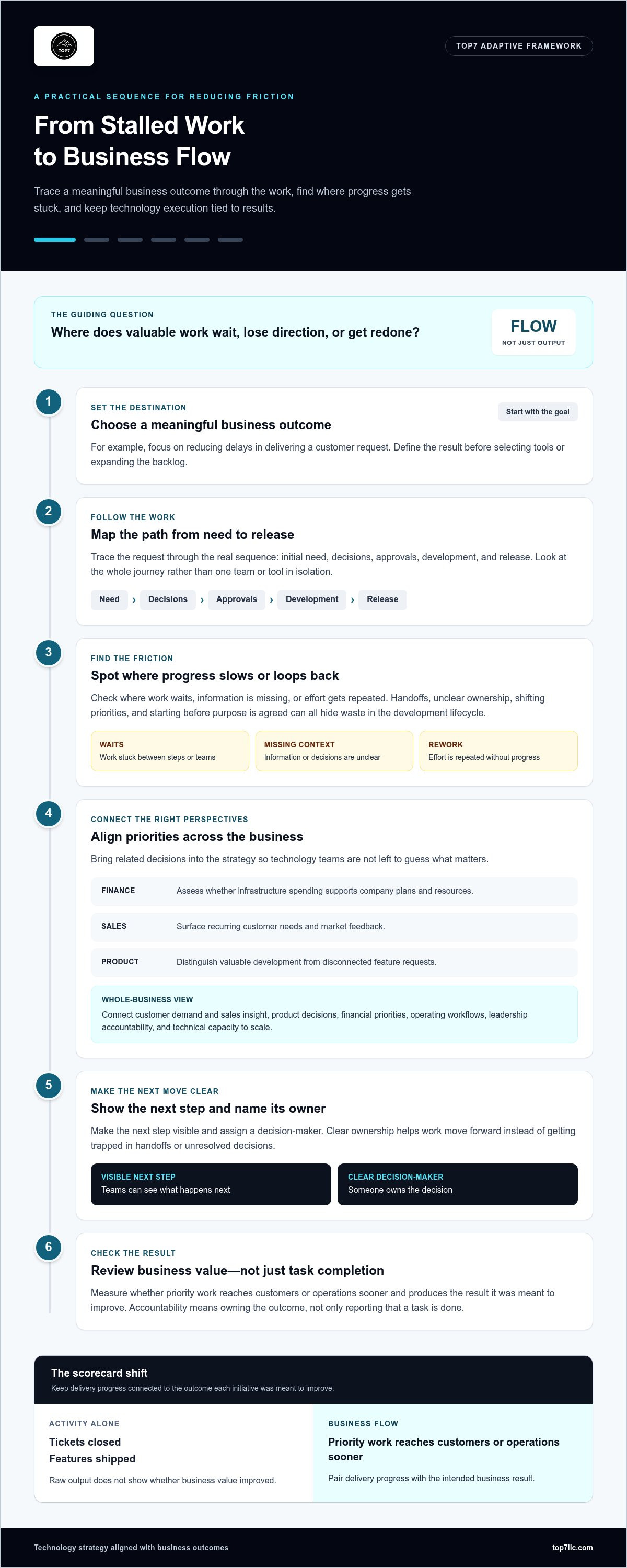
Start by tracing a meaningful business outcome, such as reducing delays in delivering a customer request. Follow the work from the initial need through decisions, approvals, development, and release. Where does it wait? Where is information missing? Where does work get redone? Investigate those friction points before adding tools or expanding a backlog.
Then connect priorities across functions. Finance can help assess whether infrastructure spending supports the company’s plans and resources. Sales can surface recurring customer needs and market feedback, helping product leaders distinguish valuable development from disconnected feature requests. The framework brings those conversations into the strategy rather than leaving technology teams to guess.
Moving from Operational Friction to Efficient Flow
Waste in a development lifecycle often hides in handoffs, unclear ownership, shifting priorities, or work started before its purpose is agreed. Make the next step visible, assign a decision-maker, and review whether completed work delivered its intended business value. Accountability means owning the outcome, not just reporting that a task is done.
Measure velocity in terms a CEO can use: whether priority work is reaching customers or operations sooner and producing the intended business result. Raw output, such as tickets closed or features shipped, is not enough. Pair delivery progress with the outcome each initiative was meant to improve. That keeps agile leadership focused on impact across the organization, not activity inside one team.
For mid-market companies looking to turn these principles into coordinated action, Fractional CTO and strategic leadership can connect technical execution to business priorities.
Fractional CTO vs. The $300k Full-Time Executive Mistake
A full-time CTO can be the right move when a business needs sustained, day-to-day technology leadership. But hiring one by default can commit a mid-market company to a full-time executive before it understands how much leadership it needs. Salary is only one part of the equation: benefits, potential equity, recruiting effort, and the time leaders spend on a search all factor into the decision.
A Fractional CTO provides senior technology leadership at a defined level of involvement. Rather than paying for a full-time role regardless of workload, the business can focus leadership on priorities such as setting direction, resolving delivery constraints, guiding an existing team, or managing a critical transformation. The useful question isn’t “Do we need a CTO?” It’s “What leadership work must get done, and at what level of involvement?”
The Hidden Costs of Full-Time Executive Hiring
Executive hiring involves costs beyond compensation. A search can take months, and time without clear technology direction can prolong stalled decisions or delayed initiatives. Equity can create lasting dilution, while benefits add ongoing commitments. A poor fit at the executive level can also unsettle a team, disrupt priorities, and force the company to start over.
Before committing, define the outcomes the role must own. Separate ongoing operational oversight from strategic decisions and transformation work. That makes it easier to decide whether the business needs a permanent executive, fractional leadership, or a transition between the two.
When Fractional Leadership Is the Superior Choice
Fractional leadership can be a strong fit when priorities are changing quickly, a specific transformation needs experienced direction, or a technical team needs strategic mentorship. For example, a legacy-to-cloud transition involves decisions about sequencing, risk, business continuity, and team capacity, not just technology selection. A fractional leader can help set that direction while working with the people responsible for delivery.
Move from a full-time hiring assumption to a fractional model deliberately:
Identify the business outcomes. Name the decisions and obstacles leadership must address.
Set the scope. Clarify which work requires executive judgment and which belongs with the operating team.
Agree on progress measures. Tie leadership activity to visible movement on business priorities.
Reassess the need. As the company grows, review whether the level of involvement still fits.
Fractional CTO support can put experienced leadership alongside the team, help relieve executive overload, and give growth-critical decisions an owner. Choose the model that matches the work, not the prestige of the title.
Designing a 90-Day Technology Roadmap for Maximum Impact
A roadmap matters only if it changes what the business can deliver. Use the next 90 days to expose constraints, align leaders on outcomes, execute a small number of high-value changes, and adjust based on what the work reveals. This isn’t a promise to fix every system in one quarter. It’s a disciplined way to replace scattered requests with decisions the organization can act on.
Start With an Organizational Audit
Trace how work moves through the business, from customer need to delivery. Review the technology stack for scalability, security, dependencies, and recurring points of failure. Look for manual workarounds, duplicate tools, slow approvals, and systems that make routine tasks harder than they should be.
Assess team performance by examining delivery quality, rework, handoffs, and unclear ownership, not just task volume. Connect software and hardware investments to actual business use. Which tools support important workflows? Which costs are hard to justify because adoption or outcomes are unclear? The audit should produce evidence and questions to resolve, not a wish list of replacements.
Align Stakeholders Around Business Outcomes
Before choosing projects, bring technology, sales, finance, and operational leaders into the same conversation. Sales can identify customer needs and delays that affect the buying experience. Finance can clarify spending priorities and constraints. Together, stakeholders can define concrete outcomes, such as reducing a specific handoff delay or making a customer-facing process more reliable.
Make trade-offs explicit. If a project is important, agree on what will be deprioritized to make room for it. A roadmap without ownership and capacity is just a list of intentions.
Execute in Focused Sprints, Then Iterate
With priorities agreed, select a manageable first wave of work based on business value, feasibility, and risk, not on which technology sounds most interesting. Set a regular cadence to review progress, surface blockers, make decisions, and demonstrate completed work to stakeholders. Explain the reason for each priority across the organization so teams understand what’s changing and how success will be judged.
Use the Velocity-7 Adaptive Framework as an ongoing discipline, not a one-time planning exercise. At the end of each cycle, compare results with intended outcomes, learn from friction, and adapt the next set of priorities. Keep the roadmap visible and revise it when business needs change. The point is steady movement toward valuable results, not rigid adherence to a plan that no longer fits.
Top7’s strategic planning and Fractional CTO leadership connect roadmap priorities to execution.
Executing the Pivot: Transforming Tech into a Profit Center
Technology becomes a growth asset when it helps the business serve customers, make decisions, and deliver work more effectively. The pivot starts by exposing friction, agreeing on business priorities, and giving someone the authority to turn those priorities into execution. Top7’s Velocity-7 Adaptive Framework links leadership and technical work so progress is measured by business outcomes, not activity alone.
That change takes more than advice delivered in a slide deck. Top7’s seasoned professionals embed directly with clients, working alongside leadership to address complex growth obstacles and keep plans connected to operating needs. Fractional leadership offers a practical option for mid-market organizations that need experienced direction without building every executive role as a full-time position.
How Top7 Embeds with Your Leadership Team
Embedded leadership brings strategic decisions closer to execution. A Fractional CTO can help set technology priorities, guide delivery, and work with the existing team to remove obstacles. The wider leadership conversation matters too: financial strategy shapes how investment is prioritized, while sales guidance helps ensure product and technology decisions respond to customer and market needs.
The objective is shared accountability. Leaders align on the outcomes that matter, technical teams understand the business context, and progress is evaluated against agreed priorities. This approach addresses a leadership gap without assuming every company needs a full-time executive for every function.
Your Next Move: Strategic Planning
Technology friction rarely resolves itself. Delayed decisions can keep teams tied up in workarounds and leave growth plans dependent on systems or processes that aren’t keeping pace. Strategic planning gives leaders a way to identify the constraint, set a direction, and decide what action comes first.
Start with a clear view of where work stalls, which business outcomes matter most, and who will own the next decisions. Put those priorities into motion and review progress as conditions change. The Velocity-7 Framework connects alignment and execution, helping turn technology from a source of drag into a platform for forward movement.
Top7’s strategic leadership can help connect technology priorities to business execution.
Turn Technology Into Your Next Growth Advantage
Technology should move the business forward, not trap teams in delays, rework, and disconnected priorities. The shift starts when technical decisions are tied to business outcomes and carried through with clear leadership and execution. A focused roadmap helps identify where work gets stuck, align teams on what matters, and direct effort toward changes with real value.
Top7’s proprietary Velocity-7 Adaptive Framework helps mid-market organizations move from friction to flow. With leadership embedded directly in the work, strategy doesn’t end as a presentation. It becomes coordinated action across technology and the business, guided by people who can help turn complex challenges into forward momentum.
Don’t let unclear priorities keep growth on hold. Talk to Top7 about bringing focused leadership and execution to your next stage of growth.
Frequently Asked Questions
What is the difference between a Fractional CTO and a technical consultant?
A Fractional CTO provides ongoing executive-level technology leadership, while a technical consultant typically advises on a defined issue or project. A Fractional CTO can help set priorities, connect technology decisions to business goals, and guide a team through execution. A consultant may contribute specialized recommendations, while company leaders remain responsible for setting direction and coordinating the broader strategy.
How does the Velocity-7 framework actually reduce operational costs?
The Velocity-7 Adaptive Framework helps identify friction that can waste resources, such as duplicated tools, avoidable rework, unclear ownership, and processes that rely on manual workarounds. Leaders can then prioritize improvements based on business value instead of adding technology by default. The framework supports better spending decisions, while savings depend on the organization’s starting point and the changes it implements.
Can a Fractional CTO manage my existing offshore development team?
A Fractional CTO can provide strategic direction and help align an existing development team, including an offshore team, around business priorities. This can include clarifying outcomes, setting priorities, addressing blockers, and creating accountability for delivery. The goal is to connect the team’s work to business needs, not simply assign more tasks. Responsibilities and working cadence should be clearly defined as part of the engagement.
How long does it take for a Fractional leader to make a measurable impact?
There’s no universal timeline for measurable impact. It depends on the organization’s systems, decision-making speed, team capacity, and the problem being addressed. A leader can begin by identifying obstacles and aligning priorities, but meaningful results require execution and a way to measure progress. Set a baseline, choose clear business outcomes, and review progress regularly rather than relying on activity reports alone.
Is our company too small or too large for a Fractional CTO?
Fit depends less on headcount than on the need for technology leadership and the level of involvement required. A growing company may need strategic direction without a full-time executive, while a larger organization may use fractional leadership to address a specific gap or transformation. Top7 focuses on mid-market growth obstacles, helping organizations connect technology decisions to priorities and execution.
What happens if we need a full-time CTO later down the road?
A Fractional CTO can help clarify the responsibilities, priorities, and leadership capacity the business will need as it grows. That creates a stronger foundation for a future full-time role, including a clearer scope and a more organized technology roadmap. Fractional leadership doesn’t prevent a later transition. It can help the organization make that decision based on evolving business needs rather than assumption.
Do you provide software development services alongside strategy?
Top7 provides technology leadership and strategic execution support. A Fractional CTO can help define business requirements, prioritize development work, and guide an existing internal or external team toward agreed outcomes. This keeps strategy connected to delivery, with a focus on helping the organization make sound choices and move work forward.
How do you handle data security and compliance within the strategy?
Security and compliance should be considered as part of technology planning, not bolted on after decisions are made. Strategic leadership can help assess key systems and risks, clarify who owns security decisions, and prioritize work in light of the organization’s obligations and business needs. Specific requirements vary by industry and environment, so plans should reflect the company’s systems, data, and applicable standards.



Comments