

Signs Your Operations Can’t Keep Up With Growth: The C-Suite Friction Audit
- Robert Fitzgerald
- Jul 2
- 11 min read

Growth is the ultimate diagnostic tool. It doesn't just build companies; it exposes every structural crack in your foundation. If you're currently the primary bottleneck for every minor decision while your best talent burns out on manual tasks, you've hit the wall. These are the undeniable signs your operations can't keep up with growth, and treating them with more hustle is a direct path to a permanent stall.
You've fought for this expansion, but now your reward is a calendar full of fires and rising customer churn. It's time to stop pretending that working longer hours will fix a broken system. This article provides a clear diagnostic of why your scale has stalled. You'll learn how to identify the hidden bottlenecks killing your margins and why fractional leadership is the surgical fix for mid-market friction. We're breaking down how to secure elite C-suite expertise without the $300,000 payroll drag, turning your reactive chaos into a predictable, repeatable operational flow.
Table of Contents
The Growth Paradox: When Success Becomes Your Biggest Liability
Growth is a double-edged sword. Most CEOs celebrate a revenue spike while ignoring the grinding sound coming from the engine room. Operational friction is the widening gap between what the market demands and what your team can actually deliver without breaking. It's the invisible tax on every new dollar of revenue. When you're small, you can ignore it. When you're scaling, it will kill you.
At $1M in revenue, you can brute-force your way through chaos with caffeine and late nights. At $10M, that same "hustle" is a death sentence. This is the core of the challenges of a scaleup company; the very skills that built the business often become the ceiling that stops it. Recognizing the signs your operations can't keep up with growth isn't just about spotting errors. It's about admitting your current structure is obsolete.
To better understand how this chaos manifests in your daily operations, watch this breakdown of the primary friction points:
The "Founder Trap" is the most common bottleneck in mid-market firms. If you're still approving every minor expense or client onboarding step, you aren't a leader; you're a glorified clearing house. You've created a system where every road leads to your desk. That's not a business. That's a job you can't quit. To scale, you must move from being the hero who saves the day to the architect who builds the system.
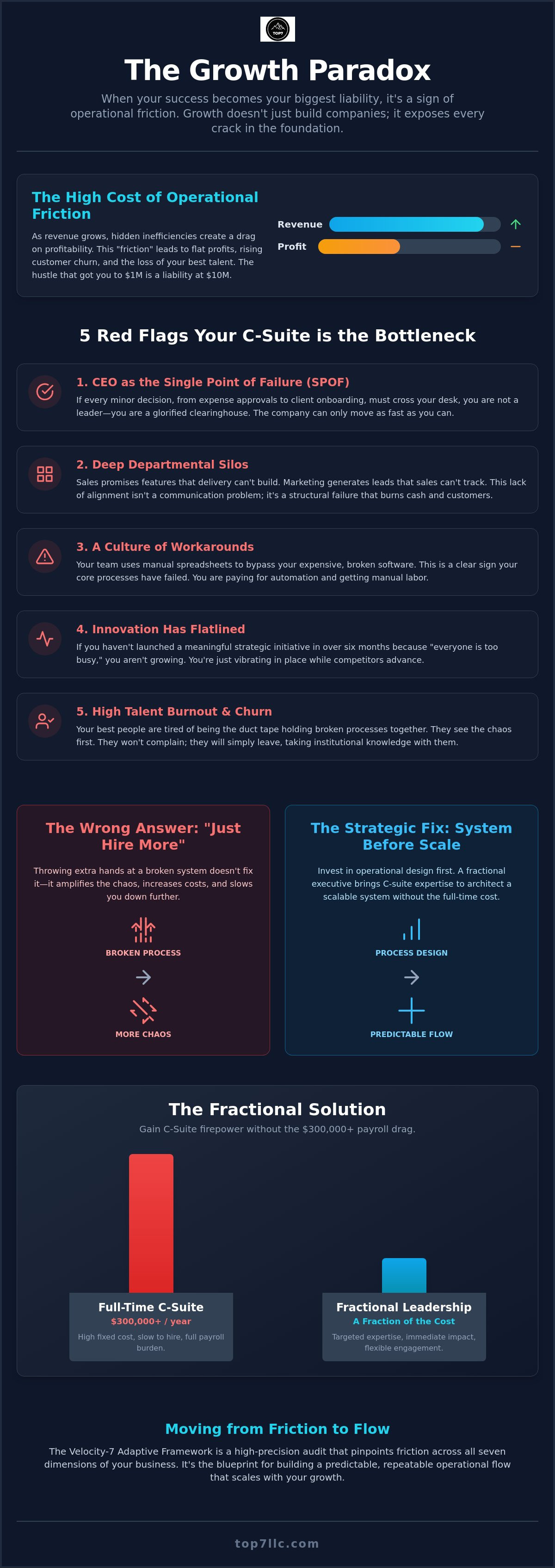
The High Cost of Operational Friction
Revenue is a vanity metric; profit is sanity. If your top line is climbing but your net stays flat, you're leaking cash through operational holes. This friction isn't just a nuisance; it's a brand killer. When delivery teams drop balls, you aren't just losing a contract. You're poisoning your reputation. Your best people see the chaos first. They're tired of being the duct tape holding your broken processes together. They won't complain; they'll just leave, taking your institutional knowledge with them.
Friction vs. Flow: The Velocity-7 Perspective
Flow is the goal. It's the state where work moves through your organization with zero resistance. Traditional consultants fail because they sell you 40-page PDFs and walk away. They give advice, but they don't give execution. You don't need more theory. You need a system that scales. The Velocity-7 Adaptive Framework identifies the specific dimensions of growth friction, from tech debt to leadership gaps. We don't just tell you the engine is smoking; we rebuild it while the car is moving. If you're seeing the signs your operations can't keep up with growth, you're already behind. It's time to stop firefighting and start engineering your exit from the daily grind.
5 Red Flags Your C-Suite Is the Bottleneck
Stop blaming your tools. If your team is stuck, look in the mirror. Most signs your operations can't keep up with growth start at the top. If every decision, from hiring a junior developer to choosing a new CRM, waits on your desk, you've become the Single Point of Failure (SPOF). You aren't leading; you're clogging the drain. A business that requires the CEO's permission to breathe is a business that's already suffocating.
Identifying these warning signs of unsustainable growth early is the difference between a controlled climb and a terminal nose-dive. When departments stop talking and start building silos, the left hand has no idea what the right is doing. Sales promises what delivery can't handle. Marketing generates leads that sales can't track. This lack of alignment isn't a communication error; it's a structural failure. If you're seeing these signs your operations can't keep up with growth, your leadership structure is likely obsolete for your current revenue tier.
Look for the "Culture of Workarounds." If your team is using manual spreadsheets to bypass your expensive, broken software processes, your operations have already failed. You're paying for automation and getting manual labor. Worse, innovation has likely flatlined. If you haven't launched a new strategic initiative in six months because "everyone is too busy," you aren't growing. You're just vibrating in place while your competitors sharpen their knives.
Is Your Leadership Team Scalable?
Your early hires were great for the $1M grind, but they might be the weight dragging you down at $10M. High growth demands strategic executives, not just high-level managers. Many teams hit the Peter Principle, where loyalty to "the originals" prevents operational maturity. If your C-suite can't design the systems the doers use, they've reached their level of incompetence. You don't need more loyalty; you need more capacity.
The "Firefighter" Syndrome
Busy isn't a badge of honor; it's a symptom of a broken system. If you're spending 80% of your day putting out fires, you've lost control. Constant crisis management is a sedative that makes you feel productive while your strategy rots. A CEO in the weeds is a CEO who has lost the map. Real growth requires a strategic planning approach that replaces firefighting with fireproofing. You need systems that run without you, or you'll never actually scale beyond your personal bandwidth.
Why "Hiring More" Is the Wrong Answer to a Scaling Crisis
Most CEOs react to growth pains by opening the checkbook for recruitment. It's a trap. If your current team is drowning, adding "extra hands" won't save them. It just adds more communication overhead and more people to manage through the same broken workflows. These are the classic signs your operations can't keep up with growth, and hiring your way out of it is like trying to put out a grease fire with water. You're just spreading the damage.
You don't need more doers. You need a system architect. A mid-market C-suite executive often commands a total compensation package north of $300,000. Combine that with equity and a six-month ramp-up period, and you've just added a massive payroll drag before seeing a single result. Interim leadership isn't a tourist ride through your org chart. It's a tactical strike designed to fix the foundation so your existing team can actually do the jobs you hired them for. Precision beats volume every time.
The Inefficiency Multiplier
Adding headcount to an unoptimized operation creates organizational bloat. It's the math of diminishing returns. If your delivery process is manual and reactive, ten people won't be ten times faster than one; they'll spend half their day in meetings trying to coordinate the chaos. Throwing bodies at a scaling crisis is the most expensive mistake a mid-market leader can make. You aren't building a team; you're funding a more expensive mess. Fix the flow first.
Strategic Planning vs. Tactical Execution
Your current team is too close to the fire to see the smoke. They're stuck in tactical execution, focused on surviving the next 24 hours. They can't audit the operational flow because they are part of the friction. This is where an outside perspective becomes lethal. By leveraging Fractional leadership vs consulting, you gain an objective audit of your systems without the permanent overhead. You need someone who has seen this movie before and knows how to rewrite the script. Stop funding the chaos and start engineering the solution.
The Velocity-7 Diagnostic: Moving from Friction to Flow
Identifying the signs your operations can't keep up with growth is only half the battle. The other half is knowing where to cut. Most mid-market leaders try to fix their scaling issues by applying a thin layer of "more" to everything. More meetings. More software. More middle management. This doesn't create flow; it creates a more expensive logjam. You need a surgical diagnostic that separates the symptoms from the source.
The Velocity-7 Adaptive Framework is that surgery. It's a holistic audit of your business dimensions designed to find exactly where your engine is seizing up. We don't guess. We audit the Seven Dimensions of Growth, starting with your financial and tech infrastructure. Once we identify the primary Friction Point causing the most significant drag on your revenue, we don't just hand you a report. We embed a Fractional Leader to execute the transformation immediately. This moves your organization from agile-based transformation to a permanent state of efficient, repeatable flow.
Dimension Audit: Where is Your Leak?
You can't fix what you haven't measured. In high-growth environments, your tech strategy is either an asset or a bottleneck. If your stack requires constant manual "duct tape" to function, it's the latter. Similarly, your financial strategy must do more than just record history. If your finances are "leaking" due to poor oversight or lack of real-time data, you're flying blind. Finally, look at your sales guidance. Is your revenue growth predictable, or is it accidental? If you can't forecast your next quarter with 90% accuracy, your sales engine is broken. Identifying these signs your operations can't keep up with growth within specific dimensions allows for precision strikes rather than broad, wasteful changes.
Agile Transformation for Operations
Agile isn't just for software developers anymore. It's a survival mechanism for the modern C-suite. By applying iterative improvements to your business operations, you see immediate ROI instead of waiting for a "grand relaunch" that never happens. Velocity-7 moves organizations from stagnation to high-velocity execution by focusing on what actually moves the needle. We replace the "we've always done it this way" mentality with a data-driven culture of execution. Stop guessing where your profit is going and start building a system that protects it.
Ready to stop the bleeding? Audit your operations with the Velocity-7 Adaptive Framework and reclaim your growth trajectory today.
The Fractional Solution: Scaling Without the $300k Payroll Drag
You've identified the signs your operations can't keep up with growth. Now you face a choice. You can spend six months and a massive $300,000+ salary package on a full-time executive who might not fit, or you can deploy surgical expertise today. Top7 isn't a recruitment firm or a traditional agency. We are a partner that embeds directly into your organization to solve the complex problems your current team is too exhausted to handle. We don't just point at the fire; we bring the equipment to put it out.
The Fractional CTO, COO, and CEO advantage is simple: you get 100% of the strategic brainpower for a fraction of the cost. Whether you need a Fractional CFO to stop financial leaks or a Fractional CPO to align your product with market demand, we provide the leadership without the permanent payroll drag. This isn't just about saving money. It's about gaining the ability to scale leadership at the same speed you're scaling revenue. If your delivery is failing because of "dropped balls," our Advanced Project Management and Interim Leadership services stabilize the ship during operational crises or executive transitions.
Why Top7 is Different from Traditional Consulting
Most consultants give you a 40-page deck and a bill. Top7 gives you a roadmap and the driver to execute it. We have a "Seasoned Professional" guarantee; you will never have a junior associate learning the ropes on your dime. Our experts have built and scaled companies in the East Coast, Midwest, and Austin markets, bringing local strategic presence and kille-instinct execution to every engagement. We don't deal in "best practices" that don't work in the real world. We deal in measurable profit and systemized flow.
Ready to End the Firefighting?
Stop guessing why your growth has stalled. If you continue to ignore the signs your operations can't keep up with growth, you aren't just losing time; you're losing market share. It's time to move from reactive chaos to proactive dominance. We offer a comprehensive operational audit using our Velocity-7 Adaptive Framework to pinpoint your friction points and build a bridge to your next revenue tier. Don't let your foundation crumble under the weight of your success. Growth shouldn't hurt; if it does, your operations are broken.
Reclaim Your Growth Trajectory
Success shouldn't feel like a slow-motion car crash. If your revenue is climbing but your margins are shrinking and your team is burning out, you've received the final warning. Identifying the signs your operations can't keep up with growth is the first step toward professional maturity. You don't need another expensive full-time hire or a generic consulting deck. You need a system that works and a leader who knows how to build it.
Top7 provides the surgical expertise required to dismantle operational friction. By deploying seasoned C-suite executives with over 20 years of experience, we embed directly with your team for immediate execution. We don't just offer advice; we rebuild your engine while you're still on the track using our proprietary Velocity-7 Adaptive Framework. Stop letting your foundation limit your future. Get the Velocity-7 Audit: Schedule Your Strategy Call with Top7 and turn your current chaos into a predictable, high-velocity organization. Your next level of scale is waiting on the other side of this audit.
Frequently Asked Questions
What are the first signs that my operations are failing?
The first signs include a CEO who must approve every minor expense and customer churn caused by delivery delays. If your team uses spreadsheets to fix what your software should automate, you're already in trouble. These are the primary signs your operations can't keep up with growth and require immediate structural intervention. Stop treating the symptoms and start fixing the system.
How is a Fractional COO different from a business consultant?
A consultant hands you a slide deck; a Fractional COO hands you results. Consultants offer outside advice and then leave you to figure out the execution. A Fractional COO embeds into your team to manage people, fix processes, and execute the strategy. They take ownership of the outcome rather than just suggesting a path from the sidelines.
Can my business outgrow its current leadership team?
Absolutely, and it's often the biggest barrier to scaling beyond your current revenue tier. The "hustle" skills required to hit $1M are rarely the systemic skills needed to manage $10M or $50M. Loyalty to early hires shouldn't come at the cost of your company's survival. If your leaders can't design the systems for the next level, they've reached their limit.
Is a Fractional CTO worth the investment for a non-tech company?
Technology is the engine of your efficiency regardless of your industry. A Fractional CTO ensures your tech stack is a scalable asset rather than a pile of expensive technical debt. They align your automation with your business goals. This ensures you aren't paying for tools that your team doesn't actually use effectively or that don't talk to each other.
How much does operational friction cost a mid-market business?
Friction is an invisible tax that erodes your margins and stalls your scale. It costs you top-tier talent who leave because they're tired of firefighting and manual workarounds. Beyond the balance sheet, it damages your brand reputation every time a customer experience is inconsistent. You're paying for this friction every day you allow it to persist.
What is the Velocity-7 Adaptive Framework?
It's our proprietary diagnostic and transformation system designed to audit the seven critical dimensions of your business. We analyze everything from financial strategy to sales guidance and tech infrastructure. The framework identifies the specific friction points stalling your growth. It provides a roadmap for immediate, high-velocity execution that turns chaos into repeatable flow.
How long does an interim management engagement typically last?
Engagements typically range from three to twelve months depending on the complexity of the transition. The goal is never a permanent stay; it's a tactical strike to stabilize the ship and build repeatable systems. Once the flow is restored and a permanent leader is ready to take over, we transition out. We focus on speed and impact, not long-term dependency.
Can fractional leadership help with a cash flow crisis?
Yes, by identifying where your revenue is leaking and tightening operational controls. A Fractional CFO or COO can quickly audit your burn rate and optimize your collections process. They move you from reactive panic to data-driven stability. They do this by fixing the underlying operational failures that are causing the cash drain in the first place.


Comments