
Sales Forecasting Methods for Startups: A Practical Guide

What if your startup’s best forecast is the one that admits how much it doesn’t know? With little sales history, trend-based projections can mislead. Changing prices, positioning, and sales cycles can also make last month’s assumptions obsolete. The right sales forecasting methods for startups don’t pretend the future is certain. They make the drivers, risks, and unknowns visible.
You need more than an optimistic revenue number. You need a forecast that helps you decide what to do when deals slip, conversion rates change, or cash gets tight. This guide compares practical methods and shows how to choose one that fits your startup’s data maturity, then update it as your market and sales process evolve.
We’ll cover approaches from assumption-based estimates to pipeline and scenario forecasting, and explain what each can and can’t tell you. You’ll also learn how to document assumptions, build best-, likely-, and worst-case views, and use them to guide sales and cash decisions. The goal isn’t false precision. It’s a forecast you can act on and revise when the facts change.
Table of Contents
Why Startup Sales Forecasts Need to Account for Uncertainty
A sales forecast is an evidence-based estimate of sales over a defined period. It isn’t a promise, a wish, or a number chosen to satisfy an investor. For startups, the evidence may be thin: a handful of deals can heavily influence the picture, while a new price, offer, or sales process can make yesterday’s pattern a poor guide to next month.
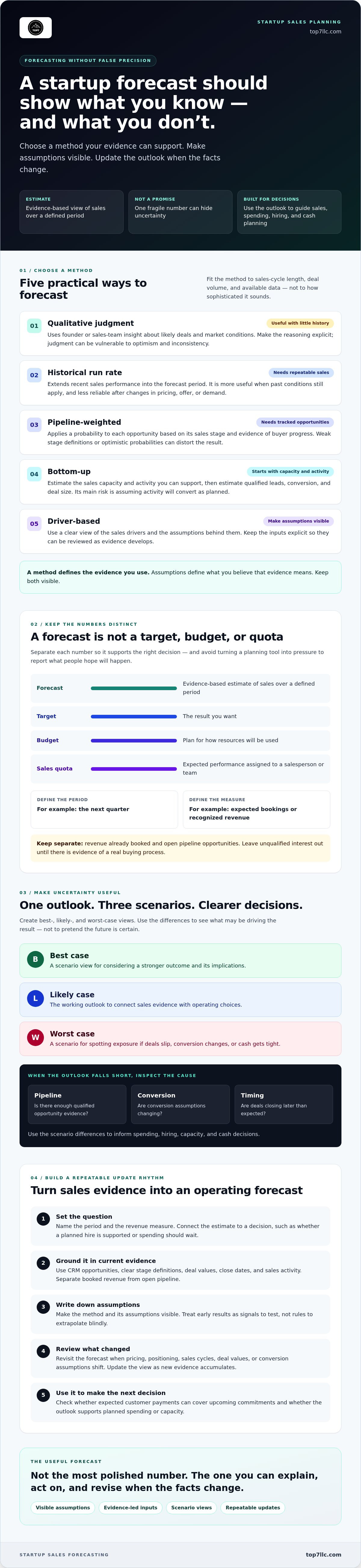
A forecast is an estimate, not a commitment. Keep it distinct from a target, which sets the result you want; a budget, which plans how resources will be used; and a sales quota, which assigns an expected level of performance to a salesperson or team. Confusing these numbers can turn a planning tool into pressure to report what people hope will happen.
For a practical overview, demand forecasting methods include both qualitative judgment and quantitative analysis, approaches that can be adapted as a startup’s evidence develops.
For a startup-focused walkthrough, watch Brett J. Fox explain how to forecast revenue:
What should a startup sales forecast answer?
Start with a specific operating question. State the period, such as the next quarter, and the revenue measure, such as expected bookings or recognized revenue. Don’t blend them. Separate revenue already booked from open pipeline opportunities, and keep unqualified interest out until there’s evidence of a real buying process.
Then connect the estimate to a decision. Does the likely outlook support a planned hire, or should spending wait? Could expected customer payments cover upcoming commitments? Sales forecasting methods for startups are useful when they turn sales activity into clearer hiring, spending, and cash-planning choices, not when they produce a polished number without a decision attached.
Why is forecasting harder before a startup has reliable history?
With few completed sales, one unusually large deal or a delayed close can distort apparent trends. A small sample can’t reliably show whether a change in conversion or deal size is lasting. Treat early results as signals to test, not rules to extrapolate blindly.
Assumptions can shift quickly. A pricing change may alter deal value; new positioning may attract different buyers; a longer sales cycle can push expected revenue into a later period. That uncertainty isn’t a reason to stop forecasting. It’s a reason to make assumptions visible, update them as evidence changes, and avoid presenting one fragile estimate as certain.
Five sales forecasting methods for startups, explained
The best method depends on what you know today: your deal flow, sales process, and history. Don’t choose a model because it looks sophisticated. Choose one whose inputs you can defend and update.
A method defines what evidence you use; assumptions define what you believe that evidence means. Keep both visible, or a forecast can look precise while resting on guesswork.
Which methods work with limited startup data?
Early on, founder judgment can fill gaps, but treat it as a provisional input, not proof of accuracy. Make the reasoning explicit, then replace opinions with observed results as they accumulate. A bottom-up estimate can also help: forecast the sales capacity and activity you can support, then estimate qualified leads, conversion, and deal size. Its main risk is assuming activity will convert as planned.
Pipeline weighting estimates revenue by applying a probability to each opportunity based on its sales stage and evidence of buyer progress. It’s useful when you track deals consistently, but weak stage definitions or optimistic probabilities can distort the result.
Qualitative judgment: Uses founder or sales-team insight about likely deals and market conditions. Useful with little history; vulnerable to optimism and inconsistent judgment.
Historical run rate: Extends recent sales performance into the forecast period. Useful when sales are repeatable and past conditions still apply; unreliable after a major change in pricing, offer, or demand.
Pipeline-weighted: Multiplies opportunity value by a probability tied to stage and evidence. Useful with an active, well-maintained pipeline; misleading when deal records or stage probabilities are poor.
Bottom-up: Builds expected sales from team capacity, activity, conversion, and deal size. Useful for testing what the current team can deliver; sensitive to unproven activity and conversion assumptions.
Driver-based: Projects revenue from inputs such as qualified leads, conversion rate, average deal value, and sales-cycle length. Useful when those drivers are measurable; less dependable when they change or lack enough observations.
When do historical and driver-based methods become more useful?
Use a historical run rate only when past performance is relevant to the period ahead. If deal size, buyer type, or sales cycle has shifted, explain why the old pattern should still hold before extending it. Driver-based forecasting becomes more useful as you gather consistent data on the factors behind revenue, letting you test how the forecast changes when a driver moves.
You don’t need to choose just one method. Compare a pipeline view with a bottom-up estimate, then build scenarios by changing assumptions such as conversion or close timing. The spread shows where uncertainty sits, not which outcome is guaranteed. When choosing inputs or aligning sales and financial plans reveals a leadership gap, fractional sales and financial guidance can be relevant to bringing the operating view together.
How to choose a startup sales forecasting method without false precision
Choose a method your team can maintain and your evidence can support. A spreadsheet won’t make weak inputs reliable, and a complex model can hide fragile assumptions behind impressive formulas. Transparent assumptions matter more than model complexity.
Which method fits your startup’s sales data maturity?
With sparse data, document what you’re assuming and build a bottom-up estimate from realistic team capacity and sales activity. As your pipeline develops, compare stage-based estimates with actual deal outcomes. If sales become repeatable, test historical patterns and measurable drivers against current pricing, customer mix, and sales-cycle conditions before relying on them.
Sales-cycle length and deal volume matter, too. A few large, long-cycle opportunities call for careful deal-level review; a high-volume, repeatable motion can support analysis of conversion and average deal value. If CRM records are incomplete, don’t treat a detailed pipeline model as stronger evidence than it is. The right sales forecasting methods for startups depend on data maturity, sales motion, and how often the inputs need updating.
How should founders compare forecast accuracy and effort?
Compare forecasts with actual results over consistent, comparable periods. Then identify the source of the gap: lead or opportunity volume, conversion, timing, or deal size. If closes repeatedly slip, changing the sales-cycle assumption may matter more than adjusting the headline revenue estimate.
Keep the method that supports a real decision and can be updated reliably. A lightweight forecast reviewed consistently beats an elaborate model nobody maintains. Improve the inputs as evidence grows, not the appearance of precision.
How to build and update a startup sales forecast
A useful forecast comes from a repeatable process, not a one-time spreadsheet exercise. Start with a decision, define what evidence counts, and review where estimates diverge from actual results. The sales forecasting methods for startups you choose matter, but consistent inputs and updates are what make them useful.
What inputs belong in a startup sales forecast?
Match the forecast period and revenue basis to the decision. A cash plan may need expected customer payments, while a sales outlook may track bookings. For each CRM opportunity, capture deal value, stage, expected close date, recent sales activity, and the evidence supporting its status. Record assumptions about conversion, sales capacity, pricing, and new customer acquisition separately from deal-level facts.
Define the question. Decide what the forecast must inform, such as near-term hiring, spending, or cash planning. Set the period and revenue measure.
Set clear stage rules. Define what evidence moves an opportunity forward. Use observable buyer actions, not a seller’s confidence alone.
Classify opportunities. Label deals as committed, likely, or early-stage using consistent criteria. For example, a committed deal might require documented buyer approval and agreed next steps; a likely deal may show active engagement but still have unresolved conditions. Early-stage interest lacks enough evidence for inclusion in the likely total.
Build the estimate. Apply the chosen method to documented opportunity data and assumptions. Keep booked revenue, qualified pipeline, and unqualified interest separate.
Compare forecast with actuals. Review results for the period, identify material gaps, and note whether they came from deal volume, conversion, timing, or value. Update assumptions based on evidence, not pressure to meet a target.
How often should a startup update its forecast?
Set a review cadence that fits your sales-cycle speed and the decisions at stake. A fast-moving pipeline may need more frequent reviews than a small number of long-cycle deals. At each review, refresh actuals, opportunity stages, values, dates, and activity. Keep the previous forecast and its assumptions so you can see what changed and learn from earlier estimates.
Don’t rewrite the forecast just to make it match the target. If a close date slips, record the new evidence and investigate the cause. If conversion falls, check whether lead quality, sales execution, or the original assumption needs attention. That discipline turns forecast variance into operating information.
Top7’s advisory services include strategic guidance and support for organizations working through complex business challenges.
Turn sales forecasts into startup decisions and a repeatable operating rhythm
A forecast earns its place when it changes a decision. Use scenarios to test how different sales outcomes could affect hiring, spending, team capacity, and cash planning. None is a promise. Each is a view of what could happen if its assumptions hold.
How can forecast scenarios support startup planning?
Build base, upside, and downside cases by changing specific inputs, not by assigning arbitrary revenue totals. For example, the base case might use current conversion and close timing; the downside might reflect slower decisions or fewer qualified opportunities; the upside might assume stronger conversion supported by evidence. Record what changed in each scenario so the team can challenge the assumptions.
Then connect each case to a decision. If the downside would put cash or delivery capacity under pressure, review discretionary spending or the timing of a hire. If the upside strains the team’s ability to serve customers, examine capacity and sales priorities. Scenarios don’t remove uncertainty or replace judgment. They reveal which decisions are sensitive to it.
When should a startup seek additional financial or sales leadership?
Pay attention when forecast reviews repeatedly stall over basic definitions, ownership of the numbers, or whether opportunity assumptions are credible. Those are execution gaps, not spreadsheet problems. A Fractional CFO may support financial strategy and cash planning; a Fractional CRO may help with sales guidance and forecast discipline. Fractional leadership or advisory services can provide experienced support when the team needs it, but they aren’t a mandatory step for every startup.
Make the forecast review a working session with clear ownership. Assign someone to validate pipeline evidence, someone to update actuals, and a decision-maker to resolve trade-offs. For each review, capture:
What changed: Pipeline volume, conversion, deal value, or expected close timing.
Why it changed: New evidence, a shifted assumption, or a gap in execution.
What happens next: An action, an owner, and a date to revisit it.
A pipeline problem means there aren’t enough qualified opportunities for the expected sales level. A conversion problem means opportunities exist but aren’t progressing or closing at the assumed rate. A timing problem means deals may still close, but later than forecast. Diagnose the cause before changing spend or sales priorities. The right sales forecasting methods for startups make those distinctions visible and give the team a shared basis for action.
When recurring forecast reviews expose gaps in sales execution, financial planning, or leadership ownership, Top7’s guidance on forecasting and leadership needs is one resource to consider.
Make your forecast a tool for your next move
The strongest sales forecasting methods for startups fit the evidence you have now, not the company you hope to become. Choose an approach your team can maintain, make assumptions visible, and compare forecasts with actual results to learn where estimates missed. Then use base, upside, and downside scenarios to test decisions about cash, hiring, spending, and sales priorities.
A forecast won’t remove uncertainty. It can help you see whether the pressure point is pipeline, conversion, or timing, and decide what to investigate next. Keep the review rhythm consistent, give each assumption an owner, and update the model when evidence changes. That’s how a forecast becomes an operating tool instead of a number on a slide.
When financial planning or sales execution needs experienced leadership, Top7 offers Fractional CFO and Fractional CRO support, sales guidance, and financial strategy. Its professionals can embed directly with clients. Discuss your sales forecasting and leadership needs with Top7.
Frequently Asked Questions
What is the best sales forecasting method for a startup?
The best method is the one your startup can support with evidence and update consistently. With little sales history, start with documented judgment and a bottom-up estimate based on capacity, activity, and expected deal size. As opportunities build, add pipeline weighting; when sales become repeatable, test historical patterns and measurable drivers. The right sales forecasting methods for startups depend on data quality, deal volume, sales-cycle length, and the decisions the forecast needs to inform.
How can a startup forecast sales with no historical data?
A startup with no sales history can build an initial forecast from current capacity and explicit assumptions. Estimate how much sales activity the team can complete, how many qualified opportunities that activity may produce, and what deal size and timing seem plausible. Use founder or sales-team judgment as a provisional input, not as proof. Separate known pipeline from future activity, document assumptions, and replace estimates with observed results as data accumulates.
Are pipeline-based sales forecasts reliable for startups?
Pipeline-based forecasts can help, but their reliability depends on the quality of opportunity data and stage rules. Record each deal’s value, expected close date, current stage, and evidence of buyer progress. Then use probabilities grounded in observed outcomes where available. A pipeline full of stale deals or optimistic stage estimates can overstate revenue. Compare past predictions with actual closes and timing, and adjust assumptions when the evidence shows a consistent gap.
What is the difference between a sales forecast and a sales target?
A sales forecast estimates what the business is likely to sell over a defined period, based on available evidence and assumptions. A sales target is the result the business wants to achieve. They serve different purposes: the forecast supports planning, while the target sets ambition or direction. Keep them separate. If the forecast is simply changed to match the target, leaders lose a clear view of likely revenue and the risks behind it.
How often should a startup update its sales forecast?
Update the forecast often enough to reflect changes in the pipeline and support upcoming decisions. The right cadence depends on sales-cycle speed and how quickly the business needs to respond. At each review, update actual results, opportunity evidence, deal values, and expected timing. Keep previous forecasts for comparison. If an estimate changes, record why. This makes it easier to distinguish a real shift in sales conditions from an unexplained adjustment.
Can startups use multiple sales forecasting methods at the same time?
Yes. Combining methods can expose assumptions that a single view might hide. For example, compare a pipeline-weighted estimate with a bottom-up projection based on team capacity and sales activity. If the results differ, investigate the gap: the pipeline may be too small, conversion assumptions may be optimistic, or close dates may be too early. Keep each method’s inputs clear, and avoid blending outputs into one number without understanding why they disagree.



Comments