
Revenue Growth Strategy Consulting: A Buyer’s Guide for 2026

What if your growth problem isn’t a lack of ideas, but a lack of ownership? When sales, marketing, product, finance, and technology pull in different directions, another strategy deck won’t fix the stall. Revenue growth strategy consulting creates value when it identifies the constraint and connects the plan to accountable execution.
You may already know growth needs attention. The harder questions are where to focus, which consulting approach fits, and how to keep recommendations moving after the meeting. A practical buying framework can help you answer them.
This guide will help you identify growth challenges with the greatest business impact, compare project-based, ongoing, and advisory models, and assess partners on strategy, execution, and accountability. You’ll also learn how to choose a scope and leadership model that match the capability gap, whether that calls for strategic planning, embedded fractional leadership, or advanced project management. At Top7, we connect growth strategy with hands-on leadership and execution, using the Velocity-7 Adaptive Framework to help organizations move from operational friction toward efficient flow. Choose a partner who can help carry the work beyond the recommendation.
Table of Contents
When Does Revenue Growth Strategy Consulting Make Sense?
Activity can rise while profitable growth stays flat. Sales launches more campaigns, marketing increases lead volume, product ships new features, and finance still sees pressure on margins. The issue may not be effort. It may be that each team is optimizing a different part of the business without addressing the constraint that limits growth overall.
Revenue growth strategy consulting can help when leaders can’t agree on what’s holding growth back, when the problem crosses several functions, or when internal teams lack the authority or capacity to resolve it. But “grow faster” isn’t a diagnosis. Start with a sharper question: Are qualified opportunities too scarce, are deals stalling, is customer retention weakening, or are costs eroding the profit from new revenue?
Which growth signals justify outside strategic support?
Look for patterns, not one disappointing result. Sales may report a pipeline gap while marketing points to rising lead volume. Product may see adoption improve while customer feedback signals unmet needs. Finance may flag falling margins even as revenue increases. If teams rely on conflicting definitions, time periods, or data sources, leadership can’t tell which signal deserves action.
A short-term dip may reflect a temporary disruption. Recurring decision delays, unclear ownership, or repeated handoff failures across teams suggest a deeper execution problem. Outside strategic support is useful when the organization needs an impartial diagnosis and cross-functional decisions it hasn’t been able to make internally. That may mean examining a potential growth platform, a longer-term initiative for expanding revenue and earnings, rather than chasing another disconnected tactic.
What should a buyer expect from the engagement?
Expect the work to start with the business question, not a preselected deliverable. A strategy deck, market study, or workshop may be useful, but only if it answers the decision leadership needs to make. Set the scope according to the question, the available evidence, and the complexity of the issue.
A disciplined engagement gathers relevant customer, pipeline, financial, and operational evidence, helps leaders interpret it, then narrows the options to a small set of priorities. Each priority needs an owner, a next step, and a way to review progress. Look for clearer decisions and accountable action, not simply a busier calendar or a longer list of initiatives.
No consultant can guarantee growth. Results depend on leadership decisions, how consistently teams execute, and market conditions. A strong partner can bring focus, challenge assumptions, and support follow-through. The business still has to act.
What Should a Revenue Growth Strategy Consulting Engagement Include?
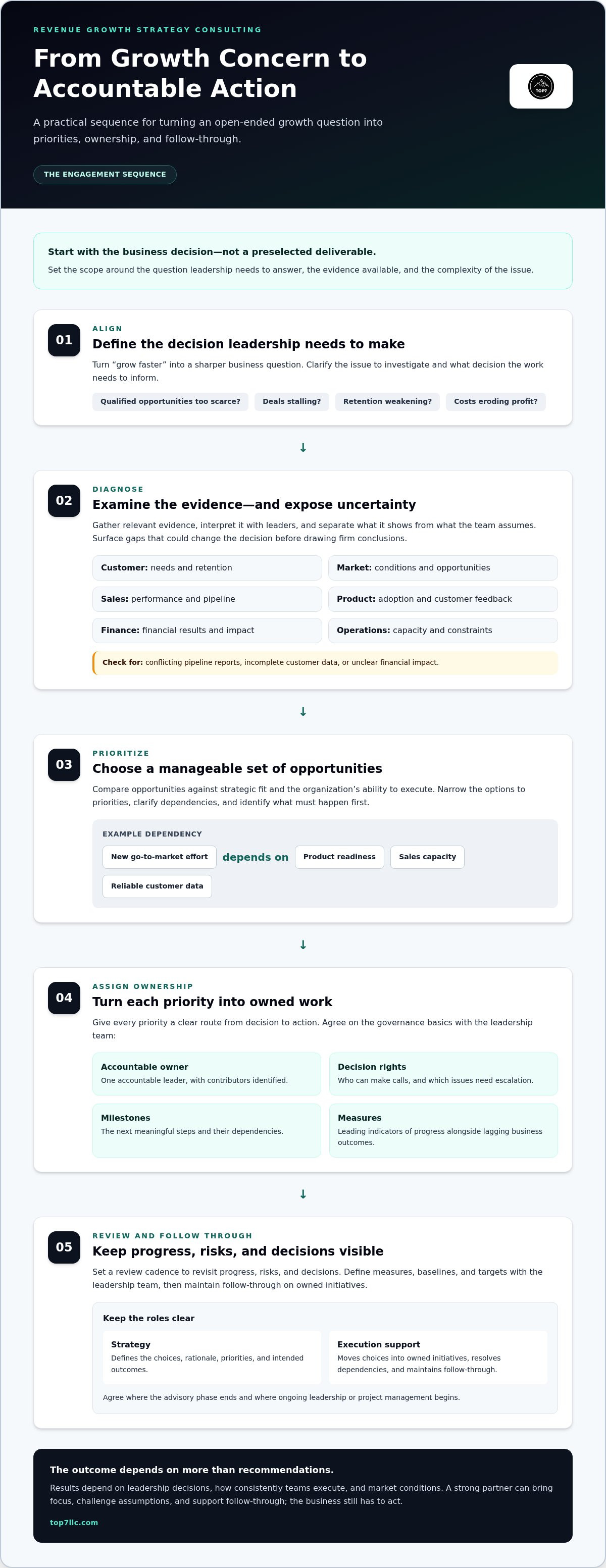
A useful engagement turns an open-ended growth concern into a decision, a set of priorities, and accountable action. Revenue growth strategy consulting should follow a clear sequence: align on the business question, diagnose the evidence, prioritize opportunities, assign owners, and review progress. Skip a step and the work can produce polished recommendations without a path to implementation.
How should diagnosis become a growth roadmap?
Start with the decision leadership needs to make. Then examine the evidence that can inform it: customer needs and retention, market conditions, sales performance, product adoption, financial results, and operational capacity. The scope should fit the question. A focused issue may need a targeted review, while a cross-functional growth challenge may call for a broader assessment.
Separate what the evidence shows from what the team assumes. If pipeline reports conflict, customer data is incomplete, or the financial impact of an initiative is unclear, surface those gaps before drawing firm conclusions. The goal isn’t to collect data for its own sake. It’s to understand which uncertainties could change the decision.
Next, compare opportunities against strategic fit and the organization’s ability to execute. A long list of possible initiatives isn’t a roadmap. Prioritize a manageable set, identify dependencies, and clarify what must happen first. For example, a new go-to-market effort may depend on product readiness, sales capacity, or reliable customer data.
How do governance and measurement support execution?
Strategy and execution support are related, but they aren’t the same deliverable. Strategy defines the choices, rationale, priorities, and intended outcomes. Execution support helps move those choices into owned initiatives, resolve dependencies, and maintain follow-through. Agree on where the advisory phase ends and where ongoing leadership or project management begins.
For every priority, establish the basics:
Owner: One accountable leader, with contributors identified.
Decision rights: Who can make calls, and which issues need escalation.
Milestones: The next meaningful steps and dependencies.
Measures: Leading indicators that show whether work is progressing, alongside lagging outcomes that reflect business results.
Review cadence: When progress, risks, and decisions will be revisited.
Define measures, baselines, and targets with the leadership team. Don’t mistake a convenient metric for a useful one. More leads, for instance, may signal activity, but it won’t prove profitable growth if conversion quality or margins weaken. Agree on what success means before execution begins, then adjust the plan as evidence changes.
For organizations that need strategy connected to hands-on follow-through, embedded strategic planning and execution support can help translate priorities into owned work.
How to Compare Revenue Growth Strategy Consultants
A compelling strategy has little value if leaders can’t act on it, assign ownership, and track what changes. Compare consultants on the work they’ll do with your organization, not just their credentials or confidence in a sales presentation. The right revenue growth strategy consulting partner should address your diagnosed constraint rather than steer you into a standard package.
Use the same criteria to assess each proposed engagement:
Look for evidence related to the challenge at hand. Relevant case examples can show how a team approached a similar constraint and supported execution. Separate documented outcomes from promotional language: a claimed result doesn’t prove the same method will fit your business or produce the same effect. Ask how the consultant’s role, client decisions, and market factors contributed.
What shows a consultant can move beyond recommendations?
Look for a practical operating plan. It should make clear who owns each initiative, who has decision rights, how teams will coordinate, and when progress will be reviewed. Confirm that senior expertise will participate directly where the work requires it. A strong approach also adapts when new evidence challenges the original assumptions instead of defending a preset plan at all costs.
Which measures should buyers use?
Choose measures that match the growth objective. Conversion may matter when opportunities fail to advance; retention or margin may be more relevant when revenue quality is the concern. For pipeline growth, assess quality as well as volume. Agree on the baseline and measurement window before interpreting movement. Then consider other influences, such as pricing decisions, seasonality, or market shifts, rather than attributing every change to consulting.
The comparison should reveal more than who presents the sharpest deck. It should show who can work with your leaders, connect strategy to accountable execution, and leave your team better equipped to continue. Top7’s embedded approach connects strategic planning with leadership and execution support; explore embedded growth strategy support as one way to structure that work.
Which Consulting Engagement Model Fits Your Growth Challenge?
The engagement model should match the gap you need to close. A defined strategic decision, a missing executive capability, a leadership transition, and a need for targeted guidance call for different levels of involvement. Choosing the wrong model can leave you with a roadmap but no owner, or ongoing support that doesn’t match the actual need.
Use the diagnosis to choose the scope. Revenue growth strategy consulting isn’t one fixed format, and one engagement may not resolve every constraint. Start with the decision or capability gap, then agree on who will lead the work and what support is needed to move it forward.
When is project-based consulting the better fit?
Choose project-based work when the question is bounded, for example, evaluating a growth opportunity or building a strategic roadmap. The scope should state the deliverables, participating stakeholders, decision points, and what counts as complete. Crucially, name the internal owners who will act on the findings. Without them, a finished project can become a shelf document.
When does fractional or interim leadership fit better?
Fractional leadership fits when the organization needs continuing executive-level ownership in a specific function. Interim leadership is designed for a temporary, hands-on leadership need, such as a transition. Advisory support provides focused guidance, but it isn’t the same as an embedded leader with sustained operating involvement.
Be precise about the gap before selecting a model. If your team has the capability but needs a decision, a project or advisory scope may fit. If priorities lack an accountable executive owner, fractional or interim leadership may better match the need. Explore how Top7 connects strategy and execution through strategic planning, fractional leadership, interim leadership, and advanced project management.
How Top7 Connects Revenue Strategy With Accountable Execution
A growth plan needs more than strategic clarity. It needs leaders who can make decisions, coordinate teams, and keep priority work moving. Top7 embeds with clients, connecting business strategy to fractional executive leadership, strategic planning, and advanced project management. The right combination depends on the constraint, not a default package of services.
Top7’s proprietary Velocity-7 Adaptive Framework is designed to help organizations move from operational friction toward efficient flow. It provides a framework for the work, while the specific growth challenge still needs to be diagnosed, priorities agreed, and accountability established.
How can embedded leadership support a growth strategy?
An embedded executive brings strategic guidance into ongoing leadership decisions and the realities of execution. The relevant role depends on where ownership or expertise is missing. For example, a technology constraint may call for fractional CTO leadership; a revenue gap may point to a fractional CRO; operational, financial, or marketing challenges may call for fractional COO, CFO, or CMO leadership. Not every organization needs every function. Start with the diagnosed gap.
Strategic planning can clarify choices and direction. Fractional leadership can provide ongoing executive ownership in a specific area. Advanced project management can help coordinate initiatives, dependencies, and follow-through. Together, these capabilities connect the plan to the work, while keeping responsibility aligned with the organization’s actual needs.
What should leaders bring to an initial growth discussion?
Come prepared to explain the outcome you’re pursuing and what appears to be blocking it. A useful starting brief includes:
Growth objective: What needs to improve, and why now?
Current constraints: Where do leaders see friction or stalled progress?
Relevant measures: Which customer, revenue, pipeline, margin, or operating indicators inform the concern?
Major decisions: What choices are unresolved or repeatedly delayed?
Ownership: Which functions own the work, and where does accountability break down?
You don’t need a perfect diagnosis before starting the conversation. Bring the evidence you have, the questions it raises, and the decisions leadership needs to make. That gives the discussion a practical focus: identify the constraint, determine what kind of leadership or strategic support fits, and define a sensible next step.
Discuss your growth challenge with Top7 and connect strategy to accountable execution.
Turn the Growth Diagnosis Into Decisive Action
The right revenue growth strategy consulting engagement starts by identifying the constraint, not buying a prepackaged plan. Match the scope to the need: a defined strategic decision may call for project work, while a persistent ownership gap may require fractional or interim leadership. Then connect priorities to accountable leaders, relevant measures, and regular progress reviews.
Top7 embeds experienced professionals with clients, bringing together fractional executive leadership, interim leadership, strategic planning, and advanced project management to support strategy and execution. Its proprietary Velocity-7 Adaptive Framework focuses on moving organizations from operational friction toward efficient flow. The aim is to align the work with the challenge and give leaders a stronger basis for action.
Ready to clarify what’s holding growth back and determine a practical next step? Discuss your growth challenge with Top7. With the right diagnosis, ownership, and follow-through, your next growth move can be focused and deliberate.
Frequently Asked Questions
What does revenue growth strategy consulting include?
Revenue growth strategy consulting typically starts by defining the business objective and examining evidence behind current performance. The work may identify opportunities, prioritize strategic choices, and turn them into initiatives with owners and measures. Scope depends on the organization and its challenge. Before engaging, clarify whether the work ends with recommendations or includes implementation support, and decide who will lead the initiatives once priorities are set.
How do I choose a revenue growth strategy consulting firm?
Choose a firm by how well its approach fits your actual growth constraint, not by broad promises. Compare diagnostic depth, senior expertise, execution support, measurement, and knowledge transfer. Ask how the team will test assumptions and turn recommendations into owned work. Review relevant examples, but distinguish documented results from marketing claims. The best fit is a scope your organization can act on, with clear responsibilities and a practical way to track progress.
When should a company hire a revenue growth consultant?
Consider outside support when growth stalls, teams disagree on priorities, or leadership can’t identify the main constraint with confidence. A consultant can also help analyze a high-stakes growth decision or align functions around a shared direction. Define the decision or outcome you need first. If the challenge calls for sustained executive ownership rather than a bounded assessment or roadmap, consider whether fractional leadership better matches the gap.
What is the difference between a growth consultant and a fractional executive?
A growth consultant often focuses on a defined diagnosis, decision, or roadmap. A fractional executive provides part-time leadership within a business function and can contribute to ongoing decisions and operating work. The distinction is about scope and accountability, not just job title. A strategy project may clarify what to do; fractional leadership can provide continued executive ownership to help put priorities into motion.
How do you measure the success of a growth strategy engagement?
Agree on the business objective, baseline, measures, and review period before implementation starts. Choose indicators that fit the strategy, such as conversion, retention, pipeline quality, or margin. Pair outcome measures with leading indicators that show whether planned initiatives are progressing. Then interpret results in context. Market changes, pricing decisions, and other business initiatives can also affect performance, so don’t attribute every change to the engagement alone.
How much does revenue growth strategy consulting cost?
Fees depend on the scope, duration, seniority involved, and level of implementation support. A time-bound strategy project differs from ongoing fractional leadership or interim management, so generic estimates may not reflect the work you need. Compare proposals by deliverables, team involvement, responsibilities, and progress reviews. Before approving an engagement, make sure the scope and fee terms are clear and aligned with the business decision or capability gap.
Can a revenue growth strategy consultant help with execution?
Yes, some engagements include implementation planning, leadership support, or ongoing execution involvement, while others focus on recommendations. Clarify which responsibilities belong to the consulting team and which remain with internal leaders. Effective execution requires named owners, decision rights, milestones, and a review cadence. If priorities need sustained executive attention, fractional leadership can complement strategic planning and project management to keep work moving across teams.



Comments