

Reducing Operational Bottlenecks: Why Your Mid-Market Growth Has Stalled
- Robert Fitzgerald
- Jul 6
- 12 min read

Updated: 2 days ago
Why did you hire five more people last quarter only to watch your delivery timelines stretch even further? If you're spending twelve hours a day firefighting instead of leading, your company isn't growing; it's just getting heavier. Most mid-market leaders mistake frantic activity for progress, but the reality is that operational inefficiency is likely costing you 20% to 30% of your annual revenue. You don't need a new project management tool or more "culture" meetings. You need a ruthless approach to reducing operational bottlenecks that actually move the needle. You're exhausted because your systems were designed for a company half your size, and the friction is finally winning.
It's time to stop blaming your team and start fixing your flow. This isn't about incremental tweaks; it's about a total tactical overhaul. We're providing a roadmap to eliminate the tech debt and structural drag that's killing your product releases. You'll learn how to implement a scalable framework designed for the 2026 market, ensuring your operations become a predictable engine rather than a source of constant executive stress. We're moving past the "growth at all costs" delusion to build a business that actually scales without breaking your spirit.
Table of Contents
The Invisible Tax: Why Operational Bottlenecks Kill Mid-Market Growth
Operational bottlenecks are not just minor delays or missed deadlines. They are strategic chokepoints that paralyze your ability to scale. While most leaders view a slow approval process or a lagging product release as a temporary annoyance; these are actually symptoms of systemic rot. In the context of the Theory of Constraints, your business is only as fast as its slowest component. If you aren't actively reducing operational bottlenecks; you are essentially paying a tax on your own success.
This "Invisible Tax" manifests as lost revenue and aggressive talent churn. According to the Groome Consulting Group; operational inefficiency can cost a business 20% to 30% of its annual revenue. For a mid-market firm; that isn't just a rounding error. It's the difference between market dominance and a slow slide into irrelevance. When your best people spend their days navigating friction rather than driving value; they don't just get frustrated. They leave. Reducing operational bottlenecks requires a shift in perspective from individual performance to system throughput.
The biggest mistake? Thinking you can hire your way out of the mess. Throwing more headcount at a broken system is like pouring high-octane fuel onto a dumpster fire. It just makes the fire bigger and more expensive. You don't have a talent problem; you have a flow problem. If your processes are garbage; adding more people just generates more garbage at a higher cost per hour.
The Financial Reality of Friction
Bottlenecks erode your EBITDA quietly. They don't appear as a line item on your balance sheet; but they bleed your margins through "opportunity lag." In a market where 49% of leaders cite economic uncertainty as a top concern; you can't afford to wait six months for a project that should take six weeks. For a $20M firm; the cost of inaction is the permanent loss of market share to more agile competitors who have already optimized their execution engine.
The Executive Burnout Cycle
Why are you still checking the status of a $50 task at 9 PM? When systems fail; CEOs become the ultimate "unblocker." This creates a dangerous cycle where the highest-paid person in the room is doing low-value work just to keep the lights on. This stagnation kills the morale of high-performing leaders who want to build; not babysit. The primary hurdle for mid-market growth is the painful transition from a founder-led "hero culture" to a system-led operational framework. If the business depends on your personal intervention to move forward; you haven't built a company; you've built a cage. Breaking free allows you to shift your focus from daily survival to long-term legacy, giving you the space to explore Retirement Income Planning and secure your financial future.
Diagnosing Friction: Where Your Organization is Actually Leaking Velocity
Stop trusting your intuition. In the mid-market sector, your "gut feeling" is a liability that keeps you stagnant while your competitors outpace you. If you want to start reducing operational bottlenecks, you need a diagnostic lens that cuts through the noise of complaining departments. The loudest problem in your office is rarely the actual source of the leak; it's just where the pressure is finally bursting the pipe. You must look at the three "Deadly Zones": Technology, Finance, and Sales. Without hard data, you're just guessing where the friction lies.
Effective diagnosis requires understanding What Is Operational Efficiency? beyond simple cost-cutting. It's about flow. In 2026, mid-market companies invested over $600,000 on average in AI and automation, yet many saw no return because they layered new tech over broken processes. This is the "Tech Debt" trap. It's not just old code; it's the operational drag created by fragmented systems that don't talk to each other. When your data is siloed, your decision-making speed drops to zero.
Technology as a Bottleneck
Is your CTO actually leading, or have they become a glorified project manager? If your technical head is spending forty hours a week managing Jira tickets instead of aligning technology with business outcomes, your growth has a ceiling. Many firms fall into the "Custom Software" trap, building bespoke tools that eventually become a legacy cage. This is where a Fractional CTO becomes essential. They provide a surgical audit of your stack to ensure your tech is an accelerator, not a lead weight. If your CTO isn't talking about EBITDA, they're part of the bottleneck.
The Sales-to-Ops Hand-off
Your sales team loves to celebrate the "big win," but if your back-end isn't agile, that win is a liability. The "Sales-Operations Gap" is where velocity goes to die. When sales promises features or timelines that operations can't fulfill, you create a toxic cycle of firefighting and client churn. You don't need more leads; you need a Fractional CRO to align your revenue engine with your actual delivery capacity. Selling more into a broken system only accelerates your collapse. If you're ready to stop the bleeding, a Strategic Planning session can help identify these hand-off failures before they hit your bottom line.
Why Your Current "Fixes" Are Just Expensive Band-Aids
You've probably already tried to buy your way out of this. Most mid-market leaders respond to friction by signing a six-figure contract for a new CRM or an ERP system. They call it "digital transformation," but it's actually the Software Fallacy in action. A new tool won't fix a broken process; it just makes the failure more expensive and faster. If your sales-to-ops hand-off is a mess, a shiny dashboard only gives you a front-row seat to the collapse. Real progress in reducing operational bottlenecks requires changing how work flows, not just where it's recorded.
Another common mistake is "Local Optimization." This happens when you "fix" the marketing department's output without checking if the fulfillment team can handle the volume. You've simply moved the chokepoint down the line. According to the Theory of Constraints, any improvement made anywhere other than the actual bottleneck is an illusion. You aren't solving the problem; you're just shifting the stress. This is why traditional big-box consulting fails. They deliver a 100-page slide deck of "advice" but leave before the actual execution breaks your culture.
The Fallacy of the Full-Time Hire
In the current 2026 market, 43% of business leaders report talent shortages as a critical risk. When growth stalls, the instinct is to recruit a new C-suite executive. This is the Recruitment Trap. A full-time hire typically requires a six-month ramp-up period before they provide a return on investment. Mid-market firms can't afford to wait two quarters for results while burning cash on executive benefits and signing bonuses. If the fit isn't perfect, you've just added a $250,000 anchor to your balance sheet. Compare that slow, risky climb to the surgical impact of an Interim COO who arrives with a proven framework and starts unblocking the flow on day one.
The Consultant vs. The Embedded Leader
Advice is cheap. Execution is where the profit lives. Most consultants are outside auditors who tell you your house is on fire and then hand you a bill for the observation. They don't have skin in the game. A Fractional Executive is different. We are embedded leaders who own the outcome. At Top7, our philosophy is simple: we don't just find the bottleneck; we own the fix. We don't care about "best practices" that look good on paper but fail in the trenches. We focus on the kőkemény reality of your operations to ensure that every tactical adjustment results in measurable revenue growth. You don't need a spectator; you need a commander who knows how to win the market share struggle.
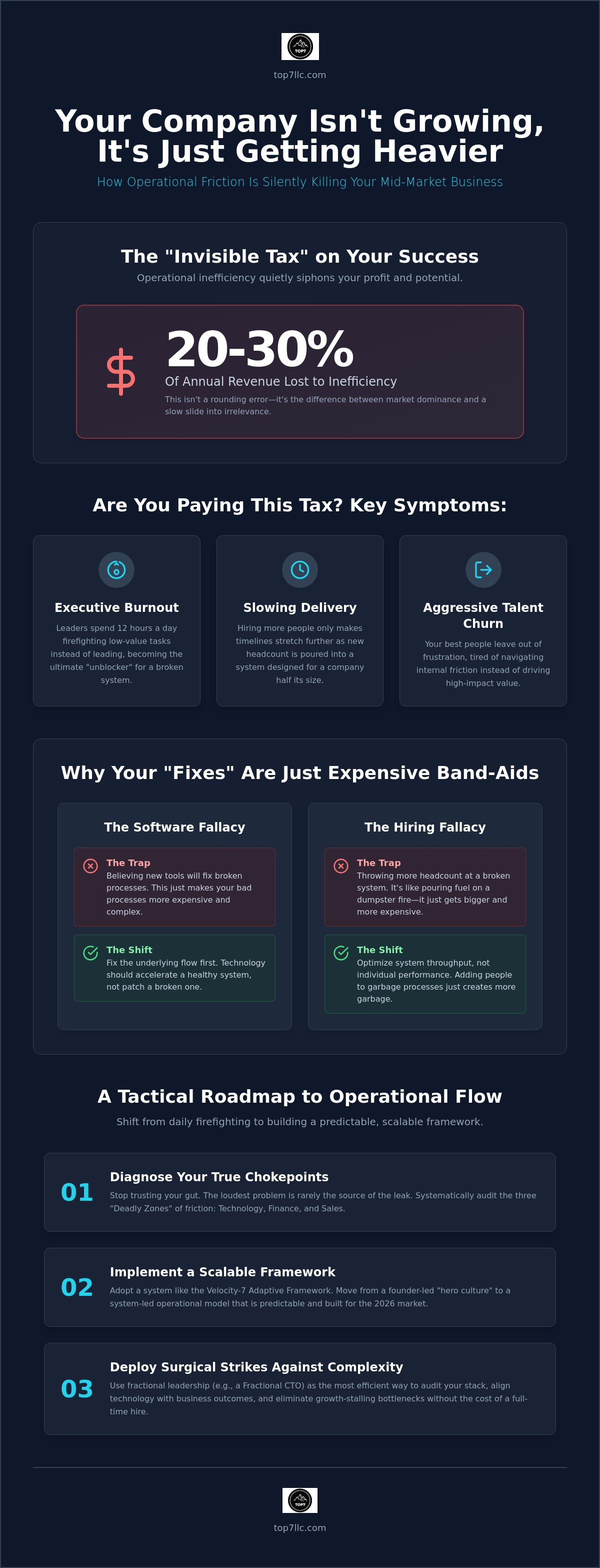
The Velocity-7 Protocol: A Tactical Roadmap to Operational Flow
Generic business advice is a waste of your time. You don't need a motivational speech; you need a combat-tested system. While your competitors are still debating which software to buy, you should be focused on reducing operational bottlenecks through a structured, aggressive methodology. The Velocity-7 Adaptive Framework isn't a suggestion. It's a surgical protocol designed to strip away the friction that's currently choking your revenue and burning out your leadership team. We don't guess. We execute.
The protocol follows a four-step cycle that prioritizes speed and measurable results over theoretical perfection:
Step 1: The Seven-Dimension Audit. We dissect your organization across Finance, Tech, Sales, Ops, Talent, Data, and Strategy to find the single chokepoint that's stalling the entire engine.
Step 2: Embed Fractional Leadership. We don't leave you with a report. We insert a Fractional COO or CTO to provide immediate strategic stability and own the execution of the fix.
Step 3: Agile Transformation. We move your culture from "waiting for permission" to "rapid iteration," breaking down the silos that prevent work from flowing.
Step 4: Measure and Iterate. We treat your operations as a living system. Because the market changes, your "fixed" state is a moving target that requires constant calibration.
Moving from Friction to Flow
The Velocity-7 Protocol identifies the hidden dependencies that your department heads are too close to see. For example; a delay in product releases is rarely just a "coding problem." It's often a failure in how finance allocates R&D budget or how sales communicates client requirements. Our 90-Day Roadmap focuses on removing the primary obstacle first to generate immediate cash flow. Agile principles at the C-suite level transform executive decision-making from a monthly bottleneck into a daily competitive advantage. If you're tired of guessing where your velocity is leaking, it's time to apply the Velocity-7 Adaptive Framework to your organization.
Measuring What Matters
Stop obsessing over vanity metrics. In the 2026 business environment, where 49% of leaders are paralyzed by economic uncertainty, you need to measure Lead Time to Value. This is the exact duration from a strategic idea to its first dollar of profit. If this number is increasing, your bottlenecks are winning. We also track "Executive Bandwidth" to ensure your leadership is focused on growth rather than administrative firefighting. With 76% of mid-market firms now using AI specifically to automate processes, your manual chokepoints are no longer just an inconvenience; they are an existential threat. Our protocol ensures that once a bottleneck is cleared; it doesn't just migrate to the next department.
Fractional Leadership: The Surgical Strike Against Friction
Growth isn't a headcount game. It's a leadership game. If your mid-market growth has stalled, you don't have a personnel shortage; you have a capability gap at the top. Mid-market firms across the US are pivoting to "Leadership-as-a-Service" because the traditional model of executive recruitment is too slow, too rigid, and far too expensive for the 2026 economy. Why pay for a full-time salary and a golden parachute for someone who needs six months just to "understand the culture"? Fractional leadership is the surgical strike required for reducing operational bottlenecks without the dead weight of permanent overhead. You're buying outcomes, not an office occupant.
You need a seasoned professional who has seen your specific chokepoint 100 times before. When you're in the middle of a revenue plateau, you don't have the luxury of letting a new hire "find their footing." You need an expert who arrives with a library of proven solutions. At Top7, we don't sit on the sidelines offering vague advice. We embed directly with your team to dismantle complex growth obstacles from the inside out. We aren't here to be your friends; we're here to win the market share struggle by building a system that actually works.
Your Fractional CTO: Fixing the Tech Bottleneck
In 2026, the average investment in AI by mid-market companies has climbed over $600,000. According to the Baker Tilly 2026 Mid-Market Report, 76% of these firms are using that tech specifically to improve efficiencies and automation. If your technology isn't actively reducing operational bottlenecks, you're just burning cash on expensive toys. A Fractional CTO services engagement turns your tech stack from a cost center into a high-velocity growth engine. We provide the strategic guidance on AI and infrastructure that your internal team likely lacks, ensuring your systems scale as fast as your ambitions.
The Interim COO: Crisis to Stability
When processes break and executive burnout hits a fever pitch, you don't have time for a three-month search. An Interim COO provides immediate stabilization for broken workflows and sinking team morale. We bridge the gap during executive transitions or operational crises, turning a chaotic firefighting culture into a predictable execution engine. We don't just identify where you're leaking velocity; we plug the holes and hand you the keys to a streamlined organization. Stop guessing where the leak is and start fixing your flow. Schedule your Velocity-7 Audit today.
Own Your Market Velocity and Leave Friction Behind
You've spent enough time treating symptoms while the underlying infection drains your EBITDA. Operational friction isn't a minor inconvenience. It's a structural failure that siphons away up to 30% of your revenue. Stop looking for a magic software solution or a slow-moving full-time hire to save you. Real growth happens when you stop firefighting and start reducing operational bottlenecks through a disciplined, tactical framework. You've seen the data; the cost of inaction is simply too high to ignore.
Top7 specializes in the $10M to $100M mid-market space. We provide seasoned C-suite professionals who don't just deliver slide decks; they embed in your team and execute. By applying our proprietary Velocity-7 Adaptive Framework, we transform your stagnant operations into a high-velocity engine designed for the 2026 landscape. It's time to decide if you want to remain a spectator in your industry or a dominant force. Eliminate Your Growth Obstacles with Top7 Fractional Leadership. The friction is winning today; make sure it loses tomorrow.
Frequently Asked Questions
What is the most common operational bottleneck in mid-market companies?
The most frequent chokepoint is the Sales-to-Operations hand-off gap. Sales teams often sell custom solutions or timelines that the delivery team isn't equipped to handle, creating a toxic cycle of firefighting and client churn. You don't need more leads; you need a system that aligns your revenue engine with your actual delivery capacity to stop the velocity leak.
How do I know if I need a Fractional COO or just a better manager?
You need a Fractional COO when your problems are systemic rather than task-oriented. Managers are designed to execute an existing playbook, but they can't rewrite the playbook when it's broken. If you're stuck in a cycle of constant firefighting and your revenue has plateaued despite increased hiring, you have a structural leadership gap that a middle manager cannot fix.
Can a bottleneck be a person rather than a process?
A bottleneck is almost always a person masquerading as a process. Whether it's a founder who refuses to delegate or a department head who hoards information, human chokepoints are the most dangerous form of friction. Reducing operational bottlenecks often involves removing these human hurdles and replacing them with transparent, automated workflows that don't depend on a single gatekeeper's approval.
How long does it take to see results from reducing operational bottlenecks?
You should see initial "quick win" results within the first 30 days of a focused intervention. However, total systemic stabilization typically takes about 90 days. The goal isn't just to move the chokepoint to a different department; it's to build a resilient, scalable flow. Speed matters, but lasting transformation requires a surgical approach to the root cause of the friction.
Is a Fractional CTO better than a full-time hire for a $20M company?
For a $20M firm, a Fractional CTO is far more efficient and cost-effective than a full-time hire. You get access to veteran strategic leadership without the $250,000 plus overhead and the risky 6-month ramp-up time of a permanent executive. This allows you to reinvest that saved capital into your actual tech infrastructure and automation rather than executive benefits.
What is the Velocity-7 Adaptive Framework and how does it work?
The Velocity-7 Adaptive Framework is our proprietary protocol for auditing and unblocking growth. It analyzes seven critical dimensions: Finance, Tech, Sales, Ops, Talent, Data, and Strategy. We don't just hand you a report and leave. We embed a fractional leader to execute the roadmap, moving your company from chaotic friction to a predictable, high-velocity engine.
How do operational bottlenecks affect my company’s valuation?
Bottlenecks are a massive red flag that lower your valuation multiple. They signal to investors that the business isn't scalable and is overly dependent on specific people or fragile processes. By reducing operational bottlenecks, you increase both your EBITDA and your market attractiveness. A company that runs as a system always commands a higher price than one that requires a hero to survive; to understand how these efficiencies impact your market value, you can consult with M&A advisors like bravokiloadvisors.com.
Do I need to change my entire tech stack to fix operational friction?
You rarely need to scrap your entire tech stack to fix friction. Most mid-market companies are only using a fraction of their software's actual capability. The problem is usually fragmented data and a lack of integration between tools. We focus on optimizing your existing stack and layering in automation where it provides the highest return before suggesting expensive new platforms.


Comments