
Fractional CTO for Digital Transformation: Turn Technology into Business Progress

What if digital transformation isn’t a technology problem, but an ownership problem? A fractional CTO for digital transformation can connect architecture, systems, data, and AI decisions to business priorities and keep the work moving. Without that ownership, projects can drift, and adding another tool won’t fix it.
If your teams need clear direction and accountable decisions, a fractional CTO can lead the work without becoming a permanent full-time executive. The difference is leadership: a fractional CTO helps set priorities, sequence decisions, align teams, and carry plans into operational handoff. Project-based support can deliver a defined piece of work, but it doesn’t replace ongoing executive ownership.
This article explains when fractional CTO leadership makes sense, what the role owns, and how to connect technology choices to business performance. You’ll also see how fractional, interim, and project engagements serve different leadership needs, and how Top7’s Velocity-7 Framework structures execution across Basecamp, Ascent, and Summit. The goal is to turn technology priorities into a plan with clear ownership, evidence of progress, and teams that know what happens next.
Table of Contents
Why Digital Transformation Needs a Fractional CTO, Not More Disconnected Projects
A company can buy a new platform, move data, or launch an AI pilot and still operate exactly as before. The gap isn’t necessarily a lack of technology or capable people. It’s often the absence of senior ownership connecting separate initiatives to the way the business needs to work. A fractional CTO provides that leadership part-time, bringing executive direction to the decisions and work already underway.
A fractional CTO owns the technology decisions, sequencing, and accountability that turn business priorities into operational change. A technical task provider delivers a defined output. That distinction matters. Transformation isn’t measured by how many tools the company implements. It’s measured by whether teams adopt better ways of working and technology decisions improve how the business operates.
What does digital transformation mean in an operating business?
It means coordinating changes to technology, processes, data use, and team practices so they support the same business goals. What is Digital Transformation? offers a broad foundation, but the operating test is practical: do your systems, architecture, data, analytics, and AI governance help people make better decisions and complete important work more effectively?
A software purchase or migration may be part of the effort, but it isn’t the whole transformation. An analytics platform, for example, creates little value if teams can’t access reliable data or leaders don’t use its insights. The technology, the process around it, and the people responsible for acting on the results must fit together.
Why can a technology leadership gap slow transformation?
Transformation crosses boundaries. Business leaders set goals, while technical teams assess systems, architecture, data, and implementation needs. Without clear decision ownership, priorities can conflict: one team pushes a platform change, another needs to stabilize existing systems, and nobody has authority to sequence the work. Decisions stall, or teams move ahead without resolving dependencies.
Unsequenced initiatives also compete for attention and implementation capacity. Starting a data initiative before addressing architecture or data quality can create rework. Launching AI adoption without governance can leave teams uncertain about which tools and practices are appropriate. The issue isn’t that internal teams are failing. They may need an executive with the capacity and authority to align their work.
That’s where fractional leadership can make a difference. An embedded senior operator helps establish which decisions need to happen first, who owns them, and how the work connects to business priorities. The CTO doesn’t replace the people closest to the systems or processes. The role gives them direction, resolves competing priorities, and keeps decisions moving toward an operational result.
Before approving another initiative, ask: what business constraint will this address, what needs to happen first, and who is accountable for the change after delivery? If those answers aren’t clear, the next project may add activity without moving the business forward.
What a Fractional CTO Owns Across Digital Transformation
A fractional CTO doesn’t need to own every technical task. The role is to own the decisions that determine what the organization should change, in what order, and how leaders will know whether the change is working. Executive technology ownership turns business priorities into a sequenced transformation agenda, with a clear decision owner and accountable next steps for each initiative.
That’s the practical value of a fractional CTO for digital transformation: senior direction connects architecture, systems, data, teams, and investment choices instead of treating each as a separate workstream. The CTO works with business leaders and technical teams to define trade-offs, surface dependencies, and keep delivery aligned with operating needs.
From technology strategy to an executable roadmap
A strategy becomes useful when it guides real choices. The CTO helps translate business priorities into an executable roadmap, then uses architecture and build-versus-buy analysis to test which path fits the need. These are decision tools, not promises to build custom software. They help leaders understand implications, dependencies, and what their teams must be ready to support.
Sequencing matters. If a reporting initiative depends on better data foundations, the roadmap should make that dependency visible before teams commit to the analytics layer. If a system choice overlaps with existing tools, leaders need to weigh the operating impact before moving ahead. Vendor and license management can also clarify how current commitments fit the intended direction.
Architecture: Identify the structural choices and dependencies that shape future technology decisions.
Build versus buy: Compare strategic options against business needs and internal capacity.
Vendors and licenses: Bring existing relationships and commitments into technology oversight.
The point isn’t to create a longer list of initiatives. It’s to make the next decision clearer, show what it depends on, and assign ownership for moving it forward.
Leading teams, data, and responsible AI adoption
Plans only move when people can execute them. Engineering team build-out and leadership help connect the roadmap to the skills, structure, and direction needed to advance the work. The CTO works alongside internal teams, clarifying responsibilities and decision paths rather than treating expertise inside the organization as the problem.
Data strategy and analytics infrastructure should serve specific decision needs. Leaders need to understand which information the business relies on, how teams will use it, and what foundations support useful analysis. AI adoption belongs in the same conversation. A CTO can help shape an adoption strategy and governance approach, connecting potential uses to business priorities and responsible oversight without assuming every use case is appropriate or promising a particular result.
To see how executive technology decisions connect with accountable execution, explore Top7’s technology leadership approach.
Fractional, Interim, or Project CTO: Which Engagement Fits the Transformation?
The right engagement depends on the leadership capacity you need, not on which label sounds most strategic. Top7 offers three ways to engage: Fractional, Interim, and Project. Each can support technology direction and execution, but the duration, scope, and day-to-day involvement differ.
When ongoing fractional CTO leadership fits
Choose the fractional model when technology decisions keep arising and the team needs ongoing executive judgment, not a one-time recommendation. A fractional CTO works part-time within the client team, maintaining context as priorities evolve and helping carry decisions into execution. That continuity matters when architecture choices, data priorities, or AI governance require coordination across leaders and technical teams.
Fractional doesn’t mean detached. The leader is embedded in the work, with one point of contact and an agreed role in decision-making. Make the scope and authority explicit: which decisions the CTO leads, which require executive approval, and how progress is reviewed. This is how a fractional CTO for digital transformation can provide active leadership without full-time coverage or hour-based billing.
When interim coverage or a defined project fits
Interim leadership fits a different need: an executive technology seat has opened unexpectedly, and the organization needs full-time, defined-term coverage to sustain leadership. It provides continuity in that seat. It isn’t simply a larger version of ongoing fractional support.
Project engagement is the focused option. Use it when the business has a specific question or outcome to address, such as shaping a build-versus-buy roadmap or assessing a defined technology decision. Set the scope, deliverable, and end date at the outset. Project work can bring clarity to a bounded issue, but it isn’t the same as ongoing ownership across a broader transformation.
Can fractional leadership carry enough authority to move work forward? It can when leadership assigns clear decision rights and the CTO is integrated with the people responsible for delivery. Detached advice ends at the recommendation. Embedded leadership stays connected to decisions, owners, and follow-through, while outcomes still depend on the organization’s choices and execution. Explore Top7’s CTO leadership engagements to see how the models align with different leadership needs.
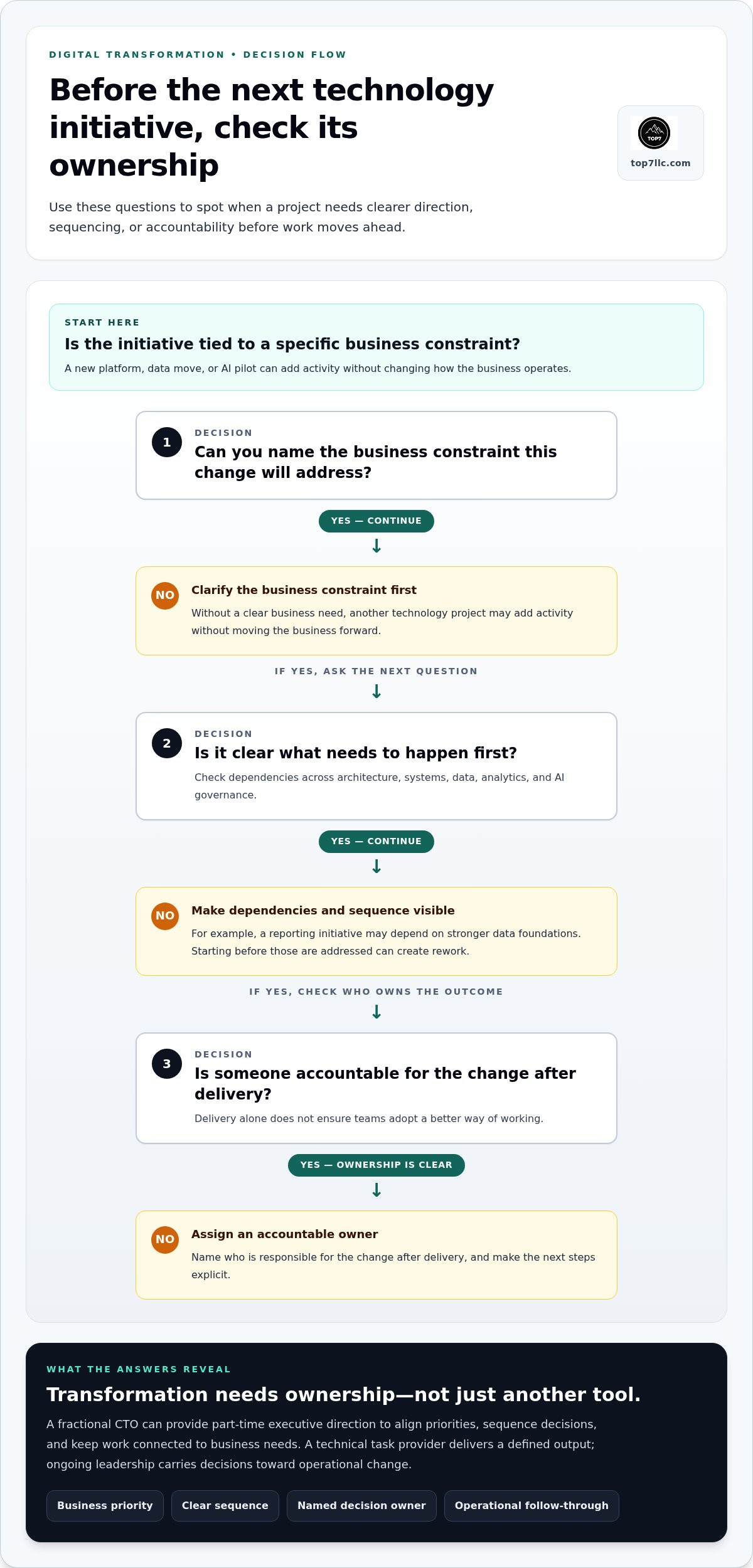
How to Set Up a Digital Transformation for Accountable Execution
A transformation plan needs more than a backlog. It needs a clear business reason, decisions made in the right order, named owners, and evidence that shows whether the work is changing operations. A fractional CTO for digital transformation can help establish that discipline, but leaders still need to define what success means for their business and who will own it.
Set priorities and decision rights before selecting technology
Start with the operating problem or growth obstacle, not a preferred tool. Is a process slowing decisions? Are teams working with fragmented data? Define the constraint in terms the business can recognize. Then rank potential initiatives by relevance to that constraint and by dependencies, so the team understands what must happen first and what can wait.
Before work begins, make decision rights explicit. Identify who approves direction, who executes, and who is accountable for adoption. When those roles are unclear, a technical deliverable can be completed while the business change it was meant to support stalls.
Define the constraint. State the business problem the transformation must address and the operating impact leaders want to change.
Set priorities. Select initiatives that address the problem, and make dependencies visible before committing team capacity.
Assign decision owners. Name who makes key choices, who delivers the work, and who is responsible for its use in day-to-day operations.
Review evidence. Agree on what observations or measures will show progress toward the business objective, then review them as work advances.
Keep business outcomes separate from technology deliverables. “Implement an analytics platform” describes an output. “Give leaders reliable information to make a specific operating decision” describes a business objective. The platform may support that objective, but implementation alone doesn’t prove the change is working. That distinction keeps progress reviews focused on value, not activity.
Measure adoption and prepare the operational handoff
Choose evidence that fits the objective and the work undertaken. If the goal is to improve access to operational insight, relevant evidence might include whether the intended teams use the reporting process and whether the information supports the decisions it was designed for. Set the measure with the business owner. Don’t assume a technology milestone is a proxy for adoption.
Plan the handoff early. Identify who will own the process after leadership support changes, what documentation teams need, and whether people are ready to use the new workflow. A roadmap without an operational owner leaves the change vulnerable once implementation activity ends.
Transformation progress should be judged by evidence of business change, not hours billed or tasks completed. Review whether priorities remain relevant, dependencies are resolved, decision owners are engaged, and teams are adopting the new way of working. If the evidence is weak, adjust the plan rather than disguising activity as impact. To put accountable technology leadership behind your priorities, discuss Top7’s fractional CTO leadership.
How Top7 Leads Digital Transformation Through the Velocity-7 Framework
A transformation needs a working sequence, not another strategy document that sits untouched. Top7’s Velocity-7 Framework organizes technology leadership into three stages: assess the current situation, turn priorities into execution, then systematize the work and hand it off. Each stage builds on the decisions and evidence from the one before it.
The first three stages create visibility, execution, and continuity
Basecamp, Days 0‑30, is Assess and Stabilize. The focus is an honest diagnostic of the technology environment, leadership needs, and operational blockers. The result is visibility into what’s slowing progress and a ranked list of blockers. This gives leaders a grounded starting point instead of a roadmap built on assumptions.
Ascent, Days 30‑60, is Plan and Execute. With the blockers in view, the work shifts to a sequenced plan, early wins, and an accountable leader. For CTO/CIO work, that can mean connecting architecture or data priorities to the operating need they support, while clarifying ownership and dependencies. The point isn’t to launch more initiatives. It’s to move the right work forward with clear accountability.
Summit, Days 60‑90, is Systematize and Hand Off. The focus moves to continuity: documented playbooks, a self-sustaining team, and a clear hire decision. A documented 100-Day Operational Plan can help carry priorities beyond the immediate engagement. The handoff should leave the team with clear processes and ownership, not dependence on a leader who has moved on.
The sequence matters. Basecamp establishes what’s true and what blocks progress. Ascent uses that visibility to guide execution. Summit makes the work repeatable and clarifies who owns it next. The framework gives leaders a structured path from diagnosis to operational continuity, without adding extra stages or treating activity as proof of impact.
In a healthcare services case study, Top7 delivered an Attorney-General-ready final report in 8 Weeks FROM ENGAGEMENT START TO AN AG‑READY FINAL REPORT. That case-specific report timeline is distinct from the Velocity-7 stage ranges: Basecamp is Days 0‑30, Ascent is Days 30‑60, and Summit is Days 60‑90.
Across each engagement, Top7 provides one point of contact and measures delivery by outcomes, not hours billed. That gives the client a clear route for decisions and accountability as priorities move through the framework. For companies considering a fractional CTO for digital transformation, the structure connects executive direction with the practical work of execution and handoff.
Start a focused conversation with Top7
Bring the technology constraint, decision bottleneck, or transformation priority that needs attention. The initial consultation is 15 minutes, no pitch deck. Use the conversation to frame the issue and identify the leadership capacity the work calls for.
Turn Your Next Technology Decision into Forward Progress
The next step isn’t to approve every promising tool or launch another initiative. It’s to choose the business constraint worth solving first, then make the decision that clears the path. That focus can turn technology from a collection of competing priorities into a capability your team can build on.
A fractional CTO for digital transformation can help you put senior ownership behind that choice and keep execution connected to the result the business needs. Start with the decision that’s holding progress back, not a wish list of technologies.
If architecture, AI governance, data priorities, or engineering capacity are pulling in different directions, bring that challenge into a focused conversation. Top7 brings a single point of contact, a shared framework, and its portfolio behind each leader, so the discussion stays anchored in your operating priorities.
Start a focused conversation with Top7 and identify the technology decision that can move your business forward. You don’t need a perfect plan to begin. You need a clear priority and the resolve to act on it.
Frequently Asked Questions
Can a fractional CTO lead digital transformation?
Yes. Top7 provides embedded senior technology leadership and execution support, so a CTO can direct transformation priorities and coordinate work with the client team. That means taking ownership of decisions and follow-through, not simply offering detached commentary. A leader can clarify decision rights, surface dependencies, and connect technology work to business needs. Leadership support doesn’t guarantee results; outcomes also depend on organizational decisions, adoption, and execution.
What does a fractional CTO do during digital transformation?
A fractional CTO helps leaders make and sequence technology decisions that support business priorities. The work can include setting technology strategy, guiding architecture choices, overseeing engineering team build-out, and shaping data strategy. The CTO can also support AI adoption strategy and governance, helping leaders consider where AI fits and how its use will be managed. The practical value for your team is a clear executive owner for decisions that cross technology and business functions.
How is a fractional CTO different from an interim CTO?
A fractional CTO provides ongoing, part-time leadership embedded in the client team for as long as needed. That model fits a continuing need for senior technology direction without full-time coverage. Interim leadership is full-time, defined-term coverage when a leadership seat opens unexpectedly. If your CTO/CIO seat becomes vacant, interim leadership can maintain coverage during the defined term; fractional leadership suits an ongoing part-time requirement.
Can a fractional CTO help decide whether to build or buy technology?
Yes. Build-versus-buy roadmaps are part of Top7’s technology practice. The CTO can frame the decision around the business need, technical considerations, and the organization’s capacity to support its choice. That guidance helps leaders compare paths and determine what decision belongs next on the roadmap. It’s decision support, not custom software development, and it doesn’t assume that either building or buying is right for every situation.
How does Top7 structure a fractional CTO engagement?
Top7 uses the Velocity-7 Framework’s three stages to structure the engagement. Basecamp, Days 0‑30, focuses on assessment and stabilization, with an honest diagnostic and ranked blockers. Ascent, Days 30‑60, moves into planning and execution, including a sequenced plan and accountable leadership. Summit, Days 60‑90, focuses on systematizing work and handing it off through documented playbooks, a self-sustaining team, and a clear hire decision.
What happens in the first conversation with Top7?
The initial conversation is 15 minutes, no pitch deck. Bring a clear business or technology challenge, such as an architecture decision that’s stalled, a data priority without an owner, or a technology leadership gap affecting execution. A focused starting point helps surface the decision that needs attention and the leadership capacity the situation calls for. You don’t need a polished transformation plan to explain what’s getting in the way.



Comments